Author: Imported Author 1852151

  • Barges Hit Mississippi Bridge, Some Drift Into 2nd Bridge

    Barges Hit Mississippi Bridge, Some Drift Into 2nd Bridge

    The I-20 bridge and the U.S. 80 bridge each was hit once earlier this month

    VICKSBURG, Miss. (AP) — Barges hit a 90-year-old railroad bridge over the Mississippi River, and some broke away and drifted back into a parallel newer bridge under which they had just passed on Monday.

    The old U.S. 80 railroad bridge was closed after the barges being pushed by the “Captain Buck Lay” hit three of its piers, Vicksburg Bridge Commission Superintendent Herman Smith told The Vicksburg Post. The commission supervises the U.S. 80 bridge.

    The Interstate 20 bridge just downriver remained open, television stations reported.

    Video shows the 28 barge tow breaking apart and drifting into the Interstate 20 bridge, the newspaper reported.

    Smith said the boat was operated by American Commercial Barge Lines of Jeffersonville, Indiana, and was pushing a tow seven barges long and four across. All 28 barges stayed afloat, Smith said.

    The I-20 bridge and the U.S. 80 bridge each was hit once earlier this month, the newspaper reported.

    The light mast of the “Crimson Duke” hit the underside of the I-20 bridge on April 14; state police closed the westbound lane until engineers had inspected it.

    The “Blake Benton,” pushing a 25-barge tow, hit a pier of the U.S. 80 bridge on April 11.

    The U.S. 80 bridge was built in 1930. It was closed to vehicular and pedestrian traffic in 1998, except for events including some road and bicycle races on the former traffic lanes, but the Kansas City Southern Railroad still uses the rails on one side.

  • Louisiana Stay at Home Order Extended Until May 15

    Louisiana Stay at Home Order Extended Until May 15

    Everyone in Louisiana should wear masks when in public; Next announcement will be May 11

    Today, Gov. John Bel Edwards announced he will extend Louisiana’s Stay at Home order until May 15 to continue to slow the spread of COVID-19. Louisiana does not currently meet the White House criteria for entering Phase One of reopening.

    While Louisiana has seen positive, improving trends statewide in terms of new case growth and new hospitalizations, in several regions across the state, new cases and hospitalizations continue to increase or to plateau, according to data from the Louisiana Department of Health. The White House criteria calls for declining numbers of new cases and hospitalizations, among other things.

    “Thanks to the commitment of the people of Louisiana, our state has made progress in flattening the curve and reducing the spread of the novel coronavirus. Unfortunately, we still have a little work to do before we meet the criteria to safely move to the next phase of reopening, so I will extend the state’s Stay at Home order until May 15, with a few minor changes,” Gov. Edwards said. “While this is not the announcement I want to make, I am hopeful, and all of Louisiana should be hopeful, that we will enter into the next phase of reopening soon, in mid-May. I am anxious to get all areas of our economy reopened, but if we accelerate too quickly, we may have to slam on the brakes. That will be bad for public health and for businesses, bad for our people and bad for our state.”

    Gov. Edwards’ decision is based on regional data that shows that while overall new cases and hospitalizations have decreased, this is not the case in several regions. In the Baton Rouge and Monroe regions, both new cases and new hospitalizations have increased. Some increases are also being seen in terms of new cases in Acadiana and a plateau for hospitalizations in Southwest Louisiana and a plateau of new cases on the Northshore.

    • Click here to view the Governor’s presentation on regional data trends.

    Under the extended order, which will be issued on Friday, May 1, businesses that previously were directed to be closed will remain closed, including salons, barber shops, bars and casinos, among other things. Businesses that are deemed essential under the third phase of federal CISA guidance may still be open. Non-essential retail businesses in Louisiana continue to be able to open with fewer than 10 people total inside.

    Three major changes in the new Stay at Home order include:

    • Malls will remain closed to the public, but stores may open for curbside delivery.
    • Restaurants will be allowed to open their outside areas for patrons to eat meals only, without tableside service.
    • All employees of a business who have contact with the public must wear a mask.

    Additionally, both the CDC and the Louisiana Department of Health strongly urge everyone to wear masks when in public.

    “Wearing cloth masks or protective face coverings is part of the new normal,” Gov. Edwards said. “Wearing a mask is being a good neighbor and in Louisiana, we pride ourselves on being good neighbors. Your mask protects me and other people and my mask protects you.”

    Hopefully, Louisiana will meet the White House criteria and move to Phase 1 on May 15, provided symptoms, new case counts and hospitalizations decrease and the state continues to surge testing and contact tracing capacity. Phase 1 lifts the Stay at Home order and eases restrictions on some public spaces like houses of worship and restaurants and opens other businesses that have been closed such as barber shops and salons, but with restrictions on occupancy and strict requirements for personal distancing and masks to keep everyone safe. Phase One occupancy for these businesses will be limited to 25 percent.

    As Louisiana prepares for its next phase of reopening, business owners and faith leaders are encouraged to plan as well, including understanding their building’s maximum occupancy limits, which may require contacting local government or the State Fire Marshal’s office. They should also plan on ensuring their employees have masks.

    Gov. Edwards intends to make his next announcement on moving to Phase 1 in Louisiana on or by May 11. Members of the public can continue to get information from the Governor’s office on coronavirus.la.gov and by texting LACOVID to 67283.

  • Harold Reid, Statler Brothers Bass Singer, Dies At 80

    Harold Reid, Statler Brothers Bass Singer, Dies At 80

    The Statlers won three Grammy Awards and were named top vocal groups nine times by the Country Music Association.

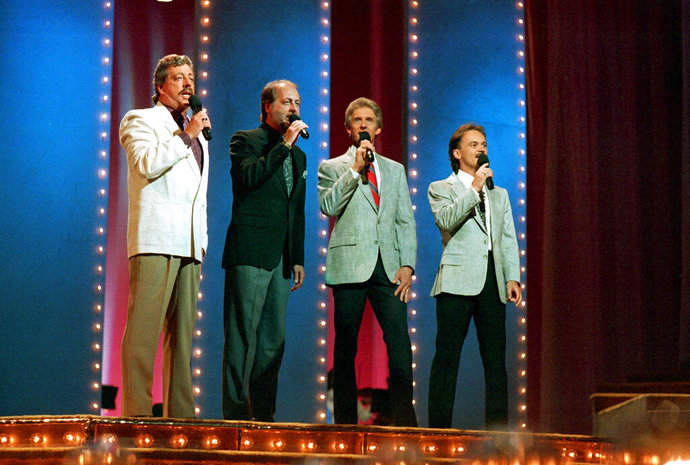
    STAUNTON, Va. (AP) — Harold Reid, who sang bass for the Grammy-winning country group the Statler Brothers, has died after a long battle with kidney failure. He was 80.

    Reid died Friday in his hometown of Staunton, Virginia, his nephew Debo Reid said.

    The Statler Brothers frequently sang backup for country icon Johnny Cash. Some of their biggest hits included 1965’s “Flowers on the Wall” and 1970′s “Bed of Rose’s.”

    Harold Reid was a member of the Country Music Hall of Fame and the Gospel Music Hall of Fame. He was also a comedian.

    “He is and will always be loved by his family, friends and millions of fans,” a statement on the band’s website said. “His singing, his songwriting and his comedy made generations happy. He has taken a piece of our hearts with him.”

    Reid and three boyhood friends — Lew DeWitt, Phil Balsley and Joe McDorman — formed the Four-Star Quartet in 1948. The group, later known as the Kingsmen, sang mostly gospel music. McDorman quit and was replaced by Don Reid, Harold’s younger brother.

    DeWitt once said the group changed its name again because several other acts — all better known — were billed as the Kingsmen. The new name came from a box of Statler tissue, he said.

    The quartet switched to country music in 1964, after meeting Cash and joining his road show.

    Over the next two decades, the Statlers won three Grammy Awards and were named top vocal groups nine times by the Country Music Association.

    “He leaves a large and loving family and millions of fans who remember his stage and TV antics with smiles and cherish his music that will live with the ages,” Debo Reid said in a statement.

  • Eric Church wants people to feel safe when concerts return

    Eric Church wants people to feel safe when concerts return

    “When people roared, they roared. I believe that will happen again.”

    April 24, 2020

    NASHVILLE, Tenn. (AP) — Country star Eric Church doesn’t know when concerts might resume in the United States after the spread of the coronavirus, but he wants people to feel safe when they return to hear live music.

    The singer known for his often-worn sunglasses sent a message to fans over the weekend in a new video and tease of a new song that offers his belief in the American resolve to overcome the pandemic.

    With echoes of the 2017 mass shooting in Las Vegas in his mind, Church recorded the song “Through My Ray Bans,” co-written with Luke Laird and Barry Dean, in February about seeing people standing shoulder to shoulder, “like an army of Friday night soldiers.”

    “It could be sports. It could be music. It could be church. It’s that fellowship that we have that makes life worth living,” Church said in an interview with The Associated Press.

    The virus reminded him of the fear that many people, even himself, felt after the Route 91 Harvest music festival, where Church had played the night before the shooting.

    “The thing that shook me about Vegas was that was my safe place,” Church said. “As messed up as the world is, I never in a million years thought that could be a danger area.”

    Now as tours and festivals are canceled or rescheduled or postponed indefinitely, Church wants to remind fans that concerts and gatherings will resume eventually, but urged people in his new video not to give into fear and panic.

    “When people come back, they have to feel that it’s OK to be there, that they can experience it the way they want to experience it,” Church said. “They should be able to go up and throw their arms around the person next to them. They should not be scared about being three feet away and not six.”

    But Church said he thinks major festivals and touring could be delayed as far out as next year.

    “For me, I think it’s summer or fall of ’21. I am going on the promise of a vaccine. I’m going on the possibility of a therapeutic that could change the game,” Church said.

    The virus has also upended a lot of plans for album releases this year, including his own. Prior to the virus spread, Church voluntarily secluded himself in a makeshift studio in the North Carolina mountains to record for a full month with several writers and his band. He wrote and recorded a song each day, ending up with about 28 songs. “It’s always intrigued me, a kind of old rock ‘n’ roll model,” Church said. “You write the song in the studio. You record the song the same day.”

    Even though he hasn’t released any songs for download or streaming or to radio yet, he’s been living with them a lot longer than he normally does before the public or even the people at his label or management has heard them.

    “I don’t know if this is an album, if it’s two albums, if it’s three,” he said. “I feel confident enough with the material that people will get to hear all of these songs at some point.”

    Meanwhile, Church said he is looking to history as a guide for what’s to come after the pandemic.

    “I think about the 1918 pandemic and there’s a reason the Roaring Twenties happened,” said Church. “When people roared, they roared. I believe that will happen again.”

  • Man Charged In Drive-By Shooting At ‘Duck Dynasty’ Estate

    Man Charged In Drive-By Shooting At ‘Duck Dynasty’ Estate

    Two Robertson homes hit by gunfire on Friday

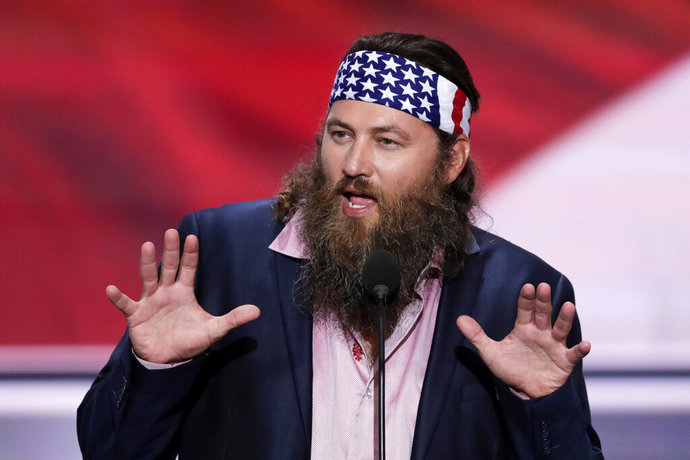
    WEST MONROE, La. (AP) — A man was arrested in connection with a drive-by shooting at the Louisiana estate of “Duck Dynasty” star Willie Robertson.

    Daniel King Jr. was booked into a correctional center after two homes in West Monroe were struck by gunfire on Friday afternoon, the Ouachita Parish Sheriff’s Office said in a Facebook post Saturday. No one was injured in the shooting, authorities said.

    “It looks like they were just spraying bullets across my property.” Robertson told The News-Star. Both homes are part of the estate belonging to Robertson, one of the stars of the reality show about duck hunting that ran from 2012 to 2017.

    Robertson said the family was “pretty shook up” after one of the eight to 10 bullets he said were fired at the residence went through the bedroom window of a home where his son John Luke Robertson lives with his wife and infant child.

    Witnesses told Ouachita Parish deputies that the second residence was also struck by gunfire.

    Robertson said many family members have huddled at the estate during the coronavirus pandemic, including his daughter Sadie Robertson and her new husband. The newlywed was a contestant on the reality show “Dancing with the Stars” in 2014.

    “Nobody was outside at the time, but everybody had been out about five minutes before,” Willie Robertson said. “I had just gone to the store when it happened.”

    Deputies said other occupants were in the car with the suspect during the shooting. They have not released more information about additional suspects.

    King was charged with aggravated assault. It was not immediately clear if he had a lawyer who could comment on his behalf.

    Willie Robertson is the CEO of Duck Commander, the multimillion-dollar duck call and decoy enterprise that inspired the A&E show, which shone a spotlight on the small north Louisiana town.

  • FDA Approves First At-Home Coronavirus Test

    FDA Approves First At-Home Coronavirus Test

    The kit includes cotton swabs, a collection tube, an insulated pouch and box to ship the specimen back to LabCorp

    WASHINGTON (AP) — U.S. health regulators on Tuesday OK’d the first coronavirus test that allows people to collect their own sample at home, a new approach that could help expand testing options in most states.

    The test from LabCorp will initially only be available to health care workers and first responders under a doctor’s orders. The sample will still have to be shipped for processing back to LabCorp, which operates diagnostic labs throughout the U.S.

    Allowing people to self-swab at home would help reduce infection risks for front-line health care workers and help conserve protective gear.

    For the home test, people are initially screened with an online questionnaire. If authorized by a physician, LabCorp will ship a testing kit to their home. The kit includes cotton swabs, a collection tube, an insulated pouch and box to ship the specimen back to LabCorp. To take a sample, a cotton swab is swirled in each nostril. The test results are posted online to a secure company website.
    The company said it will make the test available in the coming weeks. Each kit will cost $119. The kits will not be available in Maryland, New Jersey, New York and Rhode Island. Those states have laws prohibiting testing with at-home sample collection kits, according to LabCorp.
  • Publicly traded firms get $300M in small-business loans

    Publicly traded firms get $300M in small-business loans

    Companies worth over $100 million received the small business aid

    By REESE DUNKLIN, JUSTIN PRITCHARD, JUSTIN MYERS and KRYSTA FAURIA

    Companies with thousands of employees, past penalties from government investigations and risks of financial failure even before the coronavirus walloped the economy were among those receiving millions of dollars from a relief fund that Congress created to help small businesses through the crisis, an Associated Press investigation found.

    The Paycheck Protection Program was supposed to infuse small businesses, which typically have less access to quick cash and credit, with $349 billion in emergency loans that could help keep workers on the job and bills paid on time.

    But at least 75 companies that received the aid were publicly traded, the AP found, and some had market values well over $100 million. And 25% of the companies had warned investors months ago — while the economy was humming along — that their ability to remain viable was in question.

    By combing through thousands of regulatory filings, the AP identified the 75 companies as recipients of a combined $300 million in low-interest, taxpayer-backed loans.

    Eight companies, or their subsidiaries, received the maximum $10 million possible, including a California software company that settled a Securities and Exchange Commission investigation late last year into accounting errors that overstated its revenue.

    The eight firms getting maximum loans are likely just a tip of the iceberg: Statistics released last week by the U.S. Small Business Administration showed that 4,400 of the approved loans exceeded $5 million. Overall, the size of the typical loan nationally was $206,000, according to the statistics. SBA will forgive the loans if companies meet certain benchmarks, such as keeping employees on payroll for eight weeks.

    The list of recipients identified by the AP is a fraction of the 1.6 million loans that lenders approved before the program was depleted last week, but it is the most complete public accounting to date. Neither the Trump administration nor the lending industry has disclosed a list of Paycheck Protection Program beneficiaries.

    Representatives of the SBA, which is overseeing the program, did not respond to a request for comment late Monday. But last Friday, Treasury Secretary Steven Mnuchin said in a written statement that most of the loans, 74%, were for less than $150,000 and that demonstrated “the accessibility of this program to even the smallest of small businesses.”

    President Donald Trump, asked Monday whether the criteria for who can receive loans should change, said that “we’ll look at individual things and some people will have to return it if we think it’s inappropriate.” He added that the loans are supposed to be awarded, in part, by “what we think is right.”

    The AP analysis comes as lawmakers from both political parties negotiate an additional relief package that in large part would replenish the Paycheck Protection Program with more than $300 billion, but there are disagreements about terms for the new funding measure. A final deal could come as early as Tuesday.

    AP’s review also found examples of companies that had foreign owners and that were delisted from U.S. stock exchanges, or threatened with removal, because of their poor stock performance before the coronavirus caused a downturn. Other companies have had annual losses for years.

    Wave Life Sciences USA Inc., a Boston-area biotechnology company that develops new pharmaceuticals, received a $7.2 million loan. Weeks earlier, Wave Life Sciences, whose parent company is based in Singapore, disclosed in its annual report net losses of $102 million, $147 million and $194 million during the last three fiscal years.

    “We currently have no products on the market and expect that it may be many years, if ever, before we have a product candidate ready for commercialization,” it wrote.

    In an emailed statement Monday, the company said: “The livelihood of our U.S. employees and their families would be severely disrupted if they were to lose their jobs or be furloughed. We are doing everything we can to support them.”

    Michael Minnis, who has studied the SBA program as an accounting professor at the University of Chicago Booth School of Business, said he understood the frustrations of smaller businesses that have not received funding when publicly listed companies have. But he said it would be hard to go into the program and change the parameters now.

    “There’s a fundamental trade-off here between speed and targeting this in the absolute best way,” he said.

    Minnis estimates the program might need to dispense $720 billion to meet demand.

    Since launching April 3, the relief package has faced criticism about slow loan processing, unclear rules and limited funding that left many mom-and-pop businesses without help.

    News that the $1.6 billion Shake Shack burger empire had received a maximum $10 million loan, disclosed in a filing Friday, ignited public anger. Company executives said late Sunday they would return the money after finding other sources of capital.

    By design, the Paycheck Protection Program was meant to get money out quickly to as many small businesses as possible, using a formula based in part on workforce and payroll size. Some of the eligibility criteria was expanded making it possible for some businesses with more than 500 employees to qualify if, for example, they met certain size standards for their industries or other conditions.

    The owners behind large restaurants chains like Potbelly, Ruth’s Chris Steak House and Taco Cabana were able to qualify and get the maximum $10 million in loans despite employing thousands of workers.

    Some other big companies that received loans appeared to have enough cash on hand to survive the economic downturn. New York City-based Lindblad Expeditions Holdings, for example, a cruise ship and travel company with 650 workers and a branding deal with National Geographic, got a $6.6 million loan. At the end of March, the business reported having about $137 million in cash on its balance sheet.

    “When this crisis hit, we had two business planning cases: 1) substantial layoffs and furloughs or 2) receiving these funds and not impacting our employees,” spokeswoman Audrey Chang wrote in an email. “Lindblad is the very rare travel company that has not imposed any layoffs, furloughs or salary reductions to date.”

    Five of the companies that the AP identified were previously under investigation by financial and other regulators, including firms that paid penalties to resolve allegations, records show.

    Quantum Corp., a data storage company based in San Jose, California, that has a workforce of 800, paid a $1 million penalty last December over allegations that accounting errors resulted in overstated revenues. Quantum received a maximum $10 million loan.

    Without that loan, “we would most certainly be forced to reduce headcount. We owe it to our employees — who’ve stuck with us through a long and difficult turnaround — to do everything we can to save their jobs during this crisis,” company spokesman Bob Wientzen wrote in an email.

    Broadwind Energy, a suburban Chicago maker of wind turbines that employs about 520, agreed to pay a $1 million penalty five years ago after the SEC accused it of failing to inform investors that reduced business from two major customers had caused “substantial declines” in its long-term financial prospects. Broadwind, which could not be immediately reached, received $9.5 million from the loan program.

    Marrone Bio Innovations, a biopesticide company in Davis, California, that has about 50 workers, similarly agreed to pay $1.8 million in 2016 after the SEC alleged its chief operating officer had inflated financial results to hit projections that it would double revenues during its first year as a public company. Marrone received a loan worth $1.7 million.

    Pam Marrone, the chief executive, said the company “shouldn’t be punished” for what happened with the SEC because it has had clean audits for years now. She described the investigation as a “body blow” that cost it investors and drove its stock price under $1. She said it has had to take on $40 million in debt and is still digging itself out of the financial hole.

    “People don’t realize how tough it is to be a small public company like us that’s not yet profitable,” she said. “We can’t just go to investors and say, ‘OK, open up your wallets.’ “

    The AP analysis found that about 1 in 4 of the companies, in fact, had warned investors months ago that they or their auditors had significant doubts about their ability to remain viable and meet their financial obligations despite the booming economy at the time.

    One was Helius Medical Technologies, a company located near Philadelphia that develops technology to help injured brains heal themselves.

    The company has 19 employees and received a $323,000 loan amid a tough stretch. Its most recent annual report warned, “We may be unable to continue to operate without the threat of liquidation for the foreseeable future” and did not expect to have enough cash to go beyond May.

    In an interview, president and chief executive Phil Deschamps said the company was able to raise enough capital earlier this year that, when paired with the loan, it can survive to early summer — when it expects to have filed for U.S. Food and Drug Administration approval for its device. Without the federal money, he said, the company would have lost scientists and attorneys who help prepare regulatory submissions.

    Deschamps said his company followed the same rules and applied like any other, and that its device could help thousands of people in the future. But he also understands why some people might question giving money to publicly traded firms.

    “If we didn’t qualify for whatever reason, we would have walked away and figured out another way to do it,” he said.

    Another company that was facing financial doubts before the virus was Enservco Corp., a Denver-based firm that helps oil and gas firms, including in the fracking industry. In its annual report filed last month, the company said: “We do not generate adequate revenue to fund our current operations, and we incurred significant net operating losses during the years ended December 31, 2019, and 2018, which raise substantial doubt about our ability to continue as a going concern.”

    Chief executive Ian Dickinson said in an interview that his company would not have folded without the $1.9 million loan it received. But, he said, he welcomed the money and would’ve had to let go more employees than he already has without it. Enservco’s annual report cited 186 employees; Dickinson said payroll has “reduced significantly” from that mark, without giving specifics.

    Dickinson said he did not believe concerns about how long the company could survive were raised in the application process with its bank.

    “At the end of the day, our employees are really no different than the employees of a nonpublic company,” Dickinson said. “These are funds being used to keep folks on payroll and keep food on their tables.”

    That big companies and ones with questionable records received such precious financial aid during the chaotic last few weeks frustrates Zachary Davis, a Santa Cruz, California, businessman who runs two artisanal ice cream shops, a beachside café and a taco bar with partner Kendra Baker.

    Before a shelter-in-place order in mid-March, the two were expecting their best year to date and were on track to pay off in May the $250,000 loan from the federal government that they used 10 years ago to open their original shop.

    “We were feeling pretty good about where we were in the world. Now it’s just all turned upside down,” said Davis, who had to lay off 70 workers.

    Davis says they were recently able to obtain a different $10,000 disaster loan from the federal government to pay off vendors, but he says that it “evaporated within seconds.” Davis and Baker submitted a Paycheck Protection Program application with supporting documents on April 2 but are still waiting.

    Competing against businesses with hundreds of millions a year in revenue and teams of accountants and lawyers is tough, Davis said, “and if you’re a little guy, chances are you’re going to the back of the line.”

    ___

    Associated Press writers Michael Liedtke in Berkeley, California, and Jeannie Ohm in Washington, D.C., and researcher Rhonda Shafner in New York contributed to this report.

    ___

    Contact AP’s global investigative team at Investigative@ap.org.

  • Buccaneers QB Tom Brady Ejected From Tampa Florida Park

    Buccaneers QB Tom Brady Ejected From Tampa Florida Park

    Four-time Super Bowl MVP Told To Leave By Park Rangers

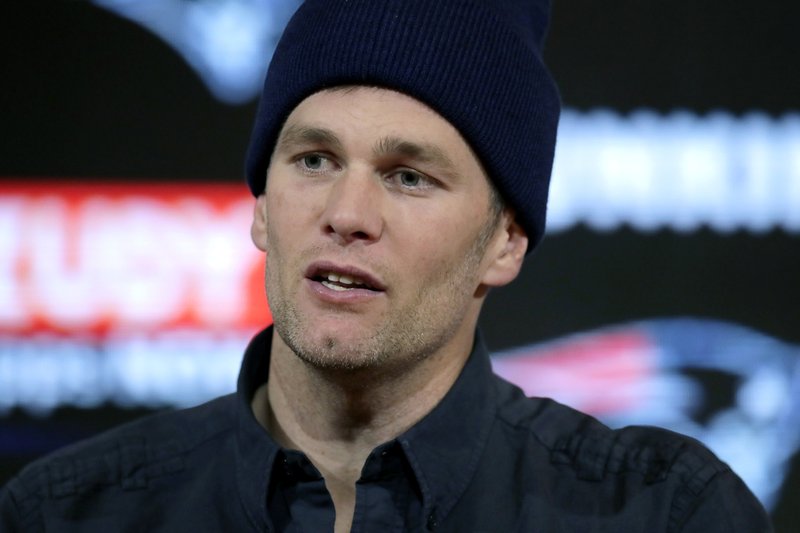
    TAMPA, Fla. (AP) — Six Super Bowl rings may get you special treatment in a lot of places but former Patriots quarterback Tom Brady learned Monday that it won’t get you anything when you’re caught working out in a park that is closed to the public due to the coronavirus pandemic.

    Tampa Mayor Jane Castor said during a news briefing Monday that the new Buccaneers quarterback was spotted working out by himself at a park downtown by staff patrol. The staffer went over to tell him he had to leave and she recognized the man to be the 42-year-old Brady.

    “He’s been sighted,” Castor said.

    The City of Tampa tweeted from its page Monday”

    “Sorry @TomBrady! Our @tampaparksrec team can’t wait to welcome you and our entire community back with even bigger smiles — until then, stay safe and stay home as much as you can to help flatten the curve.”

    Brady recently moved his family into a furnished mansion he’s renting from former New York Yankees star Derek Jeter in Tampa.

    The four-time Super Bowl MVP left the New England Patriots and signed a two-year, $50 million contract with the Bucs in free agency, joining a team with the worst winning percentage in league history.

  • Hoax Alert:  Do You Have To Pay Back Your $1200 Relief Check???

    Hoax Alert: Do You Have To Pay Back Your $1200 Relief Check???

    Fake News: Relief Checks Being Sent To U.S. Taxpayers By The Government Under The Coronavirus Economic Recovery Bill Will Have To Be Paid Back.

    In recent days, social media posts have falsely claimed there’s one catch to this money – that you’ll eventually have to pay it back. ‘Next year, you’re automatically going to owe $1,200 come tax season,’ one of the videos, viewed hundreds of thousands of times on YouTube, falsely claims.   Videos and online reports claiming that millions of Americans will have to repay the relief checks they receive from the federal government under the $2.2 trillion coronavirus economic recovery bill are not true. 

    The Truth (As Reported By AP):  The U.S. Treasury Department and Internal Revenue Service, which are working to deliver the money to people, confirmed to The Associated Press that households will not have to pay back the money in next year’s tax filing.  The government began issuing the one-time payments this week. Most adults who earned up to $75,000 will see a $1,200 payout, while married couples who made up to $150,000 can expect to get $2,400. Parents will get payments of $500 per child. The checks will be directly deposited into bank accounts or mailed to households, depending on how you’ve filed your tax returns in the past. 

    ‘This is not an advance and there is absolutely no obligation to pay it back,’ Treasury spokeswoman Patricia McLaughlin said.

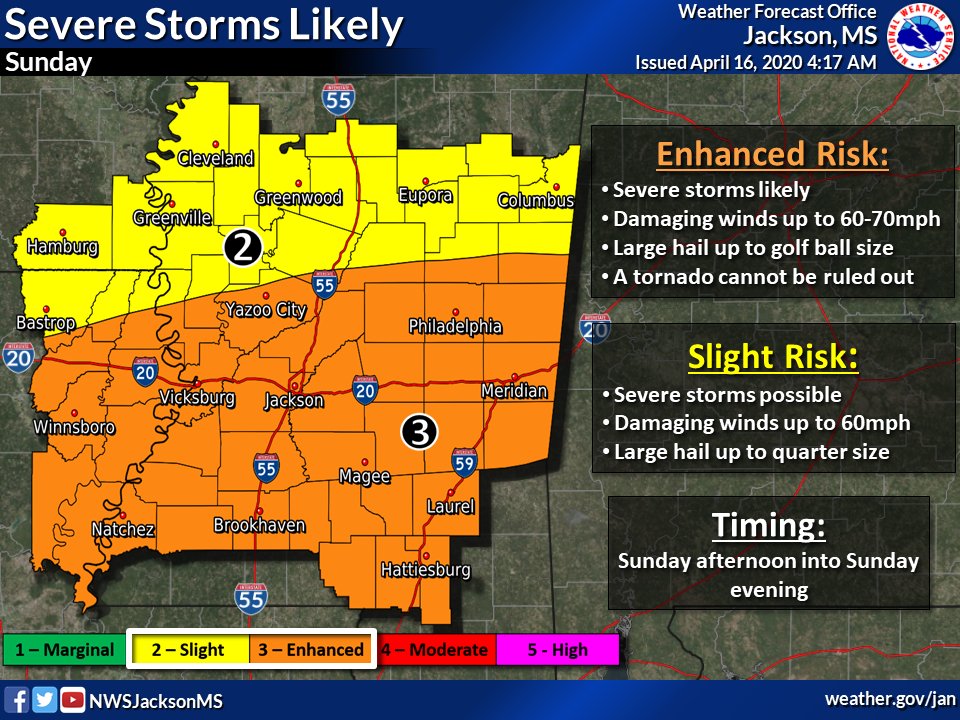
  • Severe Weather Expected For This Sunday, April 19th

    Severe Weather Expected For This Sunday, April 19th

    Heavy rain, large hail, gusty winds and tornadoes in the forecast

    Please stay weather aware this Sunday!