Author: Imported Author 1983537

  • 5 Activity Ideas During While at Home

    5 Activity Ideas During While at Home

    The novel coronavirus, or Covid-19, has many Americans feeling trapped in their own homes. Across the nation, city governments have shut down all but the most essential services. Movies theaters have ceased operations, and most restaurants are only accepting take-out orders. As many families are being forced to stay home from work and school, they are struggling to find ways to occupy their time. Movies in bed are good for a while, but over the course of the coming weeks, people will need to find original ways to occupy their time. While the usual hangout spots may all be closed, there is plenty to do during the outbreak to kill some time, and maybe even make this forced stay-cation enjoyable.

    1. Go outside

    In Mississippi, we are finally on the turning point of the season. Warm weather and less rain have made the outdoors much more inviting than it has been during the last few months. Sunshine is the best medicine, if not for Covid-19, then at least for the boredom that comes from sitting inside for months on end. We don’t know how long we will have to stay home, so this is the perfect opportunity to go outdoors and get some fresh air. Just remember to keep any walking buddies at a safe distance!

    1. Virtual tours

    If the outdoors aren’t really your thing, but you still want something more stimulating to do than watch Netflix for the fourth day in a row, then try a virtual tour. Many major museums have their facilities mapped out and viewable through either google maps, or by going through their website. The Smithsonian Museum of Natural History’s virtual tour can be found at this link: https://naturalhistory.si.edu/visit/virtual-tour They have photos of all current and past exhibits. The Georgia Aquarium has live feeds of all their animals and exhibits available here: https://www.georgiaaquarium.org/webcam/ocean-voyager/

    1. Board Games

    Board games and similar family games are a great way to pass the time when you’re stuck at home. If you don’t own a board game, a good idea would be to get games that take longer to play such as monopoly or risk. These games require more strategy and can be replayed more than a simple game like UNO.

    1. Home improvement

    This is the perfect time to hammer out some of those old projects that have been planned for months but have never been started. Repairs and maintenance are the first projects that come to mind, but also try stretching those creative muscles and do some decorating. Painting is an excellent way to pass the time. New colors make the house interesting and fresh, which is important when you’re home all the time, and the act of painting can lead to inspiration for other projects.

    1. Sleep

    Experts agree that 8 hours of sleep is important for health and wellness, but during the workweek, most of us just don’t get that. This is the chance to catch up on some well-deserved rest. The weekly stresses that we all go through keep us so busy that most of the time we don’t realize how tired we are, which is why many experts are recommending that during this time of being stuck at home to catch up on sleep. Once you are rested, you may find yourself feeling like doing some of the other activities on this list, and lying in bed watching movies will probably seem a little less appealing.


  • Edwards urges calm as Coronavirus case reported in Louisiana

    Edwards urges calm as Coronavirus case reported in Louisiana

    BATON ROUGE, La. (AP) — A Louisiana resident has tested positive for the new coronavirus and is being kept in isolation in a New Orleans hospital, Gov. John Bel Edwards said Monday, as the state joins nearly three dozen others reporting cases of the disease caused by the virus.

    Edwards said the patient is a resident of the New Orleans suburb of Jefferson Parish, but he offered no details about the patient’s background or how the person may have contracted the virus.

    The patient’s positive test results were being sent to the Centers for Disease Control for final confirmation. The governor said confirmation may take several days, though he added: “We are confident in the result of our test.”

    Edwards told lawmakers about the case Monday afternoon as Louisiana’s legislative session opened. He said people “must take action individually” to help prevent the spread of the virus. But he also urged calm.

    “Now is the time for seriousness. There is no place for panic or hysteria,” the Democratic governor told a joint gathering of the House and Senate.

    For most people, the new coronavirus causes only mild or moderate symptoms, such as fever and cough. For some, especially older adults and people with existing health problems, it can cause more severe illness, including pneumonia.

    The vast majority of people recover from the new virus. According to the World Health Organization, people with mild illness recover in about two weeks, while those with more severe illness may take three to six weeks to recover. In mainland China, where the virus first exploded, more than 80,000 people have been diagnosed and more than 58,000 have so far recovered.

    Louisiana’s governor was meeting Monday evening with health care officials, including hospital and nursing home representatives, to talk about ongoing emergency preparedness and response work.

    “While today is the first time that we can confirm that we have a presumptive positive coronavirus case, Louisiana has been preparing for this moment for many weeks,” Edwards said.

    The state’s public health office has started an investigation, he said, to determine which people have been in close contact with the patient, the risk of spread and the possible need to quarantine people.

    “The CDC still believes the risk to the general public is low, but we will work quickly and decisively to assess the risk to those around this patient,” Edwards said.

    ___

    The Associated Press receives support for health and science coverage from the Howard Hughes Medical Institute’s Department of Science Education. The AP is solely responsible for all content.

  • New lawsuit: Mississippi prison has ‘abhorrent conditions’

    New lawsuit: Mississippi prison has ‘abhorrent conditions’

    JACKSON, Miss. (AP) — The Mississippi State Penitentiary at Parchman is a violent, rat-infested place where inmates live in “abhorrent conditions” and their medical needs are routinely ignored, attorneys say in a new lawsuit filed on behalf of 152 prisoners

    The suit was filed in federal court Tuesday, and attorneys are asking for class-action status to cover all current and future inmates at Parchman. It eventually could be merged with a similar lawsuit filed in January on behalf of 33 other Parchman inmates.

    Attorneys in both lawsuits are being paid by entertainment mogul Jay-Z, rapper Yo Gotti and Team Roc, the philanthropic arm of Jay-Z’s Roc Nation.

    At least 19 inmates have died in Mississippi prisons since late December. Many died amid outbursts of violence at Parchman and other prisons. Some were found hanging in their cells. The U.S. Justice Department announced on Feb. 5 that its civil rights division would investigate Parchman and other Mississippi prisons.

    The latest inmate death occurred Wednesday. Omar Beard, 36, had been serving a 20-year sentence for a manslaughter conviction from Lowndes County. The state Department of Corrections said in a news release that Beard had been in Central Mississippi Correctional Facility, and he died at a hospital in nearby Brandon. The release said his death “appears to be from natural causes,” and an autopsy will be done.

    Mississippi prison officials have told state budget writers for years that prisons are short-staffed and that the department has trouble hiring guards because the jobs are dangerous and the pay is low. Despite the requests, budgets were cut.

    Health inspections have also shown repeated problems with broken toilets and moldy showers at Parchman. State officials cut spending at prisons over the past several years, when the current governor, Republican Tate Reeves, was lieutenant governor and had a big role in writing state budgets.

    Marcy Croft, one of the attorneys representing inmates in the two lawsuits, wrote in the new one that prisoners “endure abhorrent conditions, abuse and constant violence, inadequate health care and mental health care, and overuse of isolation. ”

    “The conditions of confinement at Parchman are so barbaric, the deprivation of health and mental health care so extreme, and the defects in security so severe, that the people confined at Parchman live a miserable and hopeless existence confronted daily by imminent risk of substantial harm in violation of their rights under the U.S. Constitution,” Croft wrote.

    The state has moved at least 425 inmates from Parchman to the privately run Tallahatchie County Correctional Facility, a few miles away.

    Reeves became governor Jan. 14 and said several days later that he has ordered the state Department of Corrections to shut down most of Parchman’s Unit 29, where some of the violence has occurred. Reeves said last week that about 500 more inmates will be moved from Parchman to the Tallahatchie prison, which is run by CoreCivic.

    Death row inmates will remain at Unit 29 because state law specifies that they must be there. Some lower-security inmates who do maintenance work at Parchman will also remain in the unit, which has about a dozen buildings.

  • House makes lynching a federal crime, 65 years after Till

    House makes lynching a federal crime, 65 years after Till

    WASHINGTON (AP) — Sixty-five years after 14-year-old Emmett Till was lynched in Mississippi, the House has approved legislation designating lynching as a hate crime under federal law.

    The bill, introduced by Illinois Rep. Bobby Rush and named after Till, comes 120 years after Congress first considered anti-lynching legislation and after dozens of similar efforts were defeated.

    The measure was approved 410 to 4 on Wednesday. The Senate unanimously passed virtually identical legislation last year, although that bill wasn’t named for Till. President Donald Trump is expected to sign the bill, which designates lynching as a federal hate crime punishable by up to life in prison, a fine, or both.

    Rush, a Democrat whose Chicago district includes Till’s former home, said the bill will belatedly achieve justice for Till and more than 4,000 other lynching victims, most of them African Americans.

    Till, who was black, was brutally tortured and killed in 1955 after a white woman accused him of grabbing her and whistling at her in a Mississippi grocery store. The killing shocked the country and stoked the civil rights movement.

    “The importance of this bill cannot be overstated,″ said Rush, a member of the Congressional Black Caucus. ”From Charlottesville to El Paso, we are still being confronted with the same violent racism and hatred that took the life of Emmett and so many others. The passage of this bill will send a strong and clear message to the nation that we will not tolerate this bigotry. ”

    Rep. Bennie Thompson, D-Miss., who represents the area where Till was abducted and murdered, called the anti-lynching bill long overdue, but said: “No matter the length of time, it is never too late to ensure justice is served.″

    House Majority Leader Steny Hoyer, D-Md., used similar language to urge the bill’s passage. “It is never too late to do the right thing and address these gruesome, racially motivated acts of terror that have plagued our nation’s history,″ he said, urging lawmakers to “renew our commitment to confronting racism and hate.″

    The bill was unanimously supported by Democrats. Three Republicans — Louie Gohmert of Texas, Thomas Massie of Kentucky and Ted Yoho of Florida — opposed the bill, along with independent Rep. Justin Amash of Michigan.

    Gohmert said he supported the bill’s concept, but preferred that those accused of lynching in Texas be tried in state court, where they could face the death penalty.

    Massie said he opposed the expansion of federal hate-crime laws. “A crime is a crime, and all victims deserve equal justice,″ he said in a statement. ”Adding enhanced penalties for ‘hate’ tends to endanger other liberties such as freedom of speech.”

    Democratic Rep. Karen Bass of California, who chairs the Congressional Black Caucus, called lynching a lasting legacy of slavery.

    “Make no mistake, lynching is terrorism,″ she said. ”While this reign of terror has faded, the most recent lynching (in the United States) happened less than 25 years ago.″

    Although Congress cannot truly rectify the terror and horror of these acts, Bass said, a legislative body that once included slave owners and Ku Klux Klan members will belatedly “stand up and do our part so that justice is delivered in the future.″

    Democratic Sens. Kamala Harris of California and Cory Booker of New Jersey applauded House passage of the bill, which mirrors legislation they co-sponsored in the Senate along with Sen. Tim Scott, R-S.C. The three are the Senate’s only black members.

    “Lynchings were horrendous, racist acts of violence,” Harris said in a statement. “For far too long Congress has failed to take a moral stand and pass a bill to finally make lynching a federal crime. This justice is long overdue.”

    Booker called lynching “a pernicious tool of racialized violence, terror and oppression” and “a stain on the soul of our nation.″ While Congress cannot undo lynching’s irrevocable damage, ”we can ensure that we as a country make clear that lynching will not be tolerated,” Booker said.

    Congress has failed to pass anti-lynching legislation nearly 200 times, starting with a bill introduced in 1900 by North Carolina Rep. George Henry White, the only black member of Congress at the time.

    Kristen Clarke, president of the Lawyers’ Committee for Civil Rights Under Law, said passage of the anti-lynching legislation “marks a milestone in the long and protracted battle against white supremacy and racial violence in our country.″

    The bill “makes clear that lynchings occupy a dark place in our country’s story and provides recognition of thousands of victims of lynching crimes,” including Emmett Till and many others, Clarke said.

  • Katherine Johnson, mathematician and real-life subject of ‘Hidden Figures,’ dies at 101

    Katherine Johnson, mathematician and real-life subject of ‘Hidden Figures,’ dies at 101

    Katherine Johnson, a mathematician who calculated rocket trajectories and earth orbits for NASA’s early space missions and was later portrayed in the 2016 hit film “Hidden Figures,” about pioneering black female aerospace workers, has died. She was 101.

    NASA Administrator Jim Bridenstine said on Twitter that she died Monday morning. No cause was given.

    Bridenstine tweeted that the NASA family “will never forget Katherine Johnson’s courage and the milestones we could not have reached without her. Her story and her grace continue to inspire the world.”

    Johnson was one of the “computers” who solved equations by hand during NASA’s early years and those of its precursor organization, the National Advisory Committee for Aeronautics.

    Johnson and other black women initially worked in a racially segregated computing unit in Hampton, Virginia, that wasn’t officially dissolved until NACA became NASA in 1958. Signs had dictated which bathrooms the women could use.

    Johnson focused on airplanes and other research at first. But her work at NASA’s Langley Research Center eventually shifted to Project Mercury, the nation’s first human space program.

    “Our office computed all the (rocket) trajectories,” Johnson told The Virginian-Pilot newspaper in 2012. “You tell me when and where you want it to come down, and I will tell you where and when and how to launch it.”

    In 1961, Johnson did trajectory analysis for Alan Shepard’s Freedom 7 Mission, the first to carry an American into space. The next year, she manually verified the calculations of a nascent NASA computer, an IBM 7090, which plotted John Glenn’s orbits around the planet.

    “Get the girl to check the numbers,” a computer-skeptical Glenn had insisted in the days before the launch.

    “Katherine organized herself immediately at her desk, growing phone-book-thick stacks of data sheets a number at a time, blocking out everything except the labyrinth of trajectory equations,” Margot Lee Shetterly wrote in her 2016 book “Hidden Figures,” on which the film is based.

    “It took a day and a half of watching the tiny digits pile up: eye-numbing, disorienting work,” Shetterly wrote.

    Shetterly told The Associated Press on Monday that Johnson was “exceptional in every way.”

    “The wonderful gift that Katherine Johnson gave us is that her story shined a light on the stories of so many other people,” Shetterly said. “She gave us a new way to look at black history, women’s history and American history.”

    Shetterly noted that Johnson died during Black History Month and a few days after the anniversary of Glenn’s orbits of the earth on Feb. 20, 1962, for which she played an important role.

    “We get to mourn her and also commemorate the work that she did that she’s most known for at the same time,” Shetterly said.

    Johnson considered her work on the Apollo moon missions to be her greatest contribution to space exploration. Her calculations helped the lunar lander rendezvous with the orbiting command service module. She also worked on the Space Shuttle program before retiring in 1986.

    Johnson and her co-workers had been relatively unsung heroes of America’s Space Race. But in 2015, President Barack Obama awarded Johnson — then 97 — the Presidential Medal of Freedom, the nation’s highest civilian honor.

    The “Hidden Figures” book and film followed, telling the stories of Johnson, Dorothy Vaughan and Mary Jackson, among others. Johnson was portrayed in the film by actress Taraji P. Henson. The film was nominated for a Best Picture Oscar and grossed more than $200 million worldwide.

    In 2017, Johnson was brought on stage at the Academy Awards ceremony to thunderous applause. Jackson and Vaughan had died in 2005 and 2008 respectively.

    Johnson was born Katherine Coleman on August 26, 1918, in White Sulphur Springs, West Virginia, near the Virginia border. The small town had no schools for blacks beyond the eighth grade, she told The Richmond Times-Dispatch in 1997.

    Each September, her father drove Johnson and her siblings to Institute, West Virginia, for high school and college on the campus of the historically black West Virginia State College.

    Johnson taught at black public schools before becoming one of three black students to integrate West Virginia’s graduate schools in 1939.

    She left after the first session to start a family with her first husband, James Goble, and returned to teaching when her three daughters grew older. In 1953, she started working at the all-black West Area Computing unit at what was then called Langley Memorial Aeronautical Laboratory in Hampton.

    Johnson’s first husband died in 1956. She married James A. Johnson in 1959.

    Johnson spent her later years encouraging students to enter the fields of science, technology, engineering and mathematics.

    Looking back, she said she had little time to worry about being treated unequally.

    “My dad taught us ‘you are as good as anybody in this town, but you’re no better,’” Johnson told NASA in 2008. “I don’t have a feeling of inferiority. Never had. I’m as good as anybody, but no better.”

  • Columbus ship replicas sail into Mississippi harbor

    Columbus ship replicas sail into Mississippi harbor

    BILOXI, Miss. (AP) — Replicas of Christopher Columbus’ Niña and Pinta have arrived along Mississippi’s Gulf Coast, sailing into a Biloxi harbor as spectators aimed their phones out to the horizon.

    About a dozen spectators lined a pier Wednesday as the ships arrived.

    Christopher Columbus sailed across the Atlantic on the Niña on his three voyages of discovery to the New World beginning in 1492.

    He was long celebrated in the U.S., and is honored with a federal holiday — but in 1992, with the 500th anniversary of his first transatlantic voyage, more voices joined in the call for a reckoning with the brutal aspects of his legacy. Columbus’ arrival brought violence, disease, enslavement, racism and exploitation to the native people. Some states and cities have replaced Columbus Day with Indigenous People’s Day.

    The original Niña was last heard from in 1501, but this replica, which was finished in 1991, serves as a floating museum. It was built entirely by hand, without the use of power tools, and is considered to be the most historically accurate Columbus ship replica ever built.

    The Pinta replica was built in Brazil and launched in 2005 to accompany the Niña on travels. It’s a larger version of the archetypal “caravel,” the term for a Portuguese ship used by Columbus and many early explorers.

    While in port, the ships will be open for public tours, beginning Thursday. They are scheduled to leave Biloxi on Monday, March 2.

    After a week-long stop in Gulf Shores, Alabama, beginning March 4, the ships will head to Florida, where they have scheduled stops in Fort Walton Beach, Venice, Vero Beach and Fernandina Beach.

  • Louisiana Man accused in beating death of mentally disabled son

    Louisiana Man accused in beating death of mentally disabled son

    BATON ROUGE, La. (AP) — A Louisiana man has been accused of beating to death his adult son, who police said was mentally handicapped.

    Ellsworth Hull, 77, turned himself in Tuesday and was charged with second-degree murder, news outlets reported. Baton Rouge police found his son, Derrick Christophe, 40, dead at his family’s home Friday.

    Hull told police he struck Christophe with a wooden mop handle and “may have” hit his son in the head with a broken metal broom handle, news outlets reported citing an arrest warrant.

    Christophe wasn’t “coming to like he normally does,” compared to previous fights, the warrant stated. Hull said he struck his son after the younger man grabbed him.

    Hull placed Christophe in a tub of water before ultimately calling his lawyer, police documents state. The attorney contacted the authorities.

    Christophe had been dead for about 12 hours by the time authorities arrived, according to the police report.

    Investigators said it appeared the home may have been cleaned before they arrived, noting spots of blood in the living room, bathroom, and hallway, as well as empty bottles of bleach in the house.

    An autopsy determined Christophe died from internal bleeding due to multiple blunt force injuries.

  • Health Officials Investigate Possible Hepatitis A Exposure in Horn Lake Restaurant Employee

    Health Officials Investigate Possible Hepatitis A Exposure in Horn Lake Restaurant Employee

    JACKSON, Miss. — The Mississippi State Department of Health (MSDH) is investigating a case of hepatitis A in a De Soto County restaurant employee which may have led to possible exposure for customers.

    An employee of Papa John’s Pizza in Horn Lake, 906 Goodman Road, has been diagnosed with hepatitis A infection. While infectious, the employee worked at the restaurant from January 28 – February 11, 2020. Customers who ate at the restaurant or received a pizza delivery on those days may have been exposed to hepatitis A.

    Vaccination can prevent hepatitis A only if given within 14 days of exposure. Because those who ate at the restaurant (or received a pizza delivery) between January 28th and February 5th would have been exposed more than 14 days ago, they should watch for any possible symptoms of hepatitis A and see their doctor if they become ill. Those who ate at the restaurant or had pizza delivered from February 6th to February 11th should get a hepatitis A vaccination if they have not been previously vaccinated.

    Those who think they may have been exposed to this case can receive a hepatitis A vaccination free of charge from 8 a.m. to 5 p.m. on Thursday, February 20th and Friday, February 21st at the De Soto County Health Department, 8705 Northwest Drive, Building A, Suite 1 in Southaven.

    “The risk of transmission of hepatitis A in this situation is likely very low. However, as a precaution, we recommend that anyone who ate food from this restaurant between February 6th and February 11th should consider getting a hepatitis A vaccination if they have not done so already. And again, those who may have been exposed between January 28th and February 5th should watch for any possible symptoms of hepatitis A and see their doctor if they become ill,” said MSDH State Epidemiologist Dr. Paul Byers.

    “The management and staff of the Papa John’s are fully cooperating with MSDH to prevent illnesses as a result of this exposure,” said Byers.

    Hepatitis A is a contagious liver disease that causes fever, nausea, diarrhea, vomiting, jaundice (yellowing of the skin or eyes), abdominal pain and dark-colored urine. Hepatitis A usually spreads when a person unknowingly ingests the virus from objects, food or drinks contaminated by small, undetected amounts of stool (feces) from an infected person. If you think you have symptoms of hepatitis A, you should contact your healthcare provider.

    Everyone can prevent the spread of hepatitis A by carefully washing hands with soap and water, including under the fingernails, after using the bathroom or changing diapers, and before preparing or eating food.

    As a reminder, there is an ongoing hepatitis A outbreak in Mississippi and surrounding states affecting those who use drugs, those who are in jail or were recently in jail, those with unstable housing or who are homeless, and men who have sex with men. The MSDH continues to recommend hepatitis A vaccination for those specific groups as well.

    Follow information about the current hepatitis A outbreak in Mississippi at HealthyMS.com/HepA.

    Papa John’s is also providing a toll-free number for any customers who have questions or concerns: 877-311-4861

  • Blues Legend and Baton Rouge native Henry Gray Passes Away at 95

    Blues Legend and Baton Rouge native Henry Gray Passes Away at 95

    Henry Gray, a Blues Hall of fame inductee and Grammy Award nominee passed away at 95 on Feb. 17. His great-grandson announced on social media: “It is with great sadness that I formally announce that my Great Grandfather Henry Gray has transitioned. My family and I appreciate every prayer, every donation, every smile, and every word of encouragement that you have given throughout his more than 70-year career. I will post the funeral arrangements as soon as we make them. Thank you all.”

    A Louisiana resident, Gray got his start playing in blues clubs in Alsen, LA. at age 16, and his experience playing these clubs enabled him to pursue a music career in full when he moved to Chicago after fighting in WWII in the Pacific front. Gray has had a prolific career playing alongside other legends such as Howlin’ Wolf, Muddy Waters, Otis Rush, and many others.

    Gray worked with so many artists during the height of Chicago Blues’ popularity, that his piano stylings can be heard in virtually every record coming out of the late ’40s to ’60s. Gray recorded for several record labels, including Chess Records in Chicago, APO, Telarc Blues, Bluebeat, Hightone, Wolf, Blind Pig, and Lucky Cat, which were the biggest labels of the height of the blues era.

    Gray’s later career saw him return to his Louisiana home, playing in virtually every blues festival in the New Orleans and Baton Rouge area, and his sound became synonymous with “swamp blues” that the area is known for. His work with Whispering Smith is widely regarded as some of the last great 45 RPM blues records to ever be produced.

    Gray also routinely brought his bayou boogie to Europe. “Everywhere I go over there, they love the blues,” Gray said. Gray’s last album, “92” was recorded in 2017 and was aptly named after Gray’s age at the time. Despite his age, Gray continued to play at blues clubs in New Orleans and Baton Rouge until his death. “I’m going to stay playing my piano,” Gray vowed. “I got to take care of my own business.”

  • Mississippi residents fleeing floods after torrential rains

    Mississippi residents fleeing floods after torrential rains

    RIDGELAND, Miss. (AP) — Trash cans and ducks floated through a neighborhood along a rain-swollen river in Mississippi on Friday as residents packed up what they could and fled to higher ground to escape what authorities warned could be devastating weekend flooding.

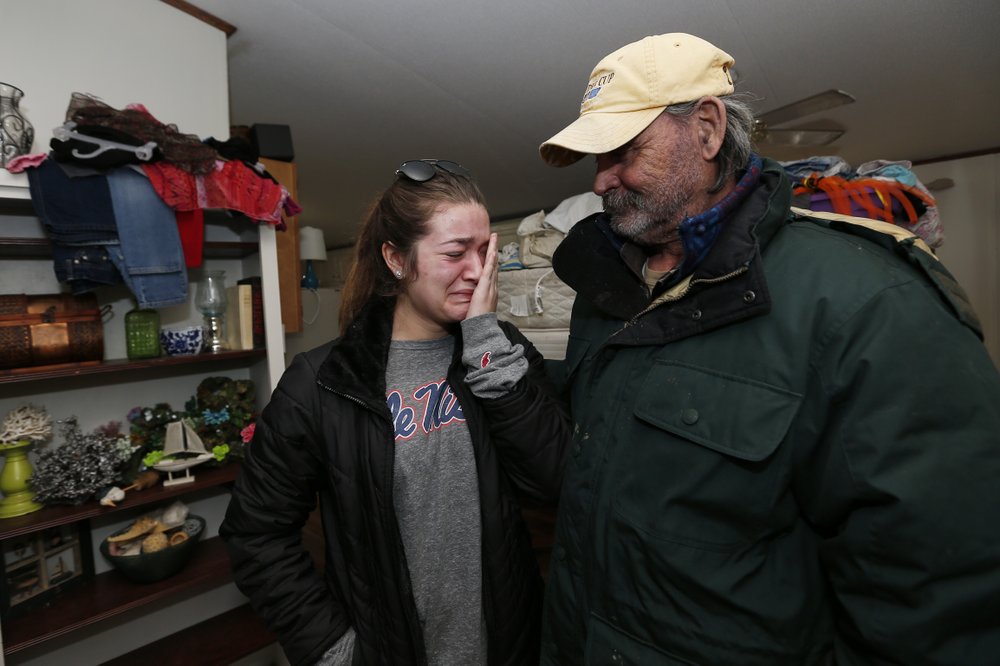
    The Pearl River, which meanders through residential and business areas near Jackson, may reach a level not seen in more than four decades, forecasters said. So Leti Vargas enlisted help from relatives to clear appliances from her double-wide in the Harbor Pines Mobile Home Community.

    “I’ve worked too hard to purchase these, and I don’t want them destroyed,” said Vargas, 50.

    Nearby, Donna and Mark Harvey put blocks under big items like furniture and left with what they could carry ahead of the rising water.

    “Can you imagine we left Florida to come here and get washed out? People warned us about hurricanes in Florida and it’s the rains that wash us out,” said Donna Harvey.

    Nearly a foot of water surrounded dozens of mobile homes in the community; lawn chairs, trash cans and mallards floated around under a sunny sky. With much of the area under mandatory evacuation orders, police patrolled for security, and firefighters went door-to-door telling residents they needed to leave.

    A few miles to the south, flood maps showed waters could cover streets in downtown Jackson and be within a few blocks of Mississippi’s Capitol building by Sunday, when the Pearl was forecast to crest just a few feet below what it reached during a major flood in 1979.

    While downtown Jackson is normally quiet on weekends, a Mardi Gras parade scheduled for Saturday and a two-day regional volleyball tournament could be affected by rising water.

    As much as 10 inches (25 centimeters) of rain pelted a wide section of Mississippi from Monday through Thursday, the National Weather Service said. On the Tombigbee River, homes were surrounded by muddy floodwaters at Columbus.

    Flood concerns extended into neighboring Alabama, where more than 7 inches (18 centimeters) of rain fell in places this week. Some people already have been forced to flee from low-lying homes, and flood warnings covered thousands of aces of land along rivers.

    James Everett, senior manager of the Tennessee Valley Authority’s River Forecast Center, said on a media conference call the utility was taking advantage of a respite from the rain to release water from some reservoirs to bring lake levels back to normal. More than 8 inches (20 centimeters) of rain fell in the valley.

    “The good news is, with this break in the rainfall we will expect to see some of these locations like in north Alabama and down below Pickwick Dam begin to reach their max levels today or tomorrow, and we should start seeing levels come down across the weekend at most locations,” he said.

    In Florence, Alabama, the river was headed down after reaching nearly 7.5 feet (2 meters) above flood level on Thursday.

    Back at Vargas’ community, her 18-year-old son Mario got ready to leave with a load of household items in the back of a pickup truck.

    “Mom, do you want me to leave the hand truck outside?” he called out.

    “Yes, you’ll be coming right back,” she said.