Category: COVID-19

  • Pandemic Vs. Pandemic: COVID-19 Hampers Fight Against HIV

    Pandemic Vs. Pandemic: COVID-19 Hampers Fight Against HIV

    As COVID-19 swept through the South, Mel Prince watched with alarm as some of the HIV positive patients she helps in the rural Black Belt stopped showing up for lab tests and doctor’s visits.

    Some fell back into drug and alcohol abuse. Others feared the AIDS virus made them more vulnerable to the coronavirus and refused to leave their homes.

    Around the same time, Prince’s HIV organization in Selma, Alabama, stopped sending staff to health fairs and other sites to test people for HIV.

    “The virus has made it very challenging for us,” said Prince, executive director of Selma AIR. “We just continue to let people know we’re here, and we’re trying our best to take care of their needs.”

    The coronavirus pandemic has disrupted the delivery of all types of health care services in the U.S. Doctors have put off surgeries to conserve hospital beds and medical supplies for COVID-19 patients and turned to telemedicine for routine consultations to avoid potentially exposing patients to the virus.

    The fight against HIV has not been spared. Clinics have stopped or limited testing for the disease, and public health officials overwhelmed by demands to control COVID-19 have shifted staff away from tracking HIV patients.

    Progress against the virus had already stalled in recent years. Now, health experts and advocates worry the country is at risk of backsliding, with a spike in new HIV infections because people don’t know they have the disease, aren’t aware if their treatment is working or aren’t getting a drug that can prevent them from getting HIV in the first place.

    “We’re losing people who are doing HIV testing and focusing on HIV to the COVID-19 response,” said Ace Robinson, with the national nonprofit HIV eradication group, NMAC. “And that means that we’re not able to support people to maintain the care that they deserve.”

    The issue is of particular concern in the South, which accounted for more than half of the country’s roughly 37,000 HIV infections in 2018 and has been a focus of the Trump administration’s goal of eradicating the disease by 2030. Fewer people in the South are aware that they have HIV compared with other regions in the U.S, according to the U.S. Centers for Disease Control and Prevention.

    Parts of the Black Belt — a poor agricultural region stretching from Louisiana to Virginia that was first known for the color of its soil and then for its mostly Black population — have particularly high rates of new HIV infections.

    HIV workers contacted by The Associated Press in Alabama, Arkansas, Georgia, Louisiana, Mississippi, South Carolina, Tennessee and Texas all reported a drop in HIV testing since the start of the coronavirus pandemic.

    Mildred Harper, who is HIV positive, was too afraid to go to a Jackson, Mississippi, hospital in April for a blood test to check on her HIV treatment. Harper is on medication that can give people with the AIDS virus a near-normal life expectancy and make it effectively impossible for them to infect other people. Elsewhere in the world, the coronavirus has disrupted the supply of those drugs.

    But people on the medication need periodic lab work to make sure the drugs are keeping the amount of virus in their bodies low. If their treatment is effective, they are not believed to face any additional risk for COVID-19, according to the CDC.

    Harper, 56, said the coronavirus had sent her into a depression, and she was “paranoid” about contracting it at the hospital.

    “It kind of felt like I was diagnosed with HIV again because it isolated me from everybody,” Harper said.

    Lee Storrow sought an HIV test in North Carolina in June, but staff at the clinic he contacted said they were focused on testing for COVID-19. Local health officials had stopped testing for sexually transmitted infections, or STIs, and a Planned Parenthood clinic could not see him for weeks, he said.

    Storrow, an HIV policy advocate and educator, said he was eventually able to get a home test kit online from a company called NURX. The CDC has encouraged HIV health providers to mail testing kits to people’s homes.

    “It took me four different steps to figure out how to get my own STI test, and I’m someone who thinks about STI testing on a daily basis,” he said. “It does make me concerned and wonder about folks who are so much more on the margins.”

    Testing at the HIV clinic at Augusta University in Georgia stopped completely for two weeks early on, said Raven Wells, the clinic’s community outreach coordinator. Tests are now conducted by appointment “instead of just driving around trying to contact as many people as you can,” Wells said.

    At sites run by the Birmingham, Alabama-based social services organization AIDS Alabama, testing is down roughly 75%, from about 30 tests a week before the pandemic to 30 tests a month now amid a drop in walk-in clients, said Tony Christon-Walker, the organization’s director of prevention and community partnerships.

    Meanwhile, scores of state social workers in Alabama who were trained to track down and reengage people who dropped out of HIV treatment have instead been put to work investigating COVID-19 cases, said Sharon Jordan, director of the HIV Prevention and Care Office at the Alabama Department of Public Health.

    “I feel like the HIV community, those who are infected, probably feel as if nobody is thinking about us anymore,” she said.

    Annual HIV infections in the United States have dropped by more than two-thirds since the height of the AIDS epidemic in the mid-1980s, but the number of new infections has leveled off in recent years, according to the CDC. An estimated 1.2 million people in the U.S. have HIV, but more than 40% either do not know they are infected or don’t have the virus under control.

    President Donald Trump’s administration announced an ambitious plan last year to end the HIV epidemic in the U.S. by focusing on hot spots for the infection and getting people on drugs. Federal health officials say that remains a priority, though they acknowledge challenges posed by COVID-19.

    “We don’t have the luxury of pulling back,” said Rev. A.J. Johnson, CEO of an HIV testing organization in Baton Rouge, Louisiana. “This is a war against HIV-AIDS, not a battle.”

    ___

    Follow AP coverage of the pandemic at https://apnews.com/VirusOutbreak and https://apnews.com/UnderstandingtheOutbreak.
  • In Defiance Of Nevada Governor, Trump Holds Indoor Rally

    In Defiance Of Nevada Governor, Trump Holds Indoor Rally

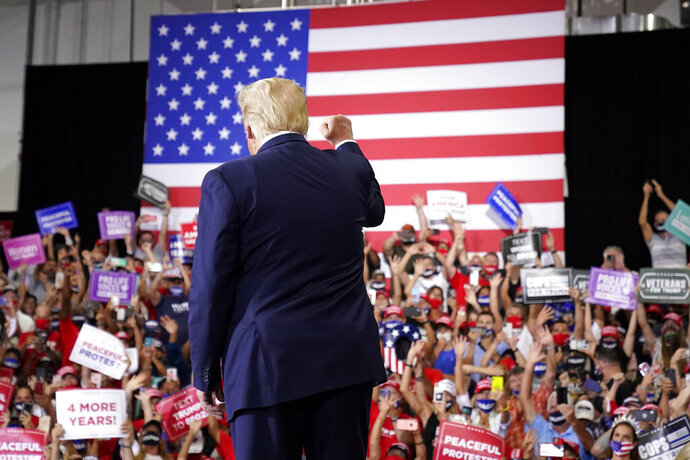
    LAS VEGAS (AP) — In open defiance of state regulations and his own administration’s pandemic health guidelines, President Donald Trump hosted his first indoor rally since June, telling a packed, nearly mask-less Nevada crowd that the nation was “making the last turn” in defeating the virus.

    Eager to project a sense of normalcy in imagery, Trump soaked up the raucous cheers inside a warehouse Sunday night. Relatively few in the crowd wore masks, with a clear exception: Those in the stands directly behind Trump, whose images would end up on TV, were mandated to wear face coverings.

    Not since a rally in Tulsa, Oklahoma, that was blamed for a surge of coronavirus infections has he gathered supporters indoors.

    “We are not shutting the country again. A shutdown would destroy the lives and dreams of millions Americans,” said Trump, before using his inflammatory moniker for the coronavirus. “We will very easy defeat the China virus.”

    He didn’t mention the pandemic’s death toll — it’s killed nearly 200,000 Americans and still claiming about 1,000 lives a day.

    The rally in Tulsa, which was his first in three months after the coronavirus reached American shores, was a disaster for the campaign, a debacle that featured a sea of empty seats and a rise in COVID-19 cases, including on his own staff. One prominent Trump supporter at the rally, businessman and former presidential candidate Herman Cain, died of COVID-19 weeks later, though it was not clear if he contracted the virus in Tulsa.

    Recognizing that many supporters were uncomfortable to gather in a large group indoors, where the virus spreads more easily, the Trump campaign shifted to holding smaller, outdoor rallies, usually at airplane hangers. But those rallies have grown in size in recent weeks, with little social distancing and few masks.

    And on Sunday, they returned indoors, in part as a nod to the Las Vegas-area heat. Temperature checks were given to all upon entrance at the industrial site in Henderson and while masks were encouraged, few wore them.

    Nevada Gov. Steve Sisolak, a Democrat, has limited in-person gatherings indoors and outdoors to 50 people since May, a recommendation based on White House reopening guidelines. In a statement released just before the rally began, Sisolak said Trump was “taking reckless and selfish actions that are putting countless lives in danger here in Nevada.”

    “To put it bluntly: he didn’t have the guts to make tough choices,” Sisolak said of Trump’s handling of the virus. “He left that to governors and the states. Now he’s decided he doesn’t have to respect our State’s laws. As usual, he doesn’t believe the rules apply to him.”

    The city of Henderson informed Xtreme Manufacturing on Sunday that the event as planned was in direct violation of the governor’s COVID-19 emergency directives and that penalties would follow. The Trump campaign pushed back against the restrictions with the president saying he would support those in attendance “if the governor came after you.”

    “If you can join tens of thousands of people protesting in the streets, gamble in a casino, or burn down small businesses in riots, you can gather peacefully under the 1st Amendment to hear from the President of the United States,” campaign communications director Tim Murtaugh said.

    To this point, the campaign has not been played out as a choice election between Trump and his Democratic opponent, Joe Biden, but rather a referendum on the president’s handling of the coronavirus. By wide margins, Americans have disapproved of Trump’s leadership, as the United States has suffered more deaths than any other nation.

    Therefore, the president’s campaign believes it needs to change the subject and project the sense, despite evidence otherwise, that the pandemic was winding down and that a vaccine was on the horizon. Part of the plan: create images of normalcy, like the packed White House lawn for Trump’s convention speech, though it was unclear if viewers were reassured or frightened.

    In a rambling, hourlong speech, Trump mused on mandatory prison sentences for flag burning, praised various UFC fighters in attendance and appeared to endorse extradjudicial killings for those who target police officers. And Trump unleashed a series of attacks on Biden, labeling him a him a tired career politician and declaring him “unfit to be president.”

    But, Trump ruminated, while complaining about the media’s coverage: “Maybe he’ll win because they don’t like me, they don’t like my personality.”

    The crowd answered with a deafening “We love you” chant.

    The rally came the night before Trump was to travel to California to receive a briefing on the devastating wildfires racing through the region. He has largely been silent on the blazes that have claimed dozens of lives in Oregon and California.

    Earlier Sunday, Trump aimed for further inroads with Latinos who could prove vital in closely contested states that could determine the White House race, promoting economic gains they made before the coronavirus pandemic.

    Though Trump has made scores of inflammatory and derogatory comments about Latinos, his campaign is growing confident that he has won some support that could help in Florida, Arizona and Nevada, his target this weekend,

    Winning support from Latinos has been an uphill climb for Trump, whose hard-line immigration policies and sometimes virulent depiction of immigrants have alienated many Hispanics.

    In the first moments of his 2016 campaign, he declared that many Mexican immigrants were “rapists.” He has drawn criticism for his tepid response to a hurricane that ravaged Puerto Rico, his polices to separate children from their families at the U.S.-Mexico border and his efforts to dismantle an Obama-era program that allows young immigrants living in the country illegally who were brought here as children to remain in the U.S.

    Trump tailored his pitch to Latinos on Sunday, noting their low unemployment rate before COVID-19 reached American shores and affirming his anti-abortion stance. He again hammered home his recent push on law and order, saying that recent violence in American cities endangered Latinos. He was set to hold a similar event in Arizona on Monday.

    ___

    Follow Lemire on Twitter at http://twitter.com/@JonLemire

    ___

    AP’s Advance Voting guide brings you the facts about voting early, by mail or absentee from each state: https://interactives.ap.org/advance-voting-2020/

  • Governor Reeves Extends Safe Return Order and Relaxes Restrictions on Businesses, Social Gatherings as COVID-19 Numbers Improve

    Governor Reeves Extends Safe Return Order and Relaxes Restrictions on Businesses, Social Gatherings as COVID-19 Numbers Improve

    JACKSON — Today, Governor Tate Reeves announced that he is extending the social distancing measures under the Safe Return order with a few amendments relaxing restrictions as Mississippi flattens the curve on new COVID-19 cases.

    Continuing to work with state and national health experts on a data-driven, measured strategy to limit transmission, Governor Reeves has extended the Safe Return order until Wednesday, September 30 at 5:00 PM.

    The Governor made the announcement at this morning’s press briefing, which you can view on our Facebook page here.

    Under the amended Safe Return order, group gathering limitations are now at no more than 10 indoors or 50 outdoors when social distancing is not possible. If people are able to social distance, group gatherings are set at no more than 20 indoors or 100 outdoors.

    Maximum capacity has also been increased to 75% for retail businesses, restaurants, gyms, and seated dinners at reception halls and conference centers. Party sizes in restaurants are now limited to 10 people per table, and gyms can be open 24 hours a day.

    You can view the signed Executive Order No. 1522 here. Signed versions of all executive orders related to COVID-19 can be found on our website at governorreeves.ms.gov/covid-19.

  • Poll: Pandemic takes toll on mental health of young adults

    Poll: Pandemic takes toll on mental health of young adults

    PHOENIX (AP) — The coronavirus pandemic has taken a harsh toll on the mental health of young Americans, according to a new poll that finds adults under 35 especially likely to report negative feelings or experience physical or emotional symptoms associated with stress and anxiety.

    A majority of Americans ages 18 through 34 — 56% — say they have at least sometimes felt isolated in the past month, compared with about 4 in 10 older Americans, according to the latest COVID Response Tracking Study conducted by NORC at the University of Chicago. Twenty-five percent of young adults rate their mental health as fair or poor, compared with 13% of older adults, while 56% of older adults say their mental health is excellent or very good, compared with just 39% of young adults.

    In the midst of the pandemic, young adults are navigating life transitions such as starting college and finding jobs, all without being able to experience normal social activities that might be especially essential for people who are less likely to have already married and started their own families. Some young people are just beginning their adult lives amid a recession, and older members of the group are already experiencing their second.

    Christina Torres, 32, a middle school teacher in Honolulu, had to postpone her June wedding and was not able to travel to her grandmother’s funeral in California because of the pandemic. She misses being able to deal with stress by going to the gym and getting together with friends.

    “And so it’s hard to not feel really hopeless sometimes, especially because the numbers keep going up,” she said.

    The study found that younger Americans also consistently show higher rates of psychosomatic symptoms, like having trouble sleeping, getting headaches or crying, compared to other age groups. The likelihood of experiencing such symptoms decreases with age.

    One possible explanation for the age gap could be that young adults have less experience dealing with a public health crisis, said Tom Smith, who has directed NORC’s General Social Survey since 1980. Smith, 71, says he grew up being told not to play in the dirt because of the risk of contracting polio.

    “This experience facing a pandemic is completely new for most younger adults,” he said.

    Torres thought some of the hardship her generation is experiencing now could be attributed to their lack of historical context, compared with her parents’ generation.

    “So it kind of feels like, oh my God, can this get any worse? When is it going to get better?” she said. “It doesn’t feel like it’s going to get better.”

    Young adults also face constant exposure to social media, which could make negative feelings about the virus even worse. The survey found that frequently watching, reading or talking about the virus is consistently linked with higher rates of negative mental health symptoms.

    Wayne Evans, 18, a freshman at North Carolina State University studying remotely after being sent home because of virus cases at the school, said social media provided daily reminders of COVID-19.

    “In some ways social media has added to my stressors, yes. Just the information overload that’s unavoidable on social media platforms can be distracting,” he said.

    The survey found 67% of young adults, but just 50% of those older, say they have at least sometimes felt that they were unable to control the important things in life. And 55% of 18 to 34 year olds say they have felt difficulties piling up too high to overcome, compared with 33% of older adults.

    In Arizona, Desiree Eskridge, 17, decided to study remotely in California for her first year at Northern Arizona University partly because she did not want to risk spreading COVID-19 to her family, which is prone to sickness. She also worried she would get sick and have to pay back a student loan for a semester she could not finish on the campus.

    She did move into her grandparents’ house so she could still be more on her own. She relies on friends who are living on campus and taking the same classes to explain things she did not quite understand during lectures and has to schedule extra Zoom appointments with her professors for additional help.

    “It’s extremely stressful, but me being home makes it a little easier because I can do it all in my own time and my own space and I don’t have to be in this new environment where I have to learn everything all over,” she said.

    _____

    Associated Press writer Colleen Slevin in Wheat Ridge, Colorado contributed to this report. Kelleher reported from Honolulu.

    ___

    The survey of 2,007 adults was conducted July 22-August 10 with funding from the National Science Foundation. It uses a sample drawn from NORC’s probability-based AmeriSpeak Panel, which is designed to be representative of the U.S. population. The margin of sampling error for all respondents is plus or minus 3.1 percentage points.

  • Louisiana deaths top 5,000 but other virus trends positive

    Louisiana deaths top 5,000 but other virus trends positive

    New Orleans (AP) — Louisiana Gov. John Bel Edwards is scheduled to give details Friday on how he will ease statewide business restrictions imposed in July to combat the spread of COVID-19 in the state.

    The Democratic governor announced Thursday that the state would move from “Phase Two” restrictions imposed in July, and which expire Friday, to a new “Phase Three.” He said a statewide mask mandate will remain in place but otherwise withheld details, including whether the change will mean bars can reopen for in-person service, rather than just takeout or delivery.

    Details on Edwards’ plans were to be released on the day the number of coronavirus-related deaths in Louisiana surpassed 5,000. Hospitalizations, however, continue to drop, totaling 723 in Friday’s figures. There had been nearly 2,000 hospitalized in early April, when the state was a national hot spot for infections. There was a second peak of 1,600 in late July during a resurgence of the disease. Other factors, including a percentage of positive tests consistently below 10 percent, led to Edwards’ decision to loosen restrictions.

    Whatever Edwards announces won’t apply to New Orleans, where Mayor LaToya Cantrell has maintained local restrictions that surpass the state’s, including a ban on takeout drinks at bars.

    State regulations set to expire Friday limit restaurants to 50% capacity for in-person dining, restrict bars to takeout and delivery only and place occupancy limits on gyms, salons and other businesses deemed nonessential. Indoor gatherings above 50 people are banned.

    —-

    Follow AP coverage of the virus outbreak at https://apnews.com/VirusOutbreak and https://apnews.com/UnderstandingtheOutbreak

    where two flare-ups of COVID-19 infections have Gov. John Bel Edwards is expected to provide details on the easing of the state coronavirus restrictions at an afternoon news conference. The state’s “Phase Two” restrictions are expiring Friday. On Thursday the governor said the state would to “Phase Three” restrictions. But he didn’t give details, except to say that a statewide mask mandate will remain in place. Edwards’ announcement comes as the rate of new cases, the percentage of positive tests and hospitalizations have declined statewide. Edwards plans won’t include New Orleans. Mayor LaToya Cantrell said Thursday the city will keep current restrictions in place.

  • ‘Deadly Stuff’: Trump’s Own Words Bring Focus Back To Virus

    ‘Deadly Stuff’: Trump’s Own Words Bring Focus Back To Virus

    WASHINGTON (AP) — Try as he might to change the subject, President Donald Trump can’t escape the coronavirus.

    View all (2)

    In April, the president tried to shift the public’s focus to the economy. In July, to defending the country’s “heritage.” In September, to enforcing “law and order.” But all along the way, the death toll from the coronavirus continued to mount.

    And now, Trump’s own words are redirecting attention to his handling of the pandemic when he can least afford it — less than two months before Election Day.

    “I wanted to always play it down,” Trump said of the threat from the virus. That was in a private conversation with journalist Bob Woodward last March that became public on Wednesday with the publication of excerpts from Woodward’s upcoming book “Rage.”

    In taped conversations released along with the excerpts, Trump insisted he didn’t want to create “panic.” But his comments also raised fresh questions about how he has managed the defining crisis of his presidency, one that has killed more than 190,000 Americans so far, with no end in sight.

    Trump’s team would much rather center the November vote around the economy, cracking down on protests spawned by racial injustice, and the president’s promise that he could appoint more conservative justices to the Supreme Court.

    Trump released a list of 20 potential nominees for the high court, part of an effort to animate conservative and evangelical voters. But his announcement was overshadowed by a cascade of unwelcome developments, including Woodward’s revelations, a move by Nevada officials to cancel upcoming Trump rallies in the state because of the virus, and a whistleblower’s charge that Trump aides had pressured him to cover up intelligence reports about Russian election interference on the president’s behalf.

    The president unleashed a barrage of tweets Thursday morning, some in an effort to change the subject, and others taking on the Woodward book head-on, defending his comments and charging the media with conspiring against him.

    “Bob Woodward had my quotes for many months,” Trump wrote. “If he thought they were so bad or dangerous, why didn’t he immediately report them in an effort to save lives? Didn’t he have an obligation to do so? No, because he knew they were good and proper answers. Calm, no panic!”

    Woodward has defended his decision to hold off by saying he needed time to make sure Trump’s private comments were true.

    Revelations from the Woodward book emerged just as Trump’s campaign was beginning to feel that the virus was receding from public view. The president himself has been thumbing his nose at public health experts’ warning against the sort of large gatherings — with few people wearing masks — that his campaign has been staging around the country.

    For all of that, Trump has faced devastating revelations of his own creation before and survived them. They stretch back to his 2015 comments questioning the heroism of Sen. John McCain, a decorated Vietnam prisoner of war, or the notorious “Access Hollywood” tape that emerged just before the 2016 election in which Trump described sexually assaulting women.

    On Wednesday, Trump didn’t deny his remarks playing down the virus, he sought to justify them.

    “The fact is I’m a cheerleader for this country. I love our country and I don’t want people to be frightened. I don’t want to create panic,” Trump told reporters. “Certainly, I’m not going to drive this country or the world into a frenzy. We want to show confidence. We want to show strength.”

    Yet Trump’s own explanation suggested he was steering people away from the reality of the coming storm. Woodward’s account details dire warnings from top Trump national security officials to the president in late January that the virus that causes COVID-19 could be as bad as the devastating influenza pandemic of 1918.

    On Feb. 25, just weeks before much of the country was forced to shut down because of the pandemic, Trump declared the virus “very well under control in our country.”

    Democratic nominee Joe Biden pounced on the Woodward revelations, declaring that Trump “lied to the American people. He knowingly and willingly lied about the threat it posed to the country for months.”

    “While a deadly disease ripped through our nation, he failed to do his job — on purpose. It was a life or death betrayal of the American people,” Biden said.

    By evening, Trump’s own words, captured on the Woodward tapes, had popped up in a Biden campaign ad. The ad includes audio of Trump privately acknowledging to Woodward the severity of COVID-19, and ends with a narrator pronouncing: “Trump knew it all along.”

    In a taped Feb. 7 call with Woodward, Trump said of the virus, “You just breathe the air and that’s how it’s passed. And so that’s a very tricky one. That’s a very delicate one. It’s also more deadly than even your strenuous flus,” Trump said.

    “This is deadly stuff,” the president repeated for emphasis.

    Just three days later, Trump struck a far rosier tone in public, in an interview with Fox Business: “I think the virus is going to be — it’s going to be fine.”

    The Washington Post, where Woodward serves as associate editor, reported excerpts of the book on Wednesday, as did CNN. The book also covers race relations, diplomacy with North Korea and a range of other issues that have arisen during the past two years.

    The book is based in part on 18 interviews that Woodward conducted with Trump between December and July.

    “Trump never did seem willing to fully mobilize the federal government and continually seemed to push problems off on the states,” Woodward writes of the pandemic. “There was no real management theory of the case or how to organize a massive enterprise to deal with one of the most complex emergencies the United States had ever faced.”

  • County Enacts Curfew To Bust Large Parties During Pandemic

    County Enacts Curfew To Bust Large Parties During Pandemic

    STARKVILLE, Miss. (AP) — Officials in a central Mississippi county have enacted a temporary curfew aimed at breaking up block parties that have drawn hundreds of people in recent weeks, sparking fears of possible coronavirus outbreaks.

    Oktibbeha County supervisors on Tuesday unanimously approved a midnight to 4 a.m. curfew that was set to last through the weekend and could be extended further, The Dispatch reported.

    Sheriff Steve Gladney asked the board to consider the measure, adding that even when deputies shut down the gatherings, groups often reconvene elsewhere.

    “We always get calls that the street is blocked and there’s loud music,” he said.

    The resolution did not outline a penalty for curfew violations.

    In April, the supervisors enacted a curfew from 10 p.m. to 5 a.m., along with surrounding areas, the newspaper said. The restrictions were lifted in mid-May.

    ___

    Follow AP coverage of the pandemic at https://apnews.com/VirusOutbreak and https://apnews.com/UnderstandingtheOutbreak.
  • Adams County COVID Rate Far Above the National Average

    Adams County COVID Rate Far Above the National Average

    Natchez, Miss. – As we enter the sixth month of the COVID-19 pandemic, remaining vigilant in our daily lives is the major key in keeping ourselves, our families, and our community healthy. Aiming to continue to slow the spread of the coronavirus disease, local county and city officials have extended the mandate to wear a mask or face covering in all public spaces through the end of October.


    On Tuesday, the Mississippi State Department of Health released the latest coronavirus numbers, reporting Adams County had an additional 37 new cases over the past 7 days, bringing our total to 828 compared to the prior week’s 47 new cases. The year-to-date positivity rate for Adams County now sits at 19.8 percent, which is a drop from the estimated August 31 rate of 20.8 percent, yet we are still lingering in the 20-percent range seen throughout August. The CDC recommends the positivity rate should be below 5 percent, and WHO recommends positivity rates below 5 percent for 14 straight days before lessening restrictions.


    During Mayor Dan Gibson’s weekly COVID-19 Conference Call, task force officials provided additional updates on where we stand locally. Lance Boyd, CEO of Merit Health Natchez, confirmed 11 people are currently hospitalized with positive COVID-19 test results, with one patient currently on a ventilator. Merit Health Natchez’s hospitalization rate has been consistently at 8-12 positive cases for months. The facility has sufficient supplies and the staff is getting a breather, as there is a likelihood of a spike in positive coronavirus cases expected in late fall. Boyd also noted COVID-19 patients require 3 to 10 times the resources for proper treatment compared to the level of care needed for a regular patient.


    The Director of the Adams County Civil Defense and Emergency Operations Center, Brad Bradford, informed that he has diligently worked with every school in the county prior to opening day, to make sure they had a plan for dealing with the students upon arrival and established protocol for when they have a COVID-19 case. The department distributed PPEs to all schools, daycares and nurseries to ensure the safety of area youth. Their goal has been to provide preventative information to everyone to make as much progress as possible, so people do not end up at the hospital for coronavirus-related complications. He advised of the safety procedures in place which includes all students adhering to mask guidelines, washing hands frequently, and refraining from touching their faces.


    Additionally, Bradford explained that Adams County’s reported COVID-19 cases currently include cases reported in correctional facilities. He noted a need for state officials to consider a different reporting measure, pointing out that cases in those facilities do not directly affect the general population while the reporting does impact the county as a whole.


    As Natchez Adams School District returned to classes today, Tony Fields – Director of Communications for NASD, thanked the city and county for the PPEs provided to the school district. While the majority of students, approximately 2,000 students or 80 percent, opted for virtual learning, McLaurin Elementary School has the highest numbers for in-person learning.


    Fields explained that every school has a triage and upon arrival, each student has their temperature checked, they are asked to provide information about their surroundings to determine if they’ve been at risk of exposure to the virus, and lunch will be served “grab and go” style. He confirmed that all students must wear masks and explained the protocol for notification to other students and parents with the new CDC 10-day quarantine guidelines in case of positive test results. NASD must also provide weekly reports of all positive cases to the state.


    Dr. Lee England, Internal Medicine physician with emphasis in infectious diseases, believes October could bring another surge in our local area per his observations and available medical information. To give a clearer perspective on numbers, the medical journals and information from his recent studies point to the probability of 300,000 deaths in the United States by the Thanksgiving holiday, increasing to over 400,000 by the end of January 2021; estimating more COVID-19 related deaths than the US suffered in WWII.

    Dr. England concluded that we all have COVID fatigue, and it would be easy for folks to not continue wearing a mask or taking extra precautions. This has been ongoing for six months and it is exhausting, however we may see a large spike later in the fall and winter if we let our guards down.

  • GOP Proposes ‘Targeted’ Virus Aid, But Dems Say Not Enough

    GOP Proposes ‘Targeted’ Virus Aid, But Dems Say Not Enough

    WASHINGTON (AP) — The Senate prepared to vote this week on a trimmed-down Republican coronavirus relief package, though it only has a slim chance of passage in the face of Democrats’ insistence for more sweeping aid.

    Senate Majority Leader Mitch McConnell released the approximately $500 billion measure on Tuesday as senators returned to Washington for an abbreviated pre-election session, but hopes were dimming for another coronavirus relief bill — or much else.

    Republicans struggling to retain their Senate majority this fall have been divided, with some GOP senators in close races anxious to respond further to the pandemic, even as conservatives are tiring of all the spending and passing legislation in concert with liberal House Speaker Nancy Pelosi.

    McConnell called the package “a targeted proposal that focuses on several of the most urgent aspects of this crisis, the issues where bipartisanship should be especially possible.” They included school aid, new money for vaccines and testing, and a second round of the popular Paycheck Protection Program for smaller businesses.

    Democrats demanded a far larger bill, including hundreds of billions of dollars for state and local governments, more generous jobless benefits, and help for renters and homeowners, along with other provisions in the House Democrats’ $3.5 trillion relief bill that passed in May.

    “Get real, Mitch McConnell,” Pelosi said during a Bloomberg interview. “It’s only a ‘check the box’ so that some of his endangered Republican senators can go home and say, ‘Well, see, I tried.’ But it isn’t trying. It is not even an attempt to do the right thing.”

    Republican senators such as Susan Collins of Maine are eager to show constituents they are continuing to work to ease the pandemic’s disastrous impact on jobs, businesses and health. But many Senate Republicans are resisting more spending, and the scaled-back bill is roughly half the size of a measure McConnell unveiled earlier this summer.

    McConnell’s move Tuesday would clear the way for a Thursday test vote in which Democrats were sure to block the legislation. Pelosi and Senate Minority Leader Chuck Schumer, D-N.Y., said in a statement that the bill “doesn’t come close to addressing the problems and is headed nowhere.”

    McConnell’s bill would provide $105 billion to help schools reopen, enact a shield against lawsuits for businesses and others that are powering ahead to reopen, create a scaled-back $300-per-week supplemental jobless benefit, and write off $10 billion in earlier debt at the U.S. Postal Service. There’s $31 billion for a coronavirus vaccine, $16 billion for virus testing and $15 billion to help child care providers reopen. There is additionally $20 billion for farmers.

    The package will also include a school choice initiative sought by Texas GOP Sen. Ted Cruz and others that would provide a tax break, for two years, for people who donate to nonprofit organizations offering private school scholarships.

    It would also provide for a $258 billion second round of paycheck protection subsidies.

    But it won’t contain another round of $1,200 direct payments going out under President Donald Trump’s name and the new $300 weekly jobless benefit would expire just after Christmas, on Dec. 27. The GOP bill also lacks funding for election security that lawmakers from both parties have supported.

    At least one Republican, Sen. Rand Paul of Kentucky, said Tuesday he would oppose the bill, refusing new spending that piles on debt. It’s a sign of the troubles McConnell has faced in crafting a bill his own party would support.

    Pelosi, D-Calif., continues to demand a package totaling $2.2 trillion, and while Trump’s negotiators have signaled a willingness to inch further in her direction, a significant gap remains.

    Talks between top Democrats and the Trump administration broke off last month and remain off track, with the bipartisan unity that drove almost $3 trillion in COVID-19 rescue legislation into law this spring replaced by toxic partisanship and a return to Washington dysfunction.

    Expectations in July and August that a fifth bipartisan pandemic response bill would eventually be birthed despite increased obstacles has been replaced by genuine pessimism. Recent COVID-related conversations among key players have led to nothing.

    Democrats seem secure in their political position, with Trump and several Senate GOP incumbents lagging in the polls. Trump is seeking to sideline the pandemic as a campaign issue, and Republicans aren’t interested in a deal on Democratic terms — even as needs like school aid enjoy widespread support.

    Poisonous relationships among key leaders like Pelosi and White House chief of staff Mark Meadows give little reason for confidence about overcoming obstacles on the cost, scope and details of a potential relief bill. Pelosi recently referred to Meadows as “whatever his name is,” while the Meadows-run White House during a press briefing ran a video loop of Pelosi’s controversial visit to a San Francisco hair salon.

    The relationship between Pelosi and her preferred negotiating partner, Treasury Secretary Steven Mnuchin, is civil but isn’t generating much in the way of results, other than a promise to avoid a government shutdown at the end of the month by keeping a government-wide temporary spending bill free of controversy. That measure is likely to keep the government running into December. It’s likely to contain a bunch of lower-profile steps, such as an extension of the federal flood insurance program and a temporary reauthorization of spending from the highway trust fund.

    But if talks continue to falter, there’s little to keep lawmakers in Washington long, particularly with the election fast approaching.

    One Republican in leadership, Sen. Roy Blunt of Missouri, said he was “disappointed” they had not reached agreement sooner. “On all of this money, the longer we wait the less effective it is, whether it’s money for elections — which particularly have one day that’s the target — or money for back to school,” said Blunt.

    The Senate returned Tuesday to resume its diet of judicial and administration nominations. The House doesn’t come back until Sept. 14 for a schedule laden with lower-profile measures such as clean-energy legislation and a bill to decriminalize marijuana. Some Democrats are expected to continue to take advantage of remote voting and may not return to Washington at all.

    This story has been corrected to show the May virus legislation total was $3.5 trillion, not billion.

  • Book: Trump Said Of Virus, ‘I Wanted To Always Play It Down’

    Book: Trump Said Of Virus, ‘I Wanted To Always Play It Down’

    WASHINGTON (AP) — President Donald Trump talked privately about the severity of the coronavirus threat even as he was telling the nation that the virus was no worse than the seasonal flu and insisting that the U.S. government had it totally under control, according to a new book by journalist Bob Woodward.

    View all (13)

    “You just breathe the air and that’s how it’s passed,” Trump said in a Feb. 7 call with Woodward. “And so that’s a very tricky one. That’s a very delicate one. It’s also more deadly than even your strenuous flus.”

    “This is deadly stuff,” the president repeated for emphasis.

    For the White House, the book serves as an unwelcome return to a focus on Trump’s handling of the pandemic just as he is trying to project that the virus is under control and as he is eager to see a return to normal activity leading up to the Nov. 3 presidential election.

    Trump told Woodward on March 19 that he deliberately minimized the danger. “I wanted to always play it down,” the president said. “I still like playing it down because I don’t want create a panic.”

    Democratic presidential nominee Joe Biden said the book shows Trump “lied to the American people. He knowingly and willingly lied about the threat it posed to the country for months.”

    “He had the information,” Biden said during a campaign event in Michigan. “He knew how dangerous it was. And while a deadly disease ripped through our nation, he failed to do his job — on purpose. It was a life or death betrayal of the American people.”

    The Washington Post, where Woodward serves as associate editor, reported excerpts of the book, “Rage” on Wednesday, as did CNN. The book also covers race relations, diplomacy with North Korea and a range of other issues that have arisen during the past two years.

    The book is based in part on 18 interviews that Woodward conducted with Trump between December and July.

    “Trump never did seem willing to fully mobilize the federal government and continually seemed to push problems off on the states,” Woodward writes. “There was no real management theory of the case or how to organize a massive enterprise to deal with one of the most complex emergencies the United States had ever faced.”

    White House press secretary Kayleigh McEnany said the president’s words to the public were designed to express confidence and calm at a time of insurmountable challenges.

    “The president has never lied to the American public on COVID. The president was expressing calm and his actions reflect that,” McEnany said.

    McEnany took questions about the book during a briefing at the White House on Wednesday. She said his actions reflect that he took COVID-19 seriously. She noted that the president put in place travel restrictions with China on Jan. 31 and that some Democrats had criticized the move.

    McEnany said “the president never downplayed the virus.” But Trump himself told Woodward that he was “playing it down, because I don’t want to create panic.”

    At times, Trump’s public comments suggested he was less interested in keeping people calm than in having them ignore the reality of the coming storm. “I think the virus is going to be — it’s going to be fine,” Trump said on February 10th — three days after telling Woodward privately it was “deadly stuff” and more dangerous than the seasonal flu.

    Trump aides and allies said at the time said Trump was aiming to prop up the economy with his rosy take on the virus throughout February, even as his administration took few concrete steps to prepare for the coming pandemic.

    “There is damning truth that President Trump lied and people died,” said Senate Democratic leader Chuck Schumer of New York. Schumer said that when he thinks about how many people in his state died, “It just makes me angry.” He added: “How many people would be alive today if he just told Americans the truth?”

    House Speaker Nancy Pelosi, D-Calif., said the president’s comments to Woodward showed weakness and a disdain for science.

    “What he was actually saying is, ‘I don’t want anybody to think anything like this happened on my watch so I’m not going to call any more attention to it,” Pelosi said during an interview on MSNBC.

    Woodward’s book is his second on the Trump White House. The first, published in 2018, portrayed Trump in an unflattering light, and the president fumed at staff that he was not interviewed for it, according to two former White House officials and Republicans close to the White House. They were not authorized to speak publicly about private conversations and discussed the matter on condition of anonymity.

    Trump was convinced that had he talked to Woodward, he could have led to a more favorable depiction in the book, according to the officials. Trump had always held Woodward in high regard — he considered the journalist as the biggest star in the field — and told aides that he insisted on being interviewed if Woodward were to write again, the officials said.

    Several Republican senators at the Capitol declined to comment, telling reporters they hadn’t yet read the book, even when informed of key passages about the virus. “I just can’t, can’t comment on it,” Sen. Rob Portman, R-Ohio.

    “Could we all have done things differently? Yes, including Congress. We were all a little slow to recognize the severity,” Portman added.

    _____

    Associated Press writers Jonathan Lemire in New York and Alexandra Jaffe in Warren, Michigan, and Lisa Mascaro contributed to this report.