Category: Fringe News

  • Artemis II astronauts return from moon with a splashdown to close out a record-breaking lunar voyage

    HOUSTON (AP) — Artemis II’s astronauts returned from the moon with a dramatic splashdown in the Pacific on Friday to close out humanity’s first lunar voyage in more than a half-century.

    It was a triumphant homecoming for the crew of four whose record-breaking lunar flyby revealed not only swaths of the moon’s far side — never seen before by human eyes — but a total solar eclipse.

    Commander Reid Wiseman, pilot Victor Glover, Christina Koch and Canada’s Jeremy Hansen hit the atmosphere traveling Mach 33 — or 33 times the speed of sound — a blistering blur not seen since NASA’s Apollo moonshots of the 1960s and 1970s. Their Orion capsule, dubbed Integrity, made the plunge on automatic pilot.

    The tension in Mission Control mounted as the capsule became engulfed in red-hot plasma during peak heating and entered a planned communication blackout.

    All eyes were on the capsule’s life-protecting heat shield that had to withstand thousands of degrees during reentry. On the spacecraft’s only other test flight — in 2022, with no one on board — the shield’s charred exterior came back looking as pockmarked as the moon.

    Like so many others, lead flight director Jeff Radigan anticipated feeling some of that “irrational fear that is human nature,” especially during the six-minute blackout that preceded the opening of the parachutes. The recovery ship USS John P. Murtha awaited the crew’s arrival off the San Diego coast, along with a squadron of military planes and helicopters.

    The astronauts’ families huddled in Mission Control’s viewing room, where cheers erupted when the capsule emerged from its communication blackout and again at splashdown.

    The last time NASA and the Defense Department teamed up for a lunar crew’s reentry was Apollo 17 in 1972. Artemis II was projected to come screaming back at 36,170 feet (11,025 meters) per second — or 24,661 mph (39,668 kph) — just shy of the record before slowing to a 19 mph (30 kph) splashdown.

    “A perfect bull’s-eye splashdown,” reported Mission Control’s Rob Navias.

    Artemis II’s record flyby and views of the moon

    Launched from Florida on April 1, the astronauts racked up one win after another as they deftly navigated NASA’s long-awaited lunar comeback, the first major step in establishing a sustainable moon base.

    Artemis II didn’t land on the moon or even orbit it. But it broke Apollo 13’s distance record and marked the farthest that humans have ever journeyed from Earth when the crew reached 252,756 miles (406,771 kilometers). Then in the mission’s most heart-tugging scene, the teary astronauts asked permission to name a pair of craters after their moonship and Wiseman’s late wife, Carroll.

    During Monday’s record-breaking flyby, they documented scenes of the moon’s far side never seen before by the human eye along with a total solar eclipse. The eclipse, in particular, “just blew all of us away,” Glover said.

    Their sense of wonder and love awed everyone, as did their breathtaking pictures of the moon and Earth. The Artemis II crew channeled Apollo 8’s first lunar explorers with Earthset, showing our Blue Marble setting behind the gray moon. It was reminiscent of Apollo 8’s famous Earthrise shot from 1968.

    “We are back in the business of sending astronauts to the moon, bringing them back safely and to set up for a series more,” NASA Administrator Jared Isaacman said Friday from the recovery ship. “This is just the beginning.”

    Their moonshot drew global attention as well as star power, earning props from President Donald Trump; Canadian Prime Minister Mark Carney; Britain’s King Charles III; Ryan Gosling, star of the latest space flick “Project Hail Mary”; Scarlett Johansson of the Marvel Cinematic Universe; and even Captain Kirk himself, William Shatner of TV’s original “Star Trek.”

    Artemis II was a test flight for future moon missions

    Despite its rich scientific yield, the nearly 10-day flight was not without technical issues. Both the capsule’s drinking water and propellant systems were hit with valve problems. In perhaps the most high-profile predicament, the toilet kept malfunctioning, but the astronauts shrugged it all off.

    “We can’t explore deeper unless we are doing a few things that are inconvenient,” Koch said, “unless we’re making a few sacrifices, unless we’re taking a few risks, and those things are all worth it.”

    Added Hansen: “You do a lot of testing on the ground, but your final test is when you get this hardware to space and it’s a doozy.”

    Under the revamped Artemis program, next year’s Artemis III will see astronauts practice docking their capsule with a lunar lander or two in orbit around Earth. Artemis IV will attempt to land a crew of two near the moon’s south pole in 2028.

    The Artemis II astronauts’ allegiance was to those future crews, Wiseman said.

    “But we really hoped in our soul is that we could for just for a moment have the world pause and remember that this is a beautiful planet and a very special place in our universe, and we should all cherish what we have been gifted,” he said.

    ___

    The Associated Press Health and Science Department receives support from the Howard Hughes Medical Institute’s Department of Science Education and the Robert Wood Johnson Foundation. The AP is solely responsible for all content.
  • Triceratops skeleton ‘Trey’ to hit the auction block as dinosaur market soars


    A triceratops skeleton that stood in a Wyoming museum for decades will be auctioned off, a rare instance of a museum-exhibited dinosaur going to the auction block just as the market for the prehistoric giants has hit record highs.

    The fossil, dubbed “Trey,” will be open for bidding from March 17 to 31 on Joopiter, an online auction platform founded by Grammy-winning artist and producer Pharrell Williams. It has a preauction estimate of $4.5 million to $5.5 million.

    Dating back more than 66 million years to the late Cretaceous period, Trey was discovered near Lusk, Wyoming, in 1993 by Lee Campbell and the late Allen Graffham, a commercial paleontologist who made numerous significant finds over his lifetime.

    The 17-foot-long (5.3-meter-long) herbivore greeted visitors at the 1995 grand opening of the Wyoming Dinosaur Center in Thermopolis, and remained there on loan until 2023.

    Having been recently sold in a private transaction, it is now in Singapore, where it is available for private viewings through the end of March, Joopiter said.

    Trey “has this cultural aspect that a lot of fossils that go to auction these days just simply don’t have,” said paleontologist Andre LuJan, who worked with Joopiter to prepare the fossil for auction. “This one is connected to people and undoubtedly has inspired young children who’ve seen it to pursue a career in paleontology.”

    Once the domain of museums and universities, dinosaur fossils have become increasingly popular investments.

    In 2024, the remains of “Apex” the stegosaurus went for $44.6 million at auction, shattering the previous record of $31.8 million paid in 2020 for “Stan,” a Tyrannosaurus rex skeleton.

    In a sign that the dinosaur fossil market remains strong, a rare young dinosaur skeleton blew past its $4 million to $6 million Sotheby’s preauction estimate in July and ended up fetching more than $30 million in a bidding frenzy, including fees and costs.

    Caitlin Donovan, Joopiter’s global head of sales, said the surging interest reflects a shift away from traditional categories like old master paintings and toward objects that have “cultural resonance.”

    “(Dinosaurs) have always captivated our imagination … and people are now starting to see the value in investing in these as assets,” LuJan said.

    But the hot market has some paleontologists concerned that important specimens could disappear into private collections, depriving scientists of important research opportunities. Public museums are “getting totally priced out of an exploding market,” said Kristi Curry Rogers, a paleontologist at Minnesota’s Macalester College.

    “If a fossil goes into a private collection without guaranteed access forever, that data is essentially lost to science,” said Curry Rogers, who is not involved in the sale.

    LuJan emphasized that Trey has always been privately owned, and he hopes it will end up in a museum, just like Apex, which is now on display at New York’s American Museum of Natural History after its buyer signed a long-term loan agreement allowing scientists to study it.

    “Because we’ve had this paradigm shift in what owning dinosaurs means to society, people are naturally gravitating toward these benevolent situations where they loan them long-term to museums or they end up donating them to a new museum that’s just being born,” LuJan said.


  • 6 planets will parade across the night sky at the end of February

    NEW YORK (AP) — Six planets are linking up in the sky at the end of February, and most will be visible to the naked eye.

    It’s what’s known as a planetary parade, which happens when multiple planets appear to line up in the sky at once. The planets aren’t in a straight line, but are close together on one side of the sun.

    Skygazers can usually spot two or three planets after sunset, according to NASA. Hangouts of four or five that can be glimpsed with the naked eye are less common and occur every few years. Last year featured lineups of six and all seven planets.

    When will they be visible?

    On Saturday, Mercury, Venus, Jupiter and Saturn will be visible to the naked eye if clear skies allow. Uranus and Neptune can only be spotted with binoculars and telescopes.

    What time is optimal for viewing?

    Go outside about an hour after sunset and venture away from tall buildings and trees that will block the view. Look to the western sky and spot Mercury, Venus and Saturn close to the horizon. Jupiter will be higher up, along with Uranus and Neptune.

    How to know if you’ve spied a member of the parade?

    “If it’s twinkling, it’s a star. If it is not twinkling, it’s a planet,” said planetary scientist Sara Mazrouei with Humber Polytechnic in Canada.

    The parade should be visible over the weekend and in the days after. Eventually, Mercury will bow out and dip below the horizon.

    At least one bright planet is visible on most nights, according to NASA.

    Glimpsing many in the sky at once is a fun way to connect with astronomers of centuries’ past, said planetary scientist Emily Elizondo with Michigan State University.

    Ancient astronomers used to make sense of the universe “just by looking up at the stars and the planets,” Elizondo said, “which is something that we can do today.”

    ___

    The Associated Press Health and Science Department receives support from the Howard Hughes Medical Institute’s Department of Science Education and the Robert Wood Johnson Foundation. The AP is solely responsible for all content.

  • Indonesian handprints are the oldest cave art found yet


    NEW YORK (AP) — Handprints on cave walls in a largely unexplored area of Indonesia may be the oldest rock art studied so far, dating back to at least 67,800 years ago.

    The tan-colored prints analyzed by Indonesian and Australian researchers on the island of Sulawesi were made by blowing pigment over hands placed against the cave walls, leaving an outline. Some of the fingertips were also tweaked to look more pointed.

    This prehistoric art form suggests the Indonesian island was home to a flourishing artistic culture. To figure out how old the paintings were, researchers dated mineral crusts that had formed on top of the art.

    Upon seeing the new study, independent paleoanthropologist Genevieve von Petzinger said she “let out a little squeal of joy.”

    “It fits everything I’d been thinking,” she said.

    Indonesia is known to host some of the world’s earliest cave drawings, and scientists have analyzed countless examples of ancient art across the globe — including simple marks on bones and stones that go back hundreds of thousands of years. Cross-hatched markings on a piece of rock in South Africa have been dated to about 73,000 years ago.

    The new art from southeastern Sulawesi is the oldest to be found on cave walls. The stencils also represent a more complex tradition of rock art that could have been a shared cultural practice, said study author Maxime Aubert with Griffith University, who published the study Wednesday in the journal Nature.

    Scientists are eager to understand when early humans learned to make art, moving from dots and lines to more meaningful representations of themselves and the world around them. These cave drawings help firm up a timeline for the dawn of human creativity.

    It’s not yet clear whose hands made the prints. They could be from an ancient human group called Denisovans who lived in the area and may have interacted with our Homo sapiens ancestors before eventually going extinct. Or they may belong to modern humans venturing away from Africa, who could have wandered through the Middle East and Australia around this time. Fine details on the cave art, including the intentionally modified fingertips, point to a human hand.

    Other drawings discovered in the same area of the island, including a human figure, a bird and horselike animals, were found to be created much more recently, some of them about 4,000 years ago.

    There’s likely more art to be found on nearby islands that could be even older than the handprints. Future studies may help scientists understand how these artistic traditions spread across the globe and how they’re woven into the fabric of humanity’s early days.

    “For us, this discovery is not the end of the story,” Aubert said in an email. “It is an invitation to keep looking.”

    ___

    The Associated Press Health and Science Department receives support from the Howard Hughes Medical Institute’s Department of Science Education and the Robert Wood Johnson Foundation. The AP is solely responsible for all content.


  • NASA cancels spacewalk due to medical issue and may bring the crew back early

    NEW YORK (AP) — NASA canceled its first spacewalk of the year and may bring its crew back early from the International Space Station due to an onboard medical issue.

    The spacewalk was supposed to happen on Thursday, but was postponed because of an unspecified medical concern with an astronaut, who was not identified, the space agency said.

    NASA said the crew member is now stable, but it’s “actively evaluating all options” including an early end to the mission.

    “Safely conducting our missions is our highest priority,” said NASA spokesperson Cheryl Warner in a statement.

    The U.S.-Japanese-Russian crew of four have been at the orbiting lab since August after launching from Florida.

    ___

    The Associated Press Health and Science Department receives support from the Howard Hughes Medical Institute’s Department of Science Education and the Robert Wood Johnson Foundation. The AP is solely responsible for all content.

  • Nobel Prize in chemistry goes to discovery that draws comparison to magical ‘Harry Potter’ handbag

    STOCKHOLM (AP) — Three scientists won the Nobel Prize in chemistry Wednesday for their development of new molecular structures that can trap vast quantities of gas inside, laying the groundwork to potentially suck greenhouse gases out of the atmosphere or harvest moisture from desert environments.

    Heiner Linke, chairperson of the committee that made the award, compared the structures called metal-organic frameworks to the seemingly bottomless magical handbag carried by Hermione Granger in the “Harry Potter” series. Another example might be Mary Poppins’ enchanted carpet bag. These containers look small from the outside but are able to hold surprisingly large quantities within.

    The committee said Susumu Kitagawa, Richard Robson and Omar M. Yaghi were honored for “groundbreaking discoveries” that “may contribute to solving some of humankind’s greatest challenges,” from pollution to water scarcity.

    Robson, 88, is affiliated with the University of Melbourne in Australia. Kitagawa, 74, is with Japan’s Kyoto University, and Yaghi, 60, is with the University of California, Berkeley.

    The work that won the 2025 Nobel Prize in chemistry

    The chemists worked separately but added to each other’s breakthroughs over decades, beginning with Robson’s work in the 1980s.

    The scientists were able to devise stable atomic structures that preserved holes of specific sizes that allowed gas or liquid to flow in and out. The holes can be customized to match the size of specific molecules that scientists or engineers want to hold in place, such as water, carbon dioxide or methane.

    “That level of control is quite rare in chemistry,” said Kim Jelfs, a computational chemist at Imperial College London. “It’s really efficient for storing gases.”

    A relatively small amount of the structure — which combines metal nodes and organic rods, somewhat like the interchangeable building pieces in Tinker Toys — creates many organized holes and a huge amount of surface area inside.

    For instance, Jelfs said, a few grams of molecular organic framework may have as much surface area as a soccer field, all of which can be used to lock gas molecules in place.

    “If you can store toxic gases,” said American Chemical Society President Dorothy Phillips, “it can help address global challenges.”

    Why the work matters

    Today researchers around the world are exploring possibilities that include using the frameworks to remove greenhouse gases from the atmosphere and pollution from industrial sites. Another possibility is to use them to harvest moisture from desert air, perhaps to one day provide clean drinking water in arid environments.

    Scientists are also investigating using the structures for targeted drug delivery. The idea is to load them with medicine that may be slowly released inside the body.

    “It could be a better way to deliver low doses continually,” as with cancer drugs, said David Pugh, a chemist at King’s College London.

    The research “could be really, really valuable” in many industries, he said. But “there are still challenges when you translate that from the lab to the real world.” For example, many of the structure store the most gas and liquid in very low-temperature, high-pressure environments, he said.

    Today, metal-organic frameworks are already being used in some surprising ways, including as part of packing material to keep fruit fresh over long shipping routes, by gradually releasing chemicals that slow down the ripening process.

    The winners’ reactions

    Yaghi learned that he had won while traveling from San Francisco to Brussels on Wednesday. As he grabbed his luggage and prepared to change flights in Frankfurt, his phone started buzzing with a call from Sweden.

    “You cannot prepare for a moment like that,” he said at a news conference. ”The feeling is indescribable, but it’s absolutely thrilling.”

    When his phone rang, Kitagawa was at first skeptical. He said he answered “rather bluntly,” thinking it must be a telemarketing call.

    “It was such a big prize so I thought, ‘Is it really true?’” he recalled during a news conference at Kyoto University. “When one of the experts came on the phone and congratulated me, I finally thought it was real and felt relaxed.”

    Kitagawa said the research has been widely recognized in the world of chemistry, but “it is very difficult to gain understanding by the ordinary people, and I’m delighted to be recognized.”

    The 88-year-old Robson, in a phone call with The Associated Press from his home in Melbourne, Australia, said he was “very pleased of course and a bit stunned as well.”

    “This is a major thing that happens late in life when I’m not really in a condition to withstand it all,” he said. “But here we are.”

    Nobel history and other 2025 prizes

    The 2024 chemistry prize was awarded to David Baker, a biochemist at the University of Washington in Seattle, and to Demis Hassabis and John Jumper, computer scientists at Google DeepMind, a British-American artificial intelligence research laboratory based in London.

    The three were awarded for discovering powerful techniques to decode and even design novel proteins, the building blocks of life. Their work used advanced technologies, including artificial intelligence, and holds the potential to transform how new drugs and other materials are made.

    The first Nobel of 2025 was announced Monday. The prize in medicine went to Mary E. Brunkow, Fred Ramsdell and Dr. Shimon Sakaguchi for their discoveries concerning peripheral immune tolerance.

    Tuesday’s physics prize went to John Clarke, Michel H. Devoret and John M. Martinis for their research on the weird world of subatomic quantum tunneling that advances the power of everyday digital communications and computing.

    This year’s Nobel announcements continue with the literature prize Thursday. The Nobel Peace Prize will be announced Friday and the economics prize next Monday.

    The award ceremony will be held Dec. 10, the anniversary of the death of Alfred Nobel, who founded the prizes. Nobel was a wealthy Swedish industrialist and the inventor of dynamite. He died in 1896.

    ___

    This version has been changed to correct that Heiner Linke compared the prizewinning discoveries to a magical bag featured in the “Harry Potter” series. An earlier version attributed the comparison to Olof Ramström, another member of the Nobel Committee for Chemistry.

    ___

    Dazio reported from Berlin, and Larson reported from Washington. Associated Press writers Mari Yamaguchi in Tokyo and Rod McGuirk in Melbourne, Australia, contributed to this report.

    ___

    AP Nobel Prizes: https://apnews.com/hub/nobel-prizes

  • Scientists find marine life thriving on World War II explosives in the Baltic Sea

    NEW YORK (AP) — An undersea submersible has spotted crabs, worms and fish thriving on the surfaces of World War II explosives thought to be toxic to marine life.

    At a former weapons dump site in the Baltic Sea, scientists found more creatures living on top of warheads than in the surrounding seabed.

    “We were prepared to see significantly lower numbers of all kinds of animals,” said study author Andrey Vedenin with the Senckenberg Research Institute in Germany. “But it turned out the opposite.”

    Past conflicts have left their mark on the world’s oceans, Vedenin said. German waters alone contain about 1.6 million tons (1.5 million metric tonnes) of dumped weapons, mostly from the two world wars in the 20th century. Dumped relics can contain nuclear and chemical remnants as well as explosives like TNT.

    It’s the latest example of wildlife flourishing in polluted sites. Previous research has shown shipwrecks and former weapons complexes teeming with biodiversity.

    In the new study, researchers filmed networks of anemones, starfish and other underwater life in the Bay of Lübeck off the coast of Germany. They were lurking on pieces of V-1 flying bombs used by Nazi Germany.

    “Normally, one does not study the ecology of bombs,” said University of Georgia ecologist James Porter, who was not involved with the research.

    The research was published Thursday in the journal Communications Earth and Environment.

    Why would sea creatures make their home on contaminated weapons? They could be drawn to the hard surfaces, which are in short supply in the Baltic Sea. The seafloor is mainly a flat bed of mud and sand because stones and boulders were fished out of the water for construction in the 1800s and 1900s, Vedenin said.

    The area is also fairly isolated from human activity because of the chemicals, creating a somewhat protective bubble for the critters to thrive despite some toxic tradeoffs.

    Scientists hope to calculate how much contamination was absorbed by sea life. Another important next step is to see what happens after the critters settle and whether they’re capable of reproducing, Porter said.

    Studies like these are a testament to how nature takes advantage of human leftovers, flipping the script to survive, said marine conservation biologist David Johnston with Duke University. He recently mapped sunken World War I ships that have become habitats for wildlife along the Potomac River in Maryland.

    “I think it’s a really cool testimony to the strength of life,” Johnston said.

    ___

    The Associated Press Health and Science Department receives support from the Howard Hughes Medical Institute’s Department of Science Education and the Robert Wood Johnson Foundation. The AP is solely responsible for all content.

  • Scientists discover a new dinosaur from Argentina with a crocodile bone in its mouth

    NEW YORK (AP) — Scientists have discovered a new dinosaur from Argentina with powerful claws, feasting on an ancient crocodile bone.

    The new find was possibly 23 feet (7 meters) long and hailed from a mysterious group of dinosaurs called megaraptorans. They prowled across what’s now South America, Australia and parts of Asia, splitting off into different species over millions of years.

    Megaraptorans were known for their stretched-out skulls and “huge and very powerful claws,” said Lucio Ibiricu with the Patagonian Institute of Geology and Paleontology, who was part of the discovery team.

    But it’s not yet clear how these creatures hunted and where they fall on the evolutionary timeline — mainly because the fossils recovered so far were incomplete.

    In a new study, researchers said they uncovered part of a skull as well as arm, leg and tail bones from the Lago Colhué Huapi rock formation in Patagonia. They noticed unique features in the bones that made them realize this could be a new species.

    This latest member of the megaraptoran clan named Joaquinraptor casali “fills a major gap by providing one of the most complete skeletons yet,” Federico Agnolin with the Argentine Museum of Natural Science Bernardino Rivadavia said in an email. Agnolin was not involved with the research, which was published Tuesday in the journal Nature Communications.

    The creature likely lived between 66 and 70 million years ago — close to the time dinosaurs went extinct — and was at least 19 years old when it died, though scientists don’t know what killed it.

    The front leg bone pressed against its jaws — belonging to an ancient relative of crocodiles — could yield some clues to its diet and whether it was the top predator on the humid prehistoric flood plains.

    Ibiricu named the new dinosaur in memory of his son Joaquin. While Joaquin was very young and hadn’t yet developed a fascination with dinosaurs, Ibiricu still thinks he would have appreciated being named after one.

    “All children love dinosaurs so he would probably be a fan too,” he said.

    ___

    The Associated Press Health and Science Department receives support from the Howard Hughes Medical Institute’s Department of Science Education and the Robert Wood Johnson Foundation. The AP is solely responsible for all content.

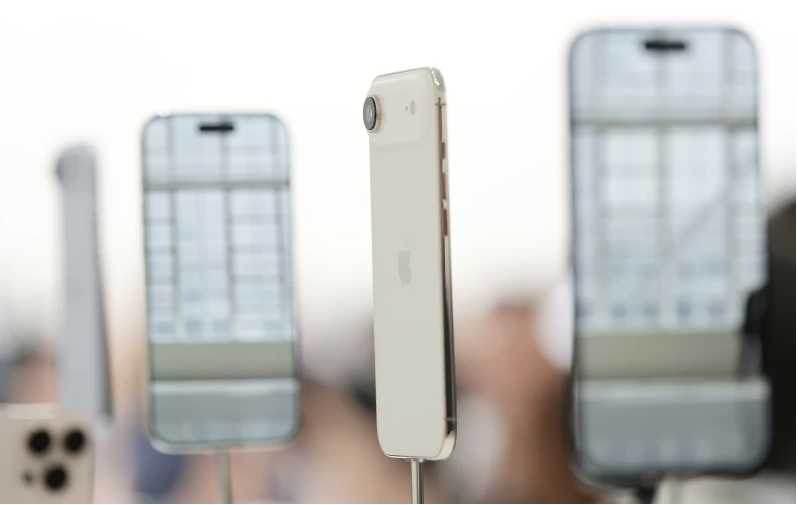
  • Apple has unveiled its iPhone 17 lineup, including the first iPhone Air. Here’s what’s new

    Apple has unveiled its iPhone 17 lineup, including the first iPhone Air. Here’s what’s new

    NEW YORK (AP) — Apple’s iPhone 17 lineup is here. The tech giant on Tuesday unveiled four new models that mark the latest editions to its marquee product.

    That includes the introduction of the iPhone Air, which Apple says is its thinnest smartphone yet. And, as seen in years past, its newest phones boast better cameras, longer lasting batteries and a handful of other upgrades across the board. The latest devices come with a new a A19 chip, which will particularly help power Apple’s artificial intelligence features.

    Tuesday’s lineup mark the first phones Apple has released since President Donald Trump returned to the White House and unleased a barrage of tariffs impacting goods that businesses sell and consumers buy every day. Some analysts speculated that California-based Apple may raise iPhone prices leading up to Tuesday’s announcement. But for the most part, Apple is sticking with the same price tags it’s slapped on its newest iPhones over recent years, just weeks after Google also held steady on prices for its new Pixel smartphones.

    Here’s what to know about the iPhone 17, which officially hits stores Sept. 19 — and other gadget updates.

    iPhone 17 prices

    Apple’s going price for the iPhone 17 begins at about $800 — compared to $1,100 and $1,200 for its iPhone 17 Pro and Pro Max models. The iPhone Air will start at $1,000.

    Most of that aligns with the pricing Apple has rolled out with its new iPhones over the last five years — with the exception of the Pro, which is $100 more expensive this year. But that still falls within the $800 to $1,200 range that the company has outlined between its most basic and top offerings since 2020.

    Apple’s latest iPhone lineup arrives as companies across industries face rising costs from Trump’s new punishing tariffs on imports from around the world. And the Trump administration has also repeatedly insisted that iPhones should be made in the U.S., rather than in the company’s current manufacturing hubs overseas. But analysts stress that this is an unrealistic demand that would take years to pull off — and could result in doubling, or event tripling, iPhone’s current average price of $1,000.

    A camera revamp and longer battery life

    In addition to better camera quality on its front and back facing lenses, iPhone 17’s front camera has been upgraded across its lineup to have a wider field of view and new sensor, allowing you to take landscape photos and other selfie orientations without having to rotate your phone.

    iPhone’s new Air offering also gives users the option to record videos using the front and back cameras simultaneously. Meanwhile, the iPhone 17 Pro and Pro Max added a more powerful telephoto lens, among other improvements.

    Apple also boasted longer battery life across its iPhone 17 lineup. It said that its new iPhone Air, in particular, would be the tech giant’s most power-efficient iPhone yet.

    What about AI?

    The iPhones Apple rolled out last year were the first the company designed with a wide range of new AI features. The iPhone 17 lineup announced Tuesday doesn’t make as many leaps as its predecessor — but each phone will come with Apple’s latest operating system, iOS 26, which will feature incremental AI advances.

    Previewed at its developers conference in June and set to also launch next week, iOS 26 will include capabilities like allowing you to take a screenshot and get a breakdown of what’s on your screen, as well as more live translation offerings. Apple on Tuesday also pointed to other features powered with AI that are specific to the iPhone 17 line, such as its new “Center Stage” feature for its front-facing camera.

    Still, Apple is playing a bit of catchup in the AI arena overall, and has run into some recent missteps. While the iPhone 16 has proven to be popular, the models didn’t sell quite as well as analysts had anticipated because Apple failed to deliver all the AI-fueled improvements it had promised, including a smarter and more versatile Siri assistant. The Siri improvements have been pushed back until next year.

    New AirPods and Apple Watches also unveiled

    In addition to the iPhone 17, Apple also unveiled other gadget updates on Tuesday — including AirPods Pro 3, Apple Watch Series 11 and Apple Watch Ultra 3.

    Among updates to Apple’s newest AirPods is live translation, which uses on-device AI to translate when other languages are spoken around the person using them. Similar live translation offerings have been previous rolled out by rival Google, for its Pixel products. Apple’s AirPods Pro 3 will be priced at $249.

    Apple’s boasted a new “sleep score” tracking feature and hypertension notifications for its Series 11 smart watch. The hypertension feature flags for potential high blood pressure — taking data from the heart rate sensor and analyzing it for patterns related to hypertension. Apple on Tuesday noted that this is still pending approval from the Food and Drug Administration.

    Meanwhile, Apple says its latest high-end sports watch — the Ultra 3 — now features the biggest display and longest battery life seen in any of the company’s watches, among other updates. Available starting Sept. 19, the Ultra 3 is priced at $799, while the Series 11 is $399. Apple’s latest update to the Apple Watch SE, its simplest watch offering, will be $249.

  • Six planets are hanging out in early morning skies this month. Here’s how to spot them

    NEW YORK (AP) — Six planets are hanging out in the sky this month in what’s known as a planetary parade. Catch the spectacle while you can because it’s the last one of the year.

    These linkups happen when several planets appear to line up in the night sky at once. Such parades are fairly common, happening around every year depending on the number of planets. At least one bright planet can be spotted on most nights, weather permitting, according to NASA.

    Six planets were visible in January skies and every planet of our solar system was visible in February, but not all could be spotted with the naked eye.

    Venus, Jupiter, Saturn and a faint Mercury are visible this month without any special equipment, and the best chances to spot them are over the next week. Uranus and Neptune can only be glimpsed through binoculars and telescopes.

    Jupiter and Venus made a close brush earlier this week and are still near each other in the eastern sky, “close together like cat’s eyes,” said Carolyn Sumners at the Houston Museum of Natural Science.

    Mercury will be at its farthest point from the sun on Tuesday morning, making it easier to spot before it disappears into the sun’s glare.

    To catch the planets, go out in the morning shortly before sunrise and look east. Try to find Jupiter and Venus clustered together first. Saturn is off to the side and Mercury will be close to the horizon, trying to rise before the sun.

    “You’re looking for little tiny pinpoints of light, but they are the brightest ones,” said Justin Bartel with the Science Museum of Virginia. “They don’t really twinkle like the stars do.”

    Before heading out, make sure it is a clear, cloudless morning and try to get away from tall buildings that could block the view.

    Mercury will hide behind the sun again toward the end of the month, but a crescent moon will then join the parade. The next big planetary hangout is in February.

    ___

    The Associated Press Health and Science Department receives support from the Howard Hughes Medical Institute’s Department of Science Education and the Robert Wood Johnson Foundation. The AP is solely responsible for all content.