Category: National News

  • East Texas Legionnaires’ Outbreak Linked To Hot Tub Display

    East Texas Legionnaires’ Outbreak Linked To Hot Tub Display

    TYLER, Texas (AP) — Authorities say a hot tub display at an East Texas state fair in September is the likely source of contamination which led to a Legionnaires’ disease outbreak that’s killed one person and sickened seven others.

    Officials in Tyler have closed the convention center where the state fair took place.

    The Tyler Morning Telegraph reports officials plan to remediate the convention center’s plumbing system.

    This is the second outbreak linked to a state fair in the U.S. this year. Officials in North Carolina say four people have died and nearly 100 were hospitalized after contamination also linked to a hot tub display at a September state fair.

    Legionnaire’s is a flu-like illness contracted when infected water vapor is inhaled. The elderly and people with weakened immune systems can be particularly susceptible.

    ___

    Information from: Tyler Morning Telegraph, http://www.tylerpaper.com

  • EPA Ends Safety Rules Put In Place After Deadly Texas Blast

    EPA Ends Safety Rules Put In Place After Deadly Texas Blast

    AUSTIN, Texas (AP) — The Trump administration is scaling back chemical plant safety measures that were put in place after a Texas fertilizer plant explosion in 2013 that killed 15 people.

    The changes announced Thursday by the Environmental Protection Agency include ending a requirement that plants provide members of the public information about chemical risks upon request.

    The Obama era rules followed a fire at the West Fertilizer Co. plant that caused ammonium nitrate to ignite, triggering a massive explosion that ripped open a large crater. Ten firefighters were among those killed.

    EPA administrator Andrew Wheeler says the changes do away with “unnecessary administrative burdens.” Chemical manufacturers had pushed for the changes.

    Environmental groups criticized the decision as one that would put people living near chemical plants at greater risk.

  • US Home Sales Rose 1.9% Last Month, Lifted By Lower Rates

    US Home Sales Rose 1.9% Last Month, Lifted By Lower Rates

    WASHINGTON (AP) — Americans took advantage of lower mortgage rates and purchased more homes in October, though sales were held back by a shortage of available properties.

    The National Association of Realtors said Thursday that sales of existing homes rose 1.9% last month to a seasonally adjusted annual rate of 5.46 million. That’s 4.6% higher than a year ago, suggesting that lower borrowing costs are bolstering the housing market.

    Still, the data shows a mixed picture. Housing, including home construction, has picked up this year and fueled economic growth in the July-September quarter for the first time in nearly two years. Economists expect it will boost growth in the current quarter as well.

    At the same time, sales have been constrained by a decline in the number of houses for sale.

    With the unemployment rate near a 50-year low and wages rising modestly, plenty of Americans are looking to buy. That is pushing up prices. Sales remain below the level reached in 2017 of 5.5 million.

    Homes are particularly scarce at lower price points, with sales in the past year falling 11% among houses priced below $100,000, which consists mostly of condos. Sales also slipped in the $100,000 to $250,000 price range. They rose in the $250,000 to $1 million range, and fell among homes priced above $1 million.

    Odeta Kushi, deputy chief economist at First American Financial, a title insurance company, said those figures indicate that most home sales are occurring among higher-income earners who already own homes and are trading up.

    “That leaves the first-time home buyers out of the mix,” she said. NAR’s data showed that in October, first-time buyers made up just 31% of sales, below longer-run averages.

    But increased home construction should boost overall inventory and provide more options for younger buyers, Kushi said. That should support sales in the coming months.

    Home construction jumped 3.8% in October and builders also secured more permits for single-family home and apartment construction, a positive sign for future building.

    The number of homes on the market fell 2.7% in October from the previous month, leaving just 1.77 million available houses. That’s the fewest since March and would last just 3.9 months at the current pace of sales. A healthy level of inventory is typically at about six months.

    For October, the level of homes for sale was the lowest on records dating back to 1999, the NAR said.

    Many buyers are unwilling to sell their homes for a variety of reasons. In some cases, they already have a low mortgage rate and don’t want to risk losing it by moving. Many older Americans are also staying in their homes longer than previous generations, rather than moving into facilities dedicated to older residents. And the NAR estimates that as many as 5 million to 7 million homes are owned by investors who rent them out, further limiting the number of available properties.

    The NAR’s measure of median home prices rose 6.2% in October from a year earlier, to $270,900. That’s nearly three times the overall rate of inflation and double the pace of wage gains.

    Some of those higher prices are offset by cheaper mortgages. The rate on a 30-year mortgage averaged 3.7% this week, down from 4.8% a year earlier.

    Sales rose in the Midwest and South, where prices are more affordable, while they fell in the more expensive Northeast and West.

  • North Pole’s ‘Christmas In Ice’ Canceled Amid Lack Of Ice

    North Pole’s ‘Christmas In Ice’ Canceled Amid Lack Of Ice

    FAIRBANKS, Alaska (AP) — Seasonal ice park officials in Alaska are missing a crucial ingredient announcing a Christmas-themed park has closed amid lack of ice in North Pole.

    The Fairbanks Daily News-Miner reported Wednesday that Executive Director Keith Fye says the annual ice park called Christmas in Ice was canceled for the first time in the city of North Pole in Alaska.

    Fye cited winter conditions including not having enough ice on ponds to harvest for ice carving this year.

    Officials say the winter ice park is located next to the Santa Claus House east of Fairbanks and normally runs for six weeks through December.

    Fye says this would have been the 14th year.

    Officials say the park features Christmas-themed ice sculptures, ice slides, hot cocoa and an annual visit from Santa Claus.

    ___

    Information from: Fairbanks (Alaska) Daily News-Miner, http://www.newsminer.com

  • The Search Is On For A Red Panda That Escaped A French Zoo

    The Search Is On For A Red Panda That Escaped A French Zoo

    PARIS (AP) — A search is on for a red panda that broke out of a zoo in the Rhone region of southeastern France.

    Officials at the Saint-Martin-la-Plaine Zoo said the endangered animal was last seen 5 kilometers (3 miles) from the park by a surprised motorist. The park said the panda escaped last Friday by climbing up branches broken by snowfall and swinging from tree to tree.

    The panda, a cat-sized nocturnal animal with reddish fur and a shaggy tail, would probably spend “a good part of the day sleeping in a tree.” The zoo advised residents to keep a look out “at the top of the trees.”

    Zoo veterinarian Jean-Christophe Gerard said the animal “has good claws and good teeth” and shouldn’t be hugged, although it isn’t considered dangerous.

  • Divided US House committee backs pot decriminalization

    Divided US House committee backs pot decriminalization

    LOS ANGELES (AP) — A divided U.S. House committee approved a proposal Wednesday to decriminalize and tax marijuana at the federal level, a vote that was alternately described as a momentous turning point in national cannabis policy or a hollow political gesture.

    The House Judiciary Committee approved the proposal 24-10 after more than two hours of debate. It would reverse a longstanding federal prohibition by removing marijuana from the Controlled Substances Act, while allowing states to set their own rules on pot.

    The vote “marks a turning point for federal cannabis policy and is truly a sign that prohibition’s days are numbered,” Aaron Smith, executive director of the National Cannabis Industry Association, said in a statement.

    Cannabis Trade Federation CEO Neal Levine called the vote “a historic step forward for cannabis policy reform.”

    The vote comes at a time when most Americans live in states where marijuana is legal in some form, and committee members from both parties agreed that national cannabis policy lagged woefully behind changes at the state level. That divide has created a host of problems — loans and other banking services, for example, are hard to get for many marijuana companies because pot remains illegal at the federal level.

    However, the bill’s future is uncertain. It wasn’t immediately clear if the proposal would be reviewed by other committees and when, or if, a vote would take place in the full House. The proposal has better chances of passing in the Democratic-controlled chamber than in the Republican-held Senate.

    The House passed a bill earlier this year to grant legal marijuana businesses access to banking, but it hasn’t advanced in the Senate.

    Republicans on the House Judiciary Committee complained that the proposal to decriminalize cannabis had never had a hearing and lacked the bipartisan support needed to become law.

    “It’s going nowhere,” said Rep. Doug Collins, a Georgia Republican.

    Among its provisions, the legislation would authorize a 5% sales tax on marijuana products to fund programs aimed at assisting people and communities harmed in the so-called war on drugs, such as job training and legal aid. It also would require federal courts to expunge prior marijuana convictions.

    Committee Chairman Jerrold Nadler said the nation has for too long “treated marijuana as a criminal justice problem, instead of a matter of personal choice and public health.”

    “Arresting, prosecuting and incarcerating users at the federal level is unwise and unjust,” the New York Democrat said. “The racial disparity in enforcement of marijuana laws has only compounded this mistake with serious consequences, particularly for minority communities.”

  • Trump to meet on teen vaping as plans for flavor ban fade

    Trump to meet on teen vaping as plans for flavor ban fade

    WASHINGTON (AP) — President Donald Trump will meet with medical experts, health advocates and industry representatives on the problem of underage vaping later this week, White House officials said Wednesday.

    Electronic cigarette use by teenagers has surged, but federal authorities have not yet finalized a plan for regulating e-cigarettes.

    At the White House meeting set for Friday, administration officials said Trump will hear from representatives from “all sides” of the vaping issue as he weighs “responsible guidelines.”

    The announcement comes days after reports that the president is backing away from a sweeping ban on virtually all e-cigarette flavors proposed in September.

    But White House spokesman Judd Deere said in a statement announcing the meeting: “The policy making process is not stalled — it continues to move forward.”

    Under the plan announced two months ago, the Food and Drug Administration would remove fruit, dessert, candy other sweet flavors because of their appeal to teens.

    But the ban has faced aggressive pushback from vaping lobbyists and conservative groups who warn it could cost Trump votes in key states.

    At a Capitol Hill hearing Wednesday, Senators prodded Trump’s nominee to head the FDA on the fate of the flavor ban. Dr. Stephen Hahn said he supports “aggressive action” on underage vaping, but had not discussed specific plans with the president.

    E-cigarettes first appeared in the U.S. more than a decade ago and have grown into a multibillion-dollar industry despite little research on their long-term effects, including whether they can help smokers quit cigarettes.

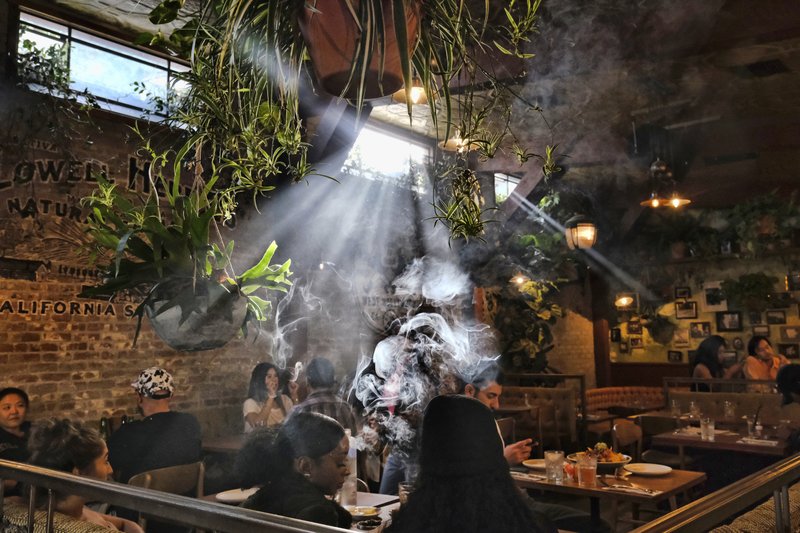
    Still, some health experts say vaping could ultimately benefit public health by steering millions of adult smokers away from traditional smoking, the leading cause of preventable death in the U.S.

    Vaping opponents argue that those benefits are unproven and that the lack of government regulation has triggered a vaping surge among U.S. teens and children. More than 1 in 4 high school students reported vaping in the past month, according to the latest government survey.

    On Tuesday, the American Medical Association called for a total ban on all e-cigarettes and vaping products until they can be reviewed by the FDA.

    The FDA has repeatedly pushed back its deadline to begin reviewing thousands of vaping products on the market. The deadline is now next May.

    ___

    Associated Press writer Kevin Freking contributed to this story.

    ___

    Follow Matthew Perrone on Twitter: @AP_FDAwriter

  • Police: White Teen Girl Aimed To Attack Black Georgia Church

    Police: White Teen Girl Aimed To Attack Black Georgia Church

    ATLANTA (AP) — A white 16-year-old girl is accused of plotting to attack a mostly black church in a north Georgia city, where police say she planned to kill worshippers because of their race.

    Bethel African Methodist Episcopal Church has a predominantly black congregation, Gainesville Police Chief Jay Parrish said in a statement Tuesday.

    “Our investigation indicated the church was targeted by the juvenile based on the racial demographic of the church members,” he said.

    Students, school administrators and law officers worked together to thwart a “potentially horrific incident,” he added.

    Police did not release her name.

    The plot came to light when Gainesville High School students told administrators the 16-year-old had a notebook with detailed plans to kill worshippers at the church, Parrish said.

    “It just grieves my spirit on a number of different levels, one that the intentions of this young person were so calculated to do great harm against people who just simply had no knowledge of such a plot,” said the Rev. Rose Johnson Mackey, director of the Newtown Florist Club, a civil rights organization founded in Gainesville 70 years ago.

    The girl is charged with criminal attempt to commit murder, the police chief said. She’s being held in a youth detention center in Gainesville.

    Details of the alleged plot haven’t been released, but Parrish said it came to light Friday when school administrators contacted police.

    “We’re just very pleased that our police department acted so swiftly, and the police department in conjunction with our school administrators were just on top of the situation,” Mackey said.

    Gainesville is about 50 miles (80 kilometers) northeast of Atlanta. It’s a city of just over 40,000 people, about 17% of whom are African-American.

    Rev. Dr. Michelle Rizer-Pool, who leads the congregation at Bethel AME, said she was shocked when notified by police about the alleged attempt.

    “When I found out I drove to the church, went inside it and prayed and anointed my church and asked God to put a hedge of protection around us,” she said in a telephone interview. “That was on Friday. On Sunday, I tried to relay what was going on without a lot of emotion so that the congregants would remain calm …

    “You know, I’ve been preaching for a while now about being on the battlefield, being a soldier in God’s army and that if you believe that God is in charge, he won’t allow hurt or harm to come your way. One of my members told me, ‘You’ve been getting us ready.’ I guess I have.”

    Rizer-Pool has pastored the church and its approximately 40 members since June 2018. She said the congregation recently celebrated 118 years of service in the community.

    “I had asked for active shooting training for the church prior to this but it never happened. Still, I had done a few things to keep us as safe as possible like upgrading the security system, locking the back door and reminding our ushers, our first line of defense, just to be aware of people we don’t know,” she said.

    The South has a long history of black churches being bombed, burned and shot up.

    White supremacist Dylann Roof fatally shot nine black church members during their Bible study lesson at Emanuel AME Church in Charleston, South Carolina, in June 2015. Roof later told FBI agents he had hoped the killings would start a race war.

    More recently, the white son of a sheriff’s deputy was arrested in April and accused of a setting fires that destroyed three black churches in rural Louisiana. Holden Matthews is awaiting trial on arson and hate crimes charges in the Louisiana church burnings.

    ___

    Associated Press writer Chevel Johnson contributed to the report from New Orleans.

  • US Prison System Long Plagued By Staffing Crisis, Violence

    US Prison System Long Plagued By Staffing Crisis, Violence

    WASHINGTON (AP) — For years, the federal Bureau of Prisons has been plagued by systematic failures, from massive staffing shortages to chronic violence. But the largest agency in the Justice Department has largely stayed out of the public view.

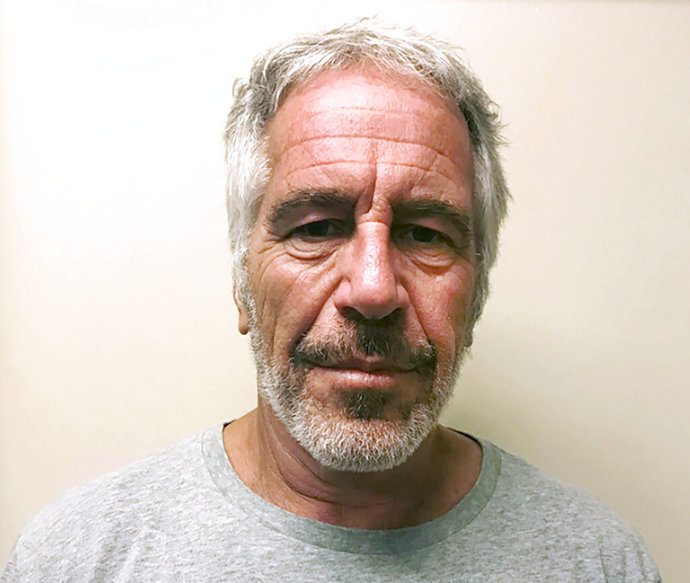
    The death of wealthy financier Jeffrey Epstein and the revelation that he was able to kill himself while behind bars at one of the most secure jails in America has cast a spotlight on the agency, which has also been besieged by serious misconduct in recent years.

    The issues at the Bureau of Prisons took center stage Tuesday as the agency’s new director appeared before the Senate Judiciary Committee.

    Staffing shortages at the agency — it employs more than 35,000 people and has an annual budget that exceeds $7 billion — are so severe that guards often work overtime day after day or are forced to work mandatory double shifts. Violence leads to regular lockdowns at federal prison compounds across the U.S. And a congressional report released earlier this year found “bad behavior is ignored or covered up on a regular basis.”

    At the same time, the Bureau of Prisons will be responsible for carrying out the first federal executions in more than 15 years, the first of which is scheduled for Dec. 9.

    Dr. Kathleen Hawk Sawyer’s appearance before Congress came at the same time federal prosecutors in New York announced charges against two correctional officers who were responsible for guarding Epstein when he took his own life in August at the Metropolitan Correctional Center in Manhattan. The city’s medical examiner ruled Epstein’s death a suicide.

    The officers were charged with falsifying prison records to conceal they were sleeping and browsing the internet during the hours they were supposed to be keeping a close watch on prisoners.

    Hawk Sawyer, who was also director from 1992 until 2003, said the agency has been “challenged significantly” because of budget reductions. But since being named director in late August, she’s put a “great emphasis on filling vacancies,” along with training employees and ensuring there’s a “re-commitment to sound correctional practice,” she said.

    The falsification of records has been a problem throughout the federal prison system. Union officials have long argued that the reduction of staff is putting both guards and inmates in danger, but they’ve faced an uphill battle as society seems to turn a blind eye.

    Hawk Sawyer sent a memo to senior prison system officials that detailed how a review at facilities across the U.S. had found some staff members failed to perform required rounds and inmate counts but logged that they had done so anyway. Officials have identified “a few” instances of guards who may have been sleeping and failed to conduct the required checks on inmates, she said, vowing to refer those cases to prosecutors for criminal punishment.

    “We have found a couple of other instances,” she said. “We don’t want those people in the Bureau of Prisons. We do have some, I know, out there who chose not to follow policy and we want them gone.”

    Across the board, the Bureau of Prisons has been down 4,000 jobs since 2017. Some officers are forced to work so much overtime that they skip going home between shift and sleep in their cars instead.

    An Associated Press analysis of federal staffing found a sharp decline in correctional officers across the U.S. in the first two years of the Trump administration.

    Between December 2016 and September 2018 – the date of the most recent data available from the federal Office of Personnel Management – the number of correctional officers fell more than 11%, from 19,082 to 16,898. That decline reversed a longtime trend. Before President Donald Trump took office, the number of federal correctional officers had continuously increased: there were 12.5% more officers at the end of 2016 compared to the beginning of 2012.

    And while union officials have been sounding the alarm about the chronic understaffing, the system allows for the use of excessive overtime. There’s nothing stopping guards who work multiple shifts per day and the staffing levels have reached a point where officers at some facilities, like the jail where Epstein took his own life, work mandatory overtime nearly every week.

    “Some people just call in sick because they’re afraid to get mandated. Because they’re tired. They’re exhausted. When you work so many hours you’re not going to be alert,” said Jose Rojas, a leader in the correctional officers’ union.

    Both officers who were guarding Epstein were working overtime because of staffing shortages. One of the guards, who did not primarily work as a correctional officer, was working a fifth straight day of overtime. The other guard was working mandatory overtime, meaning a second eight-hour shift of the day.

    The decline in officer numbers reflects a larger personnel loss in the Bureau of Prisons, which saw its overall workforce decline roughly 10 percent from the start of 2017 to late 2018, to 35,000 employees.

    The AP analysis found that the Bureau of Prisons in 2017 and 2018 simply hadn’t hired enough new correctional officers to replace departing or retiring employees. Staffing numbers fell the most among people with less than two years’ experience, indicating few new employees were brought on after Trump took office.

    By early 2018, there were only about 300 Bureau of Prisons correctional officers with less than a year of experience – compared with more than 2,200 employees with a year or less of experience in early 2017. In the three years’ preceding Trump’s presidency, the agency had an average of more than 2,000 of these rookie employees at any given time.

    Figures from September 2018 showed the bureau had slightly ramped up some hiring and had 500 employees with less than a year of experience, but still had a long way to go to meet pre-Trump numbers.

    Union officials have tried repeatedly to sound the alarm about the staffing crisis, meeting with lawmakers and even putting up billboards near a federal prison complex in Florida last year with a picture of a coffin and the message: “Budget cuts lead to deaths in federal prisons.”

    Aside from the chronic staffing issues, the agency has been plagued by violence for years.

    In one of the most public cases, Boston mobster James “Whitey” Bulger was killed at a federal prison in West Virginia in October 2018, despite warnings from advocates, lawmakers and prison guards about dangerous conditions there. But even after the death of Bulger, one of the most notorious crime figures in American history, the public and lawmakers seemed uninterested.

    In March, Hugh Hurwitz, then the director of the Bureau of Prisons, was summoned to Capitol Hill to testify about the management of the federal prison system. The hearing was sparsely attended and just one Democrat showed up.

    In late August, Attorney General William Barr removed Hurwitz as the agency’s acting director and appointed Hawk Sawyer in his place.

    Hurwitz had led the agency for about 15 months and was appointed as the acting director after Mark Inch, a former major general who oversaw the Army’s correctional system, abruptly resigned in May 2018.

    __

    Sisak reported from New York. Associated Press data journalist Riin Aljas contributed to this report.

    ___

    Follow Balsamo on Twitter at www.twitter.com/MikeBalsamo1 and Sisak at www.twitter.com/mikesisak.

  • Police Surround Last Holdouts At Hong Kong Campus Protest

    Police Surround Last Holdouts At Hong Kong Campus Protest

    HONG KONG (AP) — A small band of anti-government protesters, their numbers diminished by surrenders and failed escape attempts, remained holed up at a Hong Kong university early Wednesday as they braced for the endgame in a police siege of the campus.

    View all (20)

    Police were waiting them out after 10 days of some of the most intense protests the city has seen in more than five months of often-violent unrest gripping the semi-autonomous Chinese city. Since the siege began Sunday, more than 1,000 people were arrested and hundreds of injured treated at hospitals, authorities said.

    The government has stood firm, rejecting most of the protesters’ demands. The demonstrators shut down major roads and trains during rush hour every day last week as they turned several university campuses into fortresses and blocked a major road tunnel, which remained closed Tuesday.

    Even as the latest violence wound down, a fundamental divide suggests the protests in the former British colony are far from over.

    In Beijing, the National People’s Congress criticized Hong Kong’s high court for striking down a ban on wearing face masks at the protests, in a decree that has potentially ominous implications for the city’s vaunted rule of law and independent judiciary. China’s Communist leaders have taken a tough line on the protests and said that restoring order is the highest priority.

    Meanwhile, pro-democracy activist Joshua Wong was barred from going on a European speaking tour, after a court refused to change his bail conditions to let him travel outside Hong Kong.

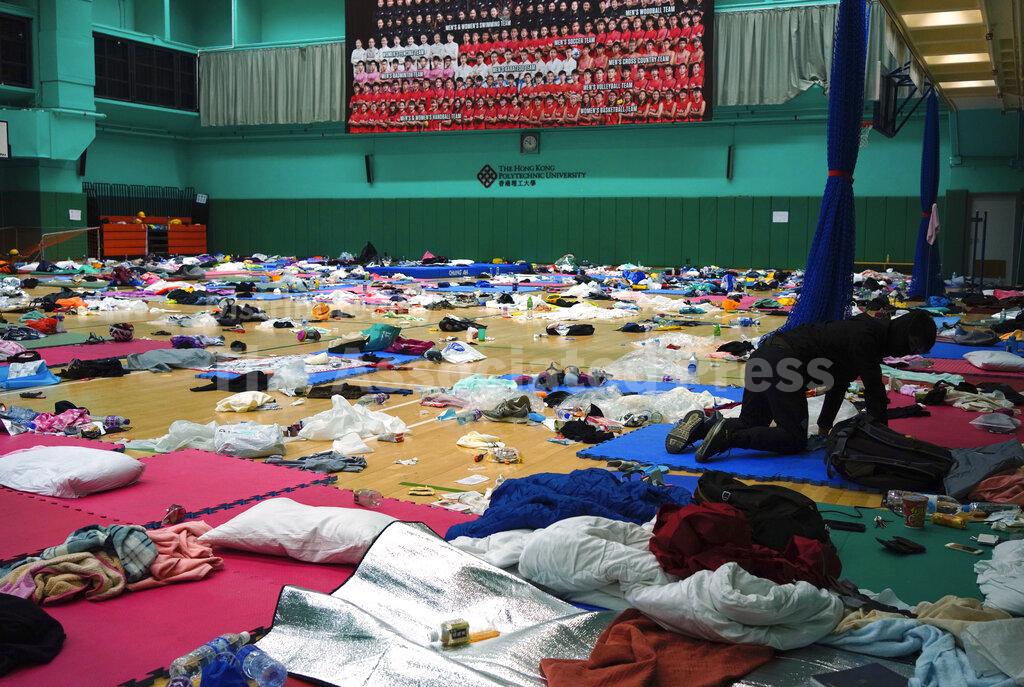
    Protesters have left all the universities except Hong Kong Polytechnic, where hundreds had barricaded themselves and fought back police barrages of tear gas and water cannons with gasoline bombs, some launched from rooftops by catapult, and bows and arrows.

    Those who remained at Polytechnic were the last holdouts. Surrounded by police, they faced arrest. Several groups have tried to escape, including one that slid down hoses from a footbridge to waiting motorcycles, but police said they intercepted 37, including the drivers, who were arrested for “assisting offenders.”

    They milled about in small groups and had boxes of homemade gasoline bombs, but the mood was grim in the trash-strewn plazas, in contrast to the excitement as they prepared to take on police just a few days earlier.

    One protester said he had no plan and was waiting for help. Another said he wanted to leave safely but without being charged. They would not give their full names, saying they feared arrest.

    “We will use whatever means to continue to persuade and arrange for these remaining protesters to leave the campus as soon as possible so that this whole operation could end in a peaceful manner,” Lam said after a weekly meeting with advisers.

    By late Tuesday night, about 800 people had left the campus to surrender, including 300 minors, according to a government tally. Authorities had agreed not to immediately arrest anyone under 18 but warned they could face charges later. City leader Carrie Lam had said Tuesday morning that 100 people were left but it was wasn’t clear how many now remained.

    Hong Kong’s Catholic Auxiliary Bishop Joseph Ha entered the campus to try to dial back tensions after hearing that some protesters were ready to die.

    At the same time, at least a dozen protesters walked out of the campus escorted by volunteers to an ambulance station to surrender. But it appeared to be a ruse, with many of them making a run for it in a last-ditch escape attempt. They were swiftly tackled by police.

    The U.N. High Commissioner for Human Rights urged authorities to de-escalate the standoff. Spokesman Rupert Colville expressed concern about increasing violence by young people “who are clearly very angry, with deep-seated grievances.”

    City leaders say the violence must stop before meaningful dialogue can begin. The protesters say they need to keep escalating the violence to get the government to accept their demands.

    The protests started in June over a proposed extradition bill that would have allowed suspects to be sent to mainland China for trial. Activists saw the legislation as part of a continuing erosion of rights and freedoms that Hong Kong was promised it could keep when Britain returned its former colony to China in 1997.

    Lam withdrew the bill months later, but protesters now want an independent investigation into police suppression of the demonstrations and fully democratic elections, among other demands.

    Throughout the day, relatives and teachers arrived sporadically to pick up the remaining protesters under 18, hugging them before walking back to a police checkpoint where officers recorded names and other information before letting them go.

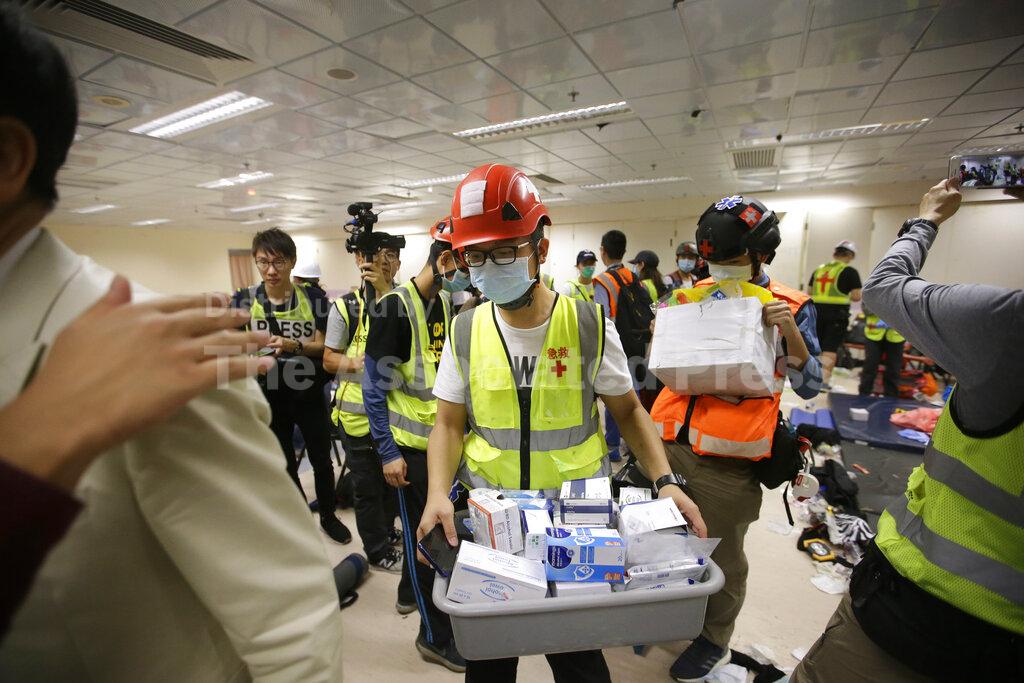
    An ambulance team was allowed in to treat the injured, wrapping them in emergency blankets. Some left with the team, but others stayed, saying they didn’t want to be arrested.

    Other parents held a news conference and said their children dared not surrender because the government has labeled them as rioters even though some had just gotten trapped by the police siege. They wore masks and refused to give their names, a sign of the fear that has developed in what has become a highly polarized city.

    China hinted it might overrule the Hong Kong high court ruling that struck down the face mask ban that was aimed at preventing protesters from hiding their identities and evading arrest.

    A statement from the National People’s Congress’ Legislative Affairs Commission said the decision doesn’t conform with Hong Kong’s constitution, known as the Basic Law, or decisions by the Congress.

    “We are currently studying opinions and suggestions raised by some NPC deputies,” the statement said. The announcement threatens to undercut Hong Kong’s rule of law and independent courts — major selling points for its role as an Asian financial center.

    Monday’s ruling said the ban infringed on fundamental rights more than is reasonably necessary. The ban has been widely disregarded.

    The Japanese government said one of its citizens was arrested near the Polytechnic campus. Japanese media identified him as Hikaru Ida, a student at Tokyo University of Agriculture. Officials did not say why he was arrested.

    About 1,100 people were arrested in the past day for offenses including rioting and possession of offensive weapons, police said at a briefing. They found more than 3,900 gasoline bombs at another university campus that was the site of a violent standoff last week. At least 354 people were treated Tuesday for protest-related injuries, according to hospital authority figures.

    Hong Kong also got a new police chief, Chris Tang, who said his priorities would include rebutting accusations against police that he called “fake news” and reassuring the public about the force’s mission.

    “We have to maintain the law and order in Hong Kong and there is a massive scale of breaking of law in Hong Kong and there is a certain sector of the community that also condones those illegal activities,” he told journalists.

    Tang, who visited officers at the Polytechnic siege after dark, replaces a retiring chief and was approved by Beijing after being nominated by Lam’s government.

    Lam, asked whether she would seek help from Chinese troops based in Hong Kong, said her government was confident it can cope with the situation.

    ___

    Associated Press journalists Alice Fung and Dake Kang contributed.