Category: National News

  • Thousands Face Life-Threatening Floods From Aging Dams

    Thousands Face Life-Threatening Floods From Aging Dams

    On a cold morning last March, Kenny Angel got a frantic knock on his door. Two workers from a utility company in northern Nebraska had come with a stark warning: Get out of your house.

    Just a little over a quarter-mile upstream, the 92-year-old Spencer Dam was straining to contain the swollen, ice-covered Niobrara River after an unusually intense snow and rainstorm. The workers had tried but failed to force open the dam’s frozen wooden spillway gates. So, fearing the worst, they fled in their truck, stopping to warn Angel before driving away without him.

    Minutes later, the dam came crashing down, unleashing a wave of water carrying ice chunks the size of cars. Angel’s home was wiped away; his body was never found.

    “He had about a 5-minute notice, with no prior warning the day before,” Scott Angel, one of Kenny’s brothers, said.

    State inspectors had given the dam a “fair” rating less than a year earlier. Until it failed, it looked little different from thousands of others across the U.S. — and that could portend a problem.

    A more than two-year investigation by The Associated Press has found scores of dams nationwide in even worse condition, and in equally dangerous locations. They loom over homes, businesses, highways or entire communities that could face life-threatening floods if the dams don’t hold.

    A review of federal data and reports obtained under state open records laws identified 1,688 high-hazard dams rated in poor or unsatisfactory condition as of last year in 44 states and Puerto Rico. The actual number is almost certainly higher: Some states declined to provide condition ratings for their dams, claiming exemptions to public record requests. Others simply haven’t rated all their dams due to lack of funding, staffing or authority to do so.

    Deaths from dam failures have declined since a series of catastrophic collapses in the 1970s prompted the federal and state governments to step up their safety efforts. Yet about 1,000 dams have failed over the past four decades, killing 34 people, according to Stanford University’s National Performance of Dams Program.

    Built for flood control, irrigation, water supply, hydropower, recreation or industrial waste storage, the nation’s dams are over a half-century old on average. Some are no longer adequate to handle the intense rainfall and floods of a changing climate. Yet they are being relied upon to protect more and more people as housing developments spring up nearby.

    “There are thousands of people in this country that are living downstream from dams that are probably considered deficient given current safety standards,” said Mark Ogden, a former Ohio dam safety official who is now a technical specialist with the Association of State Dam Safety Officials.

    The association estimates it would take more than $70 billion to repair and modernize the nation’s more than 90,000 dams. But unlike much other infrastructure, most U.S. dams are privately owned. That makes it difficult for regulators to require improvements from operators who are unable or unwilling to pay the steep costs.

    “Most people have no clue about the vulnerabilities when they live downstream from these private dams,” said Craig Fugate, a former administrator at the Federal Emergency Management Agency. “When they fail, they don’t fail with warning. They just fail, and suddenly you can find yourself in a situation where you have a wall of water and debris racing toward your house with very little time, if any, to get out.”

    ___

    It’s unclear whether Angel, a 71-year-old Vietnam War veteran, declined to flee or simply ran out of time after workers with the Nebraska Public Power District warned him that water was overtopping the dam near Spencer, a town of fewer than 500 residents.

    An attorney for Angel’s wife, who wasn’t home when the dam broke, has filed a $5 million lawsuit alleging negligence. It claims the power utility failed to properly maintain the dam, train its employees or inform the Angels of dangerous conditions.

    Even though the Angels’ home was squarely in its path, the dam was rated as a “significant” rather than “high” hazard, meaning it wasn’t required under Nebraska law to have a formal emergency action plan. About 20% of state-regulated high-hazard dams nationwide still lack emergency plans, according to the U.S. Army Corps of Engineers, which maintains the national dam inventory.

    When last inspected in April 2018 , Spencer Dam’s “fair” rating was accompanied by an ominous notation: “Deficiencies exist which could lead to dam failure during rare, extreme storm events.”

    Tim Gokie, chief engineer of Nebraska’s dam safety program, said the warning was due to past water seepage the power utility addressed by installing a drain system. Ultimately, Gokie said, the rising Niobrara River simply overwhelmed the concrete and earthen dam, which was built in 1927 to generate hydroelectricity, not for flood control.

    “The fact was that it was just an unprecedented situation,” Nebraska Public Power District spokesman Mark Becker said. “It was beyond what everybody anticipated.”

    Nebraska was among the states hardest hit by storms and floods this year that have caused an estimated $1.5 billion in damage to roads, dams, utilities and other infrastructure in 28 states, according to an AP analysis.

    A National Climate Assessment released by the White House last year noted growing frequency and intensity of storms as the climate changes. That can push some dams beyond what they were designed to handle.

    Even if kept in good condition, thousands of dams could be at risk because of extreme rainstorms, said Fugate, the former FEMA official.

    “These are like ticking bombs just sitting there, waiting for the wrong conditions to occur to cause catastrophic failure,” he said.

    ___

    The nation’s dams are categorized as high, significant or low hazard in the National Inventory of Dams database. High hazard means loss of human life is likely if a dam were to fail. A significant rating means no deaths are likely, although economic and environmental damage are possible.

    There is no national standard for inspecting dams, leading to a patchwork of state regulations. Some states inspect high-hazard dams every year while others wait up to five years. Some states never inspect low-hazard dams — though even farm ponds can eventually pose a high hazard as housing developments encroach.

    Dam conditions are supposed to be rated as unsatisfactory, poor, fair or satisfactory. But the ratings are subjective — varying by state and the interpretations of individual inspectors — and are not always publicly disclosed.

    Since the Sept. 11, 2001, terror attacks, the U.S. government has cited national security grounds in refusing to include dams’ conditions in its inventory, which was updated most recently in 2018. But the AP was able to determine both condition and hazard ratings for more than 25,000 dams across the country through public records requests.

    The tally includes some of the nation’s most well-known dams, such as Hoover Dam along the Colorado River, but mostly involves privately owned dams. Many are used for recreation.

    The AP then examined inspection reports for hundreds of high-hazard dams in poor or unsatisfactory condition. Those reports cited a variety of problems: leaks that can indicate a dam is failing internally; unrepaired erosion from past instances of overtopping; holes from burrowing animals; tree growth that can destabilize earthen dams; and spillways too small to handle a large flood. Some dams were so overgrown with vegetation that they couldn’t be fully inspected.

    Georgia led the nation with nearly 200 high-hazard dams in unsatisfactory or poor condition, according to the AP’s analysis.

    Among them is Reservoir No. 1 in Atlanta, a 180 million-gallon water supply dating to the late 1800s that has been out of service much of the past few decades. The city made repairs and brought it back online in 2017, only to shut it down again after leaks were noticed.

    If the dam were to catastrophically fail, the water could inundate more than 1,000 homes, dozens of businesses, a railroad and a portion of Interstate 75, according to an emergency action plan .

    Joel Iverson has previously noticed water trickling out of the dam near the brewery he co-founded, Monday Night Brewing.

    “If that one goes, it’s going to wash away us and a lot of beer,” Iverson said.

    The Atlanta Watershed Management Department declined the AP’s request for an interview about the reservoir and instead asked for questions in writing. When those were submitted, it declined to answer them.

    ___

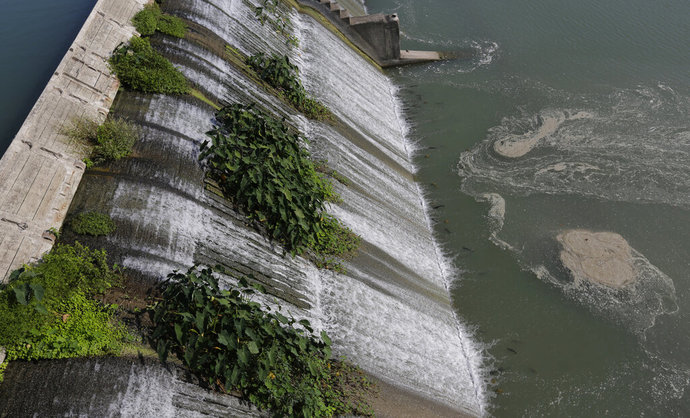
    One of the most common problems for aging dams are spillways incapable of handling an extreme rainfall event.

    If water can’t escape quickly enough through spillways, it could flow over the top of a dam, which increases the probability of rapid erosion that can cause it to collapse.

    The spillway at the 107-year-old Willett Pond Dam near the Boston suburb of Norwood is capable of handling just 13% of the water flow from a serious flood before the dam is overtopped, according to a recent state inspection report. If the dam were to give way, it could send hundreds of millions of gallons of water into the heart of the city of nearly 30,000 people.

    “We are not talking of just flooding someone’s house. We are talking about covering their house,” said Murray Beach, who lives on the shore of the 220-acre privately owned lake and belongs to a citizens group that has lobbied for years for the spillway to be repaired.

    A 2017 inspection report said improvements to the spillway could cost between $1 million and $5 million. A nonprofit that owns the lake received a $215,000 state grant last year to design spillway improvements. But there is no timeline to fix it.

    More than 1,300 properties lie within the dam’s inundation zone, including several shopping centers and at least two elementary schools, as well as more than 70 roads and two railroads.

    Tamiko Porter, who operates a Montessori school serving some 75 students, said she was surprised to learn there was a dam upstream that could flood her school if it failed.

    “Oh God, please let it happen when my kids aren’t here,” Porter said.

    Norwood emergency management director Bernard Cooper said there is no imminent risk of dam failure.

    “Yes, it needs work. The spillway should be rebuilt. Absolutely, no question,” Cooper acknowledged. But “there is no money in the system for that.”

    Concerns about inadequate dam spillways date back decades to when the Corps of Engineers undertook its first nationwide assessment of dams posing a high risk to life and property. From 1978 to 1981, the Corps inspected 8,818 dams. About one-third were deemed unsafe due to deficiencies, and about 80% of those cited inadequate spillway capacities.

    One of the dams cited for a “seriously inadequate” spillway in 1978 was Lake Sebago, located in a New York state park near the village of Sloatsburg. Forty years later, nothing has changed.

    A 2018 state inspection letter warned of “inadequate spillway capacity and dam stability” and asked for an improvement plan within 30 days. None was provided.

    The state dam safety office has no authority to force the state parks department to make repairs.

    To modify the Lake Sebago spillway, workers would have to rebuild a road and bridge that pass over the dam. The project could cost over $15 million, said Jim Hall, the recently retired executive director of the Palisades Interstate Park Commission, which manages multiple dams.

    “That structure has been in place with the same spillway capacity for over probably 60 to 70 years and it hasn’t been overtopped,” Hall said. “Should it be improved to meet all codes? Yeah, that would be nice. Does it make it the highest priority for us to do in relation to other dam structures we have? Probably not.”

    ___

    In a 1982 report summarizing its nationwide dam assessment, the Corps of Engineers said most dam owners were unwilling to modify, repair or maintain the structures, and most states were unwilling to spend enough money for an effective dam safety program.

    Since then, every state but Alabama has created a dam safety program.

    But the Great Recession a decade ago forced many states to make widespread budget and personnel cuts. Since a low point in 2011, states’ total spending on dam safety has grown by about one-third to nearly $59 million in the 2019 fiscal year while staffing levels have risen by about one-fifth, according to data collected by the Corps of Engineers.

    California, which runs the nation’s largest dam safety program, accounts for much of that gain. It boosted its budget from $13 million to $20 million and the number of full-time staff from 63 to 77 following the failure of the Oroville dam spillway in 2017.

    The scare at Oroville, the nation’s tallest dam, led to evacuation orders for nearly 200,000 people, although no one was injured and the dam ultimately held. An independent investigation cited “a long-term systemic failure ” by regulators and the dam industry to recognize and address warning signs.

    California spent $1.1 billion repairing the Lake Oroville spillway, enacted new emergency plan requirements and launched a review of 93 other dams with similar spillways.

    In South Carolina, after more than 70 dams failed following heavy rains in 2015 and 2016, the state tripled the personnel in its dam safety program and ratcheted up spending from about $260,000 annually to more than $1 million.

    But some states have continued to pare back their dam safety programs. Thirteen states and Puerto Rico were spending less in 2019 than they did in 2011, and 11 states had fewer full-time positions in their programs.

    The Association of State Dam Safety Officials says almost every state faces a serious need to pump additional money and manpower into dam safety programs.

    “If you don’t have the staff to inspect a dam, or don’t have the authority to do that, you don’t know what the problems are,” said the association’s Ogden.

    “If you are able to do the inspection but you can’t follow up, and you have dam owners who don’t have the resources to fix their dam, then ultimately you know what the problem is but you can’t get it addressed,” he added.

    Many states face a quandary when it comes to problematic private dams when they can’t identify the owners. Rhode Island’s two-person dam safety office last year listed 32 high- or significant-hazard dams with safety concerns whose owners were unknown.

    “If we don’t know the owner, then we can’t take any action to order anybody to fix it,” said David Chopy, chief of compliance and inspection for the Rhode Island Department of Environmental Management.

    In some states, dams go uninspected because of exemptions in state law.

    A 2013 Texas law exempts all dams on private property with a capacity of less than 163 million gallons that are rated significant or low hazard and are located outside of city limits in any county with fewer than 350,000 people. As a result, about 45% of its roughly 7,200 dams are exempt from regulation.

    Missouri performs safety inspections on only about 650 of its more than 5,000 dams. That’s because state law exempts all dams that are under 35 feet, used for agricultural purposes or subject to federal regulation.

    Former Missouri Gov. Matt Blunt attempted to significantly expand the number of dams under state supervision after the mountaintop Taum Sauk Reservoir collapsed in December 2005, injuring a state park superintendent’s family. But the legislation failed after some rural landowners expressed concerns. Then the proposal quietly faded away as new officials took over.

    “Maybe it’s time to take a look at that again and make sure that our dams are safe,” said Missouri state Rep. Tim Remole, who now leads the House committee overseeing dam safety.

    ___

    Until Angel’s death in Nebraska this year, the last fatal dam failure in the U.S. occurred on the Hawaiian island of Kauai in 2006.

    An earthen wall of the Kaloko Reservoir collapsed during heavy rains and sent a wave of water rushing down a hillside. Seven people — including a pregnant woman — were killed on Bruce Fehring’s property, including his daughter, son-in-law and grandson.

    Fehring, who wasn’t there at the time, got a phone call from a neighbor saying something terrible had happened. He was shocked by the scene.

    “It took a while to register, and I went, ‘Oh my God, everything’s been washed away,’” Fehring recalled. “I mean, you have no idea the power of water (until) you see what it can do in a very short amount of time.”

    Dam owner James Pflueger pleaded no contest to felony reckless endangerment and was sentenced to seven months of confinement and five years of probation. His property company pleaded no contest to seven counts of manslaughter. Prosecutors said Pflueger had filled in the dam’s spillway while attempting to make space for a waterfront development.

    The victims’ families and those whose property was damaged, including actress Bette Midler, agreed to a $25 million civil settlement. Though categorized by the state as low hazard at the time it failed, Kaloko Reservoir is now listed as a high-hazard facility in poor condition . It remains largely unrepaired.

    That’s also the case with Lake Dunlap Dam, northeast of San Antonio. On a sunny morning in May, one of the 91-year-old dam’s corroded spillway gates suddenly gave way. No one was hurt in the rush of water, but scores of homeowners’ lakeside docks were left high and dry, facing barren swaths of dried lakebed after the river retreated, leaving boats stranded.

    The dam was the second hydroelectric facility along the river to fail within the past three years. The Guadalupe-Blanco River Authority responded with plans to drain a chain of four lakes because of concerns their similarly designed spillway gates also could fail.

    But after property owners sued, the river authority agreed in September to a temporary injunction delaying the plan for a year. That could allow time to find funding for the estimated $90 million to $210 million to repair the dams.

    “This is something that communities and states all across the country are grappling with as we are reckoning with our aging infrastructure,” said Tess Coody-Anders, a homeowner near Lake McQueeney, one of the dams slated to be drained.

    “I hope that everyone will recognize that, like in our community, entire economies and ways of life have developed around what started out as a civil engineering project,” she added. “And you can’t take that away.”

    ___

    Lieb reported from Jefferson City, Missouri; Casey from Concord, New Hampshire; and Minkoff from Washington, D.C.

    ___

    Associated Press writers Eric Gay in San Antonio and Caleb Jones in Honolulu contributed to this report.
  • After Push From Perry, Backers Got Huge Gas Deal In Ukraine

    After Push From Perry, Backers Got Huge Gas Deal In Ukraine

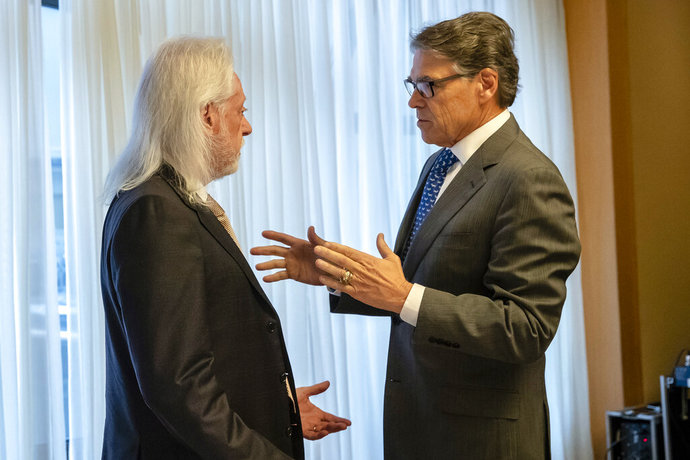
    KYIV, Ukraine (AP) — Two political supporters of U.S. Energy Secretary Rick Perry secured a potentially lucrative oil and gas exploration deal from the Ukrainian government soon after Perry proposed one of the men as an adviser to the country’s new president.

    Perry’s efforts to influence Ukraine’s energy policy came earlier this year, just as President Volodymyr Zelenskiy’s new government was seeking military aid from the United States to defend against Russian aggression and allies of President Donald Trump were ramping up efforts to get the Ukrainians to investigate his Democratic rival Joe Biden.

    Ukraine awarded the contract to Perry’s supporters little more than a month after the U.S. energy secretary attended Zelenskiy’s May inauguration. In a meeting during that trip, Perry handed the new president a list of people he recommended as energy advisers. One of the four names was his longtime political backer Michael Bleyzer.

    A week later, Bleyzer and his partner Alex Cranberg submitted a bid to drill for oil and gas at a sprawling government-controlled site called Varvynska. They offered millions of dollars less to the Ukrainian government than their only competitor for the drilling rights, according to internal Ukrainian government documents obtained by The Associated Press. But their newly created joint venture, Ukrainian Energy, was awarded the 50-year contract because a government-appointed commission determined they had greater technical expertise and stronger financial backing, the documents show.

    Perry likely had outsized influence in Ukraine. Testimony in the impeachment inquiry into Trump shows the energy secretary was one of three key U.S. officials who were negotiating a meeting between Trump and the Ukrainian leader.

    The sequence of events suggests the Trump administration’s political maneuvering in Ukraine was entwined with the big business of the energy trade.

    Perry made clear during trips to Kyiv that he was close to Bleyzer, a Ukrainian-American investor and longtime Perry supporter who lives in Houston, and Cranberg, a Republican mega-donor who provided Perry the use of a luxury corporate jet during the energy secretary’s failed 2012 presidential bid.

    Perry’s spokeswoman said Wednesday that the energy secretary has championed the American energy industry all over the world, including in Ukraine.

    “What he did not do is advocate for the business interests of any one individual or company,” said Shaylyn Hynes, the press secretary for the Energy Department.

    Jessica Tillipman, who teaches anti-corruption law at George Washington University, said even if Perry did seek to influence foreign officials to award contracts to his friends, it is likely not illegal.

    “My gut says it’s no crime,” she said. “It’s just icky.”

    Zelenskiy’s office did not respond to requests for comment.

    In a statement to AP, Bleyzer denied that Perry helped his firm get the gas deal.

    “I believe that Secretary Perry’s conversations with Ukrainian government officials, if they in fact took place, did not play any role in Ukrainian Energy winning its bid,” Bleyzer said Tuesday. He said the process was competitive and transparent and “will hopefully serve as an example of how the Ukrainian energy market can be opened for new investments.”

    Amy Flakne, a lawyer for Cranberg’s company Aspect Holdings, said Wednesday that Perry and other U.S. officials supported “a fair, competitive process to bring foreign capital and technology to Ukraine’s lagging energy sector.”

    “Aspect neither sought, nor to our knowledge received, special intervention on its behalf,” Flakne said.

    ___

    ‘FREEDOM GAS’

    As Trump’s energy secretary, Perry has flown around the globe to push for U.S. exports of liquefied natural gas, which he calls “Freedom Gas.” He’s made multiple trips to Ukraine and other former Soviet-bloc nations, where shipments of American gas and drilling technology take on strategic importance as a potential alternative to continued dependence on imports from Russia.

    Ukraine has long suffered from a reputation for political corruption, particularly in its oil and gas sector. In the chaotic days following the breakup of the Soviet Union, the newly independent Ukrainian government sold off many state-owned businesses worth billions to a cadre of well-connected oligarchs who amassed immense fortunes.

    As Ukraine sought economic and security support from the U.S. and other Western democracies, those countries pressed it to put in place a more open and transparent process for awarding oil and gas exploration rights on state land.

    At the urging of Western partners, Ukraine’s government created a process requiring that exploration contracts be put out to bid and awarded following review from a selection board appointed by the president’s cabinet of ministers. The board recommends the winners, pending final approval from the ministers.

    Those Western partners also advised Ukraine to appoint an independent supervisory board at Naftogaz, the state-owned energy company, as a guard against corruption and self-dealing.

    In February, the Ukrainian government opened up bidding for nine oil and gas blocks encompassing 4,428 square miles (11,469 square kilometers) of land. Ukrainian Energy, the joint venture between Bleyzer’s investment firm SigmaBleyzer and Cranberg’s Aspect Energy, submitted a single bid for the largest block, which covers 1,340 square miles (3,471 square kilometers).

    Under the contracts, the winning bidder is awarded exclusive rights to extract petroleum for up to 50 years. After the initial costs are recovered, the company and the government split the profits.

    An internal review of the proposals by the Ukrainian Ministry of Energy and Coal Mining obtained by the AP show they were not the highest bidder.

    The only competing bidder, UkrGasVydobuvannya, known by the acronym UGV, offered more than $60 million for the first phase of the project, compared with $53 million from Bleyzer and Cranberg, the document shows. UGV is Ukraine’s largest domestic gas producer and is a subsidiary of Naftogaz, the state-owned company where Perry sought to replace board members.

    Despite the lower upfront investment, the selection board gave the Americans higher scores for technical expertise and overall financial resources, according to the document reviewed by AP.

    Of the nine gas deals awarded on July 1, Bleyzer and Cranberg’s bid was the only one of the winners that didn’t include the participation of a Ukrainian company. UGV won four of the remaining bids.

    Two members of the board that helped select the bid winners told the AP that the process is designed to be difficult to improperly influence because it is a mix of government representatives and industry experts.

    Roman Opimakh, a commission member who is the head of the State Service of Geology and Subsoil of Ukraine, said the government was looking for foreign investment, particularly U.S., and the board considered that as a factor. He said it’s an advantage if a company is well-connected in Washington but added that he saw no indication that U.S. officials influenced the process.

    Perry, who served 14 years as the governor of Texas, has publicly championed the potential of U.S. hydraulic fracturing technology to boost oil and gas production in Ukraine and pressed for the bidding process to be opened up to U.S. companies.

    At an energy industry roundtable in Kyiv in November 2018, Perry said the potential for oil and gas development in Ukraine is “staggering.” Ukraine, he declared, had a chance to become “the Texas of Europe.”

    At the same event, which was co-sponsored by the nonprofit U.S.-Ukraine Business Council, Perry plugged Cranberg’s expertise. Both Cranberg and Bleyzer were in the room, along with several American and Ukrainian energy industry officials.

    “You know, Alex Cranberg, who has been in this business a long time, can attest to this probably as well as anyone sitting around the table, that we have the potential to change the world,” Perry said, according to a transcript released by the U.S. Embassy in Kyiv.

    During the same 2018 trip, Perry had a private meeting with then-Ukrainian President Petro Poroshenko, where they discussed deepening the ties between the two country’s energy industries, according to a U.S. Embassy summary of the meeting

    Records suggest Perry has also met regularly with Bleyzer. Visitor logs released by the Energy Department through a public records request show Bleyzer entering through the VIP check-in desk at the building where Perry’s office is at least three times, most recently on May 8.

    Less than two weeks later, Perry was on a plane to Kyiv to attend the inauguration ceremony for Zelenskiy, who had defeated Poroshenko in an April election. It was during that trip that Perry presented his list of recommended advisers that included Bleyzer and remarked on their long friendship, according to a person in the room who spoke on condition of anonymity for fear of retaliation. Attendees left the meeting with the impression that Perry wanted to replace an American representative on the Naftogaz board with someone “reputable in Republican circles,” according to the person who was there.

    Bleyzer said Tuesday that he had been included in what he described as a brainstorming session with Energy Department officials about creating an informal group knowledgeable about Ukraine’s energy industry to help develop U.S. strategy, but he had no idea his name would be forwarded to the country’s new president.

    “I was not aware at any time that my name was recommended by Secretary Perry to the Ukrainian government to act in any capacity,” Bleyzer said.

    Perry’s work in Ukraine places him at the center of the House impeachment inquiry into efforts by Trump and his personal lawyer Rudy Giuliani to press Zelenskiy to open an investigation into Biden and his son Hunter’s business dealings with Burisma, another Ukrainian gas company.

    Perry, who announced last month that he is resigning by the end of the year, has refused to cooperate with the congressional probe. In an Oct. 4 interview with the Christian Broadcasting Network, Perry said that “as God as my witness” he never discussed Biden or his son in meetings with Ukrainian or U.S. officials.

    But Perry was at the White House for a key July 10 meeting where senior Ukrainian officials were told continued U.S. support was conditional on Zelenskiy’s government opening investigations into Democrats and Burisma, Army Lt. Col. Alexander Vindman, an aide on Trump’s National Security Council, testified last month.

    ___

    TEXAS TIES

    Bleyzer and Perry’s ties go back at least a decade. As governor, Perry appointed Bleyzer in 2009 to serve as a member of a Texas state advisory board overseeing state funding to emerging technology ventures. The following year, Bleyzer contributed $30,000 to Perry’s 2010 campaign for Texas governor.

    The Ukrainian-born Texan cuts a flamboyant figure in the energy world. A 2012 profile in the Houston Chronicle is set in his modernist 15,000-square-foot mansion. In an accompanying photo, he stands next to his wife, a mane of gray hair to his shoulders, on a balcony overlooking a swimming pool.

    A former engineer at Exxon, Bleyzer was born in Ukraine’s Kharkiv region and trained in digital electronics and quantum physics. In 1994, he founded SigmaBleyzer Investment group, a private equity firm that specializes in developing corporate stakes in Eastern Europe. The company says it manages about $1 billion in assets.

    Bleyzer also has ties to Giuliani. In 2008, Bleyzer’s company hired Giuliani’s former Houston-based law firm, Bracewell & Giuliani, to help it acquire and consolidate cable holdings in 16 Ukrainian cities, including Kyiv, according to an announcement at the time. The same year, Bleyzer donated $2,300 to Giuliani’s presidential campaign.

    Bleyzer’s company is the primary funder of the U.S.-Ukraine Business Council, which promotes the interests of American businesses operating in Ukraine. According to tax records, the business council is run out of the Washington, D.C, offices of its president and CEO, Morgan Williams, who is also listed as the government affairs director for SigmaBleyzer.

    The council, which sponsors events that feature senior U.S. and Ukrainian government officials, pushes for policy priorities that dovetail with Bleyzer’s business interests — including lobbying to create the very process that opened Ukraine’s state-controlled oil and gas fields to foreign investment, according to the webpage of the state geology service.

    Days after the government in Ukraine posted the gas blocks for bidding in February, visitor logs show Williams accompanied Bleyzer through the VIP entrance at the Energy Department.

    On May 28, the day the bids were due in Kyiv, Williams again accompanied Bleyzer, who photos show was sporting a Western-style shirt with a Stars and Stripes pattern, to the offices of Ukraine’s energy ministry to submit their company’s bid.

    On June 5 — while Bleyzer and Cranberg’s proposal was under review — Williams met with a key Zelenskiy adviser, Oleg Ustenko, and told him that significant expansion of oil and gas production in Ukraine could only be achieved with investments from private companies, including ones from the United States, according to a summary of the meeting posted on the business council’s website.

    In an apparent dig at the company competing against Bleyzer and Cranberg for the gas deal, Williams also told Ustenko that the “participation of the state monopoly player” undermined the chances of private companies to win, according to the summary.

    What the council’s media release failed to mention is that, like Williams, Ustenko serves dual roles. In addition to advising the Ukrainian president, the economist is the longtime executive director of The Bleyzer Foundation, a Kyiv-based nonprofit organization founded by Bleyzer in 2001. The group’s website describes its mission as promoting private-sector investment in Ukraine.

    Less than four weeks later, Ukraine Energy was named the winner of the Varvynska block over the Naftogaz subsidiary.

    Bleyzer would not say whether he considered it a conflict for his employee to simultaneously be leading the international trade group while also advocating for his private business interests.

    He said the U.S.-Ukraine Business Council is just one of many organizations that strongly support the participation of foreign companies in the bidding process “as one of the key factors in helping Ukraine achieve its energy independence from Russia.”

    As with Bleyzer, Cranberg also has longtime ties to Perry.

    A graduate of the University of Texas in Austin, Cranberg was appointed by Perry in 2011 to serve a six-year term on the state university system’s board of regents. He is a generous political donor, giving more than $3 million since the mid-1980s primarily to Republican candidates and fundraising committees, according to federal and state campaign finance records.

    In the last 13 months, Cranberg has contributed just over $650,000 to two committees focused on electing Republicans to House seats, $637,000 to the National Republican Senatorial Committee and $258,000 to the National Republican Congressional Committee. He and his wife each gave $50,000 last April to Trump Victory, the joint entity that funds the president’s reelection campaign and the Republican National Committee.

    When Perry campaigned for president in 2011, federal disclosures show his campaign paid more than $16,000 to a holding company for a private jet used by Cranberg.

    Cranberg is also among those who entered through the VIP desk at the Energy Department, logging in with his wife for a visit in April 2018.

    Last year, his company hired Perry’s former campaign manager, Jeff Miller, as a lobbyist. Miller has been to the Energy Department’s headquarters at least a dozen times since Perry became secretary, according to the visitor logs. He mostly signed in through the VIP entrance.

    ___

    Biesecker, Braun and Lardner reported from Washington.

    ___

    Follow Associated Press investigative reporters Desmond Butler at https://twitter.com/desmondbutler , Michael Biesecker at http://twitter.com/mbieseck and Richard Lardner at http://twitter.com/rplardner

    ___

    Contact AP’s global investigative team at Investigative@ap.org

  • Still Teaching At 95, Jimmy Carter Draws Devotees To Church

    Still Teaching At 95, Jimmy Carter Draws Devotees To Church

    PLAINS, Ga. (AP) — The pilgrims arrive early and from all over, gathering hours before daybreak in an old pecan grove that surrounds a country church. They come, they say, for a dose of simple decency and devotion wrapped up in a Bible lesson.

    The teacher is the 39th president of the United States, Jimmy Carter.

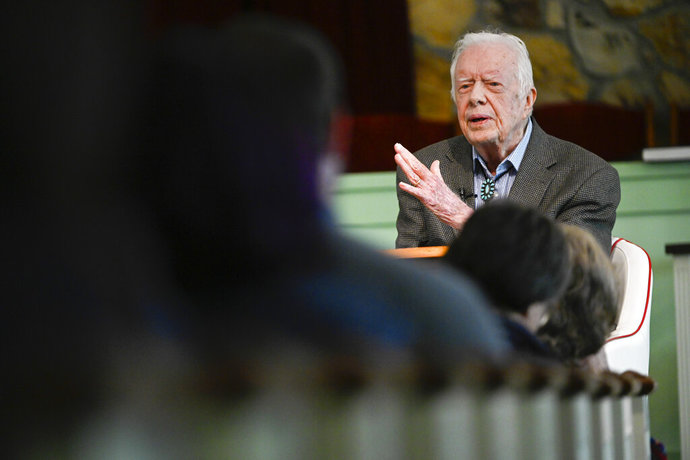
    Nearly four decades after he left office and despite a body that’s failing after 95 years, the nation’s oldest-ever ex-president still teaches Sunday school roughly twice a month at Maranatha Baptist Church in his tiny hometown of Plains in southwest Georgia. His message is unfailingly about Jesus, not himself.

    The church has only 30 or so members, but as many as 450 people attend any week Carter teaches. About 200 people fill the sanctuary, with pale-green walls and stained glass windows, and others gather in side rooms where the lesson is shown on TVs.

    It’s nearly impossible to separate even an ex-president from politics, and some come because they’re Democrats who recall voting for Carter when he was elected in 1976. Almost uniformly, they’re dismayed by the tone of President Donald Trump and his Republican administration.

    But Trump has only been in office since 2017 and Carter has been drawing crowds for years. Those who attended Carter’s most recent lesson on Nov. 3 said they just wanted to be in the presence of someone who seems kind, humble and godly despite having been a world leader.

    “He’s a role model and an inspiration for both of us both in public service and in faith,” said visitor Doug Kluth. He and his wife Ramona drove 2,400 miles (3,862 kilometers) round trip from their home in Columbus, Nebraska, to see Carter in person.

    John and Sarah Dyer packed their four daughters, ages 2 through 12, into their Honda Pilot for the 1,700-mile (2,736-kilometer) round trip to Plains from suburban Chicago.

    “To see a man who was once on top of the world choose to spend his twilight years lifting the world higher was inspirational to my family and I,” John Dyer wrote to the church’s pastor in a letter shared with The Associated Press.

    Carter faced mockery for his Southern Baptist faith in 1976 when he said in a Playboy magazine interview that he was guilty of adultery in his heart because he lusted after women. The soul-baring sentiment paralleled Jesus’ words in the Sermon on the Mount, but it came across as odd and narrow-minded to many.

    These days, with a twice-divorced president who curses in public and once said he’d never asked God for forgiveness, Carter’s approach to life — with his wife of 73 years, Rosalynn, by his side — seems especially appealing to fans.

    They say they admire Carter’s work to eradicate disease and monitor elections worldwide; the time he has spent helping build homes as a volunteer with Habitat for Humanity; and his advocacy for food programs and rural health care in his home county. Many were touched by photos of a bruised-but-smiling Carter performing volunteer work after he fell and hit his head in October.

    So they flock to Plains any week Maranatha Baptist posts on its website or Facebook page that Carter plans to teach.

    Fray and Susan Carter of Russellville, Alabama, slept overnight in their car in the church parking lot to get a front-row view as Carter taught on his first Sunday back after falling and breaking his pelvis in October.

    As recently as last year Carter would stand during his 45-minute lesson, but he now uses an electric lift chair at the front of the sanctuary as a concession to age. He breaks into that familiar smile when he raises the seat so he can see the crowd over a wooden lectern. A cross made by Carter, a longtime woodworker, adorns the choir loft. He also made the wooden offering plates, which bear his initials on the bottom.

    Carter’s lesson this day was on his belief in life after death. He ended the same way he always does, by challenging class members to do one nice thing for somebody over the next month.

    “That’s what I think would make America a better country. It would make you a better person, right? And a better Christian,” Carter said. “Well, that’s the essence of my Sunday school lesson. Not anything fancy to it. Just some personal things to think about.”

    Visitors that day included people from multiple U.S. states plus Venezuela and Ecuador. Rarely a week goes by without someone from overseas in the crowd, said the Rev. Tony Lowden, Carter’s pastor.

    The church was formed in 1977 from a split when another church refused to accept blacks as members. Lowden was hired in March as Maranatha’s first black pastor. On any given Sunday, Lowden said, the congregation is a “mix of everything.”

    “It’s a melting pot of people who are looking for faith and looking for something that they can believe in,” Lowden said. After a cancer diagnosis in 2015 and three falls this year, it’s unclear how much longer Carter can continue to teach, but Lowden said he’s welcome as long as he’s able.

    The crowd on the first Sunday in November included Chet Mulholland, an evangelical Christian from Wisconsin, and Joey and Sabrina Fretwell, faithful churchgoers from conservative Mississippi in the heart of the Deep South. The couple’s daughter attended a Trump rally in Tupelo, Mississippi, just two days before they drove to Plains to see Carter.

    Sabrina Fretwell, 46, doesn’t really remember Carter’s presidency, but she recalls hours spent listening to her grandparents talk about Carter when she was a girl. That’s one reason she wanted to see the former president, she said, to somehow honor that time.

    “I remember that warm feeling of sitting and listening to their conversations, and not being old enough to grab what they were talking about but knowing it was still important to them and knowing they admired the things he was doing,” she said.

    ___

    Associated Press religion coverage receives support from the Lilly Endowment through the Religion News Foundation. The AP is solely responsible for this content.

  • Trump Insists Impeachment Inquiry Hasn’t Hurt Him

    Trump Insists Impeachment Inquiry Hasn’t Hurt Him

    WASHINGTON (AP) — President Donald Trump insisted Friday he has not been damaged by impeachment testimony detailing efforts by him and his administration to pressure Ukraine to publicly investigate his political rivals.

    Speaking to reporters as he left on a campaign trip to Atlanta, Trump said he was “not concerned about anything” that has been disclosed so far.

    “It seems that nobody has any firsthand knowledge,” he said, adding that, “every one of those people canceled themselves out.”

    Trump’s comments came a day after the release of an impeachment inquiry transcript in which career State Department official George Kent said Trump wanted to hear just three words from the Ukraine president in their July phone call: Investigations, Biden, Clinton.

    “Potus wanted nothing less than President Zelenskiy to go to the microphone and say investigations, Biden and Clinton,” Kent testified. “Basically there needed to be three words in the message, and that was the shorthand.”

    Kent told investigators that that was his understanding of what Trump wanted Ukraine President Volodymyr Zelenskiy to say to unlock U.S. military aid, as relayed to the official by others, including those in direct contact with the president.

    Numerous current and former Trump officials have testified that the president was conditioning U.S. aid on Ukraine publicly investigating Democrats including his potential 2020 political foe Joe Biden and Biden’s son.

    Clinton, he explained, was “shorthand” for the 2016 U.S. presidential campaign. It was a reference to Trump’s view, pushed by his personal attorney Rudy Giuliani but outside of mainstream U.S. intelligence, that Ukraine played a role interfering in the election.

    Kent also raised concerns about Giuliani’s “campaign of lies” against Ukraine Ambassador Marie Yovanovitch and the Trump administration’s firing of the veteran diplomat.

    House investigators are releasing key transcripts from days of closed-door interviews in the impeachment inquiry as they prepare for public sessions with witnesses next week. A whistleblower’s complaint about Trump’s telephone call with Zelenskiy was the spark that ignited the investigation.

    Trump on Friday objected to the public sessions, even though he, the White House and Republican allies on the Hill had objected to interviews taking place behind closed-doors. And he claimed that Democrats were only interested in speaking with people who dislike him, even as the White House has blocked potentially more supportive witnesses, including acting Chief of Staff Mick Mulvaney, from appearing.

    “This is just a continuation of the hoax. It’s a disgraceful thing,” said Trump, insisting — despite evidence to the contrary — that the inquiry is helping him politically.

    Trump also tried to distance himself from his ambassador to the European Union, Gordon Sondland, telling reporters: “I hardly know the gentleman.” He has previously praised Sondland.

    Kent had testified for hours in October about the shifting U.S. policy toward Ukraine as administration officials and Giuliani were taking the lead, acting outside of regular foreign policy channels.

    The career official began to understand that unless Ukraine took on the investigations Trump wanted, the administration would hold up nearly $400 million in military aid to the young democracy that relies on U.S. support to counter Russian aggression.

    Kent said he memorialized in writing the conversations he was having with other diplomats amid his concerns of “an effort to initiate politically motivated prosecutions that were injurious to the rule of law, both in Ukraine and U.S.” The memorandum was submitted to the State Department.

    He told investigators he was uncomfortable with what he was hearing about Giuliani pushing the investigations and Trump’s special envoy to Ukraine, Kurt Volker, engaging Ukrainian officials on the subject.

    “And I told Bill Taylor, that’s wrong, and we shouldn’t be doing that as a matter of U.S. policy,” Kent said, referring to William Taylor, the top diplomat in Ukraine who has also testified in the inquiry.

    Sondland, had dubbed himself, Volker and Energy Secretary Rick Perry the “three amigos” with a mandate to take the lead on Ukraine policy over the career diplomats, Kent testified.

    At one point, Kent said, Volker’s assistant, Catherine Croft, asked if anyone had sought investigations from Ukraine. Kent said he hoped the U.S. had not, because “that goes against everything that we are trying to promote in post-Soviet states for the last 28 years, which is the promotion of the rule of law.”

    In one particularly unsettling scene, Kent describes mounting unease over Trump’s phone call with Zelenskiy.

    Within days, he was receiving a readout from Lt. Col. Alexander Vindman, an Army officer assigned to the National Security Council who was among the officials listening to the call. Vindman has become a key witness in the House investigation.

    Vindman was “uncomfortable” as he gave Kent the readout and unwilling to share much of what was discussed, even over the secure phone line between the NSC and State.

    “It was different than any readout call that I had received,” Kent said. “He felt_I could hear it in his voice and his hesitancy that he felt uncomfortable.”

    Vindman told him the tone of the Trump-Zelenskiy call was “cooler, reserved” and that Zelenskiy, a former comedian, had tried to turn on the charm.

    He said that Vindman told him that “the conversation went into the direction of some of the most extreme narratives that have been discussed publicly.”

    The diplomats and national security officials weren’t the only ones concerned about the military aid being shut off to the East European ally.

    “Many senators, particularly from the Republican side,” called and talked to the president, he said. Senate Majority Leader Mitch McConnell and Sens. Jim Inhofe of Oklahoma and Rob Portman of Ohio and were among them.

    Trump has insisted it was a “perfect” call with Zelenskiy, and he tweeted Thursday that Americans should just “Read the Transcript.”

    House Speaker Nancy Pelosi used that as an opportunity to tweet excerpts from the call, including the part where Trump asks Ukraine for “a favor.”

    Next week, Kent, Yovanovitch and Taylor are expected to appear in the public hearings.

    First to testify, on Wednesday, will be Taylor, still the top diplomat in Ukraine, who relayed in his closed-door session his understanding that there was a blatant quid pro quo, with Trump holding up military aid to Ukraine, a U.S. ally facing threats from its giant neighbor Russia.

    ___

    Associated Press writers Andrew Taylor, Matthew Lee, Matthew Daly and Jill Colvin contributed to this report.

  • Secret Service Study: School Attackers Showed Warning Signs

    Secret Service Study: School Attackers Showed Warning Signs

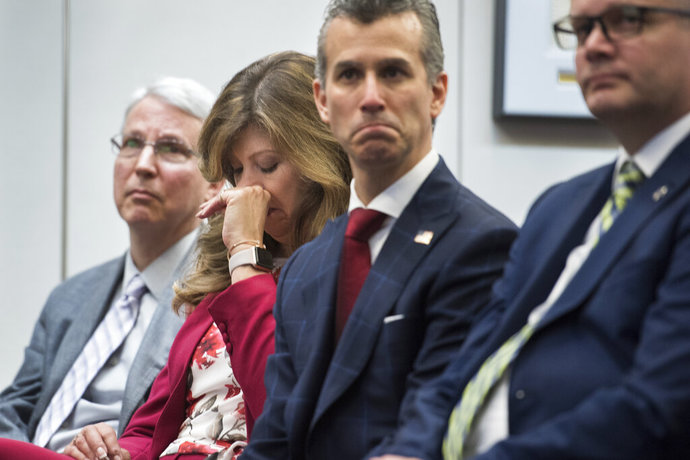
    WASHINGTON (AP) — Most students who committed deadly school attacks over the past decade were badly bullied, had a history of disciplinary trouble and their behavior concerned others but was never reported, according to a U.S. Secret Service study released Thursday.

    In at least four cases, attackers wanted to emulate other school shootings, including those at Columbine High School in Colorado, Virginia Tech University and Sandy Hook Elementary School in Connecticut. The research was launched following the shooting at Marjory Stoneman Douglas High School.

    The study by the Secret Service’s National Threat Assessment Center is the most comprehensive review of school attacks since the Columbine shootings in 1999. The report looked in-depth at 41 school attacks from 2008 through 2017, and researchers had unprecedented access to a trove of sensitive data from law enforcement including police reports, investigative files and nonpublic records.

    The information gleaned through the research will help train school officials and law enforcement on how to better identify students who may be planning an attack and how to stop them before they strike.

    “These are not sudden, impulsive acts where a student suddenly gets disgruntled,” Lina Alathari, the center’s head, said in an Associated Press interview. “The majority of these incidents are preventable.”

    The fathers of three students killed in 2018 at Marjory Stoneman Douglas High School in Parkland, Florida, attended a media conference Thursday in support of the study.

    Tony Montalto, whose daughter, Gina Rose Montalto, died, said the research was invaluable and could have helped their school prevent the attack.

    “My lovely daughter might still be here today,” he said. “Our entire community would be whole instead of forever shaken.”

    Montalto urged other schools to pay attention to the research.

    “Please, learn from our experience,” he said. “It happened to us, and it could happen to your community, too.”

    Nearly 40 training sessions for groups of up to 2,000 people are scheduled. Alathari and her team trained about 7,500 people during 2018. The training is free.

    The Secret Service is best known for its mission to protect the president. The threat assessment center was developed to study how other kinds of attacks could be prevented. Officials use that knowledge and apply it in other situations, such as school shootings or mass attacks.

    Since the Columbine attack, there have been scores of school shootings. Some, like Sandy Hook in 2012, were committed by nonstudents. There were others in which no one was injured. Those were not included in the study.

    The report covers 41 school attacks from 2008 through 2017 at K-12 schools. They were chosen if the attacker was a current or recent former student within the past year who used a weapon to injure or kill at least one person at the school while targeting others.

    “We focus on the target so that we can prevent it in the future,” Alathari said.

    Nineteen people were killed and 79 were injured in the attacks they studied; victims included students, staff and law enforcement.

    The Secret Service put out a best practices guide last July based on some of the research to 40,000 schools nationwide, but the new report is a comprehensive look at the attacks.

    The shootings happened quickly and were usually over within a minute or less. Law enforcement rarely arrived before an attack was over. Attacks generally started during school hours and occurred in one location, such as a cafeteria, bathroom or classroom.

    Most attackers were male; seven were female. Researchers said 63% of the attackers were white, 15% were black, 5% Hispanic, 2% were American Indian or Alaska Native, 10% were of two or more races, and 5% were undetermined.

    The weapons used were mostly guns, but knives were used, as well. One attacker used a World War II-era bayonet. Most of the weapons came from the attackers’ homes, the investigators reported.

    Alathari said investigators were able to examine detailed information about attackers, including their home lives, suspension records and past behaviors.

    There’s no clear profile of a school attacker, but some details stand out: Many were absent from school before the attack, often through a school suspension; they were treated poorly by their peers in person, not just online; they felt mistreated; some sought fame, while others were suicidal. They fixated on violence and watched it online, played games featuring it or read about it in books.

    The key is knowing what to look for, recognizing the patterns and intervening early to try to stop someone from pursuing violence.

    “It really is about a constellation of behaviors and factors,” Alathari said.

    The attackers ranged in age but were mostly young adults, seventh-graders to seniors. More than three-quarters initiated their attack after an incident with someone at school.

    In one case, a 14-year-old shot a classmate at his middle school after he’d been mocked and called homophobic names. The attacker later reported the victim made comments that made him uncomfortable, and they were the final straw in his decision to attack. Seven attackers documented their plans, and five researched their targets before the attack.

    Thirty-two were criminally charged, with 22 charged as adults. Most took plea deals. More than half are incarcerated. A dozen more were treated as juveniles. Seven killed themselves, and two were fatally wounded.

    Alathari said the report shows that schools may need to think differently about school discipline and intervention.

    The report does not weigh in on political topics such as whether guns are too accessible or whether teachers should be armed.

    She said their goal is to make schools a safer place where no more attacks occur.

    ___

    This story has been corrected to fix the spelling of the Florida school to Marjory Stoneman Douglas High School, not Marjorie Stoneman Douglas High School.

  • Hopes Rise That Lifting Tariffs Could Allow US-China Accord

    Hopes Rise That Lifting Tariffs Could Allow US-China Accord

    BEIJING (AP) — Prospects appear to have brightened for a preliminary breakthrough in the U.S.-China trade war after the two sides agreed to reduce some punitive tariffs on each other’s goods as part of an initial agreement.

    A Chinese spokesman announced the development Thursday as talks on ending the trade war progressed — a development that triggered a rally in U.S. stock markets.

    The agreement came during talks aimed at working out details of a “Phase 1” deal that was announced Oct. 12. Financial markets had been rattled by reports that China was pushing for tariffs to be lifted, which posed the prospect of a breakdown in talks.

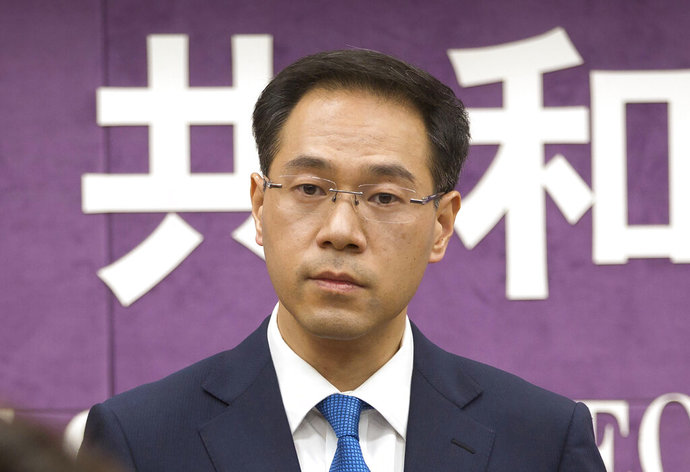
    Negotiators agreed to a “phased cancellation” of tariff hikes if talks progress, said a Commerce Ministry spokesman, Gao Feng.

    “If the two sides achieve a ‘Phase 1’ agreement, then based on the content of that agreement, tariffs already increased should be canceled at the same time and by the same rate,” Gao said at a news briefing.

    As for the size of reductions, Gao said that would depend on the agreement.

    “For almost two years now, the U.S./China trade tussle has posed the biggest headwind to global growth,” BMO Economics said in a research note. “But with promising signs of progress on the trade front, a shift in global central banks to easing … and mostly better-than-expected corporate profits, U.S. stocks” are reaching all-time highs.”

    On Wall Street, stocks pushed toward another round of records in the wake of the encouraging report from Beijing. The Dow Jones Industrial Average was up nearly 200 points in late-afternoon trading.

    Governments of the two biggest global economies have raised tariffs on billions of dollars of each other’s goods in the fight over China’s trade surplus and technology ambitions. That weighs on trade worldwide and threatens to depress corporate earnings and global economic growth, which is already showing signs of slowing.

    The Oct. 12 agreement was modest and details have yet to be put on paper but it was welcomed as a sign of progress toward ending the trade war.

    President Donald Trump agreed to postpone a planned tariff hike while lower-level officials hammered out details.

    Trump said China agreed to buy up to $50 billion of American farm goods. Beijing has yet to confirm the scale of its commitment.

    News reports said Beijing wants 15% tariffs imposed in September on $125 billion of Chinese imports removed before it will make a formal commitment.

    There had been no indication whether Trump might agree, which raised the possibility of another breakdown in negotiations.

    China’s imports of American soybeans and other goods tumbled 26.4% in the first nine months of this year following tariff hikes and orders to importers to find other suppliers.

    The Oct. 12 agreement helped to ease financial market jitters, but the two sides have yet to report progress on major disagreements over technology and other irritants following 13 rounds of talks.

    Trump and Xi were due to meet at this month’s gathering of Asia-Pacific leaders in Chile but that event was canceled due to protests there.

    That dampened hopes a face-to-face meeting might produce progress. But U.S. officials say the two governments are looking for a different location.

    U.S. Commerce Secretary Wilbur Ross said this week any “Phase 1” agreement would be general and cover trade in specific areas such as soybeans and liquefied natural gas.

    More complicated issues would be tackled in later negotiations, Ross said. He gave no indication whether rolling back tariffs was a possibility at this stage.

  • Fire Survivors Transform California City That Took Them In

    Fire Survivors Transform California City That Took Them In

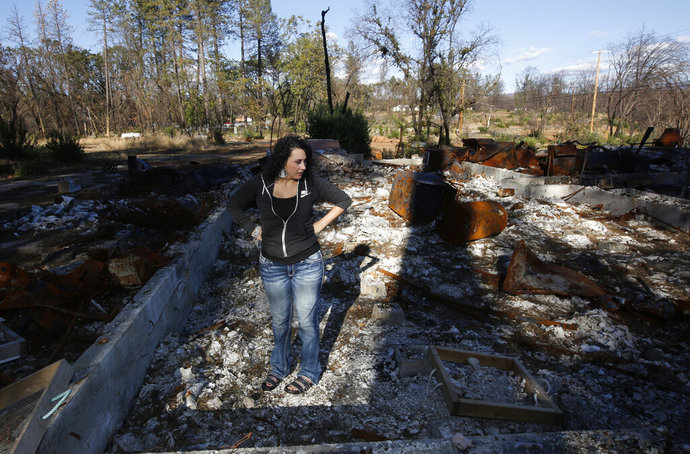
    CHICO, Calif. (AP) — Amber Blood got to Chico on Nov. 8, 2018, wearing pink slacks and her favorite white peacoat. It was all she had left.

    Blood was among tens of thousands forced to flee as a wildfire roared through Paradise and nearby communities in Northern California, killing 85 people and destroying roughly 19,000 buildings.

    Nothing burned in Chico, the closest big city. And within hours, another city had moved in — filling up hotels, living in trailers, sleeping on friends’ couches and buying up every available home, apartment and spare room.

    A year later, most are still there. State officials estimate Chico has added 20,000 people, boosting the population from 92,000 to more than 112,000. The city didn’t expect that number until at least 2030.

    “We all feel lost, still,” said Blood, who has since bought a home in Chico. “This house is beautiful, and I don’t even feel like it is my home. It’s weird.”

    What’s happened in Chico in the year since California’s deadliest wildfire shows how blazes — growing more frequent and destructive with climate change — have lasting effects far beyond the flames.

    “You normally would have a decade to prepare for such growth,” Chico Police Chief Michael O’Brien said. “We had about 10 hours.”

    Chico officials say they need close to half a billion dollars to improve infrastructure and hire enough police officers and firefighters to cover the surge in people. But because the city is outside the burn area, it isn’t eligible for most state and federal disaster funds. The most it’s gotten is $3 million from the Legislature.

    Aside from housing shortages and more traffic, the influx has strained the city in unexpected ways. About three weeks after the fire, Chico’s sewer system was handling an additional million gallons (4 million liters) a day, or the equivalent of adding an extra 5,000 homes.

    City officials had hoped the increase was temporary. But now, the system is handling an additional 600,000 gallons (2.3 million liters) a day from fire survivors, costing an extra $53,000 per month. That’s money Chico doesn’t have.

    City Manager Mark Orme says Chico will likely have to raise rates to pay for it.

    “It’s one of the unanticipated consequences of being the friendly neighbor,” he said.

    The effects go beyond government services. The region had four hospitals before the fire. But Feather River Hospital in Paradise closed and has not reopened. Since then, Enloe Medical Center in Chico has seen up to an extra 700 patients per month, according to Judy Cline, director of the emergency department.

    The hospital has added seven around-the-clock nursing shifts to keep up, but it’s having trouble filling the positions because potential employees can’t find places to live.

    “Our community is completely different than it once was, and it will always be completely different,” Cline said.

    Even before the fire, Chico’s home sales vacancy rate was below 1%. Along with hospital workers and others, former Paradise residents have struggled to find a place to call home.

    Laura Smith and her family had 2 acres in Paradise. Now, they live in a small apartment where the neighbors complain if you shut your door too hard. She dreams of moving back.

    “We’re in Chico, but we’re Paradise residents,” Smith said. “There is something separate about us.”

    It was even hard for Blood, a real estate agent in Paradise, to find somewhere for her and her children.

    They lived in a cramped, two-bedroom apartment for months. It was unfurnished, but shopping was exhausting. The first thing she bought after the fire was an expensive fake plant because it was one of the few things left in the store.

    When Blood finally bought a house a few months later from a woman who was moving overseas, she said she paid the seller an extra $7,000 to leave the furniture.

    “We literally walked in, the house was ready to go,” Blood said.

    Gov. Gavin Newsom signed a law this summer designed to speed up construction of new housing by temporarily suspending the state’s lengthy environmental review process for fire-affected areas. But the law does not include Chico because Mayor Randall Stone and most of the City Council opposed it.

    Some residents were so angry they launched an effort to remove Stone and another councilman from office. Stone said he is “beyond confident” the recall won’t succeed, saying the state law would strip authority from local governments and was an attempt by Republican lawmakers to dodge environmental protections.

    The mayor said he plans other actions to address the housing crisis, including adjusting fees for developers so they build more affordable housing. He said he was proud of Chico for coming together to help.

    “We didn’t literally have fire on our homes in this community, but we’re impacted by it,” Stone said. “We’re all burdens on each other.”

    The recall has added to tension in the community, compounded by small things like longer wait times at restaurants and heavier traffic.

    But Chico residents are careful when they complain, said Katy Thoma, president and CEO of the Chico Chamber of Commerce.

    “We’re trying to be sensitive to the people in Paradise who lost everything,” Thoma said. “Chico is a real friendly, warm town, and it’s the kind of town where you don’t honk at people when the light turns green. You let people in. There seems to be less of that.”

    All of these are signs of a city getting to know itself.

    “I don’t think we know what the new normal is,” said Alexa Benson-Valavanis, executive director of the Chico-based North Valley Community Foundation, which has given $27 million in grants since the fire. “But we’re figuring out how to take care of everybody here. I think we have a heart and a will to do that.”

  • Millions At Stake In Dinosaur Fight: Are Fossils Minerals?

    Millions At Stake In Dinosaur Fight: Are Fossils Minerals?

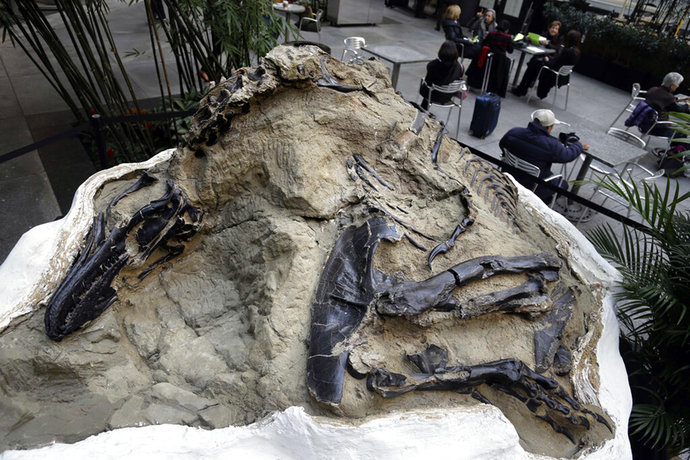
    HELENA, Mont. (AP) — The discovery of two fossilized dinosaur skeletons intertwined in what looks like a final death match could make a Montana ranching couple rich beyond their dreams. Or they may have to share the wealth.

    It all comes down to how the state Supreme Court answers a seemingly simple question: Are fossils minerals? The Montana justices heard arguments Thursday but did not rule right away.

    The outcome is key to a dispute over ownership of the “dueling dinosaurs,” worth more than $5 million, and distribution of millions of dollars in proceeds from the sale of other fossils unearthed from clay and sandstone in a fossil-rich area of central Montana.

    While someone can own what’s on top of a piece of land, others can own material like oil, gas and coal that’s found below the surface. In property sales, an owner can keep some or all of those below-surface mineral rights.

    Mary Ann and Lige Murray own the surface rights and one-third of the mineral rights on the ranch near the tiny town of Jordan, while brothers Jerry and Robert Severson own two-thirds of the mineral rights after a 2005 property sale. Neither side expected to find fossils on the property, and they’re not mentioned in the contract, court documents show.

    A few months later, amateur paleontologist Clayton Phipps discovered a 22-foot-long (7-meter-long) carnivorous theropod and a 28-foot-long (9-meter-long) plant-eating ceratopsian believed to have died 66 million years ago. Imprints of the dinosaurs’ skin were found in the sediment.

    When the Murrays went to sell the “dueling dinosaurs” for what they hoped would be at least $6 million, potential buyers wanted assurances they owned the fossils. The Murrays sought a court ruling.

    Both sides have seen rulings in their favor as the case has made its way through four courts since 2013.

    A U.S. judge in Montana ruled in 2016 that fossils were not included in the ordinary definition of a mineral because not all fossils with the same mineral composition are considered valuable. The judge said the value was based on things like the completeness of the specimen, the species of dinosaur and how well it is preserved.

    The Seversons appealed. A panel of the 9th U.S. Circuit Court of Appeals ruled 2-1 last year that the dinosaur fossils were minerals both scientifically and under mineral rights laws.

    The Murrays asked for a full panel of the appeals court to hear the case. The judges agreed but first asked the Montana Supreme Court to rule whether fossils are considered part of a property’s mineral estate under state law.

    Eric Wolff, an attorney for the Seversons, argued Thursday that the fossils in this case are composed of minerals and are valuable and are therefore part of the mineral estate.

    His clients would then be part owners of the fossil finds, which include a nearly complete Tyrannosaurus rex that was sold to a Dutch museum in 2014 for what a justice and Wolff suggested was about $15 million. That value couldn’t be independently confirmed.

    “What a mineral right is, is a lottery ticket under the ground,” Wolff said. “I give you the property, and I say, ‘If there’s valuable rocks under there, I am retaining my interest in it.’”

    He asked the justices for a narrow ruling based on just the fossils in this case, not a decision on all fossilized dinosaur bones, some of which aren’t valuable.

    “What you want us to answer is to say, ‘Some are, some aren’t?’” asked Justice James Shea, wondering how it would be practical for courts to decide ownership on a case-by-case basis.

    Harlan Krogh, an attorney for the Seversons, urged the justices to answer the question the 9th Circuit posed: Whether Montana law says dinosaur fossils constitute minerals when someone is retaining the mineral rights to a property.

    “Montana has never recognized dinosaur fossils as a mineral” like it has oil, coal or gold, he said, adding that fossils are not mined, processed, milled or smelted.

    State law was silent on the issue until earlier this year, when lawmakers unanimously passed a measure that says dinosaur fossils are part of the surface estate unless there’s a contract saying otherwise.

    “The citizens have spoken about the answer to that question,” Krogh said.

    However, the new law also says it cannot be a factor in any cases already in court.

  • Travelers Mull Safety Amid Arizona-Mexico Border Violence

    Travelers Mull Safety Amid Arizona-Mexico Border Violence

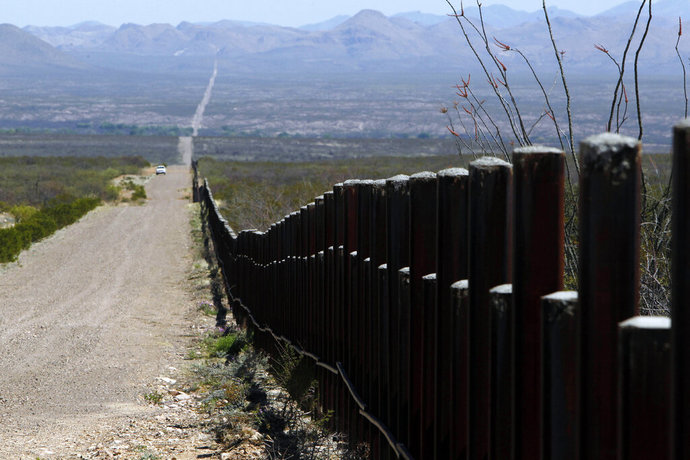
    PHOENIX (AP) — An unusual string of violence south of Arizona’s border with Mexico has sparked warnings by American authorities and is forcing U.S. citizens who say they won’t stop crossing into Mexico to at least consider how to travel more safely.

    Unaccustomed to the kind of violence long seen along some parts of the Texas-Mexico border, those who frequently cross into Mexico from Arizona say they will now think twice about traveling after dark and will confine themselves to busy commercial areas.

    “I travel across quite often,” said Ana Borrajo, a chef living in Bisbee, Arizona, who frequents the border communities of Agua Prieta and Naco in Mexico. “I go to the doctor, to the dentist, I go to eat, and I don’t feel threatened.”

    But after a recent fatal shootout in Agua Prieta and the ambush killings of three women and six children about an hour’s drive farther south, “I’ll try to go during the day, will try to be more cautious,” Borrajo said.

    Terrified residents of Douglas, Arizona, were awakened early Monday by the shootout that erupted between warring drug groups in Agua Prieta. The gunfire was confined to south of the border and reports suggest at least two people were killed.

    A similar shootout in June left at least 10 people dead in Agua Prieta and Naco, a 45-minute drive away.

    Several hours after the shootout, the women and children — nine members of an extended family with dual U.S.-Mexico citizenship — were killed by cartel gunmen in an isolated area in the mountains between Sonora and Chihuahua states. The family’s ancestors broke away many years ago from The Church of Jesus Christ of Latter-day Saints, but they still call themselves Mormons.

    After the Agua Prieta shootout, the Arizona city of Douglas and Cochise County Sheriff Mark Dannels warned residents to reconsider unnecessary travel south of the border.

    Mexican Army chief of staff Gen. Homero Mendoza said authorities are investigating a possible connection between the Agua Prieta shootout and the ambush of the family about 70 miles (117 kilometers) to the south. Both appear to be related to a turf war between the Sinaloa and Juarez cartels.

    “We have an increased presence at the ports of entry,” said Dannels, whose jurisdiction encompasses a section of southeastern Arizona that includes Douglas and Bisbee. “We are an international community down here, with a lot of people going across the border every day, so we put out the facts so people can make good decisions.”

    Dannels issued a similar travel advisory after the June shootout between rival factions of the Sinaloa cartel.

    For some Americans who regularly cross the border, the remote area where the women and children were killed seems far from the places they frequent.

    Even last month’s discovery of at least 42 bodies and skeletons in burial pits near the Gulf of California has not deterred some people who regularly visit the nearby resort of Puerto Penasco, also known as Rocky Point. Women searching for the remains of loved ones in the area say armed gunmen warned them to stay away.

    The kidnapping last week of a New York businessman who was taken from Eloy, Arizona, to the Mexican state of Sonora, where he was found unharmed, doesn’t seem to have scared off travelers, either.

    “I usually go to Rocky Point three or four times a year and have found it to be very safe,” Phoenix resident Tracy Sallen said.

    “Maybe I’m being silly, but those killings were probably the result of drugs,” she said, referring the mass grave. “The Mexicans want our tourism because it contributes to their economy.”

    Since April, the U.S. State Department has suggested that U.S. citizens reconsider travel plans to Sonora, calling it a “key location used by the international drug trade and human trafficking networks.”

    The travel advisory remains in effect and suggests that Americans not travel at all to hyper-violent Tamaulipas state, on the border with Texas.

    Sonora Gov. Claudia Pavlovich, who works closely with Arizona Gov. Doug Ducey on trade and other issues, took to Twitter to express anger and pain over the “cowardly” killings of the women and children and vowed to make the “monsters” responsible pay.

    Although the latest violence in Sonora is somewhat unusual, it’s not unheard of. Some Mexican officials have suggested that the clandestine grave was filled largely with the victims of a more violent period several years ago.

    Sonora’s Puerto Penasco was the scene of a raging gunbattle six years ago when government forces tried to capture a reputed top lieutenant of the Sinaloa drug cartel staying at a beachfront villa.

    Two government helicopter gunships opened fire in December 2013 on 10 vehicles fleeing a luxury condo complex with Gonzalo Inzunza, a top officer in the cartel then run by drug lord Joaquin “El Chapo” Guzman, now serving time in a U.S. prison.

    Cartel members carried away the bodies of Inzunza and several other comrades who were killed.

    Two federal officers were wounded in that gunfight, but no foreigners, visitors or residents were harmed.

  • Exxon Denies That It Misled Investors On Climate Risks

    Exxon Denies That It Misled Investors On Climate Risks

    NEW YORK (AP) — Climate change may be the defining risk for oil and gas companies in coming decades, and attorneys for New York state are saying Exxon Mobil misled investors about how it was handling that risk.

    The state made closing arguments Thursday in a case that accused the energy giant of downplaying the impact of stricter climate regulations in a warming world.

    Exxon countered that the company has been taking climate change risks seriously and its executives did nothing wrong.

    The lawsuit, brought by New York State Attorney General Letitia James, says Exxon Mobil used two sets of books to account for how potential regulations would impact its business.

    “The question in this case is whether Exxon’s disclosures were accurate, and the evidence shows they were not,” said attorney Jonathan Zweig, arguing for the state.

    In shareholder meetings and reports, Exxon was using two different metrics to account for stricter climate regulations: greenhouse gas costs, which measure how local regulators may tax emissions, and proxy costs, which aim to predict how demand for oil and gas may change around the world due to regulations. Exxon attorneys and executives have said the company applied appropriate costs depending on the situation.

    But the state says Exxon was conflating these concepts, leading investors to believe the company was applying a projected cost of $80 per ton for its emissions when it was not, and making some oil and gas development projects look more attractive to investors, Zweig said.

    “Exxon applied much lower costs or no costs at all,” Zweig said.

    For example, Exxon made an $850 million investment into a chemical facility in Beaumont, Texas, but didn’t apply the appropriate greenhouse gas costs in its projections, Zweig said. Instead, “Exxon was making a business as usual assumption that existing law would be frozen in place forever,” Zweig said.

    In assessing an oil sands project in Alberta, Canada, Exxon assumed costs would remain flat through 2030 and 2040, instead of applying escalating costs for the likelihood of increasingly stringent climate regulation, Zweig said.

    “The reality is that many investors, including some of the largest financial firms in the world, believe there is a real likelihood that governments will rise to the challenge of climate change,” Zweig said.

    Exxon Mobil denied the charges, saying the energy giant developed internal metrics to determine how future climate regulations would impact its business.

    “Exxon Mobil took climate risk seriously,” said Ted Wells, an attorney from law firm Paul, Weiss, Rifkind, Wharton & Garrison who represented Exxon. “This is not a case where we said one thing to the public externally and ignored it internally. We did what we said, and we showed you the model so you could see it.”

    Exxon denied using two sets of books and said its executives made it clear they were applying proxy costs in all cases and greenhouse gas costs where appropriate, because each situation is different.

    In Alberta, Exxon executives drilled down on the greenhouse gas issue and decided to use existing local regulations in their projections because they did not think politicians would escalate their policies, Wells said.

    New York failed to prove investors were harmed because none of the state’s witnesses were investors who read Exxon’s reports and later said they felt misled, he said.

    “I’m not saying they have to bring hundreds of investors into the courtroom, but they’ve got to bring somebody,” Wells said.

    New York has asked for a comprehensive review and wants Exxon to pay an estimated $476 million to $1.6 billion in restitution to shareholders.

    The outcome of the case will be decided by New York State Supreme Court Justice Barry Ostrager.