Blog

  • Federal appeals court ends a decades-old school desegregation order in Louisiana


    NEW ORLEANS (AP) — A federal appeals court on Tuesday ended more than 60 years of federal oversight of a Louisiana school system that had been ordered to eradicate segregation.

    The 5th U.S. Circuit Court of Appeals lifted a decades-old desegregation mandate for the Concordia Parish School Board, handing a victory to President Donald Trump’s administration, which has pushed to end the court-ordered plans. The school system has been a focal point in the administration’s attempt to end legal cases dating to the Civil Rights era.

    The U.S. Justice Department spent decades fighting for such cases but reversed course under Trump. Officials in his administration have framed the remaining segregation orders as federal intrusion into local school systems. Louisiana officials agree they’re no longer needed and describe them as relics of a time when Black students were once forbidden from attending some schools.

    “The good people of Concordia Parish elected their school board to govern their schools — not unelected federal judges,” Louisiana Attorney General Liz Murrill said in announcing the ruling. “Today’s decision puts that authority back where it belongs.”

    Members of the Concordia Parish School Board did not immediately respond Tuesday to emails seeking comment.

    Families who brought the suit are no longer involved.

    The Concordia Parish case dates to 1965, when the area was segregated and home to a violent offshoot of the Ku Klux Klan. Black families in Ferriday, a town on the central-eastern border of Louisiana, sued for access to all-white schools, and the federal government intervened. As the district integrated its schools, many white families fled Ferriday.

    The district’s schools came to reflect the demographics of their surrounding areas. Ferriday is still mostly Black and low-income, while neighboring Vidalia is mostly white and takes in tax revenue from a hydroelectric plant.

    Some parents and civil rights groups have argued that desegregation orders remain important tools to address vestiges of segregation such as racial disparities in student discipline, academic programs and teacher hiring.

    The Concordia Parish order was used to force a mostly white charter school that opened in 2013 to prioritize Black students and create a more integrated student body.


  • Mexico asks US state attorneys general to investigate migrant deaths in ICE custody


    MEXICO CITY (AP) — Mexico formally requested that U.S. state attorneys general criminally investigate cases of migrants who have died in Immigration and Customs Enforcement custody or during raids, the Mexican government said Tuesday.

    The request follows the death of Mexican immigrant Lorenzo Salgado Araujo, who was shot and killed by an ICE agent in Houston. Since the beginning of U.S. President Donald Trump’s second term, 17 Mexican migrants have died during immigration enforcement, 14 in ICE custody and three in agency operations.

    Mexico’s Foreign Ministry had previously said it would make the request, which was formalized on Tuesday, according to the ministry. It said a similar request will be also sent to the U.S. Department of Justice.

    The United States is not legally obliged to act on the requests.

    Also, the Mexican government said it has started sending letters to U.S. detention centers where Mexican migrants have died, demanding they “immediately cease the actions or omissions that resulted in these deaths, such as preventing access to prompt and expedited medical care, as well as the application of policies incompatible with medical and penitentiary standards.”

    The first center to receive the letter was Adelanto, in California, where four Mexican migrants died.

    The letters are a first step toward “the eventual filing of civil lawsuits” against the companies that operate the detention centers to stop human rights violations, according to the ministry.

    Last week, Mexican Foreign Minister Roberto Velasco said his country would go directly to U.S. authorities to request criminal investigations in cases of Mexicans killed in ICE custody or enforcement operations.

    Salgado Araujo, who had no criminal record and had lived in the U.S. for 35 years, was shot last Tuesday while driving his construction crew to a job site in Houston. His death sparked protests in Houston and demands for an independent investigation from Democrats and Salgado Araujo’s family.

    The Department of Homeland Security, which oversees ICE, said the 52-year-old Araujo had rammed an ICE vehicle, and that a federal agent fired a weapon in self-defense.

    Velasco also sent a letter to Volker Türk, the U.N. high commissioner for human rights, requesting that U.S. authorities gather information on the deaths of the Mexican migrants in ICE custody and analyze the “compatibility of these events with international human rights obligations.”

    The foreign minister also asked Türk to seek the opinion of the Human Rights Council, a U.N. intergovernmental body that promotes human rights, on the cases and offer recommendations.

    The developments mark an escalation in Mexican President Claudia Sheinbaum’s response to Trump’s immigration crackdown. Sheinbaum earlier this year ordered Mexico’s diplomatic missions across the U.S. to regularly check in with ICE detainees, and her government even lodged a complaint with Türk.

    ___

    Follow AP’s Latin America coverage at https://apnews.com/hub/latin-america


  • Trump will speak on elections in primetime address after pushing debunked conspiracies


    WASHINGTON (AP) — President Donald Trump will deliver a primetime address this week that he says will include a focus on elections, suggesting he could revisit long-debunked conspiracy theories about his 2020 defeat to Democrat Joe Biden. The speech comes as he’s escalated calls for Republicans to pass tighter federal voting rules for November’s midterm elections.

    The Republican president has been guarded about what he plans to say in the 9 p.m. Thursday speech, scheduled as he confronts a collapsing deal to end the war with Iran. He also faces numerous domestic issues, including recent deadly shootings by Immigration and Customs Enforcement officers. Asked for a preview of the speech on Tuesday, Trump offered scant detail but said he has “really big news.”

    “It doesn’t get bigger, because without free and fair elections, you don’t have a country,” Trump said in the Oval Office. He refused to go further, saying he wanted to “save it” for the moment, though he also hinted he would be talking about a hodgepodge of issues.

    “We’ll be discussing other things, too,” Trump said, without elaborating. “It’s going to be a very big announcement.”

    Trump has used the power of the primetime presidential address — typically reserved for milestones — to deliver politically charged speeches before, including one in December when he sought to blame the challenging economic climate on Democrats. But Thursday’s address seems poised to go even further, using the moment to amplify election lies before an audience of millions in an effort to boost Republican prospects before midterms that threaten to hobble Trump for the remainder of his term.

    On Monday, when asked about the speech, Trump repeated baseless claims of voter fraud in the Los Angeles primary race for mayor. During the interview with conservative outlet Newsmax, Trump said Republican Spencer Pratt lost his primary bid because of fraud, citing in part California’s slow vote count.

    Federal prosecutors said they were opening fraud investigations in the state last month after Trump drew attention to the claim.

    The president’s preoccupation with voting fraud and election security dates back at least to 2016, when he refused to say whether he would accept defeat to Democrat Hillary Clinton. After he won, he convened a voting integrity commission to support his claims that widespread voter fraud cost him the popular vote, though the commission disbanded without uncovering any such evidence.

    Four years later, after he lost the 2020 election to Biden, Trump again claimed cheating and zeroed in on the Democrat’s narrow win in Georgia. Trump called the state’s secretary of state and pressured him to “find 11,780 votes,” just enough votes to overturn Biden’s victory in the state. He, along with than a dozen allies, was indicted in the state though the charges were later dropped.

    Repeated audits and reviews — manyrun by Republicans, including Trump’s own then-attorney general — have found no significant fraud occurred in 2020.

    Before winning in 2024, Trump was again laying the groundwork to claim cheating if he lost. After returning to office, he stocked his administration with officials who back his false claims of 2020 election fraud.

    Trump made voting regulation central in this term

    Frequently declaring that he won the White House “three times,” Trump has made voting regulation a core issue during his second term, demanding legislation that would require voter ID and sharply limit mail-in voting. Facing midterm races that will decide control of Capitol Hill, Trump has stirred new claims to cast doubt on election results that could challenge his power in Washington.

    Earlier this year, FBI agents raided elections offices in Fulton County, Georgia, seizing materials from the 2020 election. Tulsi Gabbard, then Trump’s director of national intelligence, traveled to Atlanta to oversee the execution of the search warrant.

    Maryland Gov. Wes Moore, campaigning in Georgia for Democratic Sen. Jon Ossoff and governor’s candidate Keisha Lance Bottoms, smiled Tuesday when asked about Trump potentially rehashing the 2020 election in his national address.

    He called it a strategy “for losers.”

    “I think people are exhausted by having conversations about elections that happened six years ago, that we have the answer to,” Moore said. “He continues to bring this up because he cannot get out of his mind that he actually could have lost.”

    Beyond Georgia, Trump has widely taken aim at states that allow voters to submit ballots by mail. Trump said he called a U.S. attorney in California and demanded scrutiny of the governor’s primary last month as votes were being counted.

    Last week, Trump ousted the remaining members of the federal Election Assistance Commission, a bipartisan panel that resisted his efforts to require would-be voters to document their U.S. citizenship before registering.

    ___

    Barrow reported from Atlanta. Associated Press writer Nicholas Riccardi in Denver contributed to this report.

  • House Approves Bill to Make Daylight Saving Time Permanent

    House Approves Bill to Make Daylight Saving Time Permanent

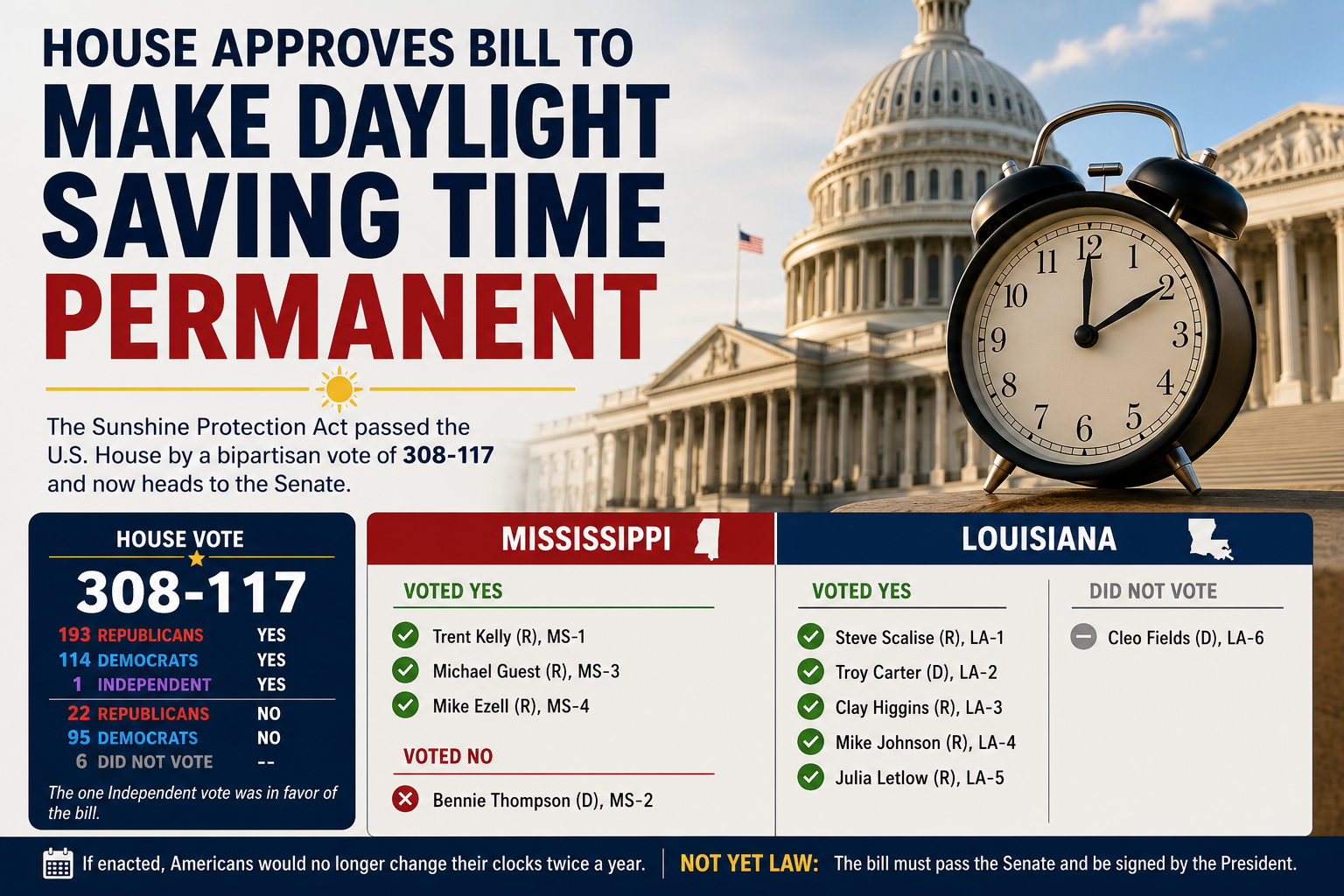
    Americans are one step closer to ending the twice-yearly ritual of changing their clocks after the U.S. House of Representatives approved legislation Tuesday that would make Daylight Saving Time permanent across most of the country.

    The Sunshine Protection Act (H.R. 139) passed the House by a 308-117 bipartisan vote. The legislation received support from 193 Republicans, 114 Democrats and one Independent, while 22 Republicans and 95 Democrats voted against it. Six members did not vote.

    If the bill ultimately becomes law, Americans would no longer “spring forward” each March or “fall back” each November. Instead, Daylight Saving Time would remain in effect year-round, eliminating the twice-yearly clock changes observed across most of the United States.

    The legislation now moves to the U.S. Senate. If approved there and signed by President Donald Trump, the change would take effect nationwide. Hawaii and most of Arizona, which already do not observe Daylight Saving Time, would remain exempt under current law.

    For residents across Mississippi, Louisiana and the rest of the Miss-Lou, the most noticeable change would come during the winter months. Sunset would occur about an hour later, providing more daylight in the evening for commuting, shopping, youth sports and outdoor recreation. The tradeoff would be darker mornings, with sunrise occurring roughly an hour later than it does under the current system.

    Supporters of the legislation say eliminating the twice-yearly clock changes would end a practice many Americans find inconvenient while providing additional evening daylight that could benefit businesses, recreation and tourism. They also point to studies suggesting the seasonal clock changes can temporarily disrupt sleep schedules and daily routines.

    Opponents, however, argue permanent standard time is better aligned with the body’s natural circadian rhythm and have expressed concerns that darker winter mornings could affect schoolchildren waiting for buses and morning commuters traveling before sunrise.

    Congress has debated ending the clock changes for years. In 2022, the Senate unanimously approved a similar version of the Sunshine Protection Act, but the measure never received a vote in the House before the end of that congressional session. The current bill must still clear the Senate before it can become law.

    How Mississippi and Louisiana’s Representatives Voted

    Mississippi’s congressional delegation largely supported the Sunshine Protection Act, with Rep. Bennie Thompson casting the state’s only “no” vote. In Louisiana, every representative who voted supported the measure, while Rep. Cleo Fields did not cast a vote.

    Mississippi

    Voted Yes

    • Trent Kelly (R), Mississippi’s 1st District
    • Michael Guest (R), Mississippi’s 3rd District
    • Mike Ezell (R), Mississippi’s 4th District

    Voted No

    • Bennie Thompson (D), Mississippi’s 2nd District

    Louisiana

    Voted Yes

    • Steve Scalise (R), Louisiana’s 1st District
    • Troy Carter (D), Louisiana’s 2nd District
    • Clay Higgins (R), Louisiana’s 3rd District
    • Mike Johnson (R), Louisiana’s 4th District
    • Julia Letlow (R), Louisiana’s 5th District

    Did Not Vote

    • Cleo Fields (D), Louisiana’s 6th District

    The legislation is not yet law. Before any changes take effect, it must pass the U.S. Senate and then be signed by President Donald Trump.

    Until then, Americans—including residents throughout Mississippi, Louisiana and the Miss-Lou—should still plan to turn their clocks back one hour this November.

  • Writers Guild of America seeks to block Paramount’s buyout of Warner in latest merger challenge


    NEW YORK (AP) — The Writers Guild of America became the latest group to challenge Paramount’s $81 billion acquisition of Warner Bros. Discovery on Tuesday, filing a lawsuit that seeks to block the merger on the grounds it would cause “specific harm” to movie and TV writers working across the U.S.

    A Paramount-Warner merger “threatens the economic and creative health of the American entertainment industry,” reads Tuesday’s federal complaint, which was filed by both the Writers Guild of America West and Writers Guild of America East (jointly the WGA).

    The union argued that the merger would create less competitors and give the larger company “both the incentive and the ability” to lower wages and the number of projects that offer workers employment.

    “This proposed combined entity would be the largest employer of writers, with tremendous power to suppress our wages, eliminate opportunities for emerging writers, cut jobs across the industry, and produce less programming,” WGAE President Tom Fontana said in a statement.

    A Warner-Paramount tie-up would bring together two of the five last legacy studios in Hollywood. It would also mean putting Warner’s HBO Max, its libraries filled with popular titles like “Harry Potter” and even CNN under the same roof of Paramount-owned CBS, movies like “Top Gun” and the Paramount+ streaming service.

    Tuesday’s complaint alleges that the merger violates antitrust law by reducing competition in three markets for writers: writing for episodic TV and streaming series, TV writing deals overall and screenwriting for the biggest theatrical films.

    In response, Skydance-owned Paramount maintained that a combined Warner-Paramount would allow the company to “expand opportunities for writers, not shrink them.” It also reiterated pledges to release at least 30 movies a year with a 45-day window exclusive to theaters — and said it would continue to commission from independent production companies while maintaining “two distinct film studios.”

    “A stronger Hollywood only means something if it’s stronger for the writers who power it,” the company said in a statement.

    The WGA’s complaint arrives a day after 12 states, led by California Attorney General Rob Bonta, filed a lawsuit challenging the deal, alleging that it would “extinguish competition” in Hollywood and lead to fewer choices for moviegoers and cable TV customers nationwide.

    The coalition of states called on Warner and Paramount to not close the merger until after a court had time to “fully evaluate” their claims. But they said the companies quickly refused — and late Monday night, the group filed an emergency motion in federal court seeking a temporary restraining order and preliminary injunction aimed at immediately halting the deal.

    Paramount on Monday called the states’ claims “wrong on both the facts and the law” and vowed to “vigorously defend” its Warner acquisition.

    The growing list of legal challenges could become a roadblock in Paramount’s quest to complete its purchase of Warner. Other regulatory reviews are ongoing in the European Union and in the U.K., which has suggested it may intervene. But Paramount has also racked up effective green lights from a handful of other countries, including the Trump administration in the U.S., China, Canada and Australia.

    Paramount and Warner have hoped to close their deal sometime in the third quarter of this year. In Monday night’s motion seeking an immediate pause, the states said the companies may try to complete the process as early as July 22.

    Including debt, Paramount’s proposed purchase of Warner is valued at nearly $111 billion based on outstanding shares.


  • Hilton Grand Vacations fires employee who sent racial slur via social media to Aces’ Chelsea Gray


    LAS VEGAS (AP) — Hilton Grand Vacations has fired an employee who sent a racial slur via social media to Las Vegas Aces guard Chelsea Gray following the team’s 109-75 loss to the Indiana Fever on Sunday.

    The 33-year-old Gray posted the message she received that included a racial slur on her Instagram story on Monday. Hilton Grand Vacations confirmed to The Associated Press on Tuesday that the individual who messaged Gray is no longer employed with Hilton Grand Vacations.

    “The person responsible for posting this information is no longer with the company,” Hilton Grand Vacations said in a statement. “His behavior was in violation of multiple company policies and does not reflect our company’s values in any way.”

    The Aces did not immediately respond to a request for comment. In March, the WNBA and its players’ union agreed on a transformational new collective bargaining agreement. It sought to enhance security, improve technological support, reinforce mental health resources, enforce a stronger fan code of conduct and protect players through an anti-hate campaign.

    But, the harassment Gray faced comes in the aftermath of Phoenix Mercury forward Alyssa Thomas saying she also received racial slurs. Thomas said she received death threats as well following her one-game suspension after she made contact with her fist to Caitlin Clark’s throat during a 111-109 win against the Fever.

    Thomas also criticized WNBA Commissioner Cathy Engelbert for not doing more to protect the league’s players when she spoke with reporters in June at the team’s practice facility.

    “It’s unfortunate that it’s come to this over basketball,” Thomas said. “A lot of us — myself included — didn’t even know the play took place until after the game. Now we’re being painted as thugs. There’s death threats out on us. It’s really unacceptable. It’s something that needs to change in this league and I’m just really sick and tired of it.”

    ___

    AP WNBA: https://apnews.com/hub/wnba-basketball


  • Duchess of Sussex earns a Daytime Emmy nomination for Netflix’s ‘With Love, Meghan’


    LOS ANGELES (AP) — Meghan, the Duchess of Sussex, has earned a Daytime Emmy nomination for her Netflix show.

    The former actor who married Britain’s Prince Harry in 2018 was nominated in the outstanding lifestyle program category for “With Love, Meghan” on Tuesday.

    The show is competing against “A Different Breed,” “George to the Rescue,” “The Motherhood,” and “The Wizard of Paws.”

    The 53rd annual Daytime Emmy Awards will be presented Oct. 30 at the Hollywood Palladium.

    The Duchess of Sussex’s show featured cooking, entertaining and gardening segments and included appearances by celebrities like Chrissy Teigen and Mindy Kaling, and a cameo by her husband, Prince Harry. The show aired for two seasons in 2025 and had a holiday special.

    Then known as Meghan Markle, she starred in the legal drama “Suits” from 2011 to 2018, before leaving to marry into the royal family.

    CBS received a leading 48 nominations.

    The nominees for daytime drama series are: “Beyond the Gates,” “Days of Our Lives,” “General Hospital,” and “The Young and the Restless.”

    The nominees for lead actress in a daytime drama series are Stacy Haiduk of “Days of Our Lives,” Karla Mosley of “Beyond the Gates,” Michelle Stafford of “The Young and the Restless,” Heather Tom of “The Bold and the Beautiful,” and Tamara Tunie of “Beyond the Gates.”

    Eric Braden of “The Young and the Restless” is among the lead actor nominees. He’s joined by Steve Burton of “General Hospital,” Scott Clifton of “The Bold and the Beautiful,” Thorsten Kaye of “The Bold and the Beautiful,” and Christian Jules Le Blanc of “The Young and the Restless.”

    The daytime talk series nominees are “3rd Hour of Today,” “The Drew Barrymore Show,” “ The Kelly Clarkson Show,” “Live with Kelly and Mark,” “TODAY with Jenna & Friends,” and “The View.”

    Clarkson is among the nominees for daytime talk series host. The others are Joy Behar, Whoopi Goldberg, Alyssa Farah Griffin, Sara Haines, Sunny Hostin & Ana Navarro of “The View,” Tamron Hall, Jennifer Hudson, and Sherri Shepherd.

    Clarkson is ending her seven-season run this fall, while Shepherd’s show was canceled in May after four seasons.

    ABC’s “The View” has been in the crosshairs of federal regulators who want to reopen the debate of whether it is subject to equal-time rules.


  • Wolves believe LaMelo Ball’s pure point guard play and joyful style will ‘elevate’ their entire team


    MINNEAPOLIS (AP) — LaMelo Ball came to Minnesota at a steep price.

    The opportunity with a cost of two proven power forwards and multiple draft picks was deemed worthwhile by the Timberwolves in their ongoing attempt to make the last and most difficult step toward an NBA title.

    “I think he’ll elevate us,” president of basketball operations Tim Connelly said, “and our environment will be conducive to his continued growth as well.”

    Eager to gain one of the league’s true point guards and lessen the ballhandling and playmaking burden on superstar Anthony Edwards, the Wolves had to swallow hard and surrender valuable assets.

    Completing a complicated four-team trade with Brooklyn, Charlotte and Chicago, Minnesota acquired Ball and guard Josh Green and sent fan favorite Naz Reid and a package of draft picks — a 2033 unprotected first-rounder, first-round swaps in 2028, 2029 and 2030, and second-rounders in 2029, 2032 and 2033 — to the Hornets.

    Second-leading scorer Julius Randle went to the Nets, who swapped the 28th overall selection in the draft last month for No. 33 that landed the Wolves guard Isaiah Evans. That first part of the trade also created the salary cap space necessary for the Wolves to re-sign guard Ayo Dosunmu.

    Edwards was the first overall pick in the 2020 draft. Ball went third. Green was the 18th selection by Dallas and McDaniels was 28th, giving the Wolves four first-round picks from that year.

    “Well, we have none for the next 10 years,” Connelly quipped at the introductory news conference for Ball and Green on Tuesday at Target Center. “It’s all about quality, not quantity, right?”

    All four of those 2020 draftees are still 25 and younger, giving the Wolves confidence they’ll continue to contend — “bites at the apple” is Connelly’s description — as long as Edwards is on their roster.

    “I’ve known Ant for a minute, so we’ve been talking,” Ball said. “Everybody’s excited, and we’re ready to get to work.”

    Ball played in only 43% of the games over a three-year stretch from 2022-25 before a promising 2025-26 season that helped propel the Hornets into the play-in games. He has shown a recklessness on and off the court at times, too. But the Wolves will give him a stronger team around him than he ever had with the Hornets, and six years into his NBA career the 6-foot-7 Ball is still just 24.

    “You’ve got to have a big backcourt. We learned that through the playoffs this year,” Wolves coach Chris Finch said.

    The flip side of Ball’s penchant for undisciplined or flashy plays is a carefree style the Wolves could use. One of the undercurrents of their underachieving season that ended with a second-round loss to San Antonio was a moodiness that became part of their collective personality. Too many players took too long to shake off unproductive games or frustrating stretches.

    “This is supposed to be fun,” Connelly said. “He enjoys life. He enjoys playing. You don’t want to make this anything but where it’s a joyous atmosphere.”

    Minnesota’s long-shot pitch for LeBron

    The void left by the departure of Randle and Reid could be filled rather neatly by a certain free agent who has included the Wolves on his list of teams worth considering. Meet Minneapolis, the city’s tourism arm, even took out digital billboards in Los Angeles to add a light-hearted element to the pitch for LeBron James.

    But even if the NBA’s all-time leading scorer is unlikely to land in Minnesota for his 24th season, the Wolves have found satisfaction in the widespread notion around the league they might well provide the best on-court fit for James next to Edwards, Ball and McDaniels with veteran defensive whiz Rudy Gobert at the rim.

    “This is a place where you’re going to have a lot of fun and win a lot of games. We’re trying to change the narrative of how this organization is viewed. We’re kind of proud of who we are, and certainly, wherever LeBron ends up, he’s going to make that place much, much better,” Connelly said. “I like who we are and we’re pretty proud of who we are. Hopefully that’s appealing, not just to LeBron, but to any free agent.”

    ___

    AP NBA: https://apnews.com/hub/NBA


  • Scottish traffic cone gets dignitary’s welcome in Boston after World Cup friendship


    BOSTON (AP) — Fresh off its first-class flight from Glasgow, it received a reception befitting a visiting dignitary: a bagpiper in full regalia playing inside Boston Logan International Airport. Waiting to greet it were diplomats, the governor and Boston’s mayor.

    The guest of honor? An orange traffic cone.

    Tuesday’s arrival of the “Boston Cone” marked the latest chapter in the city’s unlikely love affair with Scotland’s Tartan Army, whose habit of placing traffic cones atop statues during last month’s World Cup turned the humble orange cone into one of the tournament’s defining symbols.

    “I have to admit, this is probably — yes, it is — my first official welcoming ceremony for a traffic cone,” Massachusetts Gov. Maura Healey said in the airport’s Terminal E, before signing her name to the cone. “But it’s a pretty special one, isn’t it? Because this cone tells the story of what happened this summer. What happened in Boston, what happened in Massachusetts.”

    “And special thanks to the Scots for drinking all the beer,” she added to laughter. “I do promise you, when you return … we will never again run out of beer in Massachusetts.”

    During Scottish fans’ World Cup visit, Boston bars struggled to keep up with the Tartan Army’s thirst, with some running out of beer and scrambling for emergency deliveries. The fans transformed parts of Boston into an unofficial outpost of Scotland, filling downtown with bagpipes, songs and chants while bright orange traffic cones sprouted atop some of the city’s most recognizable landmarks — from Samuel Adams outside Faneuil Hall to Red Auerbach outside TD Garden, former Mayor Kevin White near Quincy Market and even the beloved Make Way for Ducklings statues in the Public Garden.

    “There are still some traffic cones atop our most important statues,” Boston Mayor Michelle Wu joked Tuesday, recalling how Boston had “unofficially become New Scotland.”

    The official commemorative cone, decorated with illustrations celebrating Boston and Scotland and the slogan “No Boston, No Party,” will spend the next week visiting landmarks across Massachusetts to raise money for mental health charities before returning home to Scotland.

    The tradition dates to Glasgow, where placing bright orange traffic cones atop public statues began as a late-night prank in the 1980s before evolving into an unofficial symbol of the country’s irreverent humor. The best-known example is the Duke of Wellington statue in the city center, where the cone has become so iconic that repeated efforts to remove it have been met with public opposition.

    “It’s an in-joke that’s gone too far, actually,” one of the cone’s Scottish escorts, Danny Campbell, said, laughing as he stood beside the cone in a kilt. “But no, it isn’t a joke. This is a metaphor for life.”

    Campbell said people can become consumed by “going to our jobs and cooking sausages and all the sort of serious stuff that adults have to do” and lose sight of what matters.

    “That’s what our countrymen represented when they came here,” he said, speaking of Scottish fans’ stay in Boston. “They left stomachs and cheeks sore from laughing, they cleaned up after themselves, they spread joy and these people came together with humor and they built relationships with each other.”

    “This is not just a silly cone,” Campbell said. “It means love. It means love, and that is the whole point.”


  • Man fleeing immigration officers in Florida is struck and killed by tractor trailer, police say


    A man running from an encounter with immigration and other federal agents in Florida was struck and killed by a tractor trailer on Tuesday, authorities said.

    It was the third death in a week involving encounters with U.S. Immigration and Customs Enforcement agents, following shootings in Texas and Maine.

    The 28-year-old was among four occupants of a vehicle that stopped in the parking lot of a gas station and convenience store in the St. Augustine area before 7 a.m. During an encounter with agents from ICE and Homeland Security Investigations, the four fled on foot, with one darting across a busy road into the path of the semi, Florida Highway Patrol Sgt. Dylan Bryan said in an emailed statement.

    The driver of the semi stopped and tried to help the man, Bryan said.

    It was at least the 10th death involving encounters with immigration agents since President Donald Trump launched his mass deportation campaign last year.

    It wasn’t immediately clear what prompted the encounter Tuesday. In an emailed statement, the Department of Homeland Security confirmed it had conducted an operation and said the Florida Highway Patrol and Homeland Security Investigations were “investigating an incident resulting in the death of a Mexican national.”

    The department did not respond to an inquiry from The Associated Press about the status of the other three occupants of the vehicle.

    State Rep. Angie Nixon, a Democrat from Jacksonville, called the death a tragedy that resulted from an out-of-control agency.

    “Whether it’s ICE agents gunning down a father in the streets of Houston, shooting a young man in Maine or conducting operations right here in Northeast Florida that result in a deadly crash, the outcome is the same: fear, chaos and death,” she said.

    In two other cases, people died after fleeing agents and being struck by vehicles.

    Last summer, a man running from immigration officers outside a Home Depot store in southern California died after being hit by an SUV as he tried to cross a freeway. Homeland Security officials said that 52-year-old Roberto Carlos Montoya Valdez, of Guatemala, was not being pursued by immigration authorities when he was struck.

    In October, a pickup truck fatally struck 24-year-old gardener Josué Castro Rivera, of Honduras, on a highway in Norfolk, Virginia, as he tried to escape authorities during a traffic stop. Authorities said Castro Rivera’s vehicle was stopped as part of a “targeted, intelligence-based” operation and that Castro Rivera had “resisted heavily and fled.”

    The Mexican government on Tuesday said it had asked state attorneys general in the U.S. to review the deaths of migrants in ICE custody or during raids for possible criminal prosecution.