Tag: covid-19

  • Louisiana Virus Cases Jump To 347, Spread To Rural Areas

    Louisiana Virus Cases Jump To 347, Spread To Rural Areas

    BATON ROUGE (AP) — The number of people known to be infected with the new coronavirus in Louisiana jumped to 347 in figures the state posted Thursday, up from 280 a day earlier.

    The death toll stood at eight with the latest victim, a resident of St. James Parish.

    The latest numbers showed New Orleans still leading the state in the number of people testing positive for the virus that causes the COVID-19 disease, which has been linked to eight Louisiana deaths. There were 231 cases there as of Thursday morning. Tulane Health System in New Orleans said in a news release it planned to shut down an emergency room in the suburb of Metairie on Friday to move staff to its downtown New Orleans campus to deal with “a surge of COVID-19 and suspected COVID-19 patients.”

    Add in neighboring Jefferson Parish with 62 cases, and the cases in other surrounding parishes and the New Orleans metropolitan area had significantly more cases – 315 — than any other metro area in the South, an Associated Press analysis of state health department data shows.

    The Atlanta and Miami metro areas – both with more than 200 cases – are also among communities with soaring numbers. The numbers were tallied from state data using the U.S. Office of Management and Budget’s classification of Metropolitan Statistical Areas.

    But the virus was also evident in other parts of the state, showing up in 17 of Louisiana’s 64 parishes, including northwestern Louisiana’s Bossier and Caddo, with two and seven respectively; southwestern Louisiana’s Lafayette, with 2; East Baton Rouge, with 5.

    Coastal Plaquemines Parish at Louisiana’s southeastern tip, which includes the New Orleans suburban city of Belle Chasse and vast rural landscapes, reported its first case late Wednesday.

    The vast majority of people recover within weeks after catching this virus, and for most people, it causes only mild or moderate symptoms, such as fever and cough. But for older adults and people with existing health problems, it can cause severe illness requiring hospitalization.

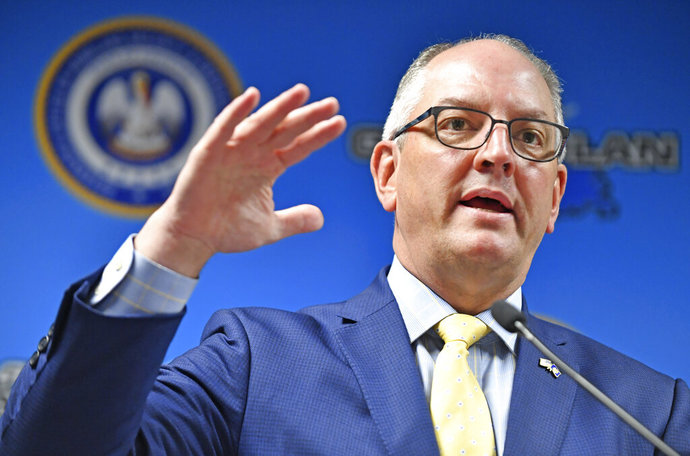
    Gov. John Bel Edwards cautioned Louisianans to get ready for a surge in coronavirus cases as testing capacity grows statewide.

    Edwards has closed K-12 public schools, bars, gyms, casinos and movie theaters and has limited restaurants to delivery and takeout until at least April 13. Public gatherings of more than 50 people are banned. New Orleans Mayor LaToya Cantrell has prohibited all public and private gatherings.

    Small businesses struggling with virus-related restrictions will be eligible to apply for low-interest federal disaster loans. Edwards announced Thursday that Louisiana won federal approval for its request to make the U.S. Small Business Administration aid available in all 64 parishes.

    Four of the people who died from the virus lived in the New Orleans retirement home Lambeth House, which has seen a cluster of cases. There have been two other New Orleans deaths, one in Jefferson Parish and the death of a 60-year-old person reported Thursday in St. James.

    Insurance Commissioner Jim Donelon issued new regulations requiring health insurers to waive co-pays and deductibles for COVID-19 testing, and banning insurers from requiring prior authorization for testing ordered by doctors. Insurers also must allow early refills of most non-opioid medications.

    Louisiana was readying several state parks to house people who have tested positive for the coronavirus and don’t need hospitalization, but can’t return home because of elderly relatives, homelessness or other reasons. Already, at least 10 people infected with the virus were staying at Jefferson Parish’s Bayou Segnette State Park, Edwards said.

    Also, Republican Rep. Steve Scalise, of Jefferson Parish, announced he now must work remotely on the national coronavirus response because he had an “extended meeting” last week with Rep. Mario Díaz-Balart of Florida, who tested positive. Scalise said he does not have any COVID-19 symptoms, but is self-isolating out of caution.

    ___

    McGill reported from New Orleans. Associated Press writer Jeff Martin in Atlanta contributed to this report.

    ___

    The Associated Press receives support for health and science coverage from the Howard Hughes Medical Institute’s Department of Science Education. The AP is solely responsible for all content.

    ___

    Follow AP coverage of the virus outbreak at https://apnews.com/VirusOutbreak and https://apnews.com/UnderstandingtheOutbreak.

  • Italian death toll overtakes China’s as virus spreads

    ROME (AP) — The death toll in Italy from the coronavirus overtook China’s on Thursday in a stark illustration of how the outbreak has pivoted toward Europe and the United States.

    Italy, with a population of 60 million, recorded at least 3,405 deaths, or roughly 150 more than in China — a country with a population over 20 times larger.

    Italy reached the bleak milestone the same day that Wuhan, the Chinese city where the coronavirus first emerged three months ago, recorded no new infections, a sign that the communist country’s draconian lockdowns were a powerful method to stop the virus’ spread.

    On Thursday, a visiting Chinese Red Cross team criticized Italians’ failure to properly quarantine themselves and take the national lockdown seriously.

    Meanwhile, the damage to the world’s largest economy kept piling up, with unemployment claims surging in the United States, while the virus appeared to be opening an alarming new front in Africa, where in less than three weeks it has spread to 35 countries.

    The epidemic has also now reached at least one European head of state, 62-year-old Prince Albert II of the tiny principality of Monaco. The palace announced that he tested positive for the virus but was continuing to work from his office and was being treated by doctors from Princess Grace Hospital, named after his American actress mother.

    In the U.S., Congress rushed to pass a $1 trillion emergency package to shore up the sinking economy and help households pull through the crisis, with the first of two possible rounds of relief checks consisting of payments of $1,000 per adult and $500 for each child.

    The worldwide death toll crept toward 10,000 as the total number of infections topped 220,000, including nearly 85,000 people who have recovered.

    French Prime Minister Edouard Philippe pleaded with people to keep their distance from one another to avoid spreading the virus, even as the crisis pushed them to seek comfort.

    “When you love someone, you should avoid taking them in your arms,” he said in Parliament. “It’s counterintuitive, and it’s painful. The psychological consequences, the way we are living, are very disturbing — but it’s what we must do.”

    The American death toll rose to 160, primarily elderly people.

    Health authorities have cited a variety of reasons for Italy’s high toll, key among them its large population of elderly people, who are particularly susceptible to serious complications from the virus, though severe cases have also been seen in younger patients. Italy has the world’s second-oldest population, and the vast majority of its dead — 87% — were over 70.

    Jonas Schmidt-Chanasit, a virologist at Germany’s Bernhard Nocht Institute for Tropical Medicine, said Italy’s high death rate could be explained in part by the almost total breakdown of the health system in some areas.

    “That’s what happens when the health system collapses,” he said.

    On a visit to the northern city of Milan, the head of a Chinese Red Cross delegation helping advise Italy said he was shocked to see so many people walking around, using public transportation and eating out.

    Sun Shuopeng said Wuhan saw infections peak only after a month of a strictly enforced lockdown.

    “Right now we need to stop all economic activity and we need to stop the mobility of people,” he said. “All people should be staying at home in quarantine.”

    Aside from the elderly and the sick, most people have mild or moderate symptoms, like a fever or cough, and most recover in a matter of weeks.

    Spain has been the hardest-hit European country after Italy, and in Madrid a four-star hotel began operating as a makeshift hospital for coronavirus patients.

    The director of the group that runs the Ayre GH Colon hotel tweeted: “365 rooms more to help win the war.” The Madrid Hotel Business Association said it has placed 40 hotels with room for 9,000 people at the service of the Madrid region, which has near half of Spain’s 17,000 or so cases.

    In London, home to almost 9 million, the government urged people to stay off public transportation as authorities considered imposing tougher travel restrictions.

    The British supermarket chain Sainsbury’s reserved the first hour of shopping for vulnerable customers, one of many such efforts around the world.

    Jim Gibson, 72, of London, said he found most of his groceries there in a “relatively trauma-free” experience. But he fretted that he hadn’t been able to get the medicine he needed for his wife and himself, and expressed concerns that Britain’s government had been too slow in ramping up testing.

    “You can’t go on ignoring World Health Organization guidelines — if they’re wrong, who the hell is right?” he said. “Let’s have no shilly-shallying.”

    The British government, which was slow to react to the virus, has shifted gears and is now drawing up legislation giving itself new powers to detain people and restrict gatherings. The bill is expected to be approved by Parliament next week.

    Thursday marked the first time since Jan. 20 that Wuhan showed no new locally transmitted cases, a rare glimmer of hope and perhaps a lesson in the strict measures needed to contain the virus.

    Wuhan, which has been under a strict lockdown since January, once was the place where thousands lay sick or dying in hurriedly constructed hospitals. But Chinese authorities said all 34 new cases recorded over the previous day had come from abroad.

    “Today, we have seen the dawn after so many days of hard effort,” said Jiao Yahui, a senior inspector at the National Health Commission.

    Meanwhile, the World Health Organization warned that the virus is spreading quickly in Africa — an especially alarming development, given the poor state of health care in many of its countries.

    “About 10 days ago we had about five countries” with the virus, said WHO’s Africa chief, Dr. Matshidiso Moeti. Now 35 of Africa’s 54 countries have cases, with the total close to 650. It is an “extremely rapid evolution,” she said. The first sub-Saharan Africa case was announced Feb. 28.

    European stock markets were up only slightly after losses in Asia despite a massive 750 billion-euro stimulus package announced overnight by the European Central Bank.

    Wall Street was calm in early trading by the standards of the past few days, when traders — weighing the increasing likelihood of a recession against the huge economic support pledged by global authorities — have caused wild swings.

    With wide swaths of the U.S. economy grinding to a halt, the number of Americans filing for unemployment benefits surged by 70,000 last week, more than economists expected.

    The U.S. Federal Reserve unveiled measures to support money-market funds and borrowing as investors worldwide rush to build up dollars and cash.

    Ford, General Motors and Fiat Chrysler, along with Honda and Toyota, announced on Wednesday that they would close all of their factories in the U.S., Canada and Mexico. The shutdown of Detroit’s Big Three alone will idle about 150,000 workers.

    More borders closed, leaving tens of thousands of tourists wondering how they would get home. In the Pacific, Australia and New Zealand shut out tourists.

    Iran’s Supreme Leader Ayatollah Ali Khamenei planned to pardon 10,000 more prisoners — including an unknown number of political detainees— to combat the virus. The country, where more than 1,100 people have already died, previously freed 85,000 prisoners on temporary leave.

    In Austria, the province of Tyrol put 279 municipalities under quarantine because of a large number of infections, barring people from leaving towns or villages except to go to work.

  • Mississippi Public Schools Closed Until Mid-April To Slow Virus

    Mississippi Public Schools Closed Until Mid-April To Slow Virus

    JACKSON, Miss. (AP) — Mississippi public schools will be closed until at least April 17 to curb the spread of the new coronavirus, Gov. Tate Reeves said Thursday.

    He said schools will continue to receive state money and teachers will continue to be paid. He said he wants students to continue learning.

    “This is not a time to take a vacation,” Reeves said in a Facebook live presentation from the Governor’s Mansion.

    Reeves said he will also relax end-of-year testing requirements and school accountability measures. He said the state Board of Education will have “maximum flexibility” to waive rules.

    Mississippi reported 50 confirmed cases of the virus as of Thursday, up from 34 Wednesday. The state Health Department said 602 people had been tested in Mississippi by Thursday.

    The vast majority of people infected with this novel coronavirus get only mild or moderate symptoms, such as fever and cough, and recover in about two weeks. But many will need hospitalization — particularly vulnerable are older adults and those with existing health problems who can develop severe complications, including pneumonia.

    Some communities in Mississippi are temporarily shutting down bars and telling restaurants to close their dining rooms to try to slow the spread of the virus.

    Jackson Mayor Chokwe Antar Lumumba issued an order prohibiting gatherings of 10 or more people.

    “The city of Jackson does not have the luxury of a wait-and-see approach to the coronavirus pandemic,” the order says.

    The University of Mississippi Medical Center in Jackson working to develop its own coronavirus test amid high demand for test kits nationwide, and it is increasing its telehealth capacity to screen patients remotely.

    The medical center’s head of emergency medicine, Dr. Alan Jones, said it’s “very important” that people not go to an emergency room if they think they have symptoms. Instead, they should first use a telephone or telehealth service to get advice on what to do.

    “We are ramping up all of our contingency planning to prepare for a tidal wave of patients that we know is about to hit us,” Jones said Wednesday.

    ___

    The Associated Press receives support for health and science coverage from the Howard Hughes Medical Institute’s Department of Science Education. The AP is solely responsible for all content.

    ___

    Follow AP coverage of the virus outbreak at https://apnews.com/VirusOutbreak and https://apnews.com/UnderstandingtheOutbreak

  • How Long Will Americans Be Fighting The Coronavirus?

    How Long Will Americans Be Fighting The Coronavirus?

    WASHINGTON (AP) — In a matter of days, millions of Americans have seen their lives upended by measures to curb the spread of the new coronavirus.

    Normally bustling streets are deserted as families hunker down in their homes. Many of those who do venture out try to stay a safe distance from anyone they encounter, even as they line up to buy now-precious commodities like hand sanitizer. Parents juggle childcare as schools close, perhaps for the rest of the school year. And restaurants and bars sit empty as more and more convert to delivery-only options.

    How long will this last? Scientists say there isn’t a simple answer.

    “In many ways, this situation is unprecedented – we’re trying to take some actions to curb the spread and timing of this pandemic,” said Stephen Morse, a disease researcher at Columbia University in New York.

    Yes, there have been past disease outbreaks that scientists can draw some lessons from but, in those cases, the disease was largely allowed to run its course. “So those models don’t precisely apply,” Morse said.

    On Monday, President Donald Trump said the U.S. may be managing the outbreak through July or August. And New York Governor Andrew Cuomo said the state’s number of coronavirus cases may peak – not end – in 45 days.

    The overall message is that the country will be fighting the virus outbreak for a matter of months, at least, not days or weeks.

    Each model of how the disease could spread relies on data and assumptions about population dynamics, demographics, health care capacity and other factors, said Rebecca Katz, a public health expert at Georgetown University.

    The challenge for designing models of what will happen next in the U.S. is that limited testing for COVID-19 means researchers don’t know what the starting point is — how many people are already infected.

    In simplest terms, scientists say that the epidemic will slow when people with infections don’t pass the virus on to others.

    “Basically, if I infect one other person or more … then the epidemic can take off. If I infect less than one person and everybody infects less than one person, then the epidemic will decline,” said Elizabeth Halloran, a disease researcher at the University of Washington.

    Based on data from China and from cruise ships, scientists estimate that unless measures are taken to limit the spread, each infected person will infect about 2 or 3 others, leading to an exponential growth of the virus.

    If the virus makes a jump to new person every two to five days, as scientists calculate, then a single infected person could lead to 4,142 total infections within a month — assuming nothing is done to break chains of transmission.

    Unless such measures are put in place, scientists estimate that between 40 and 80% of the global population could become infected. Based on an analysis of data from China, scientists found that the majority of new infections are transmitted by people with mild symptoms who may not even know they’re ill, said Jeffrey Shaman, a public health expert at Columbia University.

    Even if most people recover and only a fraction of total infections are severe enough to require hospitalization — about 14%, scientists estimate — the sheer scale of the epidemic will put enormous strain on hospitals, healthcare workers and other patients who may see unrelated procedures delayed.

    Scientists now agree that measures to break or slow the chains of transmission are crucial to ensure that emergency rooms aren’t quickly overwhelmed by surges in critically ill patients.

    If measures like closing schools are successful in slowing disease spread, “we are going to see a hump instead of a peak” in new cases, U.S. government disease expert Dr. Anthony Fauci said in a White House briefing.

    In other words, the number of infections will rise more gradually and manageably. But that also means the duration of the outbreak will be prolonged.

    “The point of the restrictions we have is actually to stretch this out even longer. We don’t want a big peak to come very quickly,” said Mark Jit, a disease researcher at the London School of Hygiene and Tropical Medicine. “It’s not like a Hollywood movie with a clear ending where everyone is saved, or everyone dies, quickly.”

    So how does this end?

    Most scientists believe the fight against COVID-19 won’t be over until there’s an effective vaccine. But Fauci and other experts say it will be more than a year before a vaccine can be ready for widespread use.

    “The best-case scenario is that we have vaccine in 12 or 18 months and then our lives go back to normal,” Jit said. “The worst-case scenario it takes a long time for a vaccine to be developed, and the world is really changed and our lives aren’t the same again.”

    While we wait, are we all shut-ins for more than a year? Almost no one thinks that’s realistic.

    “I don’t think we can maintain social distancing as it is right now for the duration of the epidemic,” said Michael Levy, a University of Pennsylvania disease researcher.

    What may be more feasible is a plan for intermittent restrictions and enhanced monitoring to control the disease, an idea explored in a new study from researchers at Imperial College London. Once the number of new cases falls below a certain threshold, schools, offices and restaurants could reopen. But if the number of infections spikes again, restrictions would be reinstated.

    “The analogy of pumping car brakes on an icy road is what we should be thinking about,” Levy said. “You push on the brakes to slow things down, then ease up – but if you skid, you have to pump the brakes again.”

    ___

    Follow Christina Larson on Twitter: @larsonchristina

    Smith reported from Providence, R.I.

    ___

    The Associated Press receives support for health and science coverage from the Howard Hughes Medical Institute’s Department of Science Education. The AP is solely responsible for all content.

  • Italian virus death toll nears China’s as outbreak spreads

    ROME (AP) — The Chinese city where the coronavirus first took hold reported no new homegrown cases Thursday, while the death toll in Italy was poised to overtake that of China in a dramatic illustration of how the outbreak has pivoted toward Europe and the United States.

    The worldwide death toll crept toward 10,000 as the total number of infections topped 220,000, including nearly 85,000 people who had recovered.

    French Prime Minister Edouard Philippe pleaded for people to keep their distance from one another to avoid spreading the virus, even as the crisis pushed them to seek comfort.

    “When you love someone, you should avoid taking them in your arms,” he said in parliament. “It’s counterintuitive, and it’s painful; the psychological consequences, the way we are living, are very disturbing — but it’s what we must do.”

    Italy, a country of 60 million, registered 2,978 deaths Wednesday after another 475 people died. Given that Italy has been averaging more than 350 deaths a day since March 15, it’s likely to overtake China’s 3,249 dead — in a country of 1.4 billion — when Thursday’s figures are released at day’s end.

    U.N. and Italian health authorities have cited a variety of reasons for Italy’s high toll, key among them its large elderly population that is particularly susceptible to developing serious complications from the virus. Italy has the world’s second oldest population after Japan’s and the vast majority of Italy’s dead — 87% — were over age 70.

    The American death toll rose to 149, primarily elderly people.

    Jonas Schmidt-Chanasit, a virologist at Germany’s Bernhard Nocht Institute for Tropical Medicine, said Italy’s high death rate could be explained in part by the almost total collapse of the health system in some parts.

    “And then people die who wouldn’t have died with timely intervention,” he said. “That’s what happens when the health system collapses.”

    A total of 222,642 cases have been reported worldwide, with 9,115 deaths and 84,506 recoveries, according to a tally kept by Johns Hopkins University. Aside from the elderly and the sick, most people only have mild or moderate symptoms, like a fever or cough.

    Spain has been the hardest hit European country after Italy, and in Madrid a four-star hotel began operating as a makeshift hospital for coronavirus patients.

    The director of the group that runs the Ayre GH Colon hotel tweeted: “365 rooms more to help win the war.” The Madrid Hotel Business Association says it has placed 40 hotels with room for 9,000 people at the service of the Madrid region, which has near half of Spain’s some 17,000 cases so far.

    In London, home to almost 9 million, the government urged people to stay off public transportation as authorities considered imposing tougher travel restrictions.

    The British supermarket chain Sainsbury’s reserved the first hour of shopping for vulnerable customers, one of many such efforts around the world.

    Jim Gibson, 72, of southeast London, said he found most of his groceries there in a “relatively trauma-free” experience. But he fretted that he hadn’t been able to get the medicine he needed for his wife and himself, and expressed concerns that Britain’s Conservative government had been too slow in ramping up tests for the virus.

    “You can’t go on ignoring World Health Organization guidelines — if they’re wrong, who the hell is right? … and their thing is test, test, test,” he said. “Let’s have no shilly-shallying.”

    In a high-profile case, Michel Barnier, the European Union’s chief negotiator for its future relationship with Britain after Brexit, said he had been infected with the coronavirus.

    “I am following all the necessary instructions, as is my team,” the 69-year-old Barnier said in a tweet. “For all those affected already, and for all those currently in isolation, we will get through this together.”

    Thursday marked the first time the Chinese city of Wuhan, where the virus first emerged late last year, showed no new numbers since Jan. 20. The news offered a rare glimmer of hope and perhaps a lesson in the strict measures needed to halt its spread.

    Wuhan once was the place where thousands lay sick or dying in hurriedly constructed hospitals. But Chinese authorities said Thursday that all 34 new cases recorded over the previous day had been imported from abroad.

    “Today, we have seen the dawn after so many days of hard effort,” said Jiao Yahui, a senior inspector at the National Health Commission.

    Wuhan has been under a strict lockdown since January.

    While China did not report any new cases in Wuhan or Hubei province, it did record eight additional deaths.

    European stock markets were up only slightly after losses in Asia despite a massive 750 billion-euro stimulus package announced overnight by the European Central Bank. Oil dropped below $21 a barrel Wednesday for the first time since 2002, and rose slightly Thursday to $23.

    The United Nations warned that the crisis could lead to the loss of nearly 25 million jobs around the world.

    More borders shut, leaving tens of thousands of tourists wondering how they would get home. In the Pacific, Australia and New Zealand shut out tourists, allowing only citizens and residents to return, while Fiji reported its first virus case, a worrying development in a region with poor healthcare.

    Iran’s Supreme Leader Ayatollah Ali Khamenei planned to pardon 10,000 more prisoners — among them an unknown number of political detainees— to combat the coronavirus. The country, where more than 1,100 people have already died from the virus, has already released 85,000 prisoners on temporary leave.

    In Austria, the western province of Tyrol put 279 municipalities under quarantine in light of a large number of infections there, banning anyone from leaving towns or villages except to go to work.

    The U.S. and Canada both closed their borders to all but essential travel and U.S. President Donald Trump said he plans to assert extraordinary powers to immediately turn back to Mexico anyone who crosses over the southern border illegally.

    Russia and Mexico each reported their first death from the virus. Mexico closed its popular spring equinox visits to the Pyramids of the Sun and the Moon at Teotihuacan.

    In the U.S., Ford, General Motors and Fiat Chrysler, along with Honda and Toyota, said they will shut all of their factories in the U.S., Canada and Mexico. The closing of Detroit’s Big Three alone will idle about 150,000 workers.

    The U.S. has reported more than 9,400 coronavirus cases and at least 149 deaths, about half of them in Washington state, where dozens in a suburban Seattle nursing home have died.

    Scientists believe the true number of people infected in the United States is higher than reported because many mild cases may have gone unrecognized and the U.S saw delays in ramping up testing.

  • How Long Will Americans Be Fighting The Coronavirus?

    How Long Will Americans Be Fighting The Coronavirus?

    WASHINGTON (AP) — In a matter of days, millions of Americans have seen their lives upended by measures to curb the spread of the new coronavirus.

    Normally bustling streets are deserted as families hunker down in their homes. Many of those who do venture out try to stay a safe distance from anyone they encounter, even as they line up to buy now-precious commodities like hand sanitizer. Parents juggle childcare as schools close, perhaps for the rest of the school year. And restaurants and bars sit empty as more and more convert to delivery-only options.

    How long will this last? Scientists say there isn’t a simple answer.

    “In many ways, this situation is unprecedented – we’re trying to take some actions to curb the spread and timing of this pandemic,” said Stephen Morse, a disease researcher at Columbia University in New York.

    Yes, there have been past disease outbreaks that scientists can draw some lessons from but, in those cases, the disease was largely allowed to run its course. “So those models don’t precisely apply,” Morse said.

    On Monday, President Donald Trump said the U.S. may be managing the outbreak through July or August. And New York Governor Andrew Cuomo said the state’s number of coronavirus cases may peak – not end – in 45 days.

    The overall message is that the country will be fighting the virus outbreak for a matter of months, at least, not days or weeks.

    Each model of how the disease could spread relies on data and assumptions about population dynamics, demographics, health care capacity and other factors, said Rebecca Katz, a public health expert at Georgetown University.

    The challenge for designing models of what will happen next in the U.S. is that limited testing for COVID-19 means researchers don’t know what the starting point is — how many people are already infected.

    In simplest terms, scientists say that the epidemic will slow when people with infections don’t pass the virus on to others.

    “Basically, if I infect one other person or more … then the epidemic can take off. If I infect less than one person and everybody infects less than one person, then the epidemic will decline,” said Elizabeth Halloran, a disease researcher at the University of Washington.

    Based on data from China and from cruise ships, scientists estimate that unless measures are taken to limit the spread, each infected person will infect about 2 or 3 others, leading to an exponential growth of the virus.

    If the virus makes a jump to new person every two to five days, as scientists calculate, then a single infected person could lead to 4,142 total infections within a month — assuming nothing is done to break chains of transmission.

    Unless such measures are put in place, scientists estimate that between 40 and 80% of the global population could become infected. Based on an analysis of data from China, scientists found that the majority of new infections are transmitted by people with mild symptoms who may not even know they’re ill, said Jeffrey Shaman, a public health expert at Columbia University.

    Even if most people recover and only a fraction of total infections are severe enough to require hospitalization — about 14%, scientists estimate — the sheer scale of the epidemic will put enormous strain on hospitals, healthcare workers and other patients who may see unrelated procedures delayed.

    Scientists now agree that measures to break or slow the chains of transmission are crucial to ensure that emergency rooms aren’t quickly overwhelmed by surges in critically ill patients.

    If measures like closing schools are successful in slowing disease spread, “we are going to see a hump instead of a peak” in new cases, U.S. government disease expert Dr. Anthony Fauci said in a White House briefing.

    In other words, the number of infections will rise more gradually and manageably. But that also means the duration of the outbreak will be prolonged.

    “The point of the restrictions we have is actually to stretch this out even longer. We don’t want a big peak to come very quickly,” said Mark Jit, a disease researcher at the London School of Hygiene and Tropical Medicine. “It’s not like a Hollywood movie with a clear ending where everyone is saved, or everyone dies, quickly.”

    So how does this end?

    Most scientists believe the fight against COVID-19 won’t be over until there’s an effective vaccine. But Fauci and other experts say it will be more than a year before a vaccine can be ready for widespread use.

    “The best-case scenario is that we have vaccine in 12 or 18 months and then our lives go back to normal,” Jit said. “The worst-case scenario it takes a long time for a vaccine to be developed, and the world is really changed and our lives aren’t the same again.”

    While we wait, are we all shut-ins for more than a year? Almost no one thinks that’s realistic.

    “I don’t think we can maintain social distancing as it is right now for the duration of the epidemic,” said Michael Levy, a University of Pennsylvania disease researcher.

    What may be more feasible is a plan for intermittent restrictions and enhanced monitoring to control the disease, an idea explored in a new study from researchers at Imperial College London. Once the number of new cases falls below a certain threshold, schools, offices and restaurants could reopen. But if the number of infections spikes again, restrictions would be reinstated.

    “The analogy of pumping car brakes on an icy road is what we should be thinking about,” Levy said. “You push on the brakes to slow things down, then ease up – but if you skid, you have to pump the brakes again.”

  • Mississippi researchers working on another coronavirus test

    Mississippi researchers working on another coronavirus test

    JACKSON, Miss. (AP) — Leaders at the University of Mississippi Medical Center said Wednesday that physicians and researchers there are working to develop a test for the new coronavirus amid high demand for test kits nationwide.

    Many Mississippi government agencies, meanwhile, are limiting activities because of the global pandemic.

    The state reported 34 confirmed cases of the virus as of Wednesday, up from 21 Tuesday. The state Health Department said 513 people had been tested in Mississippi by Wednesday.

    Dr. Richard Summers, associate vice chancellor for research at the University of Mississippi Medical Center, said it will likely be a couple of weeks before teams there develop test kits.

    UMMC’s top executive, Dr. LouAnn Woodward, said the medical center is working to increase telehealth capacity to screen patients remotely.

    The head of emergency medicine, Dr. Alan Jones, said it’s “very important” that people not go to an emergency room if they think they have symptoms. Instead, they should first use a telephone or telehealth service to get advice on what to do.

    For most people, the new virus strain causes only mild or moderate symptoms, such as fever and cough. For some, especially older adults and people with existing health problems, it can cause more severe illness, including pneumonia.

    The vast majority of people recover from the new virus. People with mild illness recover in about two weeks, while those with more severe illness may take three to six weeks to recover, according to the World Health Organization.

    The Mississippi Public Service Commission announced Wednesday that it is banning utility companies from cutting off water, sewer, natural gas or electricity service for 60 days for customers who are unable to pay. The commission said that includes city-run utilities not normally under its jurisdiction.

    Among the government services curtailed are driver’s license offices, which are closed for most functions. Gov. Tate Reeves said Tuesday that the Highway Patrol will not issue tickets to people driving with expired licenses.

    The state Health Department said distribution centers for the Women, Infants and Children nutrition program remain open, but only two clients at a time can go into a warehouse to pick up food. The secretary of state and the auditor have employees working remotely.

    Mississippi legislators are suspending their work until at least April 1, largely to prevent interaction among thousands of people who converge on the Capitol during most days of legislative sessions.

    “This virus doesn’t discriminate,” Democratic Sen. Derrick Simmons of Greenville said Wednesday. “It doesn’t matter if you’re black or white, Democrat or Republican, young or old.”

    Before leaving, senators passed a bill Wednesday to ensure that teachers and employees of city and county governments in Mississippi would be paid even if workers are told to stay home because of the pandemic.

    The bill passed the House Tuesday, and it now goes to Reeves, who requested it. The measure would give city and county governments and school boards the power to pay hourly employees who are not working during a disaster, including the current pandemic. State law already authorizes Mississippi state government to pay its hourly employees in such circumstances. The legislation would not affect private businesses.

    Mississippi’s 26 state-regulated casinos were ordered to close at midnight Monday, leaving empty parking lots in places that are often bustling. Schools are closed, and some grocery stores shelves have been picked clean of toilet paper and cleaning products.

  • Louisiana virus death toll reaches 7, amid grim warnings

    BATON ROUGE, La. (AP) — Gov. John Bel Edwards cautioned Louisiana residents Wednesday to ready for an expected surge in coronavirus cases as testing capacity grows statewide. His warning was coupled with already grim statistics as the state reported its seventh death from the disease spreading across the country and its number of positive cases neared 300.

    “I want people to be prepared for this,” the Democratic governor said. “It is going to get much worse before it gets better.”

    Although Edwards said he doesn’t expect a statewide order for residents to shelter in place, he said he could issue limited shelter-in-place orders in certain areas of Louisiana as the outbreak escalates. He urged residents to take his warnings seriously to stay home as much as possible.

    “We don’t want to look like Italy two weeks from now,” Edwards said, referencing one of the pandemic’s worst hotspots.

    The New Orleans region remains the virus epicenter in Louisiana, with most of the positive tests and all of the state’s deaths. Four of the people who died from the virus were residents of New Orleans retirement home Lambeth House, which has seen a cluster of cases. Two of the victims announced Wednesday, aged 98 and 92, were residents there, Edwards said. Wednesday’s third victim was a 72-year-old resident of the New Orleans suburb of Jefferson Parish, the health department said.

    COVID-19 has reached 13 of Louisiana’s 64 parishes, including the Baton Rouge region and a corner of northwest Louisiana, according to state data. Positive tests for the virus statewide jumped to 280, up from 196 a day earlier.

    Republican U.S. Sen. Bill Cassidy, a doctor, said Louisiana has the third highest rate of COVID-19 cases per capita in the nation. But he acknowledged the state has limited knowledge about the full spread because of the initial slow pace of testing.

    A drive-thru testing center in Baton Rouge that shuttered after running out of testing kits reopened Wednesday, while new testing began at the Cajundome in Lafayette. Edwards said new drive-thru test sites in the New Orleans area will open Friday.

    Louisiana was readying several state parks to house people who have tested positive for the coronavirus and don’t need hospitalization, but can’t return home because of elderly relatives or other reasons. Already, at least 10 people infected with the virus were staying at cabins in Jefferson Parish’s Bayou Segnette State Park, Edwards said.

    For most people, the coronavirus causes only mild or moderate symptoms, such as fever and cough. For some, especially older adults and people with existing health problems, it can cause more severe illness, including pneumonia. The vast majority of people recover. According to the World Health Organization, people with mild illness recover in about two weeks, while those with more severe illness may take three to six weeks to recover.

    Edwards has closed K-12 public schools, bars, gyms, casinos and movie theaters and has limited restaurants to delivery and takeout until at least April 13. Public gatherings of more than 50 people are banned. New Orleans Mayor LaToya Cantrell has prohibited all public and private gatherings. Louisiana lawmakers have temporarily adjourned their legislative session. The New Orleans Jazz and Heritage Festival, a huge tourism driver that draws hundreds of thousands of people, is postponed until fall.

    With schools shuttered across Louisiana, the state education department asked federal officials to suspend standardized testing requirements for public school students, along with school performance scores and letter grades.

    Amid some criticism that Edwards’ restrictions are too harsh, Republican Attorney General Jeff Landry defended the governor’s aggressive actions as legal and aimed at protecting the public — a rare moment of agreement between the political rivals.

    “He is acting with restraint and with consideration to individual liberties and freedoms, and I appreciate that,” Landry said Wednesday, appearing with Edwards.

    Trying to keep more people in their homes, Edwards brought one of Louisiana’s most popular figures to his Wednesday briefing: LSU football coach Ed Orgeron, who led the school to a national championship this year.

    Orgeron told Louisiana’s residents to follow the governor’s advice: “Have faith in the game plan. We’re going to get through this.”

  • Natchez Delays Municipal Election Cycle

    Natchez Delays Municipal Election Cycle

    STATEMENT FROM THE OFFICE OF THE MAYOR
    REGARDING MUNICIPAL ELECTIONS

    NATCHEZ, Mississippi – Mayor Grennell, City Attorney Bob Latham,
    and other local leaders are working with the Governor’s Office, the
    Secretary of State, the Attorney General’s Office and the local
    Election Commission to delay the City’s municipal election cycle,
    which begins with the April 7 primary, followed by the April 28
    runoff, and the June 2 general election.
    Mayor Grennell has spoken with several local candidates who are
    voluntarily suspending their campaigns in response to the
    coronavirus pandemic.
    “At this time of emergency, our local election is not really on the
    radar screen at the state level. This is because of our special charter
    and the fact that we are on a different election cycle from the rest of
    the municipalities. Only a few Mississippi municipalities have local
    elections this spring.”
    The Mayors office will provide updates as soon as more informaitojn
    becomes available.

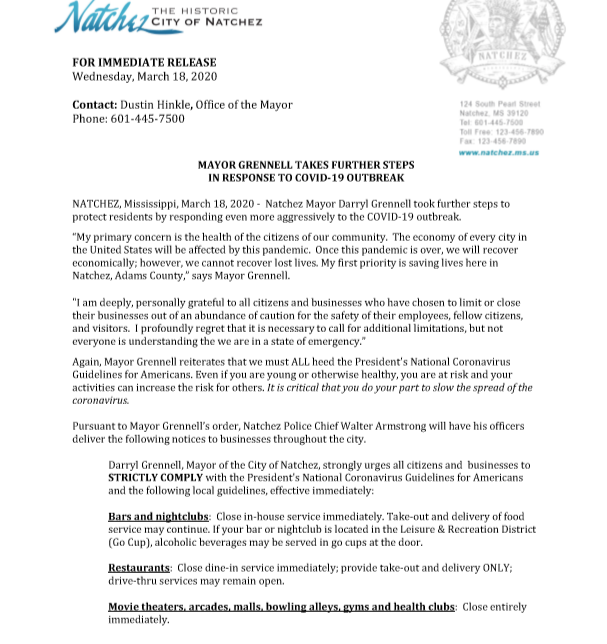
  • MAYOR GRENNELL TAKES FURTHER STEPS IN RESPONSE TO COVID-19 OUTBREAK

    MAYOR GRENNELL TAKES FURTHER STEPS IN RESPONSE TO COVID-19 OUTBREAK

    MAYOR GRENNELL TAKES FURTHER STEPS
    IN RESPONSE TO COVID-19 OUTBREAK
    NATCHEZ, Mississippi, March 18, 2020 – Natchez Mayor Darryl Grennell took further steps to
    protect residents by responding even more aggressively to the COVID-19 outbreak.
    “My primary concern is the health of the citizens of our community. The economy of every city in
    the United States will be affected by this pandemic. Once this pandemic is over, we will recover
    economically; however, we cannot recover lost lives. My first priority is saving lives here in
    Natchez, Adams County,” says Mayor Grennell.
    “I am deeply, personally grateful to all citizens and businesses who have chosen to limit or close
    their businesses out of an abundance of caution for the safety of their employees, fellow citizens,
    and visitors. I profoundly regret that it is necessary to call for additional limitations, but not
    everyone is understanding the we are in a state of emergency.”
    Again, Mayor Grennell reiterates that we must ALL heed the President’s National Coronavirus
    Guidelines for Americans. Even if you are young or otherwise healthy, you are at risk and your
    activities can increase the risk for others. It is critical that you do your part to slow the spread of the
    coronavirus.
    Pursuant to Mayor Grennell’s order, Natchez Police Chief Walter Armstrong will have his officers
    deliver the following notices to businesses throughout the city.
    Darryl Grennell, Mayor of the City of Natchez, strongly urges all citizens and businesses to
    STRICTLY COMPLY with the President’s National Coronavirus Guidelines for Americans
    and the following local guidelines, effective immediately:
    Bars and nightclubs: Close in-house service immediately. Take-out and delivery of food
    service may continue. If your bar or nightclub is located in the Leisure & Recreation District
    (Go Cup), alcoholic beverages may be served in go cups at the door.
    Restaurants: Close dine-in service immediately; provide take-out and delivery ONLY;
    drive-thru services may remain open.
    Movie theaters, arcades, malls, bowling alleys, gyms and health clubs: Close entirely
    immediately.