Tag: john bel edwards

  • Edwards: ‘Too Early To Know’ When Louisiana Can Relax Orders

    Edwards: ‘Too Early To Know’ When Louisiana Can Relax Orders

    Edwards stressed that the practice must continue for now to avoid a new spike in infections.

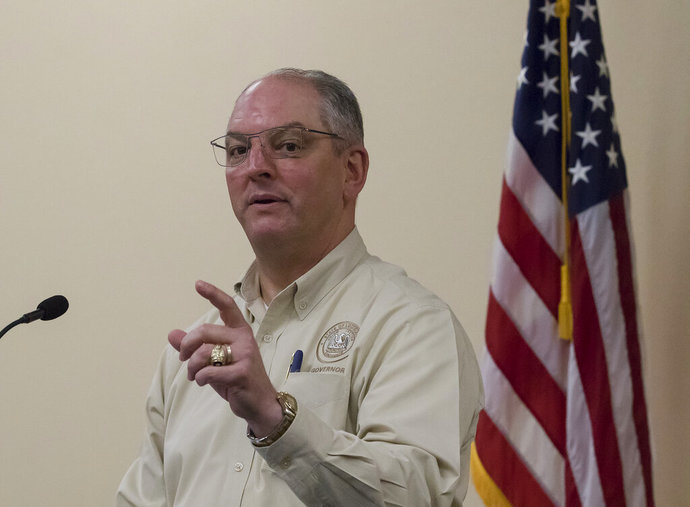
    NEW ORLEANS (AP) — “It’s just too early to know” when Louisiana can begin relaxing stay-at-home orders that have devastated the state’s economy to prevent the spread of the new coronavirus, Gov. John Bel Edwards said Monday.

    He was speaking to reporters in Monroe, in the northern part of the state, after touring sites of widespread damage from tornadoes on Sunday.

    He was responding to a question about President Donald Trump’s eagerness to get businesses re-opened around the nation.

    Edwards, a Democrat, said he will continue to work with Trump and Vice President Mike Pence on the issue.

    State officials from both parties have presented a largely unified front in facing the crisis. But a state representative issued a statement Monday saying the order “must end” April 30.

    “On May 1, we must begin opening as much as possible,” Rep. Mark Wright, a Republican from Covington, said in a news release.

    The number of deaths related to COVID-19 in Louisiana rose to 884 Monday, 44 higher than a day earlier, according to the latest figures from the state health department.

    The number of people hospitalized with the disease caused by the virus was 2,134. That’s 50 more than a day earlier. The number of those requiring ventilators was 461 — a slight increase from Sunday but still well below last week’s numbers.

    State officials have said social distancing efforts appear to be slowing the growth in serious coronavirus illnesses in Louisiana. Edwards on Monday stressed that the practice must continue for now to avoid a new spike in infections.

    He also chastised those who aren’t heeding the warning. He said there was evidence, including anecdotes and a website that records movements of cellphone customers, that many in the state were less mindful of the need for social distancing over the Easter weekend.

    The overall number of Louisiana residents known to have been infected with the new coronavirus was 21,016 as of midday Monday, an increase of 421, as the number of people tested in the state surpassed 108,000.

    The latest figures were released on the same day the state announced that it had made a one-day payment of more than $89.7 million to residents who have lost their jobs or had reduced hours due to the pandemic. That includes more than $66 million from a recently passed federal relief bill to fund the first of weekly $600 payments for unemployed people, including the self-employed who lost work because of the pandemic.

    The state said that, as of Monday, just over 59 % of COVID-19 deaths in Louisiana occurred among African Americans. The figure was down from the 70% figure released last week. However, Edwards noted that the figures vary because the race of some of those affected is not available. Officials in Louisiana and elsewhere have expressed concerns over the disease’s disparate effects on blacks. Edwards last week announced a task force to look into the issue.

    During the absence of college sporting events as a result of the coronavirus battle, LSU announced a plan Monday to help provide badly needed medical supplies. The university said it’s starting large-scale production of personal protective equipment in the assembly center where basketball games are usually played. University employees, working with doctors from New Orleans and Shreveport, are making heavy-duty, reusable gowns and face shields, all with materials donated by area businesses.

    For most people, the coronavirus causes mild symptoms like fever and a cough that resolve in two to three weeks. But for some, especially older adults and people with existing health problems, more severe symptoms can occur, including pneumonia, that can lead to death.

    ___

    Associated Press reporter Melinda Deslatte in Baton Rouge contributed to this report.
  • Politics Mixes With Science As States Turn To Virus Models

    Politics Mixes With Science As States Turn To Virus Models

    The models have resulted in conflict in several locations.

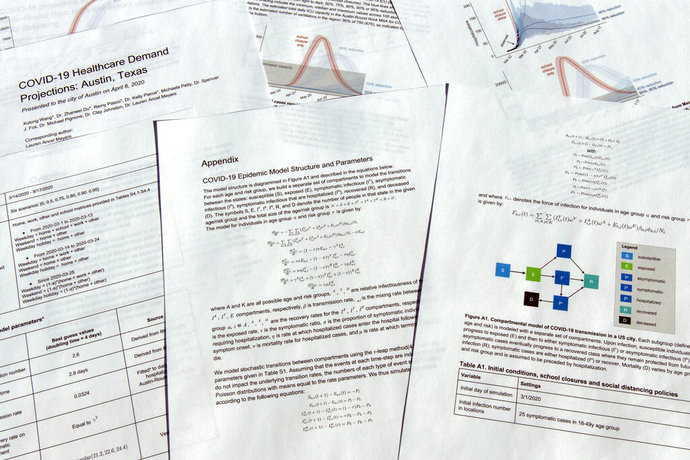
    State leaders are relying on a hodgepodge of statistical models with wide-ranging numbers to guide their paths through the deadly coronavirus emergency and make critical decisions, such as shutting down businesses and filling their inventory of medical supplies.

    During hurricane season, coastal states can trust the same set of computer models to warn of a storm’s track. During this pandemic, there is no uniform consensus to predict the toll and direction of the virus that is tearing through communities around the country.

    With little agreed-upon information, governors and local officials are basically creating do-it-yourself sources of information with their own officials and universities.

    The models have resulted in conflict in several locations.

    About 75 protesters on Thursday called on Ohio Gov. Mike DeWine to reopen businesses and questioned the models used by his health director to continue the state’s shelter-at-home order. Critics have denounced an Iowa Health Department a matrix as arbitrarily devised and being used by the governor to rationalize her decision to not issue a stay-at-home order.

    The federal government and many states rely on a University of Washington model that’s the closest thing to a benchmark but it is so imprecise that the latest projection for the death toll had a range of more than 100,000. In Washington D.C., health officials took the unusual step of publicly announcing that they didn’t trust the University of Washington’s updated model and embraced far more pessimistic predictions from a model created by researchers at the University of Pennsylvania.

    Some states, including Alaska, Ohio, Pennsylvania, Minnesota, Louisiana, are incorporating the work of local researchers and other experts to fine-tune their models.

    Some elected officials have cited the most dire forecasts in issuing stay-at-home orders. Others have seized on more optimistic figures from their models to justify their calls to loosen restrictions.

    “We know now that a lot of the models out there are not accurate,” Missouri Gov. Mike Parso said in describing why he waited until Monday to issue his stay-at-home order.

    President Donald Trump’s handling of the pandemic could well decide whether he is reelected, and the models the White House relies on for forecasting will be an issue if they miss the mark.

    Unlike with the National Hurricane Center, the federal government doesn’t have a national clearinghouse for virus models. The Centers for Disease Control and Prevention hasn’t publicly released any coronavirus models of its own. The Trump administration favors the University of Washington model, but the CDC hasn’t identified a modeling consensus for states to follow.

    Dr. Georges Benjamin, executive director of the American Public Health Association, said some public officials tend to act according to what “politically plays the best” instead of “following the science.”

    “It’s good to have optimistic models, but I prefer to be more of a pessimist when you don’t know what’s going,” Benjamin said.

    States worry about what models show because they believed there were more ventilators and other needed equipment stockpiled by the federal government than what actually exists, said Craig Fugate, who was head of the Federal Emergency Management Agency under President Barack Obama. Fugate said states are having difficulty planning and coping because the CDC, which is supposed to lead the pandemic response for the federal government, seems to be disappearing.

    “When you do not hear from the CDC directly and you have all these other filters (of information), we’re losing the message,” Fugate told The Associated Press.

    White House coronavirus task force members Drs. Deborah Birx and Anthony Fauci have delved into modeling at numerous briefings. Birx has said the task force has consulted a range of outside models to make the case for the need for social distancing to flatten the curve.

    The federal government is trying to amass and process a trove of data on testing, disease levels, hospital capacity and other factors that could help improve modeling and maybe even focus down to the community level. It’s unclear how far the effort has gotten, particularly given all the other challenges that governments at all levels are facing dealing with the outbreak.

    The model from the University of Washington, the one most frequently cited at White House press briefings, predicts daily deaths in the U.S. have peaked and will decline through the summer. The updated model on Friday shows that 26,487 to 155,315 Americans will die in a first wave stretching into the summer. A few days earlier, the same model had projected up to 136,401 deaths.

    Louisiana Gov. John Bel Edwards, a Democrat whose state has had one of the deadliest outbreaks of COVID-19, has said his administration is doing its own modeling. It’s a collaboration between the state health department, Louisiana State University, the University of Louisiana at Lafayette, a medical system and Blue Cross/Blue Shield.

    Edwards called it “heartening” to see the University of Washington’s updated model forecasting a lower death toll. But he said, “the numbers in that particular model don’t match up so well with what we’ve already experienced, so we’re trying to reconcile the assumptions that underlie that model with the assumptions that underlie ours.”

    New York Gov. Andrew Cuomo has used his daily press briefings to explain how models have helped his administration forecast the pandemic’s impact on the Empire State. The Democrat has relied on projections from McKinsey & Company and Weill-Cornell medical center and consulted the World Health Organization.

    But he has described the range of estimates as “maddening” and concedes that projections of an apex could change every day.

    Natalie Dean, an assistant professor of biostatistics at the University of Florida’s College of Medicine, has seen an overreliance on modeling and confusion about the role it should play in responding to a pandemic. She said some of the most valuable information can be anecdotal, gleaned from people working on the front lines of the response.

    “Models need to input parameters. You need to input a lot of assumptions about what you think is happening, and there’s still a lot we don’t know. We have to view numbers with skepticism,” said Dean, who is working with other experts on COVID-19 vaccine strategies.

    ___

    Kunzelman reported from Silver Spring, Maryland. Associated Press reporters Ricardo Alonso-Zaldivar in Washington; Seth Borenstein in Kensington, Maryland; Steve Karnowski in Minneapolis; Melinda Deslatte in Baton Rouge, Louisiana; Meg Kinnard in Columbia, South Carolina; David Lieb in Jefferson City, Missouri; Ryan Foley in Iowa City, Iowa; Michael Rubinkam in northeastern Pennsylvania; Ashraf Khalil in Washington; and Marina Villeneuve in Albany, New York; contributed to this report.

    ___

  • Louisiana Governor John Bel Edwards Thanks Healthcare Workers

    Louisiana Governor John Bel Edwards Thanks Healthcare Workers

    Governor Edwards Posts Thank-You Letter And Video On Social Media

    The Governor published a sincere letter of appreciation to all healthcare workers on the frontlines of the COVID-19 coronavirus outbreak in Louisiana:

    “My mother was a nurse and I learned many years ago that not all heroes wear capes…With all of my heart, and on behalf of the entire state, I want to thank you for your relentless efforts and your service to our brothers and sisters and most vulnerable Louisiana residents.”

    The Governor also made a video for social media, thanking healthcare workers for their efforts.