Tag: louisiana

  • Teachers Share How They Cope, Miss Students

    Teachers Share How They Cope, Miss Students

    “I miss my students!”

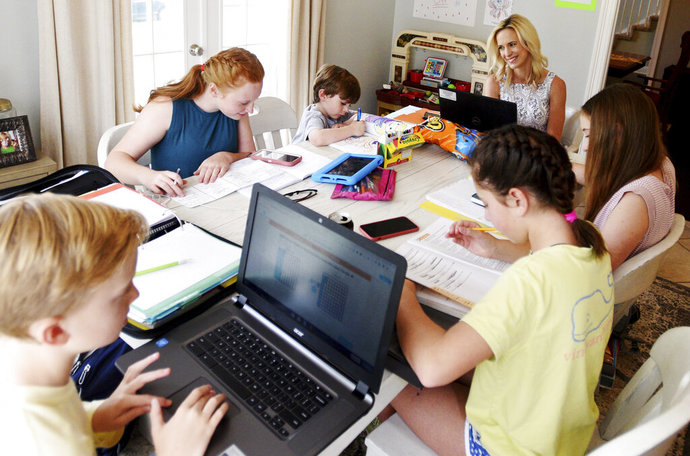
    LAFAYETTE, La. (AP) — Louisiana students and teachers learned suddenly before dismissal on a Friday afternoon that schools would shut down for a month.

    It was jarring news, and on top of all the questions — Would there be distance learning? What about meals? What happens with testing? — many educators were just plain sad.

    “Oh my word, this is even harder than summer break,” said Jennifer Babineaux, a first-grade teacher at Broadmoor Elementary in Lafayette.

    She described the initial feeling as something similar to mourning or grieving. She’s not alone. Blogs using the same descriptors have circulated on social media as teachers related and shared.

    “The announcement was made during our last hour, which is my planning (hour), so I never got a chance to tell any of my babies goodbye,” said Lucie Mesuch, who is in her 29th year teaching middle school in Sulphur.

    Taylor Wallace, a fourth-grade teacher at Woodvale Elementary in Lafayette, was out of town the last day of school, and her substitute called her at the end of the day to let the kids say goodbye on speakerphone.

    “It made me so emotional to think that I wouldn’t see them for a while and even more that I couldn’t be there to help them through this huge transition,” Wallace said.

    And now Louisiana schools will be closed at least through April 30, as Gov. John Bel Edwards extended his stay-at-home order last week to align with guidelines from the president and the U.S. Centers for Disease Control and Prevention.

    Teachers miss their students. They worry about them — that they’ll lose what they’ve learned this year, that they’ll fall behind, that they won’t be fed enough or loved enough. Teachers develop relationships with students from all backgrounds and home lives, and they worry what will happen while schools are closed.

    “I worry about my students who come to school to be loved, who need the support they find there,” Mesuch said. “I have one student who had not been himself the past few days. I wanted to talk to him Friday, but he told me he was OK and would talk to me Monday, so I have been worried about him.”

    She’s thankful and proud that her district, like others across the state, has been providing food for those who need it.

    Soon after Edwards’ proclamation closing schools, teachers were able to return to campuses briefly to collect items and finish grading for the third nine weeks. Being back on campus without their students stirred emotions.

    Carletta Anthony Jones teaches fourth grade reading and social studies at a school in northwest Louisiana.

    “I just arrived at my school, Natchitoches Magnet, and the tears are just falling!” Jones said. “As the young ones would say, ‘I’m feeling some type of way.’ I really miss my students! My prayer is that my students, coworkers and all stay safe.”

    When art teacher Erin Parish went to clean her room at Natchitoches Magnet, she wanted to make sure the classroom would be ready for kids when — or if — they return this year.

    “To cope, I sat outside looking for four leaf clovers, taking photos, and trying to create crowns, praying the entire time as I do it,” she said, “trying not to let my mind wander and become panicked.”

    Her husband told her if they do come back with just a week left, at least she would get to say goodbye to her eighth-graders and watch them graduate on to high school.

    “That broke me a little and got me crying because I really, really miss my kids,” Parish said. “I didn’t say bye on Friday because I was extremely ill. I didn’t get to tell them that I’ll miss them. I didn’t get to tell them that I hope they still create and can’t wait to see what they have made when we come back. I just pray they’re all OK and healthy.”

    In nearly every comment, teachers have expressed how much they miss their students, whom they’ve spent so much time with. That makes school like a home, Lafayette student teacher Raegan Abshire said.

    “It’s like a second family,” Abshire said.

    And email and video conferencing don’t quite fill the void, teachers are finding.

    “I miss working with my students, man,” said Mark Burt, visual art instructor in the Bossier Talented Arts Program. “I really miss seeing an engaged student — the expressions they have on their face when they solve a problem with my tutelage and encouragement.”

    Andrea Buchanan McFarlain, a teacher at Sulphur High School, feels the same way and is surprised when people expect her to be happy about being out of school.

    “Everyone assumes we are so excited to be ‘off’ work, but I’m miserable!” McFarlain said. “I miss my students!”

    Like many teachers, she’s worried about how being out of school this long will impact student learning.

    McFarlain teaches junior and senior Advanced Placement English and an EdRising course for future teachers.

    “All classes involve testing for college credits, and I want my babies to get those credits,” McFarlain said.

    She’s been messaging her students online assignments to help them prepare for upcoming AP exams, which will be given online and in a shorter format.

    “My classes work best face-to-face,” but she’s figuring out the web conferencing software Zoom, she said.

    McFarlain “hopes and prays we are able to go back,” echoing a sentiment so many others are voicing. They hope to return to school this semester, fit in some instruction and say a proper goodbye, especially to seniors.

    “I hope people take these health directives seriously, and I hope, if it’s safe, we will get to go back to school for a few weeks and at least let our seniors graduate,” said Christa Cunningham, creative writing and AP English teacher at the Magnet Academy for Cultural Arts in Opelousas.

    “While I know this is for the best, I feel bad for kids missing out on experiences they were counting on,” she continued. “I feel sad for the older kids who are missing milestones such as prom, ring ceremony and graduation, rites of passage that everyone gets.”

    It’s that social aspect of school that worries Cathlean Gilmer Snyder, a math teacher at Southwood High School in Shreveport. The transition for her students to online learning hasn’t been challenging “as far as the coursework is concerned,” she said.

    But her high-schoolers are concerned with what life is going to look like and when life is going to get back to normal, she said.

    “I just try to make sure, very much, to take care of them in that way, too, just as much as I’ve made sure they’ve finished their math curriculum,” Snyder said. “That’s important, that math is important. But making sure they get through this time of chaos OK and stable and emotionally all there, that’s what’s most important to me.”

    Wallace plans to see her kids again one way or another.

    “If we don’t end up going back to school this year, I do fully plan to host a get together for our classes when it is safe to be able to celebrate their hard work and success this year as a whole,” she said. “We will get a chance to say our proper goodbyes, somehow, someway!”

  • Politics Mixes With Science As States Turn To Virus Models

    Politics Mixes With Science As States Turn To Virus Models

    The models have resulted in conflict in several locations.

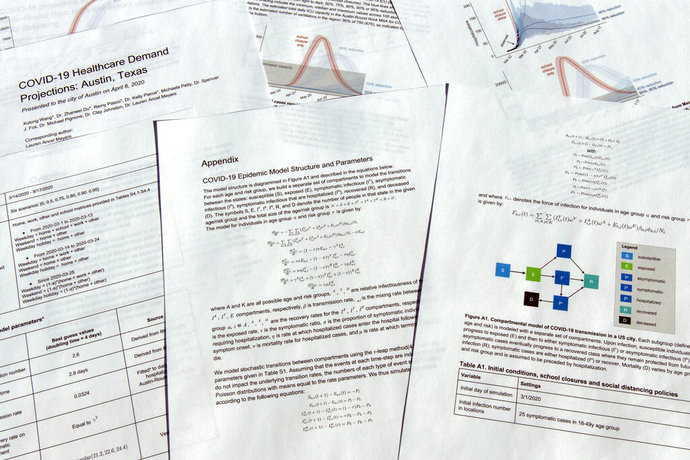
    State leaders are relying on a hodgepodge of statistical models with wide-ranging numbers to guide their paths through the deadly coronavirus emergency and make critical decisions, such as shutting down businesses and filling their inventory of medical supplies.

    During hurricane season, coastal states can trust the same set of computer models to warn of a storm’s track. During this pandemic, there is no uniform consensus to predict the toll and direction of the virus that is tearing through communities around the country.

    With little agreed-upon information, governors and local officials are basically creating do-it-yourself sources of information with their own officials and universities.

    The models have resulted in conflict in several locations.

    About 75 protesters on Thursday called on Ohio Gov. Mike DeWine to reopen businesses and questioned the models used by his health director to continue the state’s shelter-at-home order. Critics have denounced an Iowa Health Department a matrix as arbitrarily devised and being used by the governor to rationalize her decision to not issue a stay-at-home order.

    The federal government and many states rely on a University of Washington model that’s the closest thing to a benchmark but it is so imprecise that the latest projection for the death toll had a range of more than 100,000. In Washington D.C., health officials took the unusual step of publicly announcing that they didn’t trust the University of Washington’s updated model and embraced far more pessimistic predictions from a model created by researchers at the University of Pennsylvania.

    Some states, including Alaska, Ohio, Pennsylvania, Minnesota, Louisiana, are incorporating the work of local researchers and other experts to fine-tune their models.

    Some elected officials have cited the most dire forecasts in issuing stay-at-home orders. Others have seized on more optimistic figures from their models to justify their calls to loosen restrictions.

    “We know now that a lot of the models out there are not accurate,” Missouri Gov. Mike Parso said in describing why he waited until Monday to issue his stay-at-home order.

    President Donald Trump’s handling of the pandemic could well decide whether he is reelected, and the models the White House relies on for forecasting will be an issue if they miss the mark.

    Unlike with the National Hurricane Center, the federal government doesn’t have a national clearinghouse for virus models. The Centers for Disease Control and Prevention hasn’t publicly released any coronavirus models of its own. The Trump administration favors the University of Washington model, but the CDC hasn’t identified a modeling consensus for states to follow.

    Dr. Georges Benjamin, executive director of the American Public Health Association, said some public officials tend to act according to what “politically plays the best” instead of “following the science.”

    “It’s good to have optimistic models, but I prefer to be more of a pessimist when you don’t know what’s going,” Benjamin said.

    States worry about what models show because they believed there were more ventilators and other needed equipment stockpiled by the federal government than what actually exists, said Craig Fugate, who was head of the Federal Emergency Management Agency under President Barack Obama. Fugate said states are having difficulty planning and coping because the CDC, which is supposed to lead the pandemic response for the federal government, seems to be disappearing.

    “When you do not hear from the CDC directly and you have all these other filters (of information), we’re losing the message,” Fugate told The Associated Press.

    White House coronavirus task force members Drs. Deborah Birx and Anthony Fauci have delved into modeling at numerous briefings. Birx has said the task force has consulted a range of outside models to make the case for the need for social distancing to flatten the curve.

    The federal government is trying to amass and process a trove of data on testing, disease levels, hospital capacity and other factors that could help improve modeling and maybe even focus down to the community level. It’s unclear how far the effort has gotten, particularly given all the other challenges that governments at all levels are facing dealing with the outbreak.

    The model from the University of Washington, the one most frequently cited at White House press briefings, predicts daily deaths in the U.S. have peaked and will decline through the summer. The updated model on Friday shows that 26,487 to 155,315 Americans will die in a first wave stretching into the summer. A few days earlier, the same model had projected up to 136,401 deaths.

    Louisiana Gov. John Bel Edwards, a Democrat whose state has had one of the deadliest outbreaks of COVID-19, has said his administration is doing its own modeling. It’s a collaboration between the state health department, Louisiana State University, the University of Louisiana at Lafayette, a medical system and Blue Cross/Blue Shield.

    Edwards called it “heartening” to see the University of Washington’s updated model forecasting a lower death toll. But he said, “the numbers in that particular model don’t match up so well with what we’ve already experienced, so we’re trying to reconcile the assumptions that underlie that model with the assumptions that underlie ours.”

    New York Gov. Andrew Cuomo has used his daily press briefings to explain how models have helped his administration forecast the pandemic’s impact on the Empire State. The Democrat has relied on projections from McKinsey & Company and Weill-Cornell medical center and consulted the World Health Organization.

    But he has described the range of estimates as “maddening” and concedes that projections of an apex could change every day.

    Natalie Dean, an assistant professor of biostatistics at the University of Florida’s College of Medicine, has seen an overreliance on modeling and confusion about the role it should play in responding to a pandemic. She said some of the most valuable information can be anecdotal, gleaned from people working on the front lines of the response.

    “Models need to input parameters. You need to input a lot of assumptions about what you think is happening, and there’s still a lot we don’t know. We have to view numbers with skepticism,” said Dean, who is working with other experts on COVID-19 vaccine strategies.

    ___

    Kunzelman reported from Silver Spring, Maryland. Associated Press reporters Ricardo Alonso-Zaldivar in Washington; Seth Borenstein in Kensington, Maryland; Steve Karnowski in Minneapolis; Melinda Deslatte in Baton Rouge, Louisiana; Meg Kinnard in Columbia, South Carolina; David Lieb in Jefferson City, Missouri; Ryan Foley in Iowa City, Iowa; Michael Rubinkam in northeastern Pennsylvania; Ashraf Khalil in Washington; and Marina Villeneuve in Albany, New York; contributed to this report.

    ___

  • Coronavirus Ravages Storied New Orleans Mardi Gras Group

    Coronavirus Ravages Storied New Orleans Mardi Gras Group

    In a city ravaged by the coronavirus outbreak, members of the Zulu krewe have paid a heavy price.

    NEW ORLEANS (AP) — On Fat Tuesday, 51-year-old Cornell Charles was taking part in a storied New Orleans Mardi Gras tradition central to the city’s African American community — driving a car in the Zulu Social Aid and Pleasure Club’s parade.

    A month later his wife of three decades was watching him take his last breath, a victim of the coronavirus epidemic raging through the city.

    “I talked to him. I told him how much I was going to miss him,” said his wife, Nicole, describing those last minutes on March 24. “He literally took his last breath in front of my face and that was it.”

    In a city ravaged by the coronavirus outbreak, members of the Zulu krewe, one of the groups that sponsor Mardi Gras parades and balls, have paid a heavy price. Four of the fraternal organization’s members have died from coronavirus-related complications, said Zulu President Elroy A. James. Two others have also died since the pandemic began, though it’s not known if their deaths were caused by the virus, he said.

    An additional 20 have tested positive. Some are self-quarantining at home, some were hospitalized and released, while others are still hospitalized, James said.

    James spends his days on the phone, texting with and calling board members and officers of the roughly 800-member Zulu organization.

    “Members are calling every day checking on each other: ‘How’s this member doing? How’s this family member doing?’” he said.

    It’s also taken a financial toll. Many Zulu members work in the hospitality sector and are out of work, James said, a widespread problem in a city with an economy closely tied to the restaurants, bars and nightclubs now largely shuttered due to the statewide stay-at-home order.

    “Zulu is really a microcosm of the city of New Orleans,” said state Sen. Troy Carter, a longtime Zulu member. “We’re made up of every social and economic background that you can imagine. Our members come from all different walks of life.”

    The predominantly African American club is in some ways a reflection of how the disease has affected the black community in Louisiana. More than 70 percent of the state’s coronavirus patients who have died are black, according to state data released this week.

    For most people, the coronavirus causes mild symptoms like fever and a cough that resolve in two to three weeks. But for some, especially older adults and people with existing health problems, more severe symptoms can occur, including pneumonia, that can lead to death.

    For over a century Zulu members have paraded for Mardi Gras in their distinctive grass skirts and black face inspired by a 1909 vaudeville skit, according to a history compiled for the group’s 100-year anniversary in 2009. It was not just a Mardi Gras parade group but one of the benevolent societies that played an important role in African American history by providing life insurance or funeral costs to its dues-paying members.

    Over the decades Zulu Mardi Gras parades have featured ever-larger floats, with costumed float riders tossing out beads and trinkets, including the group’s hand-decorated coconuts, among the event’s most-coveted throws. The most famous man to reign as Zulu king was Louis Armstrong in 1949. Members are also elected to be one of the group’s coveted characters, such as Mr. Big Stuff or The Big Shot.

    “Nobody has more fun than Zulu,” said Mardi Gras historian, Arthur Hardy. But, he emphasized, there’s a lot more to the group than the parade. Zulu is known for it’s philanthropic works all year round, including the Junior Zulu program that reaches out to disadvantaged children and an annual Christmas bike giveaway.

    That spirit of service is what drew Charles, said his wife, Nicole.

    “The brotherhood, what they have given to the community. He loved that. My husband loved parades, so that was definitely an attraction, but he liked what he saw outside of the fun part of it,” she said.

    Charles started work every day by 3 a.m. as a courier delivering medication to hospitals and medical facilities. But his real passion, his wife said, was coaching young people. The football, baseball and basketball practices and games kept “Dickey” as he was often called, busy, but the father of two daughters always made time for family, his wife said.

    She has been amazed at the outpouring of support from people telling her how much her husband meant to them. His likely would have been a big funeral with one of the jazz parades often seen in New Orleans funerals, but social distancing guidelines meant only a handful of people could be there.

    Nicole hopes the coronavirus risk will have receded by June 23 — his birthday — so that family and friends can come together for the memorial service he deserves.

    Lost opportunities to come together one last time to honor members is being felt keenly. Carter, the state senator, said a Zulu member’s service in normal times might include a performance by the organization’s gospel choir, a proclamation read by the group’s president and a musical procession that begins on a somber note and ends with a “full fledged energetic celebration of life.”

    “I’m not sure if anyone else in the world does it the way New Orleans does,” he said.

    The organization plans a large memorial service in the safer future, complete with a “grand second-line,” said James, the group’s president, referring to a parade during which onlookers fall in behind the band and mourners, forming a “second line.”

    The group has weathered hard times before. In the aftermath of Hurricane Katrina in 2005, at least 10 members died, many members’ homes were flooded and the group’s headquarters on Broad Street was swamped with water. But come Mardi Gras 2006 they paraded, believing it was an important part of the city’s rebuilding.

    James said he’s confident that Zulu will play a role in the city’s post-coronavirus resurgence.

    “We also need to show the world that the city of New Orleans will return after this pandemic,” he said.

  • Meet ‘Hope’ The Giraffe Born In New Orleans Amid Pandemic

    Meet ‘Hope’ The Giraffe Born In New Orleans Amid Pandemic

    The calf was born 6-feet tall, weighing in at 189 pounds.

    NEW ORLEANS (AP) — The Audubon Nature Institute in New Orleans welcomed a new resident, a baby giraffe named Hope.

    Sue Ellen, a middle-aged giraffe at the Freeport-McMoRan Audubon Species Survival Center, gave birth Monday, according to a Friday news release.

    Audubon Nature Institute President and CEO Ron Forman said Hope was the perfect name for the calf, especially as New Orleans has been hit hard during the coronavirus pandemic.

    “What name could be more fitting than ’Hope” in these challenging times?” Forman said. “Hope is what has sustained our community through seemingly insurmountable crises in the past and what we must hold onto as we continue on in the coming days and weeks. May we all take comfort in the reminder that, even in the darkest of days, life continues, undaunted.”

    Species Survival Center curator Michelle Hatwood said the staff had known the calf was on the way for 15 months but said it can be tough to pinpoint a likely delivery date for giraffes.

    The calf was born 6-feet (1.8-meters) tall, weighing in at 189 pounds (86 kilograms).

    Located on 1,200 acres of land west of downtown New Orleans, the center is now home to 13 giraffes, the release said. The new calf was the eighth giraffe born at the center as part of the Alliance for Sustainable Wildlife conservation breeding partnership with San Diego Zoo Global.

    The giraffes reside in a 46-acre forested area and spend most of their day foraging and looking for their favorite leaves to eat.

    Since the coronavirus pandemic began in Louisiana, the Audubon Nature Institute has been forced to close its facilities to the public. It’s asking federal officials for assistance in providing funds to larger nonprofits like zoos and aquariums.

  • Severe Weather Outbreak Likely Today In The Miss-Lou

    Severe Weather Outbreak Likely Today In The Miss-Lou

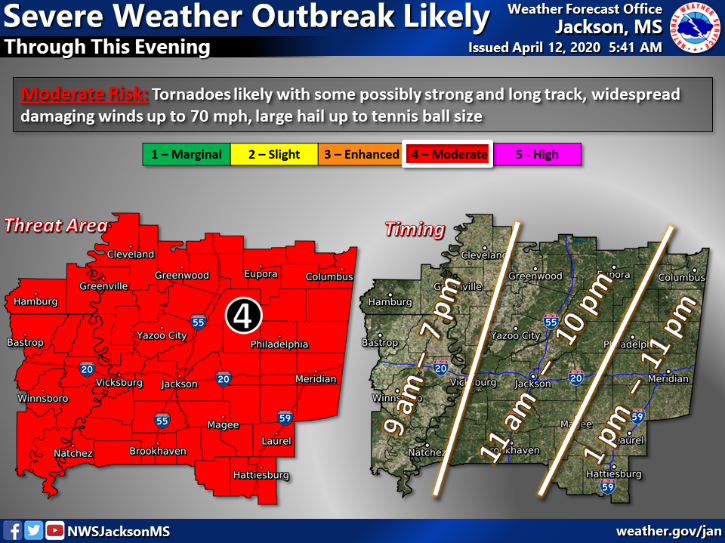
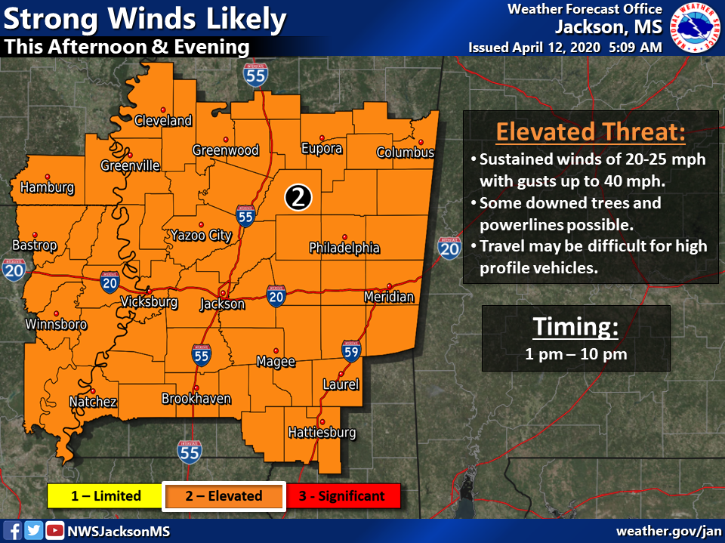
    Gusty wind, rain, hail and tornadoes in the Easter Sunday forecast

    The latest forecasts from the National Weather Service in Jackson.

  • Severe Weather Forecast For Easter Sunday

    Severe Weather Forecast For Easter Sunday

    Heavy rain, hail and potential tornadoes

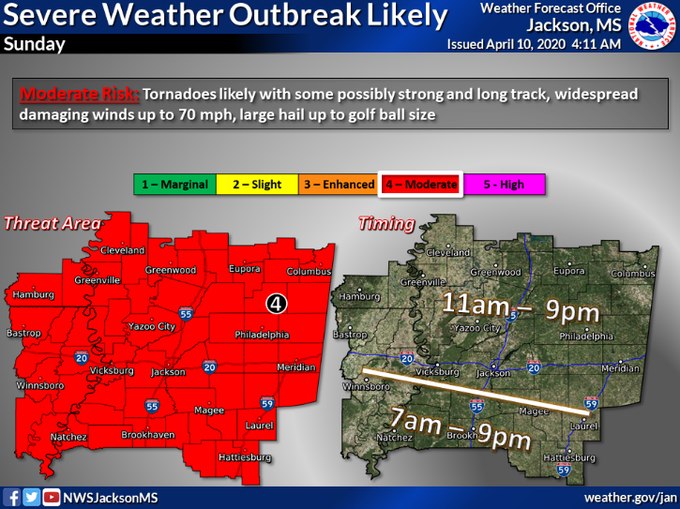
    The National Weather Service in Jackson issued this forecast this morning (4/10):

    A severe weather outbreak is looking likely Sunday morning through Sunday evening across the forecast area. Tornadoes are likely, some of which could be strong and long-tracked. Please continue to check the latest forecasts as timing, impacts and outlooks may change.

    If the National Weather Service issues a Tornado Watch, the Adams County Safe Room on Liberty Road will open to anyone who needs shelter.  Should the shelter open, please understand the following rules.


    • If they have mask or gloves ask them to bring their own, if they do not have any, protective wear will be provided to them.
    • Pets are welcome (must have a kennel), 1 pet per family
    • Bring your own blanket
    • Bring any needed medication

    This weather system could cause localized flash flooding.  If you come across a flooded road, ditch, or creek, turn around, don’t drown!  A majority of deaths in flash flood situations happen when people get trapped in vehicles.


  • Masks Returned To New Orleans Hospital After Official’s Arrest

    Masks Returned To New Orleans Hospital After Official’s Arrest

    State Troopers recovered the masks at Vernon Giscombe’s home

    NEWS ORLEANS (AP) — Eighty respirator masks taken by a high-ranking official were returned to a makeshift hospital for recovering coronavirus patients in New Orleans, authorities said.

    Ernest N. Morial Convention Center’s director of public safety, Vernon Giscombe, was arrested over the weekend and charged with one count of malfeasance in office, The Times-Picayune/ The New Orleans Advocate reported. The convention center is being used as a facility for coronavirus patients so hospitals aren’t overrun.

    Louisiana Department of Public Safety Officer Donald Furca told investigators he saw a woman leave the convention center and place two boxes in Giscombe’s car about 11:20 p.m. Friday.

    When Furca questioned Giscombe and the woman, Giscombe said he told the woman to bring the boxes, which contained 40 N95 masks for medical workers staffing the 1,000-bed hospital inside the convention center.

    Giscombe later admitted he had a different employee bring him two additional boxes containing 40 masks, Louisiana State Police said.

    Troopers recovered the masks at Giscombe’s home and Orleans Parish Magistrate Court Commissioner Brigid Collins ordered them to be returned to the hospital.

    Neither of the employees will face charges, police said.

    It’s unclear what Giscombe wanted to do with the masks. People elsewhere have been caught trying to sell the masks at inflated prices.

    It’s also unclear whether he had an attorney who could comment on his behalf.

    N95 masks filter out about 95% of liquid and airborne particles and are recommended for frontline health care workers who expect to encounter particularly infectious diseases.

    Hospitals have reported a shortage of the masks as COVID-19 has spread.

    ___

  • Sidewalk Notes Bring Smiles To Hospital Staff During Virus

    Sidewalk Notes Bring Smiles To Hospital Staff During Virus

    Unknown artist leaves messages outside Ochsner Medical Center in New Orleans

    NEW ORLEANS (AP) — The messenger is anonymous — but the messages are heartfelt, and appreciated.

    In recent days, workers at New Orleans’ Ochsner Medical Center who take the familiar stroll from the parking lot to the main entrance have been greeted with expressions of gratitude from an unnamed artist, sketched out on the sidewalk.

    “If you’re just arriving, thank you for what you’re about to do,” says one.

    And a little further along: “You are extraordinary.”

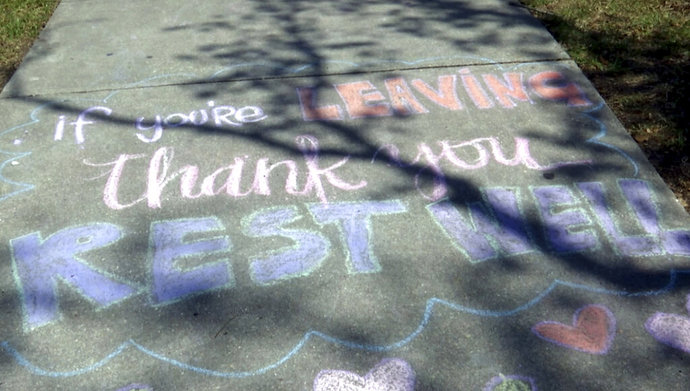
    And for those finishing their shifts: ”If you are leaving, thank you … Rest well.”

    The hospital workers have been under strain. The region has been hard hit by the coronavirus, so much so that the state’s governor said earlier this week it might run out of breathing machines by the weekend and hospital beds next week.

    Ochsner, one of the largest hospitals in the area, has been so overwhelmed that regular patient rooms have been converted into ICU-like wards to accommodate the surge in patients.

    Someone has taken note, and has reached out in chalk to tell Ochsner staffers that they are appreciated, The message has been received, loud and clear.

    “It definitely meant a lot to me and was a surprise, a colorful surprise, walking out and going home to go to bed after a long shift,” said first-year resident Leslie Miller, who works in the hospital’s pediatric care unit.

    Miller said hospital employees are used to dealing with heightened stress but for many, the coronavirus has taken stress and anxiety to another level. The messages are a balm.

    They “give us hope,” said lab technician Minerva Martin.

    ___

    While nonstop global news about the effects of the coronavirus has become commonplace, so, too, are the stories about the kindness of strangers and individuals who have sacrificed for others. “One Good Thing” is an AP continuing series reflecting these acts of kindness.

    ___

  • Louisiana Officials Report 68 More Coronavirus-Linked Deaths

    Louisiana Officials Report 68 More Coronavirus-Linked Deaths

    The Louisiana Department of Health reported the figures on its website Sunday

    NEW ORLEANS (AP) — Louisiana health officials reported 68 coronavirus-related deaths on Sunday, marking the state’s biggest jump in reported deaths since the outbreak began.  The number of infections reported to the state also increased by more than 500 cases from 12,496 to 13,010.

    Before Sunday, the largest number of deaths reported in a single day was 60. The numbers represent when the tests were reported to the state, not necessarily when the infections or deaths occurred.

    Louisiana and the New Orleans area have been an epicenter for the virus, and Gov. John Bel Edwards has repeatedly warned of looming shortages for ventilators and intensive care units.

    For most people, the new coronavirus strain causes mild or moderate symptoms, such as fever and cough that clear up in two to three weeks. For some, especially older adults and those with existing health problems, it can cause more severe illness, including pneumonia, and be life-threatening.

  • Texas Troopers Begin Screening Travelers From Louisiana

    Texas Troopers Begin Screening Travelers From Louisiana

    Sunday, April 5th is the first day troopers conducted the screenings

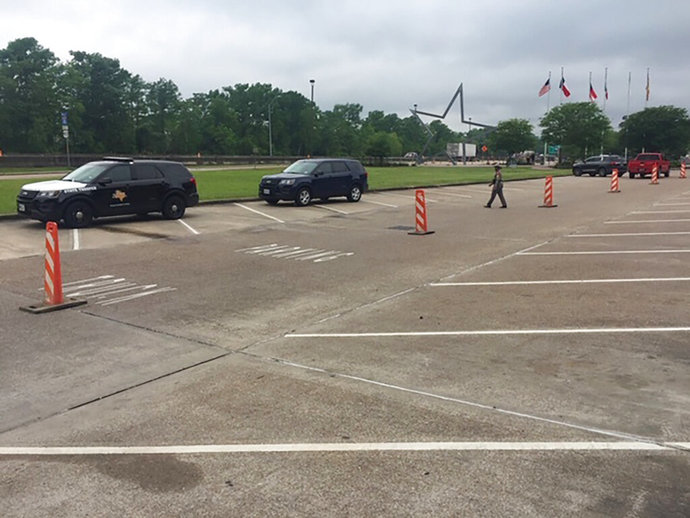
    ORANGE, Texas (AP) — State troopers started stopping and screening travelers entering Southeast Texas from Louisiana on Sunday, in accordance with an executive order from Gov. Greg Abbot.

    Troopers stopped vehicles at a visitors center on Interstate 10 near Orange, about 100 miles (160 kilometers) east of Houston, and required travelers to complete a travel form, said Texas Department of Public Safety Sgt. Stephanie Davis, who told KFDM-TV that no one was being turned back.“The established screening stations will take place on major roadways … including interstate highways and other high-volume routes,” Davis said in a statement.

    Sunday is the first day troopers conducted the screenings, a week after Abbott’s order was issued, Davis said.

    The order also calls for travelers to self-quarantine for 14 days after arriving in the state.

    State health officials on Sunday reported at least 6,669 cases and 118 COVID-19 deaths in Texas, up from 6,100 cases and at least 105 fatalities reported Saturday.

    For most people, the coronavirus causes mild or moderate symptoms, such as fever and cough. But for others, especially older adults and people with health problems, it can cause pneumonia. The World Health Organization said last week that 95% of the deaths in Europe were of people over 60.