Tag: trump

  • Second Trump-Biden debate to be virtual due to Trump’s COVID-19

    Second Trump-Biden debate to be virtual due to Trump’s COVID-19

    The nonpartisan Commission on Presidential Debates debates made the announcement Thursday morning.


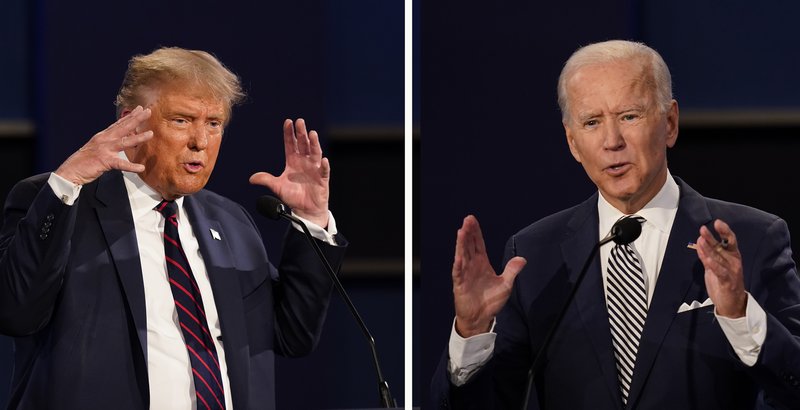
    WASHINGTON (AP) — The second presidential debate between President Donald Trump and Democratic nominee Joe Biden will take place virtually amid the fallout from the president’s diagnosis of COVID-19.

    The candidates will “participate from separate remote locations,” while the participants and moderator remain in Miami, the commission said.

    Trump was diagnosed with the coronavirus a week ago and but in a Tuesday tweet said he looked forward to debating Biden on stage in Miami, “It will be great!” he tweeted.

    Biden, for his part, said he and Trump “shouldn’t have a debate” as long as the president remains COVID positive.

    Biden told reporters in Pennsylvania that he was “looking forward to being able to debate him” but said “we’re going to have to follow very strict guidelines.”

    Trump fell ill with the virus last Thursday, just 48 hours after debating Biden in person for the first time in Cleveland. While the two candidates remained a dozen feet apart during the debate, Trump’s infection sparked health concerns for Biden and sent him to undergo multiple COVID-19 tests before returning to the campaign trail.

    Trump was still contagious with the virus when he was discharged from Walter Reed National Military Medical Center on Monday but his doctors have not provided any detailed update on his status. According to the Centers for Disease Control and Prevention, those with mild to moderate symptoms of COVID-19 can be contagious for as many as — and should isolate for at least — 10 days.

  • Leaders Of ‘We Build The Wall’ Online Fundraising Campaign Charged With Defrauding Hundreds Of Thousands Of Donors

    Leaders Of ‘We Build The Wall’ Online Fundraising Campaign Charged With Defrauding Hundreds Of Thousands Of Donors

    Brian Kolfage, Stephen Bannon, and Two Others Alleged to Have Funneled Hundreds of Thousands of Dollars From the Organization

    (US Justice Department SDNY) – Audrey Strauss, the Acting United States Attorney for the Southern District of New York, and Philip R. Bartlett, Inspector-in-Charge of the New York Field Office of the United States Postal Inspection Service (“USPIS”), announced the unsealing of an indictment charging BRIAN KOLFAGE, STEPHEN BANNON, ANDREW BADOLATO, and TIMOTHY SHEA for their roles in defrauding hundreds of thousands of donors in connection with an online crowdfunding campaign known as “We Build the Wall” that raised more than $25 million.  The defendants were arrested this morning.  KOLFAGE will be presented today before U.S. Magistrate Judge Hope T. Cannon in the Northern District of Florida.  BANNON will be presented today in the Southern District of New York.  BADOLATO will be presented today before U.S. Magistrate Judge Thomas Wilson in the Middle District of Florida.  SHEA will be presented today before U.S. Magistrate Judge Kristen L. Mix in the District of Colorado.  The case is assigned to U.S. District Judge Analisa Torres in the Southern District of New York.

    Acting U.S. Attorney Audrey Strauss said:  “As alleged, the defendants defrauded hundreds of thousands of donors, capitalizing on their interest in funding a border wall to raise millions of dollars, under the false pretense that all of that money would be spent on construction.  While repeatedly assuring donors that Brian Kolfage, the founder and public face of We Build the Wall, would not be paid a cent, the defendants secretly schemed to pass hundreds of thousands of dollars to Kolfage, which he used to fund his lavish lifestyle.  We thank the USPIS for their partnership in investigating this case, and we remain dedicated to rooting out and prosecuting fraud wherever we find it.”

    Inspector-in-Charge Philip R. Bartlett said:  “The defendants allegedly engaged in fraud when they misrepresented the true use of donated funds.  As alleged, not only did they lie to donors, they schemed to hide their misappropriation of funds by creating sham invoices and accounts to launder donations and cover up their crimes, showing no regard for the law or the truth.   This case should serve as a warning to other fraudsters that no one is above the law, not even a disabled war veteran or a millionaire political strategist.”

    According to the Indictment[1] unsealed today in Manhattan federal court:

    Starting in approximately December 2018, BRIAN KOLFAGE, STEPHEN BANNON, ANDREW BADOLATO, and TIMOTHY SHEA, and others, orchestrated a scheme to defraud hundreds of thousands of donors, including donors in the Southern District of New York, in connection with an online crowdfunding campaign ultimately known as “We Build The Wall” that raised more than $25 million to build a wall along the southern border of the United States.  In particular, to induce donors to donate to the campaign, KOLFAGE repeatedly and falsely assured the public that he would “not take a penny in salary or compensation” and that “100% of the funds raised . . . will be used in the execution of our mission and purpose” because, as BANNON publicly stated, “we’re a volunteer organization.”

    Those representations were false.  In truth, KOLFAGE, BANNON, BADOLATO, and SHEA received hundreds of thousands of dollars in donor funds from We Build the Wall, which they each used in a manner inconsistent with the organization’s public representations.  In particular, KOLFAGE covertly took for his personal use more than $350,000 in funds that donors had given to We Build the Wall, while BANNON, through a non-profit organization under his control (“Non-Profit-1”), received over $1 million from We Build the Wall, at least some of which BANNON used to cover hundreds of thousands of dollars in BANNON’s personal expenses.  To conceal the payments to KOLFAGE from We Build the Wall, KOLFAGE, BANNON, BADOLATO, and SHEA devised a scheme to route those payments from We Build the Wall to KOLFAGE indirectly through Non-Profit-1 and a shell company under SHEA’s control, among other avenues.  They did so by using fake invoices and sham “vendor” arrangements, among other ways, to ensure, as KOLFAGE noted in a text message to BADOLATO, that his pay arrangement remained “confidential” and kept on a “need to know” basis.

    *                *                *

    KOLFAGE, 38, of Miramar Beach, Florida, BANNON, 66, of Washington, D.C., BADOLATO, 56, of Sarasota, Florida, and SHEA, 49, of Castle Rock, Colorado, are each charged with one count of conspiracy to commit wire fraud and one count of conspiracy to commit money laundering, each of which carries a maximum penalty of 20 years in prison.

    The statutory maximum penalties are prescribed by Congress and are provided here for informational purposes only, as any sentencing of the defendants would be determined by the judge.

    Ms. Strauss praised the outstanding investigative work of the USPIS and the Special Agents of the United States Attorney’s Office for the Southern District of New York.  She also thanked the U.S Attorney’s Office for the Northern District of Florida for their assistance.

    The case is being handled by the Office’s Public Corruption Unit.  Assistant United States Attorneys Nicolas Roos, Alison G. Moe, and Robert B. Sobelman are in charge of the prosecution.

    The charges contained in the Indictment are merely accusations.  The defendants are presumed innocent unless and until proven guilty.

  • Military chief: Troops were issued bayonets during police brutality protests in Washington DC

    Military chief: Troops were issued bayonets during police brutality protests in Washington DC

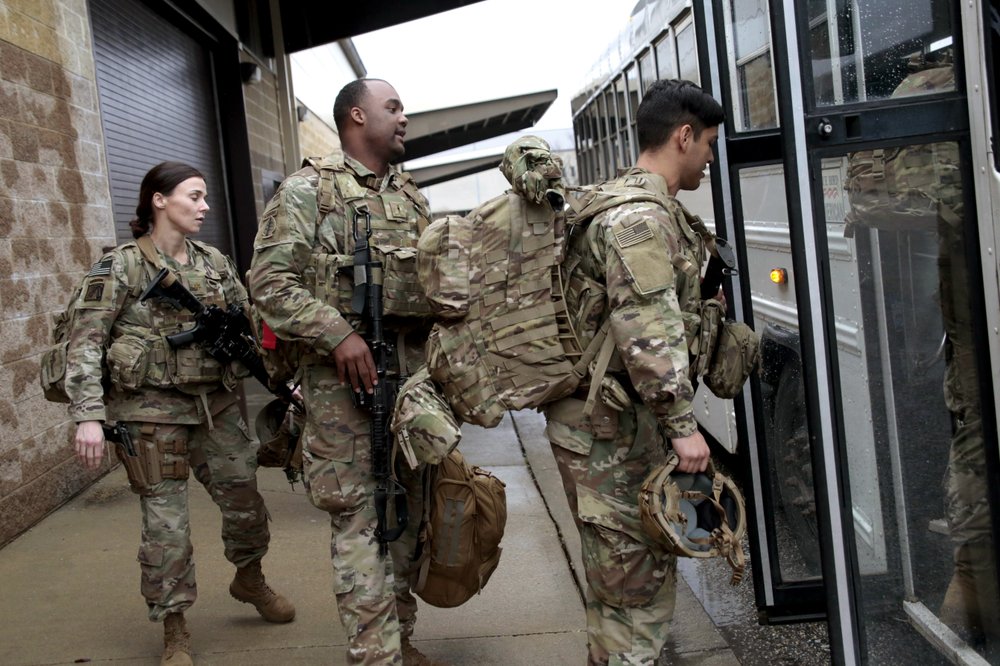
    Roughly 700 members of the 82nd Airborne Division were sent on that day to two military bases near the District Capitol Area armed with live rounds, bayonets, and riot gear.

    CHARLOTTE, N.C. (AP) — The chairman of the Joint Chiefs of Staff has confirmed a report by The Associated Press that some of the service members who were mobilized to Washington, D.C., last month in response to civil unrest over the killing of George Floyd were issued bayonets. Defense documents obtained by the AP show some were not trained in riot response.

    Members of the Army’s 82nd Airborne Division from Fort Bragg, North Carolina, and the 3rd U.S. Infantry Regiment, which is based in D.C. and typically guards the Tomb of the Unknown Soldier, were mobilized last month to respond to massive protests over the treatment of Black Americans and systemic issues of police brutality. But the troops were never actually sent to the protests after they arrived.

    The soldiers were issued bayonets for their June 2 deployment — but told they were to remain in their scabbards and not attached to their service rifles, Joint Chiefs Chairman Army Gen. Mark A. Milley wrote to two U.S. representatives in a letter that was obtained by the AP. The soldiers were also told no weapons were to enter the capital without clear orders and only after nonlethal options were first reviewed, he said.

    Milley said the order to mobilize the troops came from Army Maj. Gen. Omar Jones, who serves as commander of the military district of Washington. Milley’s letter, dated June 26, was sent to Democratic Reps. Raja Krishnamoorthi of Illinois and Rep. Ted Lieu of California, who demanded an explanation after the AP first reported on the use of bayonets on June 2.

    The AP previously reported soldiers were armed with live rounds, bayonets, and riot gear. Bloomberg reported on June 11 that the 3rd U.S. Infantry Regiment, nicknamed “The Old Guard,” was also issued bayonets.

    Upon arrival, neither the 82nd nor The Old Guard were ever called off base and into the city to respond to protests. Division paratroopers were sent back to Fort Bragg on June 4.

    But the reports led to sharp condemnation and outrage on social media platforms.

    An unclassified military document obtained by the AP also shows that some of the soldiers were not prepared to deal with the protesters. Instead, commanders planned to give them the proper training within 96 hours of their arrival in Washington.

    While some infantry soldiers are trained in crowd control, especially those preparing for overseas deployment, they don’t typically undergo training for riot control and domestic civil unrest.

    In a letter to Milley on June 22, Krishnamoorthi and Lieu expressed concern that the use of bayonets could escalate any potential violence at protests. They drew parallels to the 1970 Kent State shootings in which four students were killed by National Guardsmen.

    “The escalation and violence leading up to and following those killings included those same troops meeting peaceful demonstrators with bayonets,” the representatives wrote.

    In his response, Milley stopped short of agreeing to bar service members from deploying to domestic protests with bayonets in the future. He said each situation would have to be dealt with individually.

    In a joint statement to the AP on Thursday, the U.S. representatives wrote: “While we are grateful for General Milley’s responses to our questions concerning the arming of troops with bayonets for potential deployment against protesters, we were disappointed he was not willing to commit to banning the practice.”

    They added: “We recognize the necessity of the Joint Force preserving flexibility to respond to varying circumstances, but it is difficult for us to imagine a circumstance which could necessitate or justify the deployment of bayonets against American civilians.”

    The bayonet news broke at the same time the AP first reported that President Donald Trump ordered military aircraft to fly above demonstrators in a “show of force.” That information came from two Defense Department officials who insisted on anonymity because they were not authorized to discuss ongoing operations publicly.

    Show-of-force missions within the U.S. military are designed to intimidate an opposing force and to warn of potential military action if provoked further. Army Secretary Ryan McCarthy told reporters that the incident, involving an Army National Guard medical evacuation helicopter that hovered low over protesters in Washington, D.C., is under investigation.

    Milley also found himself embroiled in controversy after he walked with President Donald Trump to a photo-op outside St. John’s Church after passing through Lafayette Park, which the military cleared of protesters beforehand.

    He later apologized and said he “should not have been there.”

  • Facebook To Label All Rule-Breaking Posts – Even President Trump’s

    Facebook To Label All Rule-Breaking Posts – Even President Trump’s

    Facebook is also banning false claims intended to discourage voting

    OAKLAND, Calif. (AP) — Facebook said Friday that it will flag all “newsworthy” posts from politicians that break its rules, including those from President Donald Trump.

    Separately, Facebook’s stock dropped more than 8%, erasing roughly $50 billion from its market valuation, after the European company behind brands such as Ben & Jerry’s and Dove announced it would boycott Facebook ads through the end of the year over the amount of hate speech and divisive rhetoric on its platform. Later in the day, Coca-Cola also announced it joined the boycott for at least 30 days.

    CEO Mark Zuckerberg had previously refused to take action against Trump posts suggesting that mail-in ballots will lead to voter fraud, saying that people deserved to hear unfiltered statements from political leaders. Twitter, by contrast, slapped a “get the facts” label on them.

    Until Friday, Trump’s posts with identical wording to those labeled on Twitter remained untouched on Facebook, sparking criticism from Trump’s opponents as well as current and former Facebook employees. Now, Facebook is all but certain to face off with the president the next time he posts something the company deems to be violating its rules.

    “The policies we’re implementing today are designed to address the reality of the challenges our country is facing and how they’re showing up across our community,” Zuckerberg wrote on his Facebook page announcing the changes.

    Zuckerberg said the social network is taking additional steps to counter election-related misinformation. In particular, the social network will begin adding new labels to all posts about voting that will direct users to authoritative information from state and local election officials.

    Facebook is also banning false claims intended to discourage voting, such as stories about federal agents checking legal status at polling places. The company also said it is increasing its enforcement capacity to remove false claims about local polling conditions in the 72 hours before the U.S. election.

    Ethan Zuckerman, director of the Massachusetts Institute of Technology’s Center for Civic Media, said the changes are a “reminder of how powerful Facebook may be in terms of spreading disinformation during the upcoming election.”

    He said the voting labels will depend on how good Facebook’s artificial intelligence is at identifying posts to label.

    “If every post that mentions voting links, people will start ignoring those links. If they’re targeted to posts that say things like ‘Police will be checking warrants and unpaid traffic tickets at polls’ — a classic voter suppression disinfo tactic — and clearly mark posts as disinfo, they might be useful,” he said.

    But Zuckerman noted that Facebook “has a history of trying hard not to alienate right-leaning users, and given how tightly President Trump has aligned himself with voter-suppressing misinfo, it seems likely that Facebook will err on the side of non-intrusive and ignorable labels, which would minimize impact of the campaign.”

    Earlier in the day, shares of Facebook and Twitter dropped sharply after consumer-product maker Unilever announced a new ad boycott on Facebook, Twitter and Instagram through at least the end of the year.

    The European company said it took the move to protest the amount of hate speech online. Unilever said the polarized atmosphere in the United States ahead of November’s presidential election placed responsibility on brands to act.

    In addition to the decline in Facebook shares, Twitter ended the day more than 7% lower.

    Unilever, which is based in the Netherlands and Britain, joins a raft of other advertisers pulling back from online platforms. Facebook in particular has been the target of an escalating movement to withhold advertising dollars to pressure it to do more to prevent racist and violent content from being shared on its platform.

    “We have decided that starting now through at least the end of the year, we will not run brand advertising in social media newsfeed platforms Facebook, Instagram and Twitter in the U.S.,” Unilever said. “Continuing to advertise on these platforms at this time would not add value to people and society.”

    Facebook did not immediately respond to a request for comment. On Thursday, Verizon joined others in the Facebook boycott.

    Unilever “has enough influence to persuade other brand advertisers to follow its lead,” said eMarketer analyst Nicole Perrin. She noted that Unilever pulled back spending “for longer, on more platforms (including Twitter) and for more expansive reasons” — in particular, by citing problems with “divisiveness” as well as hate speech.

    Sarah Personette, vice president of global client solutions at Twitter, said the company’s “mission is to serve the public conversation and ensure Twitter is a place where people can make human connections, seek and receive authentic and credible information, and express themselves freely and safely.”

    She added that Twitter is “respectful of our partners’ decisions and will continue to work and communicate closely with them during this time.”

  • NOT REAL NEWS: A Look At What Didn’t Happen This Week

    NOT REAL NEWS: A Look At What Didn’t Happen This Week

    A roundup of some of the most popular but completely untrue stories and visuals of the week.

    CLAIM: Wearing face masks can cause fungal and bacterial pneumonia.

    THE FACTS: There’s no evidence that normal use of face masks can cause fungal or bacterial infections. On June 19, a Florida congressional candidate posted a tweet claiming that wearing face masks could lead to pneumonia. “Excessive use of face masks causes fungal and bacterial pneumonia,” wrote Jessi Melton, a conservative business owner who is running to represent Florida’s 22nd Congressional District. The false post had over 16,000 retweets as of Wednesday. Davidson Hamer, an infectious disease specialist at Boston University, said he was unaware of any harm that comes from wearing masks besides discomfort. “There’s no evidence of masks leading to fungal or bacterial infections of the upper airway or the lower airway as in pneumonia,” said Hamer, who is also a professor of global health and medicine at the university. Hamer noted that bacterial growth could occur, in theory, if someone wore a mask that was already contaminated with moisture and became moldy. “Theoretically, it could happen, but it’s highly unlikely with just typical mask use,” he said in a phone call with the AP. However, he added, paper masks that become visibly wet should be discarded. Anne Monroe, an internal medicine physician and epidemiologist at George Washington University’s Milken Institute School of Public Health, agreed: “There’s no evidence to back up this claim. Digging into it a little bit more, in terms of mask use, it is important to follow general sanitation guidelines.” She said it’s important that disposable masks be discarded and cloth masks be washed. “The idea that contamination could cause fungal pneumonia is not a valid conclusion,” she said. Monroe agreed with Hamer that it’s “potentially theoretical,” but that it has not been documented. The real danger, Hamer said, is “spreading incorrect information like this, especially at a time when we really need to be encouraging more people to wear masks.” The number of confirmed new coronavirus cases per day in the U.S. hit an all-time high of 40,000 Friday — eclipsing the mark set during one of the deadliest stretches in late April.

    ___

    CLAIM: A May 20 tweet sent and later deleted by U.S. Rep. Alexandria Ocasio-Cortez, a Democrat representing New York, argues that governors should keep businesses closed until after the presidential election because economic recovery will help get President Donald Trump reelected.

    THE FACTS: The tweet was fabricated. It does not appear in archived versions of Ocasio-Cortez’s Twitter feed or in databases that track deleted tweets by politicians. The congresswoman also knocked down the tweet on her Twitter feed: “I usually don’t tweet to correct fake posts about me bc the right circulates so many, but needless to say the alleged ‘deleted’ reopening tweet people are saying I wrote is a photoshopped fake being circulated by Republicans.” On Tuesday, June 23 — the same day as New York state’s primary election — an image of the tweet supposedly posted by Ocasio-Cortez circulated rapidly on Twitter, Facebook and Instagram. “It’s vital that Governors maintain restrictions on businesses until after the November Elections because economic recovery will help Trump be re-elected,” the fabricated tweet read. “A few business closures or job losses is a small price to pay to be free from his presidency. #KeepUsClosed.” Social media users sharing the image in Facebook groups and other social media forums claimed the congresswoman deleted the tweet after it had already amassed more than 20,000 retweets. They used the image to criticize the congresswoman and her intentions on the same day she was defending her seat in a Democratic primary election. “Lil’ miss enemy of the people strikes again,” one Instagram user said. But an investigation into the supposed tweet reveals there is no evidence that it ever appeared on Ocasio-Cortez’s Twitter timeline. Archived versions of her account from the day it was allegedly posted don’t show the tweet. Neither do databases that track deleted tweets by politicians. There’s also no indication that the tweet was re-shared by anyone between May 20, the date on the supposed tweet, and June 23. A tool that tracks the first Twitter user to post certain words and phrases showed that the message didn’t appear on the site until June 23.

    ___

    CLAIM: In North Carolina, you can be charged with a class H felony if you have a concealed carry permit and carry while wearing a mask, according to state statute 14-12.

    THE FACTS: North Carolina state statutes do not prohibit people with permits to carry concealed guns from doing so while wearing a mask. As counties in North Carolina began requiring masks to prevent spread of the coronavirus, posts online have circulated suggesting that gun owners permitted to carry a concealed gun would face a felony charge if they carry while wearing a mask. North Carolina Gov. Roy Cooper announced Wednesday that face coverings would be required while out in public saying that “people must wear face coverings when in public places, indoors or outdoors.” Posts circulating on social media warn that those who decide to concealed carry and wear a mask can be charged with a felony. “Once you have a felony you can no longer carry,” stated one post with more than 5,000 shares on Facebook. The posts online referenced “NC Gen. Statute 14-12” as the reason state residents with “concealed carry” permits could not carry their gun and wear a mask at the same time. But in May, as part of its Covid-19 Recovery Act, the North Carolina state legislature made a temporary exception to the state’s mask law due to public health concerns. The bill also stipulates that a person wearing a mask shall remove the mask upon request of a law enforcement officer. The law dates to the 1950s, when masks were banned in public. Several states passed such laws at the time in response to the Ku Klux Klan. “We are not aware of any statutes that would prohibit people from continuing to concealed carry, which is their legal right in North Carolina, and also wear a mask to protect themselves,” Patrick Ryan, spokesman for North Carolina Senate leader Phil Berger, said.

    ___

    CLAIM: NASCAR allows a Black Lives Matter-themed car, but won’t allow its audience to wear MAGA hats or other Trump clothing.

    THE FACTS: The auto racing association has not banned Trump-themed clothing, according to NASCAR spokesman Mike Forde. This claim emerged as a piece of satire on June 13, days after NASCAR announced it would ban the Confederate flag from its events and properties. Daily World Update, a self-described satire website, published a piece that said NASCAR would no longer allow “Make America Great Again” hats or other political clothing “in order to stem any conflicts resulting from disagreements among ‘politically charged’ attendees.” The trouble came when Facebook users began spreading the claim as real. Over the last several days, posts claiming NASCAR has instituted a MAGA hat and Trump clothing ban have eclipsed 6 million views and been shared more than 100,000 times on Facebook. “WOW HOW TO DIG YOUR OWN GRAVE AND JUMP IN : NASCAR HAS NOW BANNED ALL MAGA HATS AND TRUMP CLOTHING !!! JUST WOW,” one post read. Many other posts claimed NASCAR was hypocritical for allowing its athlete Bubba Wallace to drive a Black Lives Matter-themed car while banning Trump gear. Forde confirmed that beyond the Confederate flag ban, people at NASCAR events are free to wear political clothing as they please. “There is no ban on maga hats or Trump clothing,” he said in an email.

    ____

    CLAIM: In a Facebook post, tennis star Serena Williams said she was sick of COVID-19, “black vs. white,” “gay vs. straight” and “Democrats vs. Republicans,” and that people should “stop thrusting your beliefs on others.”

    THE FACTS: This is a case of mistaken identity. Another Facebook user named Serena Williams shared the comments. Screenshots of her post are being shared on social media, mistaking her for the tennis athlete. In late June, Facebook and Twitter users began sharing a screenshot of the Facebook post, which showed the name Serena Williams next to a message about COVID-19 and political tension. “I’m sick of COVID-19. I’m sick of black vs. white. I’m sick of Democrats vs. Republicans. I’m sick of gay vs. straight. I’m sick of Christians vs atheists. I’m REALLY sick of the media. I’m sick of no one being allowed to think what they want & feel what they do without offending someone,” said the message, which went on for three more paragraphs, encouraging people to be tolerant of others’ opinions. ”If you can’t handle the fact that you may have a friend that has opposing views as you then you are not any better than the bigots and the racists. I don’t have to agree with everything you believe to be a decent human being & your friend,” it concluded, with a heart emoji at the end. But the actual Facebook user who posted the opinions on Sunday, June 14, is not the athlete Serena Williams — they just happen to share the same name. “Nope, not THAT Serena Williams,” the user’s Facebook bio reads. The message in the post appears to have originated with a different Facebook user who shared the same words on Facebook on June 2. The tennis star Serena Williams has been outspoken on social media about racial injustice, denouncing racism on Twitter and hosting discussions on the topic on her Instagram page. Williams’ publicist confirmed the tennis star didn’t make the post.

    ____

    CLAIM: Photo shows a massive crowd in a parking lot at President Trump’s rally in Tulsa, Oklahoma.

    THE FACTS: The photo shows an event in Arlington, Virginia, not Trump’s rally in Tulsa. On Saturday, June 21, as Trump prepared for a rally in Tulsa, posts began circulating online sharing a photo of a red car passing a parking lot crowded with people. “Look at Tulsa now!!!!” stated one Facebook post with more than 3,000 shares. In reality, the photo shows the North Pentagon parking lot in Arlington, Virginia, a location that has been used by the Rolling Thunder, a group that honors prisoners of war and service members killed in action, for their annual motorcycle demonstration. Similar photos on the Rolling Thunder Washington, DC Inc., Facebook page match the parking lot, surrounding greenery and a building in the background of the one being misrepresented online. Rolling Thunder Washington, DC confirmed to The Associated Press that the photo appeared to show a Rolling Thunder event in a Pentagon parking lot. Photos of the event online also show the Washington Monument in the background. “First Amendment Demonstration Run – Bikes leave the North Pentagon parking lot to begin their run through the Mall area,” Rolling Thunder organizers wrote on their website, showing a map of the area. The photo was widely misrepresented on social media, including by Donald Trump Jr., who posted it to Facebook the day of his father’s rally. “The Silent Majority is about to GET LOUD,” he wrote. The misrepresented Arlington photo was labeled: “Line for today’s Trump rally.” One Instagram post sharing the misrepresented photos received about 30,000 likes. Posts falsely identifying the photo also circulated widely following reports that turnout at Trump’s Tulsa rally on Saturday was far lower than anticipated. According to estimates by the city’s fire marshal’s office, about 6,200 people gathered in the BOK center for the rally. The center will hold about 19,000 people. Other posts shared the photo in a side-by-side comparison with a photo that appeared to show poor turnout at a June 17 campaign event for Democratic presidential nominee Joe Biden in Darby, Pennsylvania. “A Joe Biden ‘rally’ this week,” said the caption with the photo taken at the Biden event, which was closed to the public and allowed only journalists and nine official attendees.

    ___

    CLAIM: Photo depicts Japanese police spraying looters and rioters with blue dye so they could be identified and arrested later.

    THE FACTS: The photo is miscaptioned and being shared out of context. A reverse-image search reveals it actually shows Hong Kong police spraying pro-democracy protesters in 2019 with water containing blue dye. The photo of people on a street being drenched with blue-tinted water circulated widely on Facebook with a false caption this week, reaching more than 6 million people. “Japan sprays looters and rioters with indelible blue dye so they can be identified and arrested later,” a caption with the photo read. “How about it America?” The misrepresented photo was being shared in the wake of nationwide protests in the U.S. following the death of George Floyd in Minneapolis. Floyd, who is Black, died May 25 after a white officer used his knee to pin him down by the neck. Peaceful protests supporting the Black Lives Matter movement have erupted in Japan in the past month — but this image doesn’t show one of them. Instead, an internet search for the photo reveals it was taken in Hong Kong in 2019, amid protests sparked by a proposed law that would allow suspects there to be extradited to mainland China to stand trial. During the protests in 2019, Hong Kong police used water cannons with blue dye in them, The Associated Press reported at the time.

    ___

    CLAIM: “Congratulations, Dr. Michelle Obama! Since her husband left the White House, and her children are out of the house, Mrs. Obama decided to complete her ‘PHD in law.’”

    THE FACTS: Social media users are posting Facebook photos of Michelle Obama and falsely congratulating her for supposedly completing a new law degree after leaving the White House in 2016. The posts, many of which were made in May or June, have received thousands of shares on Facebook. Obama was already accomplished on this front, having earned a juris doctor from Harvard Law School in 1988, decades before her husband assumed the presidency in 2008. She earned that degree three years after finishing her bachelor’s degree at Princeton University. A spokeswoman for Obama confirmed in an email to The Associated Press that she has not earned any new degrees since leaving the White House in 2016. Obama has received several honorary degrees from universities after giving commencement speeches, including honorary doctorate degrees from Oregon State University in 2012, Bowie State University in 2013 and Jackson State University in 2016. Since the end of her time as first lady, Obama released a memoir, “Becoming,” in 2018 that was followed by a 34-city book tour that concluded last year, and a Netflix documentary was unveiled this year.

    ___

    This is part of The Associated Press’ ongoing effort to fact-check misinformation that is shared widely online, including work with Facebook to identify and reduce the circulation of false stories on the platform.

    ___

    Find all AP Fact Checks here: https://apnews.com/APFactCheck

  • Publicly traded firms get $300M in small-business loans

    Publicly traded firms get $300M in small-business loans

    Companies worth over $100 million received the small business aid

    By REESE DUNKLIN, JUSTIN PRITCHARD, JUSTIN MYERS and KRYSTA FAURIA

    Companies with thousands of employees, past penalties from government investigations and risks of financial failure even before the coronavirus walloped the economy were among those receiving millions of dollars from a relief fund that Congress created to help small businesses through the crisis, an Associated Press investigation found.

    The Paycheck Protection Program was supposed to infuse small businesses, which typically have less access to quick cash and credit, with $349 billion in emergency loans that could help keep workers on the job and bills paid on time.

    But at least 75 companies that received the aid were publicly traded, the AP found, and some had market values well over $100 million. And 25% of the companies had warned investors months ago — while the economy was humming along — that their ability to remain viable was in question.

    By combing through thousands of regulatory filings, the AP identified the 75 companies as recipients of a combined $300 million in low-interest, taxpayer-backed loans.

    Eight companies, or their subsidiaries, received the maximum $10 million possible, including a California software company that settled a Securities and Exchange Commission investigation late last year into accounting errors that overstated its revenue.

    The eight firms getting maximum loans are likely just a tip of the iceberg: Statistics released last week by the U.S. Small Business Administration showed that 4,400 of the approved loans exceeded $5 million. Overall, the size of the typical loan nationally was $206,000, according to the statistics. SBA will forgive the loans if companies meet certain benchmarks, such as keeping employees on payroll for eight weeks.

    The list of recipients identified by the AP is a fraction of the 1.6 million loans that lenders approved before the program was depleted last week, but it is the most complete public accounting to date. Neither the Trump administration nor the lending industry has disclosed a list of Paycheck Protection Program beneficiaries.

    Representatives of the SBA, which is overseeing the program, did not respond to a request for comment late Monday. But last Friday, Treasury Secretary Steven Mnuchin said in a written statement that most of the loans, 74%, were for less than $150,000 and that demonstrated “the accessibility of this program to even the smallest of small businesses.”

    President Donald Trump, asked Monday whether the criteria for who can receive loans should change, said that “we’ll look at individual things and some people will have to return it if we think it’s inappropriate.” He added that the loans are supposed to be awarded, in part, by “what we think is right.”

    The AP analysis comes as lawmakers from both political parties negotiate an additional relief package that in large part would replenish the Paycheck Protection Program with more than $300 billion, but there are disagreements about terms for the new funding measure. A final deal could come as early as Tuesday.

    AP’s review also found examples of companies that had foreign owners and that were delisted from U.S. stock exchanges, or threatened with removal, because of their poor stock performance before the coronavirus caused a downturn. Other companies have had annual losses for years.

    Wave Life Sciences USA Inc., a Boston-area biotechnology company that develops new pharmaceuticals, received a $7.2 million loan. Weeks earlier, Wave Life Sciences, whose parent company is based in Singapore, disclosed in its annual report net losses of $102 million, $147 million and $194 million during the last three fiscal years.

    “We currently have no products on the market and expect that it may be many years, if ever, before we have a product candidate ready for commercialization,” it wrote.

    In an emailed statement Monday, the company said: “The livelihood of our U.S. employees and their families would be severely disrupted if they were to lose their jobs or be furloughed. We are doing everything we can to support them.”

    Michael Minnis, who has studied the SBA program as an accounting professor at the University of Chicago Booth School of Business, said he understood the frustrations of smaller businesses that have not received funding when publicly listed companies have. But he said it would be hard to go into the program and change the parameters now.

    “There’s a fundamental trade-off here between speed and targeting this in the absolute best way,” he said.

    Minnis estimates the program might need to dispense $720 billion to meet demand.

    Since launching April 3, the relief package has faced criticism about slow loan processing, unclear rules and limited funding that left many mom-and-pop businesses without help.

    News that the $1.6 billion Shake Shack burger empire had received a maximum $10 million loan, disclosed in a filing Friday, ignited public anger. Company executives said late Sunday they would return the money after finding other sources of capital.

    By design, the Paycheck Protection Program was meant to get money out quickly to as many small businesses as possible, using a formula based in part on workforce and payroll size. Some of the eligibility criteria was expanded making it possible for some businesses with more than 500 employees to qualify if, for example, they met certain size standards for their industries or other conditions.

    The owners behind large restaurants chains like Potbelly, Ruth’s Chris Steak House and Taco Cabana were able to qualify and get the maximum $10 million in loans despite employing thousands of workers.

    Some other big companies that received loans appeared to have enough cash on hand to survive the economic downturn. New York City-based Lindblad Expeditions Holdings, for example, a cruise ship and travel company with 650 workers and a branding deal with National Geographic, got a $6.6 million loan. At the end of March, the business reported having about $137 million in cash on its balance sheet.

    “When this crisis hit, we had two business planning cases: 1) substantial layoffs and furloughs or 2) receiving these funds and not impacting our employees,” spokeswoman Audrey Chang wrote in an email. “Lindblad is the very rare travel company that has not imposed any layoffs, furloughs or salary reductions to date.”

    Five of the companies that the AP identified were previously under investigation by financial and other regulators, including firms that paid penalties to resolve allegations, records show.

    Quantum Corp., a data storage company based in San Jose, California, that has a workforce of 800, paid a $1 million penalty last December over allegations that accounting errors resulted in overstated revenues. Quantum received a maximum $10 million loan.

    Without that loan, “we would most certainly be forced to reduce headcount. We owe it to our employees — who’ve stuck with us through a long and difficult turnaround — to do everything we can to save their jobs during this crisis,” company spokesman Bob Wientzen wrote in an email.

    Broadwind Energy, a suburban Chicago maker of wind turbines that employs about 520, agreed to pay a $1 million penalty five years ago after the SEC accused it of failing to inform investors that reduced business from two major customers had caused “substantial declines” in its long-term financial prospects. Broadwind, which could not be immediately reached, received $9.5 million from the loan program.

    Marrone Bio Innovations, a biopesticide company in Davis, California, that has about 50 workers, similarly agreed to pay $1.8 million in 2016 after the SEC alleged its chief operating officer had inflated financial results to hit projections that it would double revenues during its first year as a public company. Marrone received a loan worth $1.7 million.

    Pam Marrone, the chief executive, said the company “shouldn’t be punished” for what happened with the SEC because it has had clean audits for years now. She described the investigation as a “body blow” that cost it investors and drove its stock price under $1. She said it has had to take on $40 million in debt and is still digging itself out of the financial hole.

    “People don’t realize how tough it is to be a small public company like us that’s not yet profitable,” she said. “We can’t just go to investors and say, ‘OK, open up your wallets.’ “

    The AP analysis found that about 1 in 4 of the companies, in fact, had warned investors months ago that they or their auditors had significant doubts about their ability to remain viable and meet their financial obligations despite the booming economy at the time.

    One was Helius Medical Technologies, a company located near Philadelphia that develops technology to help injured brains heal themselves.

    The company has 19 employees and received a $323,000 loan amid a tough stretch. Its most recent annual report warned, “We may be unable to continue to operate without the threat of liquidation for the foreseeable future” and did not expect to have enough cash to go beyond May.

    In an interview, president and chief executive Phil Deschamps said the company was able to raise enough capital earlier this year that, when paired with the loan, it can survive to early summer — when it expects to have filed for U.S. Food and Drug Administration approval for its device. Without the federal money, he said, the company would have lost scientists and attorneys who help prepare regulatory submissions.

    Deschamps said his company followed the same rules and applied like any other, and that its device could help thousands of people in the future. But he also understands why some people might question giving money to publicly traded firms.

    “If we didn’t qualify for whatever reason, we would have walked away and figured out another way to do it,” he said.

    Another company that was facing financial doubts before the virus was Enservco Corp., a Denver-based firm that helps oil and gas firms, including in the fracking industry. In its annual report filed last month, the company said: “We do not generate adequate revenue to fund our current operations, and we incurred significant net operating losses during the years ended December 31, 2019, and 2018, which raise substantial doubt about our ability to continue as a going concern.”

    Chief executive Ian Dickinson said in an interview that his company would not have folded without the $1.9 million loan it received. But, he said, he welcomed the money and would’ve had to let go more employees than he already has without it. Enservco’s annual report cited 186 employees; Dickinson said payroll has “reduced significantly” from that mark, without giving specifics.

    Dickinson said he did not believe concerns about how long the company could survive were raised in the application process with its bank.

    “At the end of the day, our employees are really no different than the employees of a nonpublic company,” Dickinson said. “These are funds being used to keep folks on payroll and keep food on their tables.”

    That big companies and ones with questionable records received such precious financial aid during the chaotic last few weeks frustrates Zachary Davis, a Santa Cruz, California, businessman who runs two artisanal ice cream shops, a beachside café and a taco bar with partner Kendra Baker.

    Before a shelter-in-place order in mid-March, the two were expecting their best year to date and were on track to pay off in May the $250,000 loan from the federal government that they used 10 years ago to open their original shop.

    “We were feeling pretty good about where we were in the world. Now it’s just all turned upside down,” said Davis, who had to lay off 70 workers.

    Davis says they were recently able to obtain a different $10,000 disaster loan from the federal government to pay off vendors, but he says that it “evaporated within seconds.” Davis and Baker submitted a Paycheck Protection Program application with supporting documents on April 2 but are still waiting.

    Competing against businesses with hundreds of millions a year in revenue and teams of accountants and lawyers is tough, Davis said, “and if you’re a little guy, chances are you’re going to the back of the line.”

    ___

    Associated Press writers Michael Liedtke in Berkeley, California, and Jeannie Ohm in Washington, D.C., and researcher Rhonda Shafner in New York contributed to this report.

    ___

    Contact AP’s global investigative team at Investigative@ap.org.
  • Trump declares virus pandemic a national emergency

    Trump declares virus pandemic a national emergency

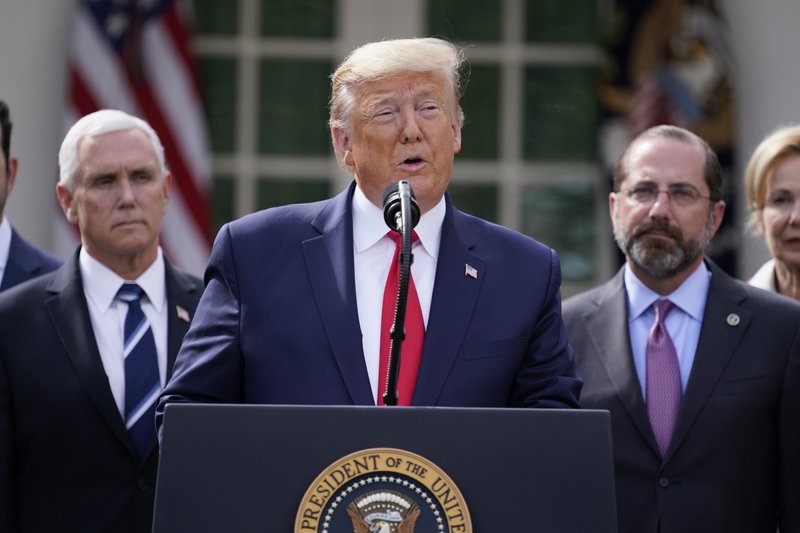
    WASHINGTON (AP) — President Donald Trump announced Friday that he is declaring the coronavirus pandemic a national emergency, as Washington struggles with providing Americans with relief and officials race to slow the spread of the outbreak.

    Speaking from the Rose Garden, Trump said, “I am officially declaring a national emergency.” He said the emergency would open up nearly $50 billion for state and local governments to respond to the outbreak.

    Trump said he was also giving Secretary of Health and Human Services Alex Azar emergency authorities to waive federal regulations and laws to give doctors and hospitals “flexibility” in treating patients.

    He also announced a new public-private partnership to expand coronavirus testing capabilities, as his administration has come under fire for being too slow in making the test available. The partnership will include drive-thru testing in some locations and an online portal to screen those seeking to get tested.

    Still, Trump said that officials don’t want people taking the test unless they have certain symptoms. “It’s totally unnecessary,” Trump said. He added, “This will pass.”