Tag: update

  • Main Street Closure to Continue Following Delta Fuel Fire; Downtown Natchez Businesses Remain Open

    Main Street Closure to Continue Following Delta Fuel Fire; Downtown Natchez Businesses Remain Open

    Mayor Dan Gibson is urging residents and visitors to continue supporting Downtown Natchez businesses as a portion of Main Street remains closed following Sunday’s fire at the Delta Fuel building.

    According to the City of Natchez, engineers have evaluated the fire-damaged structure and determined it poses a collapse risk. As a result, Main Street between the intersections of Union Street and Commerce Street will remain closed to vehicle traffic until the building can be safely stabilized or demolished.

    In addition, the section of Main Street between Union Street and Locust Alley will remain closed to pedestrian traffic for public safety. City officials said there is currently no timeline for reopening the area as they continue working with Delta Fuel and structural engineers to determine the safest course of action.

    Despite the temporary closure, city leaders emphasized that Downtown Natchez remains open for business.

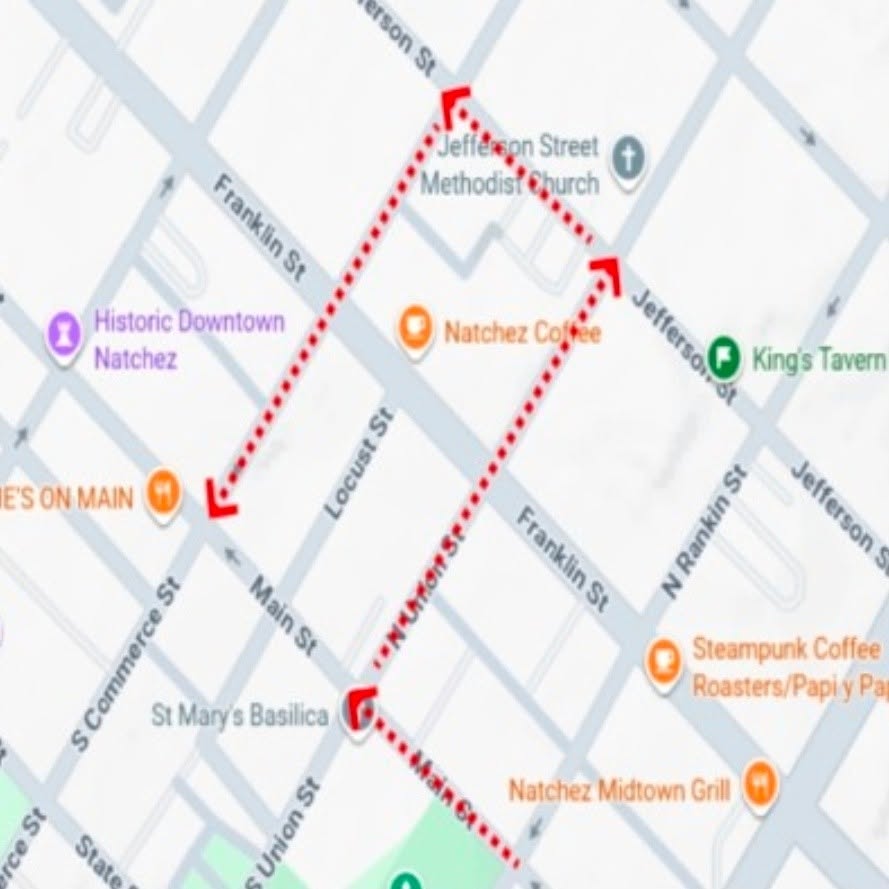
    Motorists traveling through downtown are being directed to turn right onto Union Street, left onto Jefferson Street, and then left onto Commerce Street to reconnect with Main Street. Pedestrians can also access the downtown business district by using Locust Alley.

    The City is encouraging residents and visitors to continue shopping, dining, and visiting downtown restaurants, retail stores, attractions, and other local businesses during the closure.

    Mayor Dan Gibson also expressed his appreciation to the many agencies and individuals who responded to Sunday’s fire, including the Natchez Fire Department, Vidalia Fire Department, Adams County, Concordia Parish, law enforcement officers, first responders, volunteers, and citizens who provided food, drinks, and other support throughout the emergency response.

    “Most importantly, we are thankful there were no injuries and no loss of life,” the City said in its update. “While this closure is an inconvenience, public safety remains our highest priority, and we appreciate everyone’s patience and continued support of our downtown community.”

  • Britain to test mixing and matching of COVID-19 vaccines

    Britain to test mixing and matching of COVID-19 vaccines

    British scientists are starting a study Thursday to find out if it’s OK to mix and match COVID-19 vaccines.

    The vaccines being rolled out now require two doses, and people are supposed to get two shots of the same kind, weeks apart.

    Guidelines in Britain and the U.S. say the vaccines aren’t interchangeable, but can be mixed if the same kind isn’t available for the second dose or if it’s not known what was given for the first shot.

    Participants in the government-funded study will get one shot of the AstraZeneca vaccine followed by a dose from Pfizer, or vice versa.

    “This study will give us greater insight into how we can use vaccines to stay on top of this nasty disease,” said Jonathan Van Tam, the U.K.’s deputy chief medical officer.

    He said that given the challenges of immunizing millions of people amid a global vaccine shortage, there would be advantages to having data that could support more “flexible” immunization campaigns.

    COVID-19 vaccines all train the body to recognize the coronavirus, mostly the spike protein that coats it. The ones from AstraZeneca and Pfizer use different technologies. AstraZeneca’s uses a common cold virus to carry the spike gene into the body. Pfizer’s is made by putting a piece of genetic code called mRNA — the instructions for that spike protein — inside a little ball of fat.

    The British research is scheduled to run 13 months and will also test different intervals between doses, four weeks and 12 weeks apart.

    A study published this week on the Russian-made Sputnik V vaccine showed it was about 91% effective in preventing COVID-19. Some immunologists credit the fact that the vaccine uses two slightly different shots, made with similar technology to AstraZeneca’s.

    But the AstraZeneca and Pfizer vaccines are “so different that it’s really hard to know if that would work,” said Alexander Edwards, an associate professor in biomedical technology at Britain’s University of Reading.

    Matthew Snape, the new study’s leader at Oxford University, which helped develop the AstraZeneca vaccine, called for British volunteers over age 50 to sign up; scientists are hoping to enroll more than 800 people.

    If the vaccines can be used interchangeably, “this will greatly increase the flexibility of vaccine delivery,” he said in a statement. ”(It) could provide clues as to how to increase the breadth of protection against new virus strains.”

    In recent weeks, Britain, the European Union and numerous other countries have been hit with vaccine supply issues: AstraZeneca said it would dramatically reduce the expected number of doses it could deliver due to manufacturing delays and Pfizer also slowed deliveries while it upgraded its Belgian factory.

  • New Beijing outbreak raises virus fears for rest of world

    New Beijing outbreak raises virus fears for rest of world

    BEIJING (AP) — China raised its emergency warning to its second-highest level and canceled more than 60% of the flights to Beijing on Wednesday amid a new coronavirus outbreak in the capital. It was a sharp pullback for the nation that declared victory over COVID-19 in March and a message to the rest of the world about how tenacious the virus really is.

    New infections spiked in India, Iran and U.S. states including Florida, Texas and Arizona as authorities struggled to balance restarting economic activity without accelerating the pandemic.

    European nations, which embarked on a wide-scale reopening this week, looked on with trepidation as the Americas struggled to contain the first wave of the pandemic and Asian nations like China and South Korea reported new outbreaks.

    Chinese officials described the situation in Beijing as “extremely grave.”

    “This has truly rung an alarm bell for us,” Party Secretary Cai Qi told a meeting of Beijing’s Communist Party Standing Committee.

    After a push that began June 14, the city expects to have tested 700,000 people by the end of the day, said Zhang Qiang, a Beijing party official. About half of them were workers from the city’s food markets, nearby residents and close contacts.

    The party’s Global Times said 1,255 flights to and from the capital’s two major airports were scrapped by Wednesday morning, about two-thirds of those scheduled.

    Since the virus emerged in China late last year and spread worldwide, there have been more than 8.1 million confirmed cases and at least 443,000 deaths, according to a tally kept by Johns Hopkins University. Experts say the true toll is much higher, due to the many who died without being tested and other factors.

    The U.S. has the most infections and deaths in the world, with a toll that neared 117,000 on Wednesday, surpassing the number of Americans who died in World War I.

    Arizona reported a daily high of nearly 2,400 new infections for a total of more than 39,000, while in Texas, Gov. Greg Abbott insisted the state’s health care system could handle the fast-rising number of new cases and hospitalizations.

    Tuesday marked the eighth time in nine days that Texas set a new high for COVID-19 hospitalizations at 2,518. State health officials reported 2,622 new cases.

    “It does raise concerns, but there is no reason right now to be alarmed,” Abbott said.

    Texas began aggressively reopening its economy May 1. Abbott noted that Texans may have become lax in wearing masks or practicing social distancing and urged people to stay home as much as possible.

    Canada and the U.S. extended to July 21 a deal to keep their border closed to nonessential travel, with many Canadians fearing cases arriving from the U.S.

    As the U.S. struggles with the first wave of the virus, other countries where it was widely thought to be under control faced disturbing developments.

    In South Korea, authorities reported 43 new cases amid increased public activity. Authorities said 25 of them came from around Seoul, where hundreds of infections have been linked to nightclubs, church gatherings, e-commerce workers and door-to-door salespeople. Twelve of the new cases came from international arrivals.

    Not long after declaring itself virus-free, New Zealand saw a reemergence of the virus. Prime Minister Jacinda Ardern assigned a top military leader to oversee the border quarantines after what she described as an “unacceptable failure” by health officials.

    Two New Zealand citizens who had returned from London to see a dying relative were allowed to leave quarantine before being tested. After the women tested positive, New Zealand began tracing their potential contacts to ensure the virus is contained.

    Their cases raised the specter that international air travel could ignite a new surge of the virus just as countries seek to boost devastated tourism industries.

    China also limited other travel around the capital, keying in on hot spots. Beijing had essentially eradicated local transmissions until recent days, with 137 new cases since last week.

    On Wednesday, the city of 20 million raised its threat level from 3 to 2, canceling classes, suspending reopenings and strengthening requirements for social distancing. China had relaxed many lockdown controls after the Communist Party declared victory over the virus in March.

    India, with the fourth-highest caseload after the U.S., Brazil and Russia, added more than 2,000 deaths to its tally after Delhi and Maharashtra states included 1,672 previously unreported fatalities. Its death toll of 11,903 is now eighth-highest in the world. India has reported 10,000 new infections and more than 300 deaths each day for the last two weeks.

    Iran’s latest outbreak comes after a major Muslim holiday last month and as travel and lockdown restrictions were relaxed. Health Minister Saeed Namaki said he realized the extent of the challenge when he took a domestic flight.

    “Many people have become careless, frustrated with wearing masks,” he said. “They did not observe (social) distancing in the flight’s seating and the airliner’s ventilation system was not working.”

    In Europe, which has seen over 184,000 virus-related deaths, Spanish Prime Minister Pedro Sánchez announced the country will hold a ceremony July 16 to honor its more than 27,000 dead.

    German officials said over 400 people at a large meatpacking plant had tested positive for COVID-19, prompting authorities to order the closure of all schools and childcare centers in the western region of Guetersloh. The industry has seen several outbreaks in recent weeks, prompting the government to impose stricter safety rules.

    Denmark’s health minister urged anyone who joined a large racial injustice protest on June 7 to be tested “whether you have symptoms or not” after one person in the crowd was found to be infected.

    “As long as we have the virus in Europe and in Denmark, it will flare up. We are dealing with a very, very contagious disease,” said Health Minister Magnus Heunicke.
     

  • Louisiana COVID-19 hospitalizations dip below 800

    Louisiana COVID-19 hospitalizations dip below 800

    NEW ORLEANS (AP) — The number of confirmed COVID-19 cases in Louisiana climbed to about 38,500 in figures reported Wednesday, an increase of more than 400 from the day before as the number of tests conducted in the state continues to grow.

    However, the number of people hospitalized with the disease caused by the new coronavirus has fallen below 800 for the first time since late March.

    A falling hospitalization rate is one of the factors state officials use to decide how and when restrictions on public gatherings and business can be eased.

    The death toll in the state from the disease rose to 2,617, up by 21 from Tuesday. Officials say at least 28,700 people have recovered from the disease.

    For most people, the new coronavirus causes mild or moderate symptoms, such as fever and cough that clear up within weeks. For some, especially older adults and those with existing health problems, it can cause more severe illness and be life-threatening.

  • Donation brings a bit of Mardi Gras to hospital workers

    NEW ORLEANS (AP) — Emily Bauman is a believer in the power of music. So when she got her stimulus check, she put that power to work — for New Orleans’s hospital workers and the city’s out-of-work musicians.

    Bauman and a friend funded the stimulus serenade, a concert for front-line health care workers in one of the nation’s coronavirus hot spots, and a paying gig for musicians who badly need one.

    Health care workers in masks and hair coverings hoisted umbrellas and waved handkerchiefs, danced and clapped as nine members of the New Orleans Jazz Orchestra performed outside New Orleans East Hospital. They played “Do Whatcha Wanna” and “Hot Sausage Rag” and Paul Barbarin’s “Second Line.”

    In a city known for music and good times, last Friday’s serenade was a balm for difficult ones.

    “This was fantastic therapy for us and our staff,” said Takeisha Charles Davis, a doctor at the hospital and among those dancing there on Friday. “The last 8½ weeks have been tremendously stressful.”

    Their benefactor is not even a local resident. A professor, classical pianist and jazz enthusiast, Bauman lives in New York City. (An anonymous friend also donated a stimulus check to the project.)

    At first, the plan was to present the serenade in New York. When Bauman was told it wasn’t practical to do it there, she was elated to hear it would be workable in New Orleans.

     Bauman, 49, said she fell hard for NOLA when she lived there temporarily as part of the Teach for America program in the 1990s.

    “Music, I think, is really important as a way for us to communicate with each other in these isolating times,” she said.

    Her hope: to inspire copycats who will fund stimulus serenades across the country and in New Orleans.

    Adonis Rose, artistic director for the jazz orchestra and one of the musicians performing at the serenade, said the 20 of the group’s members who typically perform all over town are now unemployed due to the pandemic and subsequent business closures.

    Rose said the gift was a boost to musicians who have been unemployed and in quarantine for more than two months.

    “This was great for the musicians to keep the musicians working and also to show support for the health care workers and the patients affected by the virus,” Rose said. “Being able to bring them together, to be able to do it for such a great cause, was amazing.”

    There’s enough money left over for a second concert, planned for later this month at the Lambeth House, the retirement and assisted living facility where a dozen died early on in the pandemic.

    Bauman, more than 1,400 miles away, watched the hospital concert on the jazz orchestra’s website.

    “I loved it and found it very emotional but also very joyful, which I didn’t expect,” she said. “The dancing was so inspiring and made me feel watching it like I was there and part of it. I actually felt like the serenade was sending courage and soul to me, too, and I was one of the ones organizing it!”

  • Detective, nurse, confidant: Virus tracers play many roles

    SALT LAKE CITY (AP) — Health investigator Mackenzie Bray smiles and chuckles as she chats by phone with a retired Utah man who just tested positive for the coronavirus.

    She’s trying to keep the mood light because she needs to find out where he’s been and who he’s been around for the past seven days. She gently peppers him with questions, including where he and his wife stopped to buy flowers on a visit to a cemetery. She encourages him to go through his bank statement to see if it reminds him of any store visits he made.

    Midway through the conversation, a possible break: His wife lets slip that they had family over for Mother’s Day, including a grandchild who couldn’t stop slobbering.

    “Was there like a shared food platter or something like that?” Bray asks. “There was, OK, yep … sharing food or sharing drinks, even just being on the same table, it can spread that way.’”

    Suddenly, with a shared punch bowl, the web has widened, and Bray has dozens more people to track down.

    She is among an army of health professionals around the world filling one of the most important roles in the effort to guard against a resurgence of the coronavirus. The practice of so-called contact tracing requires a hybrid job of interrogator, therapist and nurse as they try coax nervous people to be honest.

     The goal: To create a road map of everywhere infected people have been and who they’ve been around.

    While other countries have devised national approaches, a patchwork of efforts has emerged in the U.S. where states are left to create their own program.

    Bray normally does this type of work to track contacts for people with sexually transmitted diseases. She is now one of 130 people at the Salt Lake County health department assigned to track coronavirus cases in the Salt Lake City area. The investigators, many of them nurses, each juggle 30 to 40 cases, and try to reach everyone the original person was within 6 feet (1.8 meters) of for 10 minutes or more. They stay in touch with some people throughout the 14-day incubation period, and calls can take 30 minutes or more as they meticulously go through a list of questions.

    Some estimate as many as 300,000 contact tracers would be needed in the U.S. to adequately curtail the spread. While some states like Utah have reported having enough contact tracers, others are hundreds or even thousands of people short.

    The contact tracers often find themselves in a tangled web of half-truths and facts that don’t match up. Language and cultural barriers arise that require interpreters and taxing conversations that leave the investigators wondering if the person understands what they’re trying to do.

  • Louisiana Stay at Home Order Extended Until May 15

    Louisiana Stay at Home Order Extended Until May 15

    Everyone in Louisiana should wear masks when in public; Next announcement will be May 11

    Today, Gov. John Bel Edwards announced he will extend Louisiana’s Stay at Home order until May 15 to continue to slow the spread of COVID-19. Louisiana does not currently meet the White House criteria for entering Phase One of reopening.

    While Louisiana has seen positive, improving trends statewide in terms of new case growth and new hospitalizations, in several regions across the state, new cases and hospitalizations continue to increase or to plateau, according to data from the Louisiana Department of Health. The White House criteria calls for declining numbers of new cases and hospitalizations, among other things.

    “Thanks to the commitment of the people of Louisiana, our state has made progress in flattening the curve and reducing the spread of the novel coronavirus. Unfortunately, we still have a little work to do before we meet the criteria to safely move to the next phase of reopening, so I will extend the state’s Stay at Home order until May 15, with a few minor changes,” Gov. Edwards said. “While this is not the announcement I want to make, I am hopeful, and all of Louisiana should be hopeful, that we will enter into the next phase of reopening soon, in mid-May. I am anxious to get all areas of our economy reopened, but if we accelerate too quickly, we may have to slam on the brakes. That will be bad for public health and for businesses, bad for our people and bad for our state.”

    Gov. Edwards’ decision is based on regional data that shows that while overall new cases and hospitalizations have decreased, this is not the case in several regions. In the Baton Rouge and Monroe regions, both new cases and new hospitalizations have increased. Some increases are also being seen in terms of new cases in Acadiana and a plateau for hospitalizations in Southwest Louisiana and a plateau of new cases on the Northshore.

    • Click here to view the Governor’s presentation on regional data trends.

    Under the extended order, which will be issued on Friday, May 1, businesses that previously were directed to be closed will remain closed, including salons, barber shops, bars and casinos, among other things. Businesses that are deemed essential under the third phase of federal CISA guidance may still be open. Non-essential retail businesses in Louisiana continue to be able to open with fewer than 10 people total inside.

    Three major changes in the new Stay at Home order include:

    • Malls will remain closed to the public, but stores may open for curbside delivery.
    • Restaurants will be allowed to open their outside areas for patrons to eat meals only, without tableside service.
    • All employees of a business who have contact with the public must wear a mask.

    Additionally, both the CDC and the Louisiana Department of Health strongly urge everyone to wear masks when in public.

    “Wearing cloth masks or protective face coverings is part of the new normal,” Gov. Edwards said. “Wearing a mask is being a good neighbor and in Louisiana, we pride ourselves on being good neighbors. Your mask protects me and other people and my mask protects you.”

    Hopefully, Louisiana will meet the White House criteria and move to Phase 1 on May 15, provided symptoms, new case counts and hospitalizations decrease and the state continues to surge testing and contact tracing capacity. Phase 1 lifts the Stay at Home order and eases restrictions on some public spaces like houses of worship and restaurants and opens other businesses that have been closed such as barber shops and salons, but with restrictions on occupancy and strict requirements for personal distancing and masks to keep everyone safe. Phase One occupancy for these businesses will be limited to 25 percent.

    As Louisiana prepares for its next phase of reopening, business owners and faith leaders are encouraged to plan as well, including understanding their building’s maximum occupancy limits, which may require contacting local government or the State Fire Marshal’s office. They should also plan on ensuring their employees have masks.

    Gov. Edwards intends to make his next announcement on moving to Phase 1 in Louisiana on or by May 11. Members of the public can continue to get information from the Governor’s office on coronavirus.la.gov and by texting LACOVID to 67283.

  • Concordia Parish School Board is now delivering meals to student’s home’s

    Concordia Parish School Board is now delivering meals to student’s home’s

    Concordia Parish is committed to working to assist families with meals for school-aged students during this unprecedented pandemic associated with COVID-19 and we continue to assess the ability to provide assistance while adhering to guidance from the CDC and other state agencies to stop the spread.

    Concordia Parish and the Healthy School Food Collaborative will provide shelf-stable, easily prepared meals to students that attend Concordia Parish. Meals will be delivered directly to your residence.

    Click this link and fill out the form in order to sign up your Concordia Parish student to receive delivered meals to your residence.
  • Mississippi gov: Closing businesses amid virus could do harm

    JACKSON, Miss. (AP) — Mississippi Gov. Tate Reeves said Monday that he is not ordering businesses to close or people to stay at home to try to slow the spread of the coronavirus, in contrast to what several other governors are doing.

    Republican Reeves strongly suggested that Mississippians follow state Health Department recommendations to wash their hands, stay home if possible and keep distance from others in places like grocery stores. He said he is trying to balance concerns about public health and the economy.

    “We don’t want to make any decisions that will ultimately do more harm than good,” Reeves said Monday during a Facebook live session in which he spent nearly an hour answering questions from the public.

    Reeves led a prayer session Sunday on Facebook and suggested that people avoid gathering in large groups. He faced intensifying criticism Monday from some local officials and state lawmakers who said he needs to issue a statewide order for people to stay at home unless they have essential jobs or are getting groceries or prescriptions.

    “Mayors and local leaders are putting in place differing curfews and orders. This patchwork system is creating public confusion that will result in panic,” Democratic state Rep. Jarvis Dortch wrote Monday on Twitter.

    Reeves last week ordered public schools to remain closed until at least mid-April. Some schools are taking steps to help students with distance learning. In the Jackson suburb of Clinton, teachers on Monday distributed iPads. Some parents wore masks or gloves when they picked up the tablets.

    Reeves said Monday that day care centers are among the businesses that remain open.

    The Mississippi State Department of Health on Monday reported the state had 249 confirmed cases of the coronavirus as of 6 p.m. Sunday. The department said one Mississippi resident has died of COVID-19; he was a Hancock County resident who had underlying medical conditions, and he died last week in a Louisiana hospital.

    Several medical facilities in Mississippi are now providing coronavirus testing to people with fever and “severe cough or chest pain,” and screening began Monday for people to get appointments for a drive-thru testing site that opens Tuesday on the Mississippi State Fairgrounds.

    The health department said Biloxi, Ocean Springs and Tupelo each have two test sites open. The other sites, as of Monday, were in Bay St. Louis, Fulton, Gulfport, Hattiesburg, Hurley, Jackson, Long Beach, Pascagoula, Philadelphia, Vancleave, Wiggins and Woolmarket.

    The vast majority of people infected with the novel coronavirus get only mild or moderate symptoms, such as fever and cough, and recover in about two weeks. But many will need hospitalization. Particularly vulnerable are older adults and those with existing health problems who can develop severe complications, including pneumonia.

    The Mississippi health department recommended last week that bars and restaurants stop dine-in services and only provide carry-out orders of food.

    Gulfport closed all of its city buildings and facilities, including parks, as of midnight Friday. A statement from the city said many people are adhering to suggestions of social isolation.

    “Unfortunately, there are some in our community who have irresponsibly ignored these recommendations,” Gulfport officials said in a statement late Friday. “People continuing to congregate in the public and at places of business have only served to penalize those observing the new protocols — and worse, have created an environment where this invasive contagion can easily spread.”

  • Louisiana “Stay at Home” Order issued By Gov. Edwards

    Louisiana “Stay at Home” Order issued By Gov. Edwards

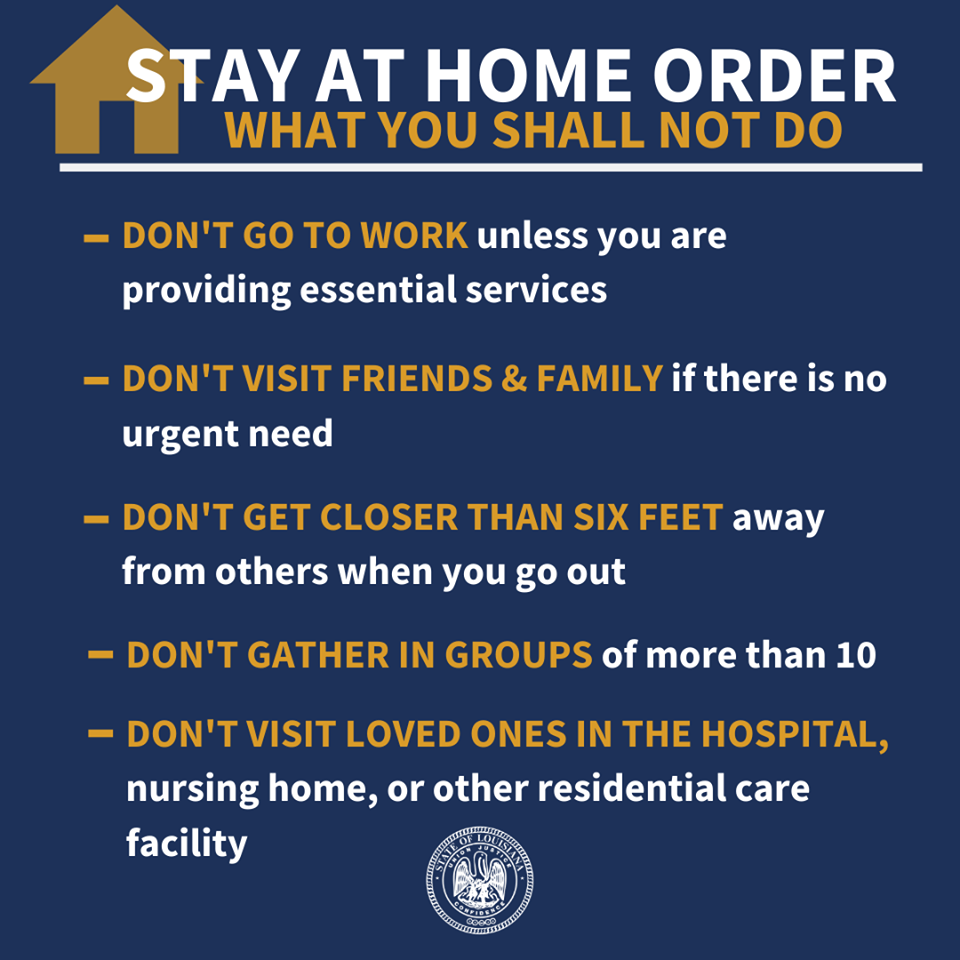
    Today, Gov. John Bel Edwards issued a statewide Stay at Home order that goes into effect at 5 p.m. Monday, March 23, to further fight the spread of COVID-19 in Louisiana, as the number of confirmed cases have topped 800 and spread to more than half of our parishes.

    • Click here to read the Governor’s statewide Stay at Home order.
    • Click here to see graphics.

    “In Louisiana we have taken aggressive measures to mitigate the spread of COVID-19 and flatten the curve; however, this is not enough. As our number of cases continue to grow, I am directing all Louisianans to stay at home unless it is absolutely necessary for you to leave. I am implementing this measure to help prevent you from becoming infected or infecting someone else. People can leave their homes to do essential things like buying groceries or food, pick up medicine or go to work only if their job is essential. If you have to go out, make sure you practice social distancing measures and keep 6 feet between you and the people around you. People are encouraged to go outside and to stay active during this time, as long as they practice social distancing when they are around their neighbors,” Gov. Edwards said. “This order is not something I take lightly, but it is necessary to protect the health, safety and well-being of our people, our communities and our way of life.”

    The order is set to expire at the end of the night on Sunday, April 12. The Governor will re-evaluate the need for the statewide Stay at Home order and other mitigation measures currently in place to determine if they need to be extended beyond April 12.

    The Governor previously ordered all K-12 public schools, casinos, bars movie theatres, gyms and fitness centers closed and restricted restaurants to take-out, drive-through and delivery orders only. He has also moved the state’s April 4 elections and limited crowd size.

    For businesses, the new Stay at Home order has limits on the following:

    • All places of public amusement, whether indoors or outdoors, including but not limited to, locations with amusement rides, carnivals, amusement parks, water parks, trampoline parks, aquariums, zoos, museums, arcades, fairs, pool halls, children’s play centers, playgrounds, theme parks, any theaters, concert and music halls, adult entertainment venues, racetracks, and other similar businesses.
    • All personal care and grooming businesses, including but not limited to, barber shops, beauty salons, nail salons, spas, massage parlors, tattoo parlors, and other similar businesses.
    • All malls, except for stores in a mall that have a direct outdoor entrance and exit that provide essential services and products as provided by the Cybersecurity & Infrastructure Security Agency (CISA) guidelines.
    • Businesses closed to the public as listed in the order can conduct necessary activities such as payroll, cleaning services, maintenance or upkeep as necessary.
    • Any business not covered by the guidance from the CISA discussed in Section 3 of the order and not ordered to temporarily close must reduce operations to continue with minimum contact with members of the public and essential employees, while requiring proper social distancing, adhering to the 10-person limitation on gathering size.
    • Early learning centers and child care facilities adhering to the guidance issued by the Louisiana Department of Education and Office of Public Health may continue to operate.

    Examples of Essential Worker Functions under the Cybersecurity & Infrastructure Security Agency (CISA) guidelines include:

    • Healthcare workers and caregivers
    • Mental health and Social Service workers
    • Pharmacy employees
    • Workers supporting groceries, pharmacies and other retail sales of food and beverage products
    • Restaurant carryout and quick-serve food operations and food delivery employees
    • Farm workers
    • Electricity and Utility Industry Employees
    • Critical Manufacturing Employees (medical supply chains, energy, transportation, food, chemicals)
    • Petroleum, Natural and Propane Gas Workers
    • Transportation and Logistics Workers
    • Communications and Information Technology Employees
    • Financial Services and Banking Industry Employees

    See CISA essential business guidelines here.

    Members of the public will still be allowed to go to grocery stores and pharmacies to pick up food, medicine and necessary supplies, go to their essential jobs and to go outside for exercise and fresh air. When leaving their home, people should practice social distancing.

    OTHER ORDERS FROM THE GOVERNOR:

    Gov. Edwards has issued a number of orders designed to mitigate the spread of COVID-19 in Louisiana and flatten the curve. They are:

    In addition, Gov. Edwards issued a proclamation on March 13 moving Louisiana’s elections, which can be found here.