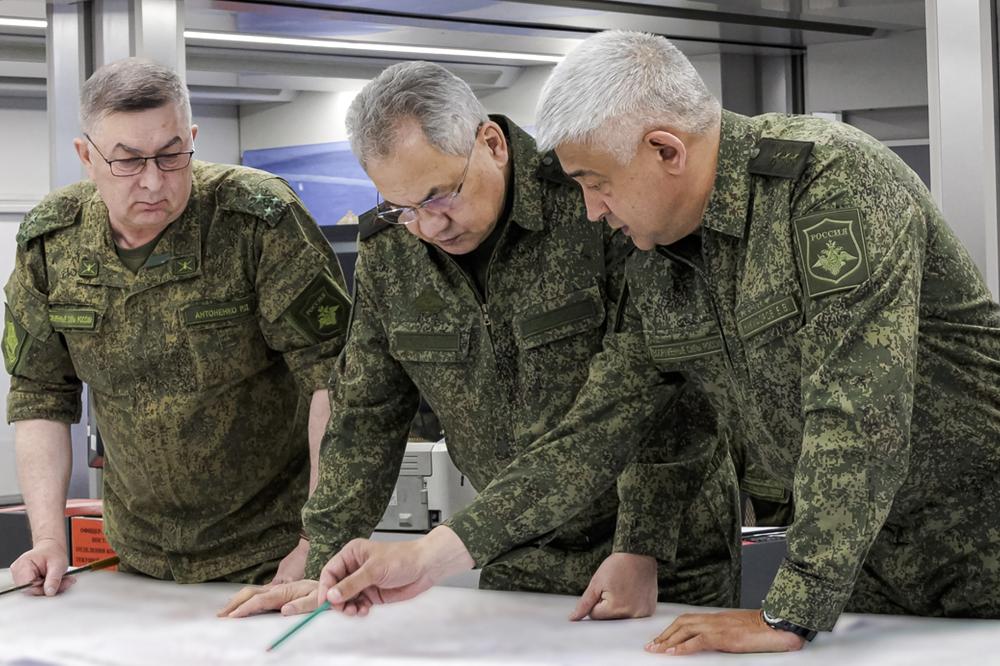
The leader of the Wagner mercenary group defended his short-lived insurrection in an audio statement Monday, and Russian Defense Minister Sergei Shoigu made his first public appearance since the uprising that demanded his ouster, in a video aimed at projecting a sense of order after the country’s most serious political crisis in decades.
But uncertainty still swirled about his fate, as well as that of rebellion leader Yevgeny Prigozhin and his private army, the impact on the war in Ukraine, and even the political future of President Vladimir Putin.
In an 11-minute audio statement, Prigozhin denied trying to attack the Russian state and said he acted in response to an attack on his force that killed some 30 of his fighters.
A feud between the Wagner Group leader and Russia’s military brass that has festered throughout the war erupted into a mutiny that saw the mercenaries leave Ukraine to seize a military headquarters in a southern Russian city and roll seemingly unopposed for hundreds of miles toward Moscow, before turning around after less than 24 hours on Saturday.
The Kremlin said it had made a deal for Prigozhin to move to Belarus and receive amnesty, along with his soldiers. There was no confirmation of his whereabouts Monday, although a popular Russian news channel on Telegram reported he was seen at a hotel in the Belarusian capital, Minsk.
Russian media reported a criminal probe against Prigozhin continued, and some lawmakers called for his head.
In a return to at least superficial normality, Moscow’s mayor announced an end to the “counterterrorism regime” imposed on the capital Saturday, when troops and armored vehicles set up checkpoints on the outskirts and authorities tore up roads leading into the city.
The Defense Ministry video of Shoigu came as Russian media speculated that he and other military leaders have lost Putin’s confidence and could be replaced.
Shoigu was shown in a helicopter and then meeting with officers at a military headquarters in Ukraine in video broadcast on Russian media, including state-controlled television. It was unclear when it was shot.
General Staff chief Gen. Valery Gerasimov, also a main target of Prigozhin’s ire, has not appeared in public.
It was unclear what would ultimately happen to Prigozhin and his forces under the deal purportedly brokered by Belarusian President Alexander Lukashenko.
Though his mutiny was brief, it was not bloodless. Russian media reported that several military helicopters and a military communications plane were shot down by Wagner forces, killing at least 15. The Defense Ministry has not commented. Prigozhin denied there were any casualties on his side, but media reports indicated the airstrikes hit some Wagner vehicles, and messaging app channels featured images of the damage.
The U.S. had intelligence that Prigozhin had been building up his forces near the border with Russia for some time, suggesting the revolt was planned. That conflicts with Prigozhin’s claim his rebellion was a response to a Friday attack on his field camps in Ukraine by the Russian military, which he said killed a large number of his men. The Defense Ministry denied that.
Russia’s RIA Novosti state news agency cited unidentified sources in the Prosecutor General’s office as saying the criminal case against Prigozhin hasn’t been closed, despite earlier Kremlin statements. The Interfax news agency carried a similar report.
Should the case continue, Prigozhin’s presence in Belarus — a staunch Kremlin ally — would offer little protection against arrest and extradition.
It was unclear what resources Prigozhin has to draw on, and how much of his substantial wealth he can access. Police searching his St. Petersburg office on the day of the rebellion found 4 billion rubles ($48 million) in trucks outside the building, according to Russian media reports confirmed by the Wagner boss. He claimed the money was intended to pay his soldiers’ families.
Russian media reported that Wagner offices in several Russian cities had reopened on Monday and the company had resumed enlisting recruits.
Several Russian lawmakers called for tight regulations of private military companies under a new law set to be considered — and some argued that Prigozhin must be punished.
Andrei Gurulev, a retired general and current lawmaker who has rowed with the mercenary leader, said Prigozhin and his right-hand man Dmitry Utkin, a former military officer who runs Wagner, deserve “a bullet in the head.”
“I firmly believe that traitors in wartime must be executed,” he said.
Leave a Reply
You must be logged in to post a comment.