Blog

  • Mississippi Mayor Challenges Medical Marijuana Initiative

    Mississippi Mayor Challenges Medical Marijuana Initiative

    JACKSON, Miss. (AP) — A Mississippi mayor on Tuesday challenged the petition process that put one of two medical marijuana proposals on the statewide ballot, arguing that the number of signatures gathered does not meet standards set in the state constitution.

    Madison Mayor Mary Hawkins Butler filed papers with the state Supreme Court one week before the Nov. 3 general election, more than a month after the start of absentee voting in Mississippi and several months after the secretary of state’s office said the initiative qualified for the ballot.

    Supporters of Initiative 65 said their petition process met the requirements set by the constitution and by a 2009 attorney general’s opinion. They also accused Butler and the city of Madison of trying to undermine the initiative.

    “The Secretary of State properly qualified Initiative 65 under the same constitutional procedures used for every other successful voter initiative,” Jamie Grantham, spokeswoman for Mississippians for Compassionate Care, said in a statement. “The lawsuit from the City of Madison is meritless.”

    The Mississippi initiative process requires petitioners to gather signatures from registered voters, getting no more than one-fifth of the signatures from any congressional district.

    Mississippi had five congressional districts in the 1990s when the initiative process was established, but the state dropped to four congressional districts after the 2000 Census.

    In papers filed Tuesday with the state Supreme Court, Butler argued it’s “a mathematical certainty” that more than one-fifth of the signatures for Initiative 65 came from at least one of the four congressional districts.

    In a legal opinion dealing with initiatives, the Mississippi attorney general’s office said in 2009 that the secretary of state should require an equal number of signatures from each of the five old congressional districts.

    Butler argued that the secretary of state ignored the “plain language” of the constitution when he said Initiative 65 had qualified for the ballot. Delbert Hosemann was in his final months as secretary of state when the initiative petitions were submitted, and he became lieutenant governor in January.

    Justice Leslie D. King on Tuesday ordered the current secretary of state, Michael Watson, to respond to Butler’s lawsuit by Wednesday. During a news conference Tuesday, Watson declined to comment on the lawsuit. Hosemann, Watson and Butler are all Republicans.

    Initiative 65 would allow patients to use medical marijuana to treat debilitating conditions, as certified by physicians.

    An alternative measure that is also on the Mississippi ballot, Initiative 65A, also would allow patients with debilitating conditions to use medical marijuana, but it does not specify that those would have to be certified by physicians. It says the state would create a program based on “sound medical principles.”

    More than 100,000 registered voters petitioned to put Initiative 65 on the ballot. The alternative was put there by legislators. Sponsors of the original initiative say the alternative is intended to cause confusion and kill the original.

    There’s a two-step process for voting on 65 and 65A. The ballot first instructs people to “Vote for approval of either, or against both.” It then says, “And vote for one” — either 65 or 65A.

    Watson has said that even if people vote against both initiatives on the first part, they can still vote for one of the proposals on the second part.

    The Mississippi Municipal League opposes Initiative 65, partially because the initiative limits zoning rules that local governments may put on medical marijuana centers.

    ____

    This story has been edited to correct that when the petitions for Initiative 65 were submitted, the secretary of state was Delbert Hosemann, not Michael Watson.

    ___

    Follow Emily Wagster Pettus on Twitter at http://twitter.com/EWagsterPettus.

  • Hurricane Zeta Speeds Toward A Storm-Weary Louisiana

    Hurricane Zeta Speeds Toward A Storm-Weary Louisiana

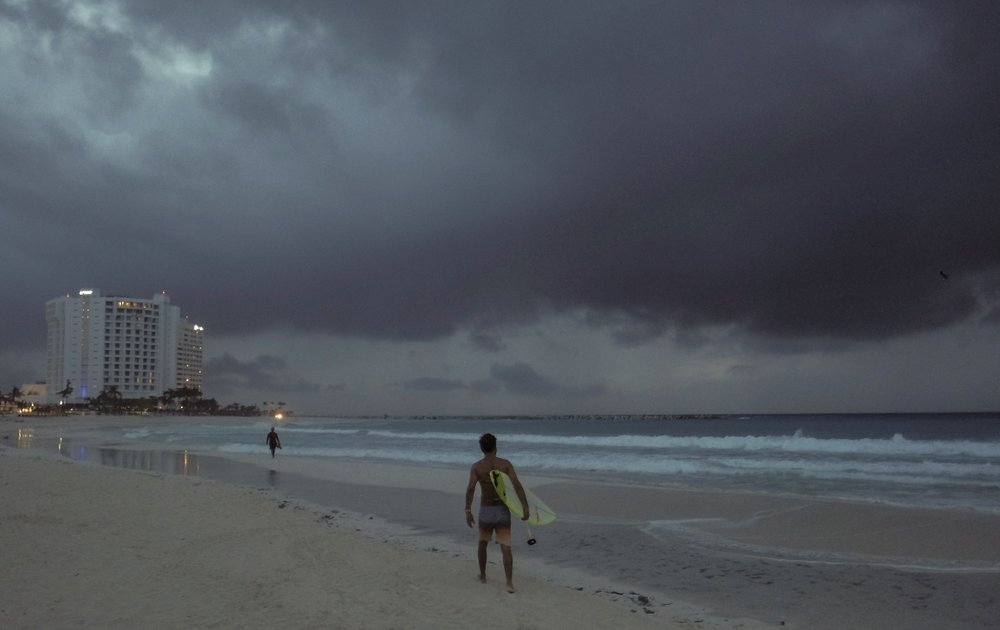
    NEW ORLEANS (AP) — Hurricane Zeta was speeding toward storm-weary Louisiana with top winds of 90 mph (150 kph), forecast to strike the coast as a Category 2 hurricane Wednesday afternoon. New Orleans, where a pump system failure raised flood risks, was squarely in its path.

    Workers closed one of the last floodgates surrounding the city as residents braced for the 27th named storm of a historically busy Atlantic hurricane season. The iconic streetcars shut down and City Hall closed until after the storm, Mayor LaToya Cantrell said.

    Tropical storm warnings were issued as far away as the north Georgia mountains, highly unusual for the region. New Orleans has been in the warning areas of seven previous storms that veered east or west this season. Zeta was staying on course.

    “I don’t think we’re going to be as lucky with this one,” city emergency director Collin Arnold said.

    Zeta had been predicted to hit as a relatively weak Category 1 hurricane, but Louisiana residents awoke to updated forecasts predicting a Category 2, intensifying to nearly 100 mph (160 kph) at landfall.

    “The good news for us -– and look, you take good news where you can find it –- the storm’s forward speed is 17 mph. That’s projected to increase, and so it’s going to get in and out of the area relatively quickly, and then we’re going to be able to assess the damage more quickly,” Gov. John Bel Edwards said in an interview on The Weather Channel.

    Officials urged people to take precautions and prepare to shelter in place, but there were few signs of concern in New Orleans. It was business as usual in the French Quarter. “This one is moving fast and I don’t think it’s going to do much,” said Kelly Ann, a visitor from St. Petersburg, Florida, as she strolled Decatur Street.

    The winds were picking up and water was rising above the docks in Jean Lafitte, a small fishing town south of New Orleans that takes its name from a French pirate. Workers drove truckloads of sand to low-lying areas where thousands of sandbags were already stacked before previous storms.

    “We’re going to get a lot of water fast,” said the mayor, Tim Kerner Jr. “I’m optimistic regarding the tidal surge because of the speed of the storm, but we’re not going to take it for granted.”

    New Orleans officials announced that a turbine that generates power to the city’s aging drainage pump system broke down on Sunday, with no quick repair in sight. There was enough power to keep the pumps operating if needed, but little excess power to tap if other turbines fail, officials said.

    Officials said they were running through contingencies to provide power and make repairs where needed should there be other equipment problems. Forecasts called for anywhere from 2 to 6 inches (5 to 15 centimeters) of rain to fall in the New Orleans area, but Zeta is expected to be a relatively fast-moving storm, possibly mitigating the flood threat.

    By late Wednesday morning, Zeta’s top winds had grown to 90 mph (150 kph) and its forward movement increased to 18 mph (28 kph) as its center moved north, about 235 miles (380 kilometers) south of New Orleans.

    Zeta raked across Mexico’s Yucatan Peninsula Tuesday, toppling trees and briefly cutting power to more than 300,000 people but causing no deaths, before strengthening again along a path slightly east of Hurricane Laura, which was blamed for at least 27 Louisiana deaths after it struck in August, and Hurricane Delta, which exacerbated Laura’s damage in the same area just weeks later.

    Hurricane warnings stretched from Morgan City, Louisiana to the Alabama/Mississippi state line, including Lake Pontchartrain and metropolitan New Orleans. The deteriorating weather forced early voting sites to close for hours in the western Florida Panhandle, where Republicans dominate.

    Tropical storm warnings covered a large swath of the South, from Louisiana and Mississippi into Alabama and Georgia, including all of the Atlanta area, where winds could gust up to 55 mph (89 kph) early Thursday. Winds could be “especially severe” in the southern Appalachian Mountains, where flash flooding is possible, the hurricane center said.

    Edwards asked President Donald Trump for a disaster declaration ahead of the storm. He and Alabama Gov. Kay Ivey both declared emergencies, as did Mayor Andrew “FoFo” Gilich in Biloxi, Mississippi. Trump declared an emergency for Louisiana Tuesday evening.

    An average season sees six hurricanes and 12 named storms. This extraordinarily busy season has focused attention on climate change, which scientists say is causing wetter, stronger and more destructive storms.

    “I’m physically and mentally tired,” a distraught Yolanda Lockett of Lake Charles said outside her New Orleans hotel. She’s one of about 3,600 evacuees from Laura and Delta still sheltering.

    In coastal St. Bernard Parish, Robert Campo readied his marina for another onslaught. “We’re down for four or five days, that’s four or five days nobody’s fishing. That’s four or five days nobody is shrimping. That’s four or five days, no economic wheels are turning,” he said.

    After Hanna, Isaias, Laura, Sally and Delta, Zeta will tie a record set in 1886 and repeated in 1985 for six hurricanes smacking the continental U.S., according to Colorado State University hurricane researcher Phil Klotzbach.

    And as the 11th named storm to make landfall in the continental U.S., Zeta will set a new record, well beyond the nine storms that hit in 1916.

    ___

    This story has been corrected. The New Orleans emergency director’s surname is Arnold.

    ___

    Plaisance reported from Laffite, Louisiana, and Santana from Shell Beach, Louisiana. Associated Press contributors include Gerald Herbert in New Orleans; Jay Reeves, in Birmingham, Alabama; Melinda Deslatte in Baton Rouge, Louisiana; Seth Borenstein in Kensington, Maryland; Jeff Martin in Marietta, Georgia; and Gabriel Alcocer in Cancun, Mexico.

  • Itta Bena May Be Left In The Dark Over Unpaid Power Bill

    Itta Bena May Be Left In The Dark Over Unpaid Power Bill

    As of August 1, the city owed more than $800,000 to its wholesale electrical provider.

    ITTA BENA, Miss. (AP) — A decade ago, the sole grocery store in the city of Itta Bena shuttered. The last bank left a few years later, followed by the pharmacy — lifelines for a small, rural community.

    Now, the lights may go out for all 1,800 residents.

    Because of long-standing debt with its wholesale electrical provider, the city faces complete disconnection Dec. 1. As of August, Itta Bena owed more than $800,000. That’s equal to one-third of the annual budget for the whole city — located in the Mississippi Delta, a region along the Mississippi River known for its long history of cotton farming and deep impoverishment.

    The news is devastating for the community, where 40% of people live below the poverty line and 90% are Black. Itta Bena has long struggled with a decreasing tax base, white flight and job loss. The coronavirus pandemic has sparked more worry.


    “It just feels like we keep losing and losing. There’s no growth,” said Patricia Young, a day care owner who submitted a petition signed by 300 residents asking the state auditor to investigate the city’s electrical department. “We just can’t take the hurt anymore. You start to wonder, ‘Do they really want us to survive?’”

    Itta Bena’s electric system is city-run and owned, and unregulated by the state. Mississippi’s Public Service Commission, which oversees utilities, opened an investigation anyway and invited the state auditor, citing safety and quality-of-life concerns. State officials are organizing meetings among the city, wholesale electrical provider Municipal Energy Agency of Mississippi, and other providers to find coverage for Itta Bena.

    Brandon Presley, a public service commissioner, said he’s never seen an electric provider threaten to pull out of a city in Mississippi — or any other state. He said it’s a “failure of the city government” and that residents “deserve better than to be left in the dark.”

    Itta Bena Mayor J.D. Brasel said some of the debt — more than $300,000 — stems from residents’ unpaid bills that the city now must cover. As a middleman of sorts between residents and MEAM, the city purchases electricity from the wholesaler to sell residents and is responsible for the bill.

    Former Mayor Thelma Collins, who left office in 2017, said officials have long known about the debt but prioritized other projects. She said lack of vision and planning exacerbate problems.

    Itta Bena was founded around 1850 by plantation owner, Confederate general and former Gov. Benjamin Grubb Humphreys. He chose the name, which means “forest camp” in the language of the Choctaw people, who were forcibly removed from the land. Humphreys brought slaves to help turn the Delta into the South’s cotton-producing capital.

    After the Civil War, slaves were freed into a sharecropping system that resulted in generational poverty. Black families were blocked from educational and political opportunities. Industrialization led to fewer jobs in the fields. And after the Civil Rights movement made strides for racial equity and integration, white families began leaving, taking tax dollars with them.

    From 2000 to 2010, white population decreased from 20% to 10% of Itta Bena. Total population has decreased by one-third — from around 3,000 to 1,800 — since 1980.

    Birdia and John Williams bought their home 23 years ago from a white family moving away. She remembers driving through and seeing a beautiful neighborhood of nice, clean houses.

    “While we moved in, they were all moving out,” said Williams, 64, a Black woman. “It’s not the same city today as it used to be. We have good people here, lovely people. But there’s nothing here anymore.”

    Emma Harris, 66, was raised 10 miles away, where her parents worked on a white-owned plantation. She said her husband was born and worked on the plantation, until they married and moved to the Itta Bena area in 1978. Growing up, she remembers traveling the country road to shop in Itta Bena and seeing the “city lights” downtown.

    Today, 20 downtown storefronts are abandoned. Remaining are a laundromat, a used-car seller, a clinic run by a nurse practitioner, a bar, a credit union. The corner store sells canned food, bread, fishing gear – with a small food menu from a kitchen in back.

    The nearest grocery store is 10 miles away; a Dollar General sells some fruits and vegetables. Some folks, like Williams, travel 45 miles to a bargain store in Grenada for groceries.

    Businesses and city offices will lose power if MEAM leaves. Some businesses purchased generators as backup. Only institutions like the historically Black Mississippi Valley State University, whose utility system is separate from the city’s, will be unaffected.

    Itta Bena’s financial woes aren’t new. In 2014, the federal government placed a tax lien on city assets after officials failed to pay $200,000 in payroll taxes. In 2016, a former city clerk was convicted of embezzlement. The power debt dates back to 2009.

    MEAM didn’t answer a request for comment, but in a letter shared with the Public Service Commission, President and CEO Geoffrey Wilson said the company has exercised “extraordinary patience” trying to collect.

    “The situation brought about by the City’s failure to pay its MEAM invoices in full is regrettable, but it is a situation of Itta Bena’s own making,” Wilson wrote.

    Residents said they were surprised to learn the city was so in debt. Itta Bena light bills are notoriously high.

    Williams said monthly bills for her one-story home sometimes exceed $650. Kathy Gee, who’s lived in Itta Bena for 40 years and is on disability for lupus, said her income is about $500 monthly, and she’s received bills over $400. The mayor said he’s aware of high bills, and that rates are calculated correctly.

    Harris said she’s tried approaching City Hall with partial payments, in hopes her power wouldn’t be shut off.

    “My lights have been out many, many, many times because I didn’t have the money,” she said. “Knowing they are the ones in debt, you feel used. You work so hard for so long, and it feels like you get nothing in return.”

  • Zeta re-strengthens to a hurricane, takes aim at Gulf Coast

    Zeta re-strengthens to a hurricane, takes aim at Gulf Coast

    NEW ORLEANS (AP) — Zeta re-strengthened into a hurricane early Wednesday as Louisiana braced for the 27th named storm of a historically busy Atlantic hurricane season.

    Landfall is expected south of New Orleans with life-threatening storm surge and strong winds expected along portions of the northern Gulf Coast beginning around midday.

    Zeta raked across the Yucatan Peninsula Tuesday, striking as a hurricane, before weakening to a tropical storm.

    Hurricane warnings stretched from Morgan City, Louisiana, along the Mississippi coast to the Alabama state line. The tropical storm sarning along the coast of the Florida panhandle has been extended eastward to the Walton/Bay County Line. Early Wednesday, the storm had sustained winds of 85 mph (136 kph) and was centered 320 miles (514 kilometers) south-southwest of the Mississippi River’s mouth.

    The center of Zeta will approach the northern Gulf coast Wednesday and make landfall in southeastern Louisiana in the afternoon, according the National Hurricane Center. Zeta will move close to the Mississippi coast Wednesday evening, and move across the southeastern and eastern United States on Thursday.

    Louisiana Gov. John Bel Edwards asked President Donald Trump for a disaster declaration ahead of the storm. He and Alabama Gov. Kay Ivey both declared emergencies, as did Mayor Andrew “FoFo” Gilich in Biloxi, Mississippi. Trump declared an emergency for Louisiana Tuesday evening.

    “There’s no doubt that we’ve seen a lot this year, with COVID and so many threats from so many storms,” Gilich said in a news release, “but this storm shows that we haven’t seen it all yet.”

    The storm approached as New Orleans officials announced that a turbine that generates power to the city’s aging drainage pump system broke down Sunday, with no quick repair in sight. There was enough power to keep the pumps operating if needed but it left authorities with little excess power to tap should a breakdown of other turbines occur, officials said at a news conference with Mayor LaToya Cantrell.

    Officials said they were running through contingencies to provide power and make repairs where needed should there be other equipment problems. Forecasts, meanwhile, called for anywhere from 2 to 6 inches (5 to 15 centimeters) of rain to fall in the New Orleans area. Officials noted that Zeta is expected to be a relatively fast-moving storm, possibly mitigating the flood threat.

    Zeta broke the record for the previous earliest 27th Atlantic named storm that formed Nov. 29, 2005. It’s also the 11th hurricane of the season. An average season sees six hurricanes and 12 named storms.

    The extraordinarily busy hurricane season has focused attention on the role of climate change, which scientists say is causing wetter, stronger and more destructive storms.

    Louisiana has been hit by two tropical storms and two hurricanes: Laura, blamed for at least 27 Louisiana deaths after it struck in August, and Delta, which exacerbated Laura’s damage in the same area just weeks later. New Orleans has been in the warning area for potential tropical cyclones seven times this year but has seen them veer to the east or west.

    “I don’t think we’re going to be as lucky with this one,” city emergency director Colin Arnold said.

    Another approaching storm piled on more worries for evacuees from previous hurricanes. The state is sheltering about 3,600 evacuees from Laura and Delta, most in New Orleans area hotels.

    “I’m physically and mentally tired,” a distraught Yolanda Lockett of Lake Charles said, standing outside a New Orleans hotel.

    Meanwhile, many along the coast renewed an unwanted ritual of preparation.

    On Dauphin Island, off the Alabama coast, workers at Dauphin Island Marina prepared for Zeta, although there was little left to protect after Hurricane Sally hit in September.

    “We don’t have any docks or fuel pumps at this point. Sally took it all out,” employee Jess Dwaileebe said.

    In Louisiana’s coastal St. Bernard Parish, east of New Orleans, Robert Campo readied his marina, again, for an approaching storm. “We’re down for four or five days, that’s four or five days nobody’s fishing. That’s four or five days nobody is shrimping. That’s four or five days, no economic wheels are turning,” he said.

    “I’ve never seen anything like it,” Thomas Hymel, an extension agent in Jeanerette with the LSU Agricultural Center, said of this year’s series of storms and other troubles. He said the storms have meant more than a month of down time for seafood harvesters, many of whom are suffering a drop in demand from restaurants due to the coronavirus pandemic.

  • Natchez officials addressing crime near Cathedral school

    Natchez officials addressing crime near Cathedral school

    NATCHEZ, Miss. — City officials are considering whether to close convenience stores near Cathedral School because criminal activities there have become a “public nuisance.”


    Prompted by a shooting last week at the store by the Martin Luther King Street campus, the Natchez Board of Aldermen on Tuesday directed its attorney to look into what steps could be taken to curb crime in the area. Natchez Mayor Dan Gibson said illegal activities there — such as outdoor drinking, drug dealing and prostitution — have “been an ongoing problem for many years.”


    Alderman Valencia Hall noted there have been several shootings in that area of north Natchez. “Enough is enough….We’ve got to put a stop to this crime,” said Hall, who noted her nephew was shot and killed several years ago.


    At Tuesday’s meeting of the mayor and aldermen, they zeroed in on the Shop and Save convenience store at MLK and Aldrich streets and the nearby Zipy store on MLK, where the mayor said crimes occur “under the noses of their business owners.” He said the stores have become “24-hour unregulated bars.”


    Natchez Police Chief Walter Armstrong said the crime rate for that area is “very disturbing,” and he insisted store operators do more to help police ensure the area is safe. He and Gibson said the businesses should hire private security guards, install crime cameras, improve outdoor lighting and report to police any suspected illegal activities on their premises.


    Cathedral lead administrator Norm Yvon and St. Mary Basilica assistant pastor Mark Shoffner urged city officials Tuesday to take steps to stifle the criminal activities occurring near the 600-student Catholic school.


    The Board of Aldermen voted to get city attorney Brian Callaway to work with Armstrong in developing recommendations on what aldermen can do, which includes whether the stores can be officially declared public nuisances and forced to close.


    Callaway noted the city ordinance prohibits stores from selling alcoholic beverages within 200 yards of schools between 7 a.m. and 5 p.m. Monday through Friday. If enforced, loss sales could put Shop and Save out of business operating across the street from Cathedral.


    Cathedral parents and administrators have expressed their crime worries to city officials in the past. In 2017, for example, they requested a manned Natchez police car be posted by the campus during peak school-day periods to deter lawbreakers.


  • Barrett Sworn In At Court As Issues Important To Trump Await

    Barrett Sworn In At Court As Issues Important To Trump Await

    WASHINGTON (AP) — Amy Coney Barrett was formally sworn in Tuesday as the Supreme Court’s ninth justice, her oath administered in private by Chief Justice John Roberts. Her first votes on the court could include two big topics affecting the man who appointed her.

    The court is weighing a plea from President Donald Trump to prevent the Manhattan district attorney from acquiring his tax returns. It is also considering appeals from the Trump campaign and Republicans to shorten the deadline for receiving and counting absentee ballots in the battleground states of North Carolina and Pennsylvania.

    It’s not certain Barrett will take part in any of these issues, but she will make that call.

    Barrett was confirmed Monday by the Senate in a 52-48 virtual party line vote. She is expected to begin work as a justice on Tuesday after taking the second of two oaths required of judges by federal law. No justice has assumed office so close to a presidential election or immediately confronted issues so directly tied to the incumbent president’s political and personal fortunes.

    At 48, she’s the youngest justice since Clarence Thomas joined the court in 1991 at age 43.

    Other election-related issues are pending at the high court, which next week also will hear a clash of LGBTQ rights and religious freedoms. The fate of the Affordable Care Act is on the agenda on Nov. 10, and Trump himself last week reiterated his opposition to the Obama-era law. “I hope they end it,” he said in an interview with CBS News’ “60 Minutes.”

    On Friday, Barrett, the most open opponent of abortion rights to join the court in decades, also could be called upon to weigh in on Mississippi’s 15-week abortion ban. The state is appealing lower court rulings invalidating the ban. Abortion opponents in Pittsburgh also are challenging a so-called bubble zone that prevents protesters from getting too close to abortion clinics.

    The court put off acting on both cases before Barrett joined the court, without offering any explanation in the Mississippi case. It ordered Pittsburgh to file a response to the appeal filed by the protesters, who call themselves sidewalk counselors.

    It’s not clear that the public will know how Barrett voted in the two abortion cases because the court typically doesn’t make the vote counts public when it is considering whether to grant full review to cases.

    Barrett declined to commit to Democratic demands that she step aside from any cases on controversial topics, including a potential post-election dispute over the presidential results.

    Barrett is joining the court at an unusual moment. The justices are meeting remotely by telephone because of the coronavirus pandemic, both for their private conferences and public argument sessions, at least through the end of 2020. The public can listen to the arguments as they take place, a change also resulting from the court’s response to the pandemic.

    After her first private conference with her new colleagues on Friday, two weeks of arguments begin on Monday. In an institution that pays strict attention to seniority, Barrett will go last in the private and public sessions.

    As she settles into her new office at the court, Barrett will be joined by four law clerks, usually recent law school graduates who have experience working for federal judges.

    When the court reopens to the public and the justices return to the courtroom, Barrett is expected to assume several duties reserved for the court’s junior justice. She will be a member of the committee that oversees the court’s public cafeteria, and the person who takes notes and answers the door when someone knocks during the justices’ private conferences.

  • Interstate 10 Widening In Louisiana Capital Region Completed

    Interstate 10 Widening In Louisiana Capital Region Completed

    BATON ROUGE, La. (AP) — A $72 million project to widen Interstate 10 in Louisiana’s capital region is wrapping up, nearly three years after construction began.

    Gov. John Bel Edwards, along with East Baton Rouge and Ascension parish officials, celebrated the largely completed work at an event Monday. I-10 was widened from four lanes to six lanes from Baton Rouge to Prairieville, and an overpass was replaced and enlarged.

    The widening project that started in February 2018 is aimed at easing traffic congestion along an interstate traveled by more than 95,000 motorists daily that featured frequent bottlenecks. The state estimates the number of drivers along that stretch of highway will top 110,000 over the next decade.

    U.S. Rep. Garret Graves, a Republican from Baton Rouge who helped secure project financing, said the widening will save commuters up to 15 minutes of travel time.

  • Louisiana Man Accused Of Fatally Stabbing 2, Wounding 2 More

    Louisiana Man Accused Of Fatally Stabbing 2, Wounding 2 More

    LAPLACE, La. (AP) — A Louisiana man is accused of emerging from a room in a mask and fatally stabbing his girlfriend, his girlfriend’s 15-year-old sister and injuring his own siblings during a family gathering, according to authorities.

    Oscar Urias, 23, was with his girlfriend, Elizabeth Tornabene, 31, and her sister in their shared LaPlace home Sunday afternoon, joined by his 15-year-old brother and his 17-year-old sister visiting from Baton Rouge, the St. John the Baptist Parish Sheriff’s Office said.

    The group had been talking in the living room when Urias and Tornabene went into a bedroom. Urias left the bedroom wearing a mask, armed with two “machete-style” knives, according to Sheriff Mike Tregre.

    He was accused of stabbing Tornabene to death and wounding his own sister, officials said.

    Urias then chased his brother and Tornabene’s sister as they ran from the home, eventually catching the girl inside a garage down the road where he fatally stabbed her, investigators said.

    Deputies found Urias there and ordered him to drop the knives. He was taken into custody.

    Urias’ sister was in serious condition at a hospital Monday. His brother was also wounded during the attacks and was treated and released Sunday, the sheriff’s office said.

    The teenagers were not immediately identified. Authorities did not comment on what may have prompted the attacks.

    Urias was charged with two counts of first-degree murder and two counts of attempted first-degree murder, news outlets reported. He was being held without bond Monday. It was not clear whether he had an attorney who could comment for him.

  • Lawsuit: Man Killed By Louisiana Police Did Not Have Knife

    Lawsuit: Man Killed By Louisiana Police Did Not Have Knife

    LAFAYETTE, La. (AP) — The parents of a man killed by police in Louisiana is suing the Lafayette Police Department, saying their son did not have a knife when he was killed.

    Trayford Pellerin, 31, was killed Aug. 21 as he walked away from a convenience store in Lafayette. Police said the Black man was trying to go into another store while still holding the knife when officers shot him.

    In Monday’s federal lawsuit, Pellerin’s family said the only knife seen in body camera footage and photographs after the shooting shown to them is one used to cut Pellerin’s clothing to give him first aid after he was shot.

    The footage also fails to show officers attempt to use other methods to stop Pellerin before shooting him, according to the lawsuit.

    “You never see him physically engaging with any police officer at all,” said Ron Haley, a lawyer representing the Pellerin family told The Acadiana Advocate. “He does not make a threat to any officer or any person. You clearly can see that.”

    private autopsy released by Pellerin’s family determined he was shot 10 times.

    The body camera footage shown to the family was from the first officer to respond to two calls from different stores about a suspicious man with a knife, according to the lawsuit.

    Pellerin first talks to the officer with his hands in the air, then walks away, with the officer following for six minutes on the footage.

    Officers said they tried to stun Pellerin with a Taser, but the footage shows the first officer missing with the barbs of the stun gun before the shooting.

    The lawsuit said three officers shot at Pellerin.

    His family suggested Pellerin was having a mental health crisis and likely was tuning out the officers. They said the only evidence he had a knife came from several calls to police suggesting he had one.

    Pellerin’s shooting was also captured on private video, and that footage prompted several days of protests.

    The city didn’t respond to questions about the lawsuit.

  • Judge Throws Out La. Attorney General’s Election Grant Suit

    Judge Throws Out La. Attorney General’s Election Grant Suit

    BATON ROUGE, La. (AP) — A Louisiana state district judge has dismissed Attorney General Jeff Landry’s lawsuit seeking to block millions of dollars in grants to local election leaders, offered through a nonprofit backed by Facebook founder Mark Zuckerberg.

    The Advocate reports Landry said he will appeal the ruling from Judge Lewis Pitman, of the 16th Judicial District in St. Martin Parish, that threw out the lawsuit last week. But already the dispute over the money has kept the grants from flowing to Louisiana.

    The nonprofit Center for Tech and Civic Life said it was offering the grants to help local leaders run elections during the coronavirus pandemic. Zuckerberg funded the grants with a $300 million donation to the nonprofit, and followed it with another $100 million earlier this month after saying on Facebook he received a “far greater response” than anticipated.

    Local election officials across Louisiana initially applied for $7.8 million in grant money after Secretary of State Kyle Ardoin told parish clerks of court and registrars of voters about the opportunity. The officials said they planned to use the money for coronavirus-related costs, such as equipment, personal protective gear and wages for workers staffing voting sites for longer hours.

    But Landry pushed back against the idea. The Republican attorney general told the officials the grants were illegal, and he filed the lawsuit asking a judge to declare the grants illegal. Local officials then backed off the grant money.

    Landry’s lawsuit argued private money going to public entities to run elections would have a “corrosive influence.” The suit named as defendants the Center for Tech and Civic Life and Dawn Cole, a lobbyist who helped connect local officials to the grant money.

    Judge Pitman ruled against Landry from the bench last week.

    “The judge said we had no cause of action,” Landry said. “I just think he was a little confused. These issues can sometimes become complicated. I think he misapplied the procedure.”

    Cole’s lawyers said Landry’s effort was keeping officials from tapping into much-needed funds. They argued the Louisiana Constitution allows private donations to local governments.

    “The petition rests on little more than unfounded statements suggesting that the nonprofit corporations are somehow attempting to taint the election process, amounting to nothing more than a scare tactic aimed at preventing local election officials from gaining additional funding to assist with the workload, increased voter turnout and added burdens posed by COVID-19,” attorneys for Cole wrote.

    The Center for Tech and Civic Life called such lawsuits “frivolous.”

    “Another day, another judge rejecting baseless litigation that would make it harder for all voters to participate in the election and remain safe and healthy,” the organization said in a statement.

    Beyond the lawsuit, Landry successfully pushed a bill sponsored by House GOP leader Blake Miguez to declare such grants illegal. Lawmakers passed the measure on a largely party-line vote in the just-ended special session and sent it to Democratic Gov. John Bel Edwards, who said Monday that he vetoed the bill.

    Louisiana was one of several states where Republican officials went to court over the Zuckerberg funding, seeking to stop it from flowing to election officials.

    Though Ardoin initially encouraged grant applications, the Republican secretary of state later switched his position and said he agreed with the attorney general that such funding shouldn’t be allowed.