Tag: covid19

  • Pop Superstar Rihanna Donates $5 Million To COVID-19 Relief Efforts

    Pop Superstar Rihanna Donates $5 Million To COVID-19 Relief Efforts

    Rihanna Opens Her Wallet

    Rihanna‘s Clara Lionel Foundation is giving $5 million to the response efforts against the coronavirus.

    The money will support “on-the-ground partners working on the frontlines of disaster response especially those focused on protecting and serving marginalized communities — helping the most vulnerable in the United States, the Caribbean and in Africa prepare for what is to come,” the foundation said in a statement.

    The funding will be channeled through Direct Relief, Partners In Health, Feeding America, the International Rescue Committee, the World Health Organization’s COVID-19 Solidarity Response Fund and others.

    “Never has it been more important or urgent to protect and prepare marginalized and underserved communities –those who will be hit hardest by this pandemic,” CLF’s executive director Justine Lucas said in the statement.

    The money will go to food banks, testing, healthcare worker training, virus prevention and distribution of critical respiratory supplies.

    FILE – In this Dec. 2, 2019, file photo, singer Rihanna poses for photographers upon arrival at the British Fashion Awards in central London. Rihanna will receive the President’s Award during the 51st NAACP Image Awards this month, the NAACP announced Tuesday, Feb. 3, 2020. (Photo by Joel C Ryan/Invision/AP, File)

    BESPOKE FACE MASKS COMING

    Hospitals and health care workers in New York without enough face masks to deal with the coronovirus are being promised help from someone more famous for his red carpet looks.

    Christian Siriano in a tweet vowed to make masks, asking his sewing team to pump them out to help medical responders. The tweet got Gov. Andrew Cuomo’s attention, who thanked the “Project Runway” star and got in touch with his team.

    Siriano later posted a photo of a mask in a plastic bag and captioned it: “Prototypes are happening — more updates by next week.”

    SECOND BROADWAY CASUALTY

    A revival of Edward Albee’s “Who’s Afraid of Virginia Woolf?” will not reopen when Broadway resumes performances, a second play to call it quits as the theater world grapples with the fallout over the coronavirus.

    “Who’s Afraid of Virginia Woolf?” starred Laurie Metcalf as Martha and Rupert Everett as George. It managed just nine previews before Broadway was shuttered on March 12. Producers early Saturday blamed “cast scheduling conflicts amid the shutdown” for abandoning the show.

    The move came a day after producers of Martin McDonagh’s dark comedy “Hangmen” said that show also will not reopen on Broadway.

    “Who’s Afraid of Virginia Woolf?” and “Hangmen” were two of 16 shows that were scheduled to open this spring that were suspended when Broadway went dark.
  • Mississippi Department Of Public Health Planning Drive-Up Testing Sites

    Mississippi Department Of Public Health Planning Drive-Up Testing Sites

    Testing Site Locations To Be Announced Soon

    The Mississippi Department of Public Health posted this on their website:

    Next week MSDH will be setting up six drive-up testing sites across the state with assistance from the National Guard and the Mississippi Highway Patrol. The sites are aimed at those with COVID-19 symptoms such as fever of 100.4 or greater and severe cough or chest pain. We’ll be checking temperatures and getting samples to the state Public Health Lab for testing as part of a larger effort to get wide-scale COVID-19 testing under way for those who need it most.

    Mississippi Coronavirus Hotline (available 24/7): 877-978-6453

  • Vital but vulnerable, cleaners hold the line against a virus

    Vital but vulnerable, cleaners hold the line against a virus

    These largely unsung workers are often the first line of defense against the global COVID-19 pandemic

    NEW YORK (AP) — When hospitals need to prep a room for the next coronavirus test, when jetliners discharge their passengers at the gate, when suburbanites start to take sanitary precautions more seriously, the call goes out:

    Send in the cleaners.

    These largely unsung workers are often the first line of defense against the global COVID-19 pandemic, cleaning and disinfecting homes, offices, medical facilities and public spaces where the novel coronavirus could spread. But the people doing all this cleaning earn low wages, frequently lack sick leave and paid days off, and can be fired with no warning.

    Amid all that is the constant fear that they could encounter the virus themselves, despite what many say are diligent precautions.

    Shasmin Lewis, who spends her mornings doing office work for MaidPro in Philadelphia and her afternoons cleaning homes, says her hours have jumped almost 80% to 40 hours a week. She brings her own mask to work even though MaidPro provides both masks and gloves, washes her hands frequently and wears gloves even when dusting.

    “I’m very worried, but I plan on staying around until we can’t,” she said. Not only do her elderly customers need her help, she says, but like countless workers, she has enough savings to support her and two kids for about a month — even though she’s moving into management.

    For most people, the coronavirus causes only mild or moderate symptoms, such as fever and cough. For some, especially older adults and people with existing health problems, it can cause more severe illness, including pneumonia. The vast majority of people who contract the virus recover.

    Overall demand for cleaning has been heavy. Airlines, including Delta and Southwest, added disinfecting measures on flights. Amtrak increased the frequency of cleaning services at trains and stations, in some cases on an hourly basis, and is using more disinfectant to wipe down handrails, door knobs and handles.

    During the first two weeks of March, ads for cleaners were up 75% in the U.S. and 20% in the U.K. compared to a year ago, according to Ziprecruiter, an online job posting site.

    But that’s starting to change as cities across the U.S. and Europe enter lockdown and schools, hotels, restaurants and other businesses shut down.

    Last week, Zoraida Rodriguez was working overtime to keep the Bernard B. Jacobs theater clean for well-heeled Broadway enthusiasts. She and other custodial workers were called in early and stayed late to help with deep cleaning, disinfecting door knobs, stair rails and anything else theatergoers might touch.

    This week, Rodriguez is out of a job. Broadway theaters abruptly closed until at least April 12 and possibly beyond. At least 204 theaters and stadium service workers lost their jobs, according to the Service Employees International Union that represents them. There is no clear answer about whether they would get severance pay or any type of relief. Rodriguez was told to pick up her last paycheck this week.

    According to a study by the National Domestic Workers Alliance, 82 % of domestic workers don’t get paid sick days. Many are afraid if they do stay out sick they’ll get fired: about 25% of domestic workers fired from their jobs say it was due to their request to take time off, 22% were fired for actually taking time off, and 20% were discharged for missing work to take care of themselves or a family members.

    The mean annual wage for maids and housekeepers was $25,570 in 2018, according to the most recent data from the Bureau of Labor Statistics. For janitors and building cleaners it is $26,100 per year. That’s close to the poverty line for a family of four.

    Technology is also encroaching on their jobs. Hong Kong’s subway operator is deploying 20 robots developed with a local biotech startup that spray vapourized hydrogen peroxide to “penetrate in the small gaps that are difficult to reach during normal cleaning work” on train cars or station facilities. The Westin Houston Medical Center is rolling out two ultraviolet “germ-zapping robots” to disinfect rooms, saying it’s the first and only U.S. hotel to do so.

  • Louisiana Expands Drive-Thru Testing For Coronavirus

    Louisiana Expands Drive-Thru Testing For Coronavirus

    Coronavirus cases have been reported in 35 of the state’s 64 parishes.

    BATON ROUGE, La. (AP) — Drive-thru testing for the coronavirus in the New Orleans area will be extended to a wider range of people as the number of infections and deaths in Louisiana continues to increase, state health officials said Saturday.

    Three such federally funded test sites are operating in the state, two in New Orleans and one that opened Saturday in nearby Jefferson Parish. Initially, the tests were accessible only to health care workers and first-responders showing symptoms consistent with the COVID-19 disease caused by the virus.

    Beginning Sunday, testing will be offered to anyone with a fever or other symptoms, the New Orleans Office of Homeland Security and Emergency Preparedness and the New Orleans Health Department said in a news release.

    Testing in New Orleans is taking place in the parking lots of the Mahalia Jackson Theater and the University of New Orleans Lakefront Arena, and in Jefferson Parish at the Alario Event Center. The New Orleans sites will be open from 8 a.m. to 6 p.m. or until 100 people have been tested at each site, officials said. The Jefferson Parish site will operate from 8 a.m. to 6 p.m., with a cap of 250 tests per day.

    Louisiana has one of the nation’s highest per capita rates of infection, Gov. John Bel Edwards has said, with New Orleans at the epicenter of the state’s outbreak.

    The number of known virus infections in Louisiana had jumped to more than 760 as of Saturday, and at least 20 people have died, according to health department figures. Coronavirus cases have been reported in 35 of the state’s 64 parishes.


  • Lazy Magnolia Brews Up Hand Sanitizer Instead Of Hard Seltzer

    Lazy Magnolia Brews Up Hand Sanitizer Instead Of Hard Seltzer

    “Keeps people working and gives the community something it needs”

    KILN, Miss. (AP) — Lazy Magnolia Brewing has been on the Mississippi Coast for 15 years.

    They’re known for their ales, but as cases of the new coronavirus began to rise in Mississippi, co-owner Leslie Henderson saw something distilleries across the country were doing to help their communities.

    The brewery had been looking at making flavored seltzers, thanks to the popularity of White Claw and other hard seltzers over the past year. But that project was put on hold.

    Instead, they decided to use those materials to make something the community needed during the COVID-19 pandemic — hand sanitizer.

    “We had a drum of denatured food-grade alcohol,” Henderson said. “We found a recipe from the World Health Organization to make an effective hand sanitizer.”

    The hand sanitizer is a liquid consistency that Henderson suggested be put into a spray bottle. They combined the alcohol and glycerin or aloe to keep the hands moisturized. They also use filtered rainwater from the roof that’s normally purified and sold as Richard’s Rainwater.

    The project was announced on the brewery’s Facebook page Monday afternoon (March 16). When Henderson arrived 45 minutes before the doors opened, people were already lined up.

    “I honestly thought I’d be making a couple gallons a day, and giving it to friends, family and some employees,” Henderson said.

    “It was completely unexpected. It recoups cost of materials, keeps people employed, and gives the community something it needs.”

    One of the people to reach out was the Bay St. Louis Police Department, which had been asking for donations. Henderson made sure that she hand-delivered some bottles.

    “That was the first thing I did,” she said. She also saved some bottles in reserve in case they needed more.

    In keeping with the Centers for Disease Control guidelines, the brewery allowed 10 people at a time inside. People lined up at the door, some with their own containers and others ready to purchase spray bottles or metal growlers usually used for beer.

    One by one, each person’s vessel of choice was filled with sanitizer running at 75 cents an ounce. Many community members came up to thank Henderson and her crew.

    By 1 p.m. Tuesday, the brewery ran out of hand sanitizer. Henderson estimated about 50 people had come through their doors to buy hand sanitizer since they opened.

    “The power of social media,” Henderson said.

    While the brewery doesn’t plan on making hand sanitizer for long, they hope it can help their community until mass-produced bottles start populating the shelves again.

    Lazy Magnolia has gotten creative after weathering multiple disasters and roadblocks in their 15 years on the Coast.

    The brewery started the year Hurricane Katrina hit the Gulf Coast. They survived the BP oil spill, the 2008 market crash and most recently the Bonnet Carré Spillway’s impact on tourism.

    This is another hard time they plan to help their community through.

    “We really want to be something good,” Henderson said. “We had to get creative and keep people employed. That’s just in our nature now, to all get together… How can we be a positive in our community?”

  • Governor Reeves Provides Unemployment Benefits to Help Mississippi Workers During COVID-19 Outbreak

    Governor Reeves Provides Unemployment Benefits to Help Mississippi Workers During COVID-19 Outbreak

    JACKSON — Today, Governor Tate Reeves announced efforts to provide unemployment benefits to help Mississippi workers and their families impacted by the COVID-19 outbreak.

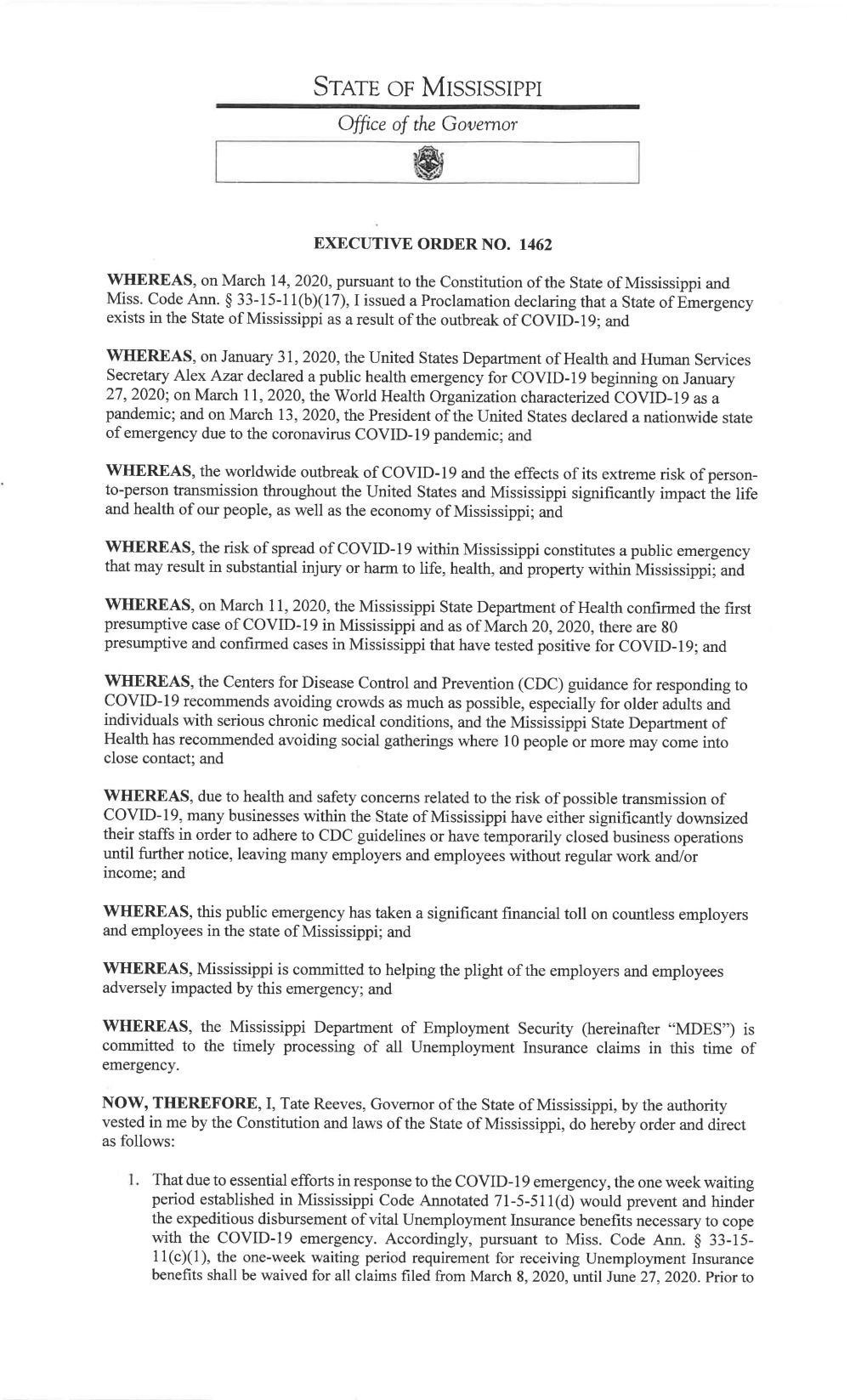
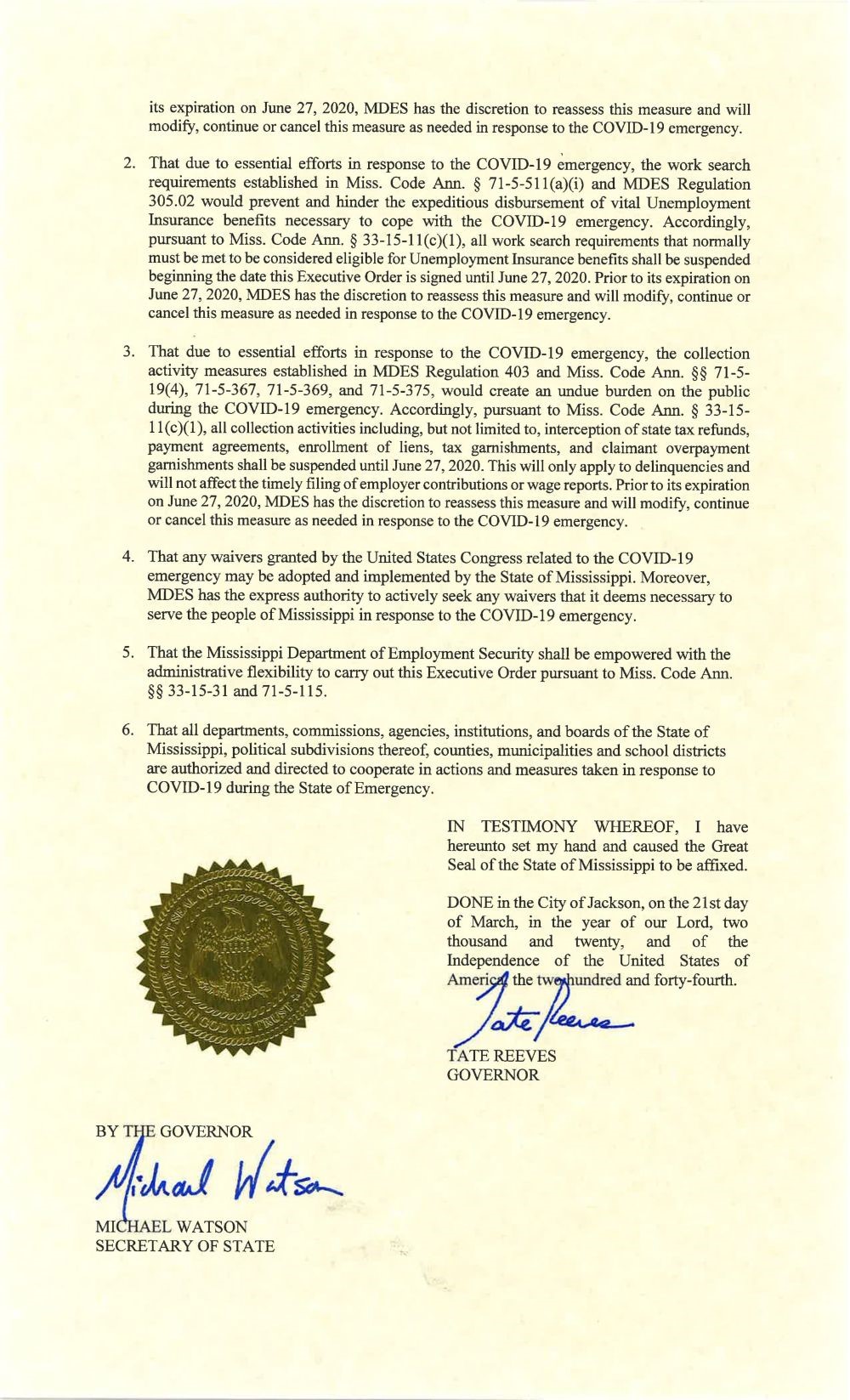
    Working to support Mississippi’s dedicated workforce and relieve undue burdens, Governor Reeves signed an executive order (below) instructing the Mississippi Department of Employment Security (MDES) to expedite payments to unemployed Mississippians and relax collection requirements on employers.

    The Governor made the announcement directly addressing Mississippi via Facebook Live.

    “This is not a time for us to panic. This is a time for us to come together as Mississippians, as Americans. Small businesses are the backbone of our economy, and their employees are the people who keep our economy going. We have worked very closely with the Mississippi Department of Employment Security to help employees of small businesses that are having a difficult time keeping their doors open in these challenging times,” said Governor Tate Reeves.

    Governor Reeves is waiving the one-wee k waiting period to receive unemployment benefits for all claims filed from March 8 to June 27 and suspending all work search requirements that normally must be met to receive benefits.

    To relieve some of the pressure on employers, the Governor is also suspending all collection activities, such as enrollment of liens and tax garnishments, and providing MDES and employers some flexibility as we move forward during this difficult time.

    Governor Reeves is currently working on next steps to take care of Mississippi employers and help them navigate this unprecedented time.

  • Big Jump In Number Of New Coronavirus Cases In Mississippi

    Big Jump In Number Of New Coronavirus Cases In Mississippi

    JACKSON, Miss. (AP) — Mississippi now has at least 140 confirmed cases of COVID-19, up from 80 reported a day earlier, health officials said Saturday.

    Of those cases, 24% are being treated in hospitals, the Mississippi Department of Health reported. In addition, the agency said its laboratory had tested more than 770 people. Positive cases have been reported in 45 of the state’s 84 counties.

    Only one death has been reported for the state.

    The vast majority of people infected with the novel coronavirus get only mild or moderate symptoms, such as fever and cough, and recover in about two weeks. But many will need hospitalization. Particularly vulnerable are older adults and those with existing health problems who can develop severe complications, including pneumonia.

    COVID-19 testing will begin next week at the Mississippi Fairgrounds in Jackson. The drive-thru testing site will open by appointment starting Tuesday from 9 a.m. to 5 p.m. for those showing symptoms such as fever or respiratory problems, said state health officer Dr. Thomas Dobbs.

    ___

    The Associated Press receives support for health and science coverage from the Howard Hughes Medical Institute’s Department of Science Education. The AP is solely responsible for all content.

    ___

    Follow AP coverage of the virus outbreak at https://apnews.com/VirusOutbreak and https://apnews.com/UnderstandingtheOutbreak.

  • Virus cases top 500 in Louisiana, new testing sites open

    Virus cases top 500 in Louisiana, new testing sites open

    NEW ORLEANS (AP) — Additional testing centers for the new coronavirus ran out of the day’s supply of tests within hours of opening Friday in New Orleans, one of the nation’s hot spots for the virus.

    Four more state residents died, including the first victim outside of southeastern Louisiana, as doctors worried about dwindling supplies and an expected spike in patients.

    Also Friday, Mayor LaToya Cantrell bolstered her earlier efforts to prevent gatherings that could result in the virus spreading with a “stay at home mandate.” She said at a news conference that people should leave their homes only for “critical needs” such as food or grocery runs or doctor visits. Restaurants can continue to offer takeout food.

    “You can go outside for recreation but do not do so in a group,” said Dr. Jennifer Avegno, the city’s health director.

    Tests were available at New Orleans’ two new drive-thru sites, in the parking lots of a local theater and a university arena. But they initially were being offered only to health care workers and first responders showing symptoms consistent with the COVID-19 disease caused by the virus, according to New Orleans Mayor LaToya Cantrell’s office. The sites are supplied by the federal government.

    Both locations, with materials for 100 tests a day, shut down by early afternoon — several hours earlier than advertised — after reaching their day’s testing capacity early. They were expected to reopen Saturday.

    More than 500 people in Louisiana tested positive for the virus by Friday morning, and 14 Louisiana residents have died from COVID-19, according to state health department data.

    While more than three-quarters of positive tests were in the New Orleans area, cases of the virus were showing up in nearly every metropolitan region of the state, and in 28 of Louisiana’s 64 parishes.

    One of the deaths announced Friday by the state health department was a 38-year-old Catahoula Parish resident who had existing health problems, the first person known to die from the virus in central Louisiana — and the state’s youngest recorded death from the virus.

    Gov. John Bel Edwards, like other states’ leaders, has offered dire warnings about the risk of health care shortages, if residents don’t actively decrease contact with others. Edwards has closed schools, shuttered bars and gyms and limited restaurants to takeout and delivery.

    The vast majority of people recover within weeks after catching the virus, and for most, it causes only mild or moderate symptoms, such as fever and cough. But for older adults and people with existing health problems, it can cause severe illness requiring hospitalization.

    Hospitals were canceling elective procedures and moving staff from other facilities to ready for increases in COVID-19 patients. Health care facilities in Louisiana, like counterparts around the nation, were having difficulty getting medical equipment.

    Dr. Katherine Williams said she has the needed supplies in her Covington obstetrics and gynecology office right now. But she’s watching it dwindle — even toilet paper and paper towels are on back order for doctors.

    As president of the Louisiana State Medical Society, Williams is hearing concerns from doctors around the state. Surgical masks are running low. Disinfectant wipes are running out. Gloves are difficult to find. Hospitals are rationing and sterilizing items they once tossed in the trash can after one use.

    Williams is urging companies that produce masks, gloves and cleaning products to give health care workers a priority for getting those items. She said medical supply levels likely will reach critical lows by next week.

    “The ability for us to care for those who are most sick is going to be diminished,” Williams said.

    The slow rate of testing — and the lag time in getting results — further stretched resources, said Paul Salles, president of the Louisiana Hospital Association. Hospitals were using protective gear for any patient who had symptoms consistent with COVID-19 until a test returned negative. With those test results taking up to seven days, Salles said: “We’re just burning through equipment faster than expected.”

  • Mississippi limits dine-in at restaurants to slow virus

    Mississippi limits dine-in at restaurants to slow virus

    JACKSON, Miss. (AP) — The Mississippi State Department of Health recommended on Friday that all restaurants and bars immediately stop dine-in services and that people not attend weddings, funerals, church services or other gatherings of 10 or more people, all to help slow the spread of the new coronavirus

    Health officials also said a drive-through testing center for the virus will open Tuesday on the Mississippi State Fairgrounds in Jackson.

    Separately, the Mississippi Emergency Management Agency announced that it will work with the state Health Department and the National Guard, starting Saturday, to distribute medical workers’ personal protective equipment. Some of it will come from gear already held in reserve by the state and some from a national stockpile.

    And, Gov. Tate Reeves said, federal loans are available for small businesses affected by a downturn in commerce because of the virus.

    “Small businesses and their employees are struggling to stay afloat during this trying time, but we will get through this together,” Reeves said Friday in announcing that the Small Business Administration is making loans of up to $2 million.

    The state health officer, Dr. Thomas Dobbs, said bars and restaurants may still provide carry-out food. He said the recommendation to close dining rooms “will in no way affect gas stations, pharmacies, grocery stores or food marts.”

    The drive-through testing center opening Tuesday on the fairgrounds will see patients by appointment only. People will need to answer questions to be screened for an appointment. Other drive-through centers are already operating in some parts of the state, including Tupelo, Philadelphia and Batesville.

    The testing site in Jackson will be operated by the University of Mississippi Medical Center and the Mississippi State Department of Health. Up to 128 appointments a day will be available for people who show symptoms of the virus, including fever.

    To get an appointment, people must answer questions either by telephone or by using a health app created by C Spire, a Mississippi-based wireless provider.

    “If you do not do that and you just show up at the testing site, you will not be tested,” said Dr. Alan Jones, head of emergency medicine at UMMC.

    Screening by phone call or app begins Monday, and appointments begin Tuesday. Officials said the testing site could be closed during thunderstorms or other dangerous weather.

    Mississippi reported 80 cases of the new coronavirus as of Friday, up from 50 Thursday. The state Health Department said 775 people had been tested in Mississippi by Friday.

    A Mississippi man died of the new coronavirus in a Louisiana hospital, the Mississippi State Department of Health said Thursday. The department said the Hancock County resident was between 60 and 65 years old and had an underlying medical condition.

    A growing number of Mississippi cities are closing bars and telling restaurants to either limit or temporarily stop dine-in options because of concerns about the coronavirus pandemic. Casinos in the state are closed, and auto manufacturing plants will shut down temporarily.

    The vast majority of people infected with this novel coronavirus get only mild or moderate symptoms, such as fever and cough, and recover in about two weeks. But many will need hospitalization. Particularly vulnerable are older adults and those with existing health problems who can develop severe complications, including pneumonia.

    The Mississippi state health officer, Dr. Thomas Dobbs, said Friday that some people who have sought testing so far are the “worried well.” He urged people to practice social distancing and to wash their hands to slow the spread of the virus.

    “It’s going to be a hard few weeks, for sure … but the main thing right now is to cut this epidemic off,” Dobbs said.

    The mayor of Jackson issued an order banning gatherings of 10 or more people. The co-owner of three Jackson-area restaurants said he and his partner made the difficult decision to close all three outlets until the virus threat passes. Jeff E. Good said they first tried to limit service to carry-out orders.

    “We just didn’t see how we could still prepare food and deliver it to you curbside, since by definition we were not practicing any social distancing and had many folks involved in the make, bake and take process,” Good wrote on Facebook.

    Reeves said Thursday that public schools will be closed until at least April 17 to curb the spread of the virus.

  • SBA Offers Disaster Assistance to Mississippi Small Businesses Economically Impacted by the Coronavirus (COVID-19)

    ATLANTA – The U.S. Small Business Administration is offering low-interest federal disaster loans for
    working capital to Mississippi small businesses suffering substantial economic injury as a result of the
    Coronavirus (COVID-19), SBA Administrator Jovita Carranza announced today. SBA acted under its
    own authority, as provided by the Coronavirus Preparedness and Response Supplemental
    Appropriations Act that was recently signed by the President, to declare a disaster following a request
    received from Gov. Tate Reeves on March 18, 2020.
    The disaster declaration makes SBA assistance available in the entire state of Mississippi; and the
    contiguous counties of Choctaw, Colbert, Franklin, Lamar, Lauderdale, Marion, Mobile, Pickens,
    Sumter and Washington in Alabama; Chicot, Crittenden, Desha, Lee, Phillips in Arkansas; Concordia,
    East Carroll, East Feliciana, Madison, Saint Helena, Saint Tammany, Tangipahoa, Tensas, Washington
    and West Feliciana in Louisiana; and Fayette, Hardeman, Hardin, McNairy and Shelby in Tennessee.
    “SBA is strongly committed to providing the most effective and customer-focused response possible
    to assist Mississippi small businesses with federal disaster loans. We will be swift in our efforts to help
    these small businesses recover from the financial impacts of the Coronavirus (COVID-19),” said
    Administrator Carranza.
    SBA Customer Service Representatives will be available to answer questions about SBA’s Economic
    Injury Disaster Loan program and explain the application process.
    “Small businesses, private non-profit organizations of any size, small agricultural cooperatives and
    small aquaculture enterprises that have been financially impacted as a direct result of the Coronavirus
    (COVID-19) since Jan. 31, 2020, may qualify for Economic Injury Disaster Loans of up to $2 million to
    help meet financial obligations and operating expenses which could have been met had the disaster
    not occurred,” said Carranza.
    “These loans may be used to pay fixed debts, payroll, accounts payable and other bills that can’t be
    paid because of the disaster’s impact. Disaster loans can provide vital economic assistance to small
    businesses to help overcome the temporary loss of revenue they are experiencing,” Carranza added.
    Eligibility for Economic Injury Disaster Loans is based on the financial impact of the Coronavirus
    (COVID-19). The interest rate is 3.75 percent for small businesses. The interest rate for private nonprofit organizations is 2.75 percent. SBA offers loans with long-term repayments in order to keep
    payments affordable, up to a maximum of 30 years and are available to entities without the financial
    ability to offset the adverse impact without hardship.
    Applicants may apply online, receive additional disaster assistance information and download
    applications at https://disasterloan.sba.gov/ela. Applicants may also call SBA’s Customer
    Service Center at (800) 659-2955 or email disastercustomerservice@sba.gov for more
    information on SBA disaster assistance. Individuals who are deaf or hard-of-hearing may call
    (800) 877-8339. Completed applications should be mailed to U.S. Small Business Administration,
    Processing and Disbursement Center, 14925 Kingsport Road, Fort Worth, TX 76155.
    The deadline to apply for an Economic Injury Disaster Loan is Dec. 21, 2020.
    For more information about Coronavirus, please visit: Coronavirus.gov.
    For more information about available SBA resources and services, please visit: SBA.gov/coronavirus.
    ###
    About the U.S. Small Business Administration
    The U.S. Small Business Administration makes the American dream of business ownership a reality. As
    the only go-to resource and voice for small businesses backed by the strength of the federal
    government, the SBA empowers entrepreneurs and small business owners with the resources and
    support they need to start, grow or expand their businesses, or recover from a declared disaster. It
    delivers services through an extensive network of SBA field offices and partnerships with public and
    private organizations. To learn more, visit www.sba.gov.