Tag: covid19

  • Global stocks, US futures rise on virus aid hopes

    BEIJING (AP) — Global stock markets and U.S. futures rose Friday on hopes that government and central bank action can help the world economy endure a looming recession caused by the coronavirus.

    European markets were as much as 4% higher and Shanghai, Hong Kong and other Asian markets advanced. Seoul surged 7.4%.

    Investors were encouraged after seeing more steps by the Federal Reserve and other central banks and governments to support credit markets and the economy.

    On Wall Street, the future for the benchmark S&P 500 index rose 2% and that for the Dow Jones Industrial Average gained 2.4%.

    Hopes are rising that there will be progress in finding virus treatments and that “a boatload of stimulus by both central banks and governments will put the global economy in position for a U-shaped recovery,” said Edward Moya of Oanda in a report.

    On Thursday, the European Central Bank launched a program to inject money into credit markets by purchasing up to 750 billion euros ($820 billion) in bonds. The Bank of England cut its key interest rate to a record low of 0.1% and restarted its own program of money injections into the financial system. Australia’s central bank cut its benchmark lending rate to 0.25%. Central banks in Taiwan, Indonesia and the Philippines also cut rates.

    They are trying to reduce the impact of a global recession that forecasters say looks increasingly likely as the United States and other governments tighten travel controls, close businesses and tell consumers and travelers to stay home.

    Investors also appeared to be encouraged by reports that China is set to ramp up stimulus spending after the province where the virus emerged in December showed no new infections on Wednesday.

    London’s FTSE 100 rose 1.6% to 5,237 and the DAX in Frankfurt advanced 4.2% to 8,968. France’s CAC 40 gained 4.9% to 4,044 and Italy’s FTSE MIB gained 2% to 15,773.

    In Asia, the Shanghai Composite Index rose 1.6% to 2,745.62, while Hong Kong’s Hang Seng gained 5.1% to 22,805.07. The Kospi in Seoul advanced 7.4% to 1,566.15 and Australia’s S&P-ASX 200 added 0.7% to 4,816.60 after being up more than 4% at one point.

    The U.S. Federal Reserve unveiled measures Thursday to support money-market funds and the borrowing of dollars as investors in markets worldwide hurry to build up dollars and cash as insurance against falling asset prices.

    That rush to gather dollars is straining markets, with sellers of even high-quality bonds struggling to find buyers at reasonable prices.

    Investors are jumpy due to uncertainty about the size and duration of the impact of the coronavirus and the spreading wave of business shutdowns meant to help contain it.

    More than 10,000 people have died. There are more than 244,000 cases worldwide, including nearly 85,000 people who have recovered.

    For most people, the coronavirus causes only mild or moderate symptoms, such as fever and cough, and those with mild illness recover in about two weeks. Severe illness including pneumonia can occur, especially in the elderly and people with existing health problems, and recovery could take six weeks in such cases.

    Wall Street has bounced up and down by record-setting margins of up to 12% over the past week.

    Unease has grown as forecasters say a global recession looks increasingly likely and have cut growth outlooks for the United States, China and other major economies.

    In energy markets, benchmark U.S. crude gained 75 cents to $25.97 per barrel in electronic trading on the New York Mercantile Exchange. The contract surged $5.08 on Thursday to settle at $25.91.

    Brent crude, used to price international oils, added 77 cents to $29.24 per barrel in London. It rose 14.4%, or $3.59, to settle at $28.47 the previous session.

    The dollar declined to 110.07 Japanese yen from Thursday’s 110.71 yen. The euro rose to $1.0721 from $1.0692.

  • 40 million Californians ordered to stay home to halt virus

    SACRAMENTO, Calif. (AP) — California’s 40 million residents should stay home indefinitely and venture outside only for essential jobs, errands and some exercise, Gov. Gavin Newsom said Thursday, warning that the coronavirus threatens to overwhelm the state’s medical system.

    The move, the most sweeping by any state so far, was an exclamation point at the end of a week of increasingly aggressive moves meant to keep the virus in check by forcing people to stay away from each other as often as possible.

    “I can assure you home isolation is not my preferred choice, I know it’s not yours, but it’s a necessary one,” Newsom said at an evening news conference streamed on social media.

    He assured residents that they “can still take your kids outside, practicing common sense and social distancing. You can still walk your dog.” Restaurant meals can still be delivered to homes.

    The announcement came after the release of a letter to President Donald Trump where Newsom warned the virus was spreading quickly and eventually could infect more than half the state’s population. A spokesman later clarified that the figure did not take into account the aggressive mitigation efforts that have been made.

    The governor said he doesn’t expect police will be needed to enforce his stay-at-home order, saying “social pressure” already has led to social distancing throughout the state.

    “I don’t believe the people of California need to be told through law enforcement that it’s appropriate just to home isolate,” he said.

    The Democrat who is barely a year into his first term also called up 500 National Guard troops to help distribute food. The move comes after panic buying led to massive lines at some grocery stores.

    Newsom also outlined a series of steps aimed at providing more space for hospital patients.

    He said the state has taken over a 357-bed bankrupt hospital in the San Francisco Bay Area, soon will announce the purchase of a similarly sized hospital in Southern California and may use dormitories at the state’s public colleges and universities. He also asked Trump to dock the Navy’s 1,000-patient Mercy hospital ship in the Port of Los Angeles.

    The coronavirus is spread through sneezes and coughs. There are at least 1,030 confirmed cases in California and 18 people have died, according to a tally by Johns Hopkins University.

    Newsom’s statewide order came after counties and communities covering about half the state’s population already had issued similar edicts. He said the restriction is “open-ended” because it could raise false hopes if he included an end date.

    However, he did offer a glimmer by saying he didn’t expect it would last “many, many months.”

    Just before Newsom’s statewide declaration, Los Angeles announced what officials there called a “Safer at Home” order that carried the same restrictions.

    “We’re about to enter into a new way of living here in Los Angeles,” Mayor Eric Garcetti said. “What we do and how we do it and if we get this right will determine how long this crisis lasts.”

    In the letter to Trump seeking the hospital ship, Newsom said California’s infection rates are doubling every four days in some areas and that 56% of the state’s population could contract the virus in the next eight weeks, which would be more than 22 million people. He later said the “overwhelming majority won’t have symptoms” and will be fine but that up to 20% could be hospitalized.

    “If we meet this moment we can truly bend the curve” of escalating cases, Newsom said.

    For most people, the new coronavirus causes only mild or moderate symptoms, such as fever and cough. It can cause more severe illness, including pneumonia, for some people, especially older adults and those with existing health problems.

    Most people recover — those with mild illness in about two weeks, while those with more severe illness may take three to six weeks, according to the World Health Organization.

    Also Thursday, Newsom asked U.S. House and Senate leaders for $1 billion to support state and local health systems. He said that money would be needed to do things like set up state-run and mobile hospitals, housing options to help people socially distance and testing and treatment for people without health insurance.

    He also asked for assistance so the state can extend unemployment benefits beyond the usual 26-week limit, expand food assistance programs, resources for the homeless and tribal communities and boost childcare programs. He further asked for assistance for schools, aid to local and state budgets and transportation relief.

    “While California has prudently built a sizable Rainy Day Fund over the past ten years, the economic effects of this emergency are certain to mean that the state and its 58 counties will struggle to maintain essential programs and services,” he wrote.

    Newsom earlier announced $150 million of a $1 billion emergency state appropriation would go toward getting homeless people off the streets. He has estimated up to 60,000 of the state’s homeless could get infected.

    ___

    This story has been corrected to show that Newsom said up to 20% of people infected by coronavirus, not 20,000 people, could be hospitalized.

  • National Guard Deployed To Support Hospitals, Set Up Testing Sites

    National Guard Deployed To Support Hospitals, Set Up Testing Sites

    State Governors To Use The Guard In Ways They Deem Most Effective

    General Joseph L. Lengyel, 28th Chief of the National Guard Bureau announced today (March 19) that about 2500 National Guard members will be deployed in 27 states to help with COVID19 coronavirus response efforts across the US.

    General Lengyel shared news of what the Guard is doing in various states:

    The New York National Guard is helping local officials distribute food, much of it in the hard-hit area of New Rochelle.

    A Tennessee Air National Guard C-17 Globemaster transport aircraft delivered 500,000 swabs to be added to COVID-19 test kits in Memphis Wednesday.

    More than 500 soldiers are assisting with collecting samples from drive-through testing in Broward County, Florida.

    In Maryland, the National Guard is supporting medical assessments and testing site operations.

    The Wisconsin National Guard is supporting transportation missions for the Wisconsin Department of Health Services.

    In Louisiana, Guard liaison officers are assisting the New Orleans Office of Homeland Security in emergency preparedness.

    Across the U.S., civil support teams are supporting the local departments of health with drive-through testing stations.

    So far, six members of the Guard in the U.S. have tested positive for COVID-19, according to the General. Force health protection measures are in place to prevent more from contracting the virus.

  • Trump weighs controls on companies that take virus bailouts

    WASHINGTON (AP) — President Donald Trump said Thursday the government should take an equity stake in some companies that need bailouts because of devastating effects of the coronavirus pandemic on the U.S. economy.

    Trump told a briefing he has executive authority to curb the impact on businesses. “There’s a lot of executive power,” he said. “If we don’t have to use it, that would be a good thing, not a bad thing.”

    Such a move could be an extraordinary reach by government into the private sector. He said he’d specifically target companies that did stock buybacks, rather than investing in infrastructure. Trump also said he’d back restrictions on executive bonuses and future buybacks from companies receiving federal support.

    Trump reported Thursday on therapeutic drugs that might hold potential down the road to treat those suffering with COVID-19 and stepped up criticism of China for not telling the world earlier about what has become a pandemic.

    “More help is on the way,” Trump said at a White House briefing on the spread of the virus.

    Trump and FDA commissioner Dr. Stephen Hahn described several approaches under testing, such as chloroquine, a drug long used to treat malaria; remdesivir, an experimental antiviral that’s being tried in at least five separate experiments, and possibly antibodies culled from the blood of COVID-19 patients after they recover. But no new and imminent treatment was announced.

    Chloroquine is widely available now and could be used off-label, but Hahn said officials want a formal study to get good information on safety and effectiveness.

    “We’re looking at drugs that are already approved for other indications” as a potential bridge or stopgap until studies are completed on other drugs under investigation, Hahn said. But there remains no proven treatment for the disease, from which most people recover.

    Trump, who planned to visit the Federal Emergency Management Agency on Thursday, has invoked rarely used emergency powers to marshal critical medical supplies against the coronavirus pandemic. Trump also signed an aid package — which the Senate approved earlier Wednesday — that will guarantee sick leave to workers who fall ill.

    Trump jabbed at China, where the virus was first reported, contending: “Could have been stopped. Could have been stopped. Could have been stopped pretty easily.” He said Chinese officials “didn’t decide to make it public” in time to stop the virus from going global.

    The pandemic was starting to show its effects in the job market. The Labor Department reported Thursday that the number of Americans filing new claims for unemployment benefits surged last week by 70,000.

    The Canada-U.S. border, the world’s longest, was effectively closed, save for commerce and essential travel, while the administration pushed its plan to send relief checks to millions of Americans.

    Trump says he is expanding the nation’s diagnostic testing capacity and deploying a Navy hospital ship to New York City, which is rapidly becoming an epicenter of the pandemic, and another such ship to the West Coast. And the Housing and Urban Development Department is suspending foreclosures and evictions through April to help the growing number of Americans who face losing jobs and missing rent and mortgage payments.

    On Wednesday the Senate overwhelmingly passed a second coronavirus response bill, which Trump signed Wednesday night. The vote was a lopsided 90-8 despite worries by many Republicans about a temporary new employer mandate to provide sick leave to workers who get COVID-19. The measure is also aimed at making tests for the virus free.

    Meanwhile the administration pushed forward its broad economic rescue plan, which proposes $500 billion in checks to millions of Americans, with the first checks to come April 6 if Congress approves.

    The White House urged hospitals to cancel all elective surgeries to reduce the risk of being overwhelmed by cases. The president was pressed on why a number of celebrities, like professional basketball players, seemed to have easier access to diagnostic tests than ordinary citizens.

    The government has told Americans to avoid groups of more than 10 people and the elderly to stay home while a pointed reminder was given to millennials to follow the guidelines and avoid social gatherings. But officials urged younger people to donate blood, saying it is safe to do so.

    The Defense Production Act gives the president broad authority to shape the domestic industrial base so that it is capable of providing essential materials and goods needed in a national security crisis. The law allows the president to require businesses and corporations to give priority to and accept contracts for required materials and services.

    The executive order issued by Trump gives Health and Human Services Secretary Alex Azar the authority to determine “the proper nationwide priorities and allocation of all health and medical resources, including controlling the distribution of such materials … in the civilian market, for responding to the spread of COVID-19 within the United States.” It also applies to certain health services.

    Azar released a statement Wednesday night, saying, “we are coordinating closely with private suppliers, healthcare purchasers, and our federal partners like the Commerce Department to ensure that resources are going where they’re needed.”

    Trump also said he would soon invoke a rarely used federal statute that would enable the U.S. to tighten controls along the southwest border because of the new coronavirus, based on a recommendation of the U.S. surgeon general.

    The president said the law, intended to halt the spread of communicable diseases, would give authorities “great latitude” to help control the outbreak. Earlier, U.S. officials told The Associated Press that the administration would invoke the law to immediately turn back all people who cross the border illegally from Mexico and to refuse people the right to claim asylum there.

    More than eight weeks after the first U.S. case of the virus was detected, the federal government is still struggling to conduct widescale testing for the virus. Compounding the problem, laboratories are reporting shortages of supplies needed to run the tests, which officials urged to be given to those most likely to have COVID-19.

    Deborah Birx, who is coordinating the White House response, cautioned that there has been a backlog of swabs waiting in labs to be tested, and as that backlog clears “we will see the number of people diagnosed dramatically increased” in the next few days.

    Asked about the administration’s mixed messages when it comes to the threat posed by the virus, Birx said new studies about how long the virus can be transmissible on hard surfaces helped prompt the administration’s tightening of recommendations on social distancing. “None of us really understood” that, she said. “We’re still working out how much is by human transmission and how much is it by surface.” She added, “Don’t exposure yourself to surfaces outside the home.”

    For most people, the new coronavirus causes only mild or moderate symptoms, such as fever and cough. For some, especially older adults and people with existing health problems, it can cause more severe illness, including pneumonia.

    The vast majority of people recover from the new virus. According to the World Health Organization, people with mild illness recover in about two weeks, while those with more severe illness may take three to six weeks to recover.

    Birx said there have been “concerning reports” from France and Italy about young people becoming seriously ill. The task force last week urged young generations to avoid going out to bars and restaurants and to avoid groups of more than 10 people.

    “We cannot have these large gatherings that continue throughout the country for people who are off work,” Birx said. She added that the federal pandemic task force so far has not seen any “significant mortality” in children.

  • Important From OEP Office Concordia

    I have received several phone calls, text messages, and facebook messages in regards to the rumor of the National Guard being deployed in the next 48 to 72 hours for a mandatory 14 day quarantine for all Louisiana residents.


    That information is not true, it is totally false and is being spread through social media, text messages, and by word of mouth.


    I am asking you as the leadership of Concordia Parish to please copy and paste the information below to your information websites, and  to your City, Town, or Village Face Book Pages.


    I am also asking that you forward this email to all of your Board of Alderman, Police Chiefs, Fire Chiefs, and your areas media personnel


    This is the kind of rhetoric that begins to cause fear and paranoia throughout our community, and it is up to us as the leadership of Concordia Parish to get factual information to the public to dispel false information.


    Today I have spoken with every Mayor or Mayor’s Office in Concordia Parish to get a pulse of how things are going with the Governor’s Declaration for Concordia Parish and for each of the Authorities Having Jurisdiction.  I was very encourage by the feedback and comments that I have received from each.  I am assured that each AHJ is being diligent in their efforts to abide by the Emergency Declaration set forth by our Governor.


    Concordia Parish seems to be heading in the right direction and taking all the necessary precautions to combat the spread of the COVID-19 Virus.


    On behalf of the Concordia Parish Office of Homeland Security & Emergency Preparedness I would like to thank you for your efforts in keeping Concordia Parish safe.  The work and the effort that is being put forth by every agency, entity, and leader in this Parish is what makes me proud to be a Concordia Parish resident.


    Once again thank you and please don’t hesitate to contact me or my office if you have any questions, concerns, or comments.


    Thank You


    Timothy Vanier

    OEP Director Concordia Parish

    4001 Carter St, Room 1, Vidalia, LA 71373

    oep@conppj.org

    Office 318-414-1678

    Cell      318-719-2010

  • Louisiana Virus Cases Jump To 347, Spread To Rural Areas

    Louisiana Virus Cases Jump To 347, Spread To Rural Areas

    BATON ROUGE (AP) — The number of people known to be infected with the new coronavirus in Louisiana jumped to 347 in figures the state posted Thursday, up from 280 a day earlier.

    The death toll stood at eight with the latest victim, a resident of St. James Parish.

    The latest numbers showed New Orleans still leading the state in the number of people testing positive for the virus that causes the COVID-19 disease, which has been linked to eight Louisiana deaths. There were 231 cases there as of Thursday morning. Tulane Health System in New Orleans said in a news release it planned to shut down an emergency room in the suburb of Metairie on Friday to move staff to its downtown New Orleans campus to deal with “a surge of COVID-19 and suspected COVID-19 patients.”

    Add in neighboring Jefferson Parish with 62 cases, and the cases in other surrounding parishes and the New Orleans metropolitan area had significantly more cases – 315 — than any other metro area in the South, an Associated Press analysis of state health department data shows.

    The Atlanta and Miami metro areas – both with more than 200 cases – are also among communities with soaring numbers. The numbers were tallied from state data using the U.S. Office of Management and Budget’s classification of Metropolitan Statistical Areas.

    But the virus was also evident in other parts of the state, showing up in 17 of Louisiana’s 64 parishes, including northwestern Louisiana’s Bossier and Caddo, with two and seven respectively; southwestern Louisiana’s Lafayette, with 2; East Baton Rouge, with 5.

    Coastal Plaquemines Parish at Louisiana’s southeastern tip, which includes the New Orleans suburban city of Belle Chasse and vast rural landscapes, reported its first case late Wednesday.

    The vast majority of people recover within weeks after catching this virus, and for most people, it causes only mild or moderate symptoms, such as fever and cough. But for older adults and people with existing health problems, it can cause severe illness requiring hospitalization.

    Gov. John Bel Edwards cautioned Louisianans to get ready for a surge in coronavirus cases as testing capacity grows statewide.

    Edwards has closed K-12 public schools, bars, gyms, casinos and movie theaters and has limited restaurants to delivery and takeout until at least April 13. Public gatherings of more than 50 people are banned. New Orleans Mayor LaToya Cantrell has prohibited all public and private gatherings.

    Small businesses struggling with virus-related restrictions will be eligible to apply for low-interest federal disaster loans. Edwards announced Thursday that Louisiana won federal approval for its request to make the U.S. Small Business Administration aid available in all 64 parishes.

    Four of the people who died from the virus lived in the New Orleans retirement home Lambeth House, which has seen a cluster of cases. There have been two other New Orleans deaths, one in Jefferson Parish and the death of a 60-year-old person reported Thursday in St. James.

    Insurance Commissioner Jim Donelon issued new regulations requiring health insurers to waive co-pays and deductibles for COVID-19 testing, and banning insurers from requiring prior authorization for testing ordered by doctors. Insurers also must allow early refills of most non-opioid medications.

    Louisiana was readying several state parks to house people who have tested positive for the coronavirus and don’t need hospitalization, but can’t return home because of elderly relatives, homelessness or other reasons. Already, at least 10 people infected with the virus were staying at Jefferson Parish’s Bayou Segnette State Park, Edwards said.

    Also, Republican Rep. Steve Scalise, of Jefferson Parish, announced he now must work remotely on the national coronavirus response because he had an “extended meeting” last week with Rep. Mario Díaz-Balart of Florida, who tested positive. Scalise said he does not have any COVID-19 symptoms, but is self-isolating out of caution.

    ___

    McGill reported from New Orleans. Associated Press writer Jeff Martin in Atlanta contributed to this report.

    ___

    The Associated Press receives support for health and science coverage from the Howard Hughes Medical Institute’s Department of Science Education. The AP is solely responsible for all content.

    ___

    Follow AP coverage of the virus outbreak at https://apnews.com/VirusOutbreak and https://apnews.com/UnderstandingtheOutbreak.

  • Italian death toll overtakes China’s as virus spreads

    ROME (AP) — The death toll in Italy from the coronavirus overtook China’s on Thursday in a stark illustration of how the outbreak has pivoted toward Europe and the United States.

    Italy, with a population of 60 million, recorded at least 3,405 deaths, or roughly 150 more than in China — a country with a population over 20 times larger.

    Italy reached the bleak milestone the same day that Wuhan, the Chinese city where the coronavirus first emerged three months ago, recorded no new infections, a sign that the communist country’s draconian lockdowns were a powerful method to stop the virus’ spread.

    On Thursday, a visiting Chinese Red Cross team criticized Italians’ failure to properly quarantine themselves and take the national lockdown seriously.

    Meanwhile, the damage to the world’s largest economy kept piling up, with unemployment claims surging in the United States, while the virus appeared to be opening an alarming new front in Africa, where in less than three weeks it has spread to 35 countries.

    The epidemic has also now reached at least one European head of state, 62-year-old Prince Albert II of the tiny principality of Monaco. The palace announced that he tested positive for the virus but was continuing to work from his office and was being treated by doctors from Princess Grace Hospital, named after his American actress mother.

    In the U.S., Congress rushed to pass a $1 trillion emergency package to shore up the sinking economy and help households pull through the crisis, with the first of two possible rounds of relief checks consisting of payments of $1,000 per adult and $500 for each child.

    The worldwide death toll crept toward 10,000 as the total number of infections topped 220,000, including nearly 85,000 people who have recovered.

    French Prime Minister Edouard Philippe pleaded with people to keep their distance from one another to avoid spreading the virus, even as the crisis pushed them to seek comfort.

    “When you love someone, you should avoid taking them in your arms,” he said in Parliament. “It’s counterintuitive, and it’s painful. The psychological consequences, the way we are living, are very disturbing — but it’s what we must do.”

    The American death toll rose to 160, primarily elderly people.

    Health authorities have cited a variety of reasons for Italy’s high toll, key among them its large population of elderly people, who are particularly susceptible to serious complications from the virus, though severe cases have also been seen in younger patients. Italy has the world’s second-oldest population, and the vast majority of its dead — 87% — were over 70.

    Jonas Schmidt-Chanasit, a virologist at Germany’s Bernhard Nocht Institute for Tropical Medicine, said Italy’s high death rate could be explained in part by the almost total breakdown of the health system in some areas.

    “That’s what happens when the health system collapses,” he said.

    On a visit to the northern city of Milan, the head of a Chinese Red Cross delegation helping advise Italy said he was shocked to see so many people walking around, using public transportation and eating out.

    Sun Shuopeng said Wuhan saw infections peak only after a month of a strictly enforced lockdown.

    “Right now we need to stop all economic activity and we need to stop the mobility of people,” he said. “All people should be staying at home in quarantine.”

    Aside from the elderly and the sick, most people have mild or moderate symptoms, like a fever or cough, and most recover in a matter of weeks.

    Spain has been the hardest-hit European country after Italy, and in Madrid a four-star hotel began operating as a makeshift hospital for coronavirus patients.

    The director of the group that runs the Ayre GH Colon hotel tweeted: “365 rooms more to help win the war.” The Madrid Hotel Business Association said it has placed 40 hotels with room for 9,000 people at the service of the Madrid region, which has near half of Spain’s 17,000 or so cases.

    In London, home to almost 9 million, the government urged people to stay off public transportation as authorities considered imposing tougher travel restrictions.

    The British supermarket chain Sainsbury’s reserved the first hour of shopping for vulnerable customers, one of many such efforts around the world.

    Jim Gibson, 72, of London, said he found most of his groceries there in a “relatively trauma-free” experience. But he fretted that he hadn’t been able to get the medicine he needed for his wife and himself, and expressed concerns that Britain’s government had been too slow in ramping up testing.

    “You can’t go on ignoring World Health Organization guidelines — if they’re wrong, who the hell is right?” he said. “Let’s have no shilly-shallying.”

    The British government, which was slow to react to the virus, has shifted gears and is now drawing up legislation giving itself new powers to detain people and restrict gatherings. The bill is expected to be approved by Parliament next week.

    Thursday marked the first time since Jan. 20 that Wuhan showed no new locally transmitted cases, a rare glimmer of hope and perhaps a lesson in the strict measures needed to contain the virus.

    Wuhan, which has been under a strict lockdown since January, once was the place where thousands lay sick or dying in hurriedly constructed hospitals. But Chinese authorities said all 34 new cases recorded over the previous day had come from abroad.

    “Today, we have seen the dawn after so many days of hard effort,” said Jiao Yahui, a senior inspector at the National Health Commission.

    Meanwhile, the World Health Organization warned that the virus is spreading quickly in Africa — an especially alarming development, given the poor state of health care in many of its countries.

    “About 10 days ago we had about five countries” with the virus, said WHO’s Africa chief, Dr. Matshidiso Moeti. Now 35 of Africa’s 54 countries have cases, with the total close to 650. It is an “extremely rapid evolution,” she said. The first sub-Saharan Africa case was announced Feb. 28.

    European stock markets were up only slightly after losses in Asia despite a massive 750 billion-euro stimulus package announced overnight by the European Central Bank.

    Wall Street was calm in early trading by the standards of the past few days, when traders — weighing the increasing likelihood of a recession against the huge economic support pledged by global authorities — have caused wild swings.

    With wide swaths of the U.S. economy grinding to a halt, the number of Americans filing for unemployment benefits surged by 70,000 last week, more than economists expected.

    The U.S. Federal Reserve unveiled measures to support money-market funds and borrowing as investors worldwide rush to build up dollars and cash.

    Ford, General Motors and Fiat Chrysler, along with Honda and Toyota, announced on Wednesday that they would close all of their factories in the U.S., Canada and Mexico. The shutdown of Detroit’s Big Three alone will idle about 150,000 workers.

    More borders closed, leaving tens of thousands of tourists wondering how they would get home. In the Pacific, Australia and New Zealand shut out tourists.

    Iran’s Supreme Leader Ayatollah Ali Khamenei planned to pardon 10,000 more prisoners — including an unknown number of political detainees— to combat the virus. The country, where more than 1,100 people have already died, previously freed 85,000 prisoners on temporary leave.

    In Austria, the province of Tyrol put 279 municipalities under quarantine because of a large number of infections, barring people from leaving towns or villages except to go to work.

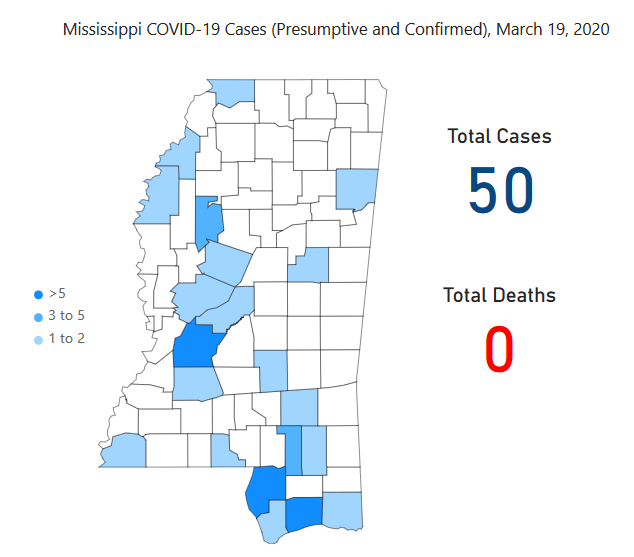
  • 16 New COVID-19 Coronavirus Cases In Mississippi

    16 New COVID-19 Coronavirus Cases In Mississippi

    Wilkinson and Walthall Counties Report First Cases

    The Mississippi Department Of Public Health reports 16 new cases of the COVID-19 coronavirus as of March 19, 2020, bringing the total known cases to 50.

    Click or tap here for more news on COVID-19 coronavirus in Mississippi and Louisiana.

  • Mississippi Public Schools Closed Until Mid-April To Slow Virus

    Mississippi Public Schools Closed Until Mid-April To Slow Virus

    JACKSON, Miss. (AP) — Mississippi public schools will be closed until at least April 17 to curb the spread of the new coronavirus, Gov. Tate Reeves said Thursday.

    He said schools will continue to receive state money and teachers will continue to be paid. He said he wants students to continue learning.

    “This is not a time to take a vacation,” Reeves said in a Facebook live presentation from the Governor’s Mansion.

    Reeves said he will also relax end-of-year testing requirements and school accountability measures. He said the state Board of Education will have “maximum flexibility” to waive rules.

    Mississippi reported 50 confirmed cases of the virus as of Thursday, up from 34 Wednesday. The state Health Department said 602 people had been tested in Mississippi by Thursday.

    The vast majority of people infected with this novel coronavirus get only mild or moderate symptoms, such as fever and cough, and recover in about two weeks. But many will need hospitalization — particularly vulnerable are older adults and those with existing health problems who can develop severe complications, including pneumonia.

    Some communities in Mississippi are temporarily shutting down bars and telling restaurants to close their dining rooms to try to slow the spread of the virus.

    Jackson Mayor Chokwe Antar Lumumba issued an order prohibiting gatherings of 10 or more people.

    “The city of Jackson does not have the luxury of a wait-and-see approach to the coronavirus pandemic,” the order says.

    The University of Mississippi Medical Center in Jackson working to develop its own coronavirus test amid high demand for test kits nationwide, and it is increasing its telehealth capacity to screen patients remotely.

    The medical center’s head of emergency medicine, Dr. Alan Jones, said it’s “very important” that people not go to an emergency room if they think they have symptoms. Instead, they should first use a telephone or telehealth service to get advice on what to do.

    “We are ramping up all of our contingency planning to prepare for a tidal wave of patients that we know is about to hit us,” Jones said Wednesday.

    ___

    The Associated Press receives support for health and science coverage from the Howard Hughes Medical Institute’s Department of Science Education. The AP is solely responsible for all content.

    ___

    Follow AP coverage of the virus outbreak at https://apnews.com/VirusOutbreak and https://apnews.com/UnderstandingtheOutbreak

  • How Long Will Americans Be Fighting The Coronavirus?

    How Long Will Americans Be Fighting The Coronavirus?

    WASHINGTON (AP) — In a matter of days, millions of Americans have seen their lives upended by measures to curb the spread of the new coronavirus.

    Normally bustling streets are deserted as families hunker down in their homes. Many of those who do venture out try to stay a safe distance from anyone they encounter, even as they line up to buy now-precious commodities like hand sanitizer. Parents juggle childcare as schools close, perhaps for the rest of the school year. And restaurants and bars sit empty as more and more convert to delivery-only options.

    How long will this last? Scientists say there isn’t a simple answer.

    “In many ways, this situation is unprecedented – we’re trying to take some actions to curb the spread and timing of this pandemic,” said Stephen Morse, a disease researcher at Columbia University in New York.

    Yes, there have been past disease outbreaks that scientists can draw some lessons from but, in those cases, the disease was largely allowed to run its course. “So those models don’t precisely apply,” Morse said.

    On Monday, President Donald Trump said the U.S. may be managing the outbreak through July or August. And New York Governor Andrew Cuomo said the state’s number of coronavirus cases may peak – not end – in 45 days.

    The overall message is that the country will be fighting the virus outbreak for a matter of months, at least, not days or weeks.

    Each model of how the disease could spread relies on data and assumptions about population dynamics, demographics, health care capacity and other factors, said Rebecca Katz, a public health expert at Georgetown University.

    The challenge for designing models of what will happen next in the U.S. is that limited testing for COVID-19 means researchers don’t know what the starting point is — how many people are already infected.

    In simplest terms, scientists say that the epidemic will slow when people with infections don’t pass the virus on to others.

    “Basically, if I infect one other person or more … then the epidemic can take off. If I infect less than one person and everybody infects less than one person, then the epidemic will decline,” said Elizabeth Halloran, a disease researcher at the University of Washington.

    Based on data from China and from cruise ships, scientists estimate that unless measures are taken to limit the spread, each infected person will infect about 2 or 3 others, leading to an exponential growth of the virus.

    If the virus makes a jump to new person every two to five days, as scientists calculate, then a single infected person could lead to 4,142 total infections within a month — assuming nothing is done to break chains of transmission.

    Unless such measures are put in place, scientists estimate that between 40 and 80% of the global population could become infected. Based on an analysis of data from China, scientists found that the majority of new infections are transmitted by people with mild symptoms who may not even know they’re ill, said Jeffrey Shaman, a public health expert at Columbia University.

    Even if most people recover and only a fraction of total infections are severe enough to require hospitalization — about 14%, scientists estimate — the sheer scale of the epidemic will put enormous strain on hospitals, healthcare workers and other patients who may see unrelated procedures delayed.

    Scientists now agree that measures to break or slow the chains of transmission are crucial to ensure that emergency rooms aren’t quickly overwhelmed by surges in critically ill patients.

    If measures like closing schools are successful in slowing disease spread, “we are going to see a hump instead of a peak” in new cases, U.S. government disease expert Dr. Anthony Fauci said in a White House briefing.

    In other words, the number of infections will rise more gradually and manageably. But that also means the duration of the outbreak will be prolonged.

    “The point of the restrictions we have is actually to stretch this out even longer. We don’t want a big peak to come very quickly,” said Mark Jit, a disease researcher at the London School of Hygiene and Tropical Medicine. “It’s not like a Hollywood movie with a clear ending where everyone is saved, or everyone dies, quickly.”

    So how does this end?

    Most scientists believe the fight against COVID-19 won’t be over until there’s an effective vaccine. But Fauci and other experts say it will be more than a year before a vaccine can be ready for widespread use.

    “The best-case scenario is that we have vaccine in 12 or 18 months and then our lives go back to normal,” Jit said. “The worst-case scenario it takes a long time for a vaccine to be developed, and the world is really changed and our lives aren’t the same again.”

    While we wait, are we all shut-ins for more than a year? Almost no one thinks that’s realistic.

    “I don’t think we can maintain social distancing as it is right now for the duration of the epidemic,” said Michael Levy, a University of Pennsylvania disease researcher.

    What may be more feasible is a plan for intermittent restrictions and enhanced monitoring to control the disease, an idea explored in a new study from researchers at Imperial College London. Once the number of new cases falls below a certain threshold, schools, offices and restaurants could reopen. But if the number of infections spikes again, restrictions would be reinstated.

    “The analogy of pumping car brakes on an icy road is what we should be thinking about,” Levy said. “You push on the brakes to slow things down, then ease up – but if you skid, you have to pump the brakes again.”

    ___

    Follow Christina Larson on Twitter: @larsonchristina

    Smith reported from Providence, R.I.

    ___

    The Associated Press receives support for health and science coverage from the Howard Hughes Medical Institute’s Department of Science Education. The AP is solely responsible for all content.