Category: Mississippi News

  • Advocates push for full Medicaid expansion as Mississippi legislators enter negotiations

    Advocates push for full Medicaid expansion as Mississippi legislators enter negotiations

    JACKSON, Miss. (AP) — A coalition of advocates rallied for full Medicaid expansion Tuesday at the Mississippi Capitol as lawmakers prepare to negotiate a final plan that could extend health care coverage to tens of thousands of residents in one of the poorest states in the U.S.

    Members of Working Together Mississippi — a coalition of religious and nonprofit groups — said lawmakers face an economic and moral imperative to ensure more citizens gain access to health care coverage. In recent weeks, they and other advocacy groups have accelerated public campaigns as top lawmakers aim to reach a consensus on what would be a landmark shift in the state’s health care policy.

    “We urge the House and the Senate to find a compromise that takes full advantage of the federal funding that will move our state from 50th in most health outcomes and would save our hospitals,” said the Rev. Gregory Divinity of New Vineyard Church in Utica.

    Against a backdrop of signs emblazoned with “Full Expansion,” speakers on the Capitol steps called for lawmakers to pass a bill that covers people earning up to 138% of the federal poverty level, as the House did, rather than a competing Senate proposal that would only cover people earning up to 100% of that threshold.

    The pressure campaigns come as lawmakers have agreed to begin negotiations, with three members from each chamber trying to iron out a final product.

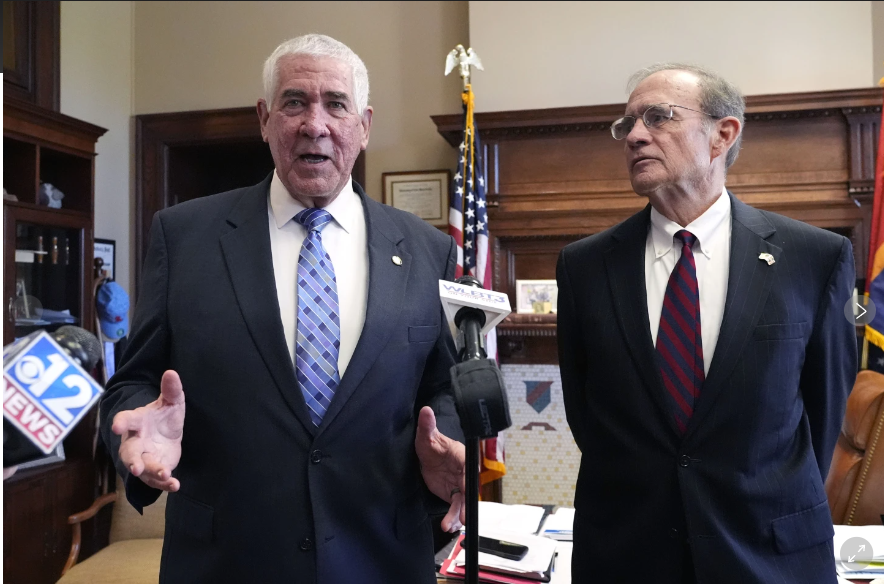
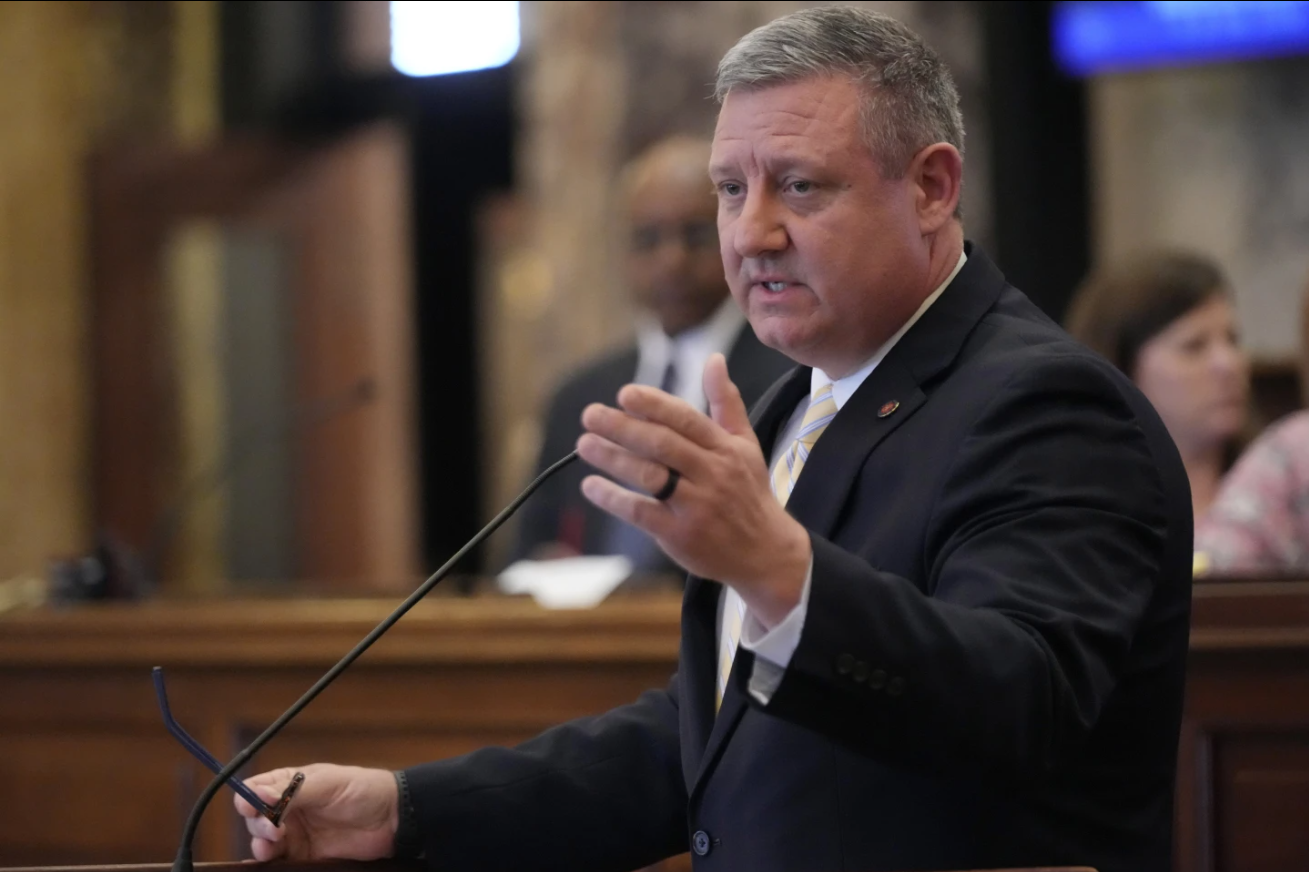
    House Medicaid Committee Chairwoman Missy McGee, a Republican, said her approach could extend benefits to as many as 200,000 people. Senate Medicaid Committee Chairman Kevin Blackwell, also a Republican, said the Senate’s plan could make 80,000 people eligible for expanded coverage, but he estimates that only about 40,000 would enroll.

    The Senate plan also includes a stricter work requirement unlikely to be approved by President Joe Biden’s Administration. This would make the state ineligible for an additional $700 million from the federal government that is otherwise available if Mississippi fully expands Medicaid.

    Mississippi’s Republican-controlled Legislature is considering Medicaid expansion after years of opposition to the policy allowed under the Affordable Care Act, a 2010 federal health overhaul signed by then-President Barack Obama. Speaker Jason White’s ascension to the top leadership position this year helped pave the way for consideration of Medicaid expansion.

    Mississippi has the highest rate of preventable deaths in the U.S. Its top health official has said it ranks at the bottom of virtually every health care indicator and at the top of every disparity. Hospitals are struggling to remain open. The state also has one of the nation’s lowest labor force participation rates. Expansion proponents have said the policy could help ameliorate these conditions.

    Opponents of Medicaid expansion say the program would foster government dependency, increase wait times for health services and push people off private insurance. Republican Gov. Tate Reeves opposes expansion and has launched public and private pressure campaigns to dissuade senators from supporting the policy.

    Reeves is likely to veto the legislation if it reaches his desk. Lawmakers could override his veto with a two-thirds vote from the House and Senate.

    Policy analysts from the Hilltop Institute, a Maryland-based health care research organization, have also circulated a proposed compromise plan among key lawmakers. That plan would address those who make between 100% to 138% of the poverty level by using federal money to help them purchase private insurance plans through Mississippi’s state health care exchange. The institute estimates the plan would provide coverage for 197,000 people.

    On Tuesday, Leaders from Christian, Jewish and Muslim institutions argued that full expansion makes economic sense and is the correct moral stance, regardless of one’s party affiliation.

    “I was warned as a Southern Baptist Republican that this issue, expanding Medicaid, might possibly brand me as a liberal,” said Pastor Jeff Parker of Southside Baptist Church in Jackson. “My response was simple: You Christians … cannot have it both ways. You hold to conservative fiscal policies in government (while) you tighten the grip of our government on humanitarian expenditures.”
  • Storms bring floods and damaging wind across the South; 1 dead in Mississippi

    Storms bring floods and damaging wind across the South; 1 dead in Mississippi

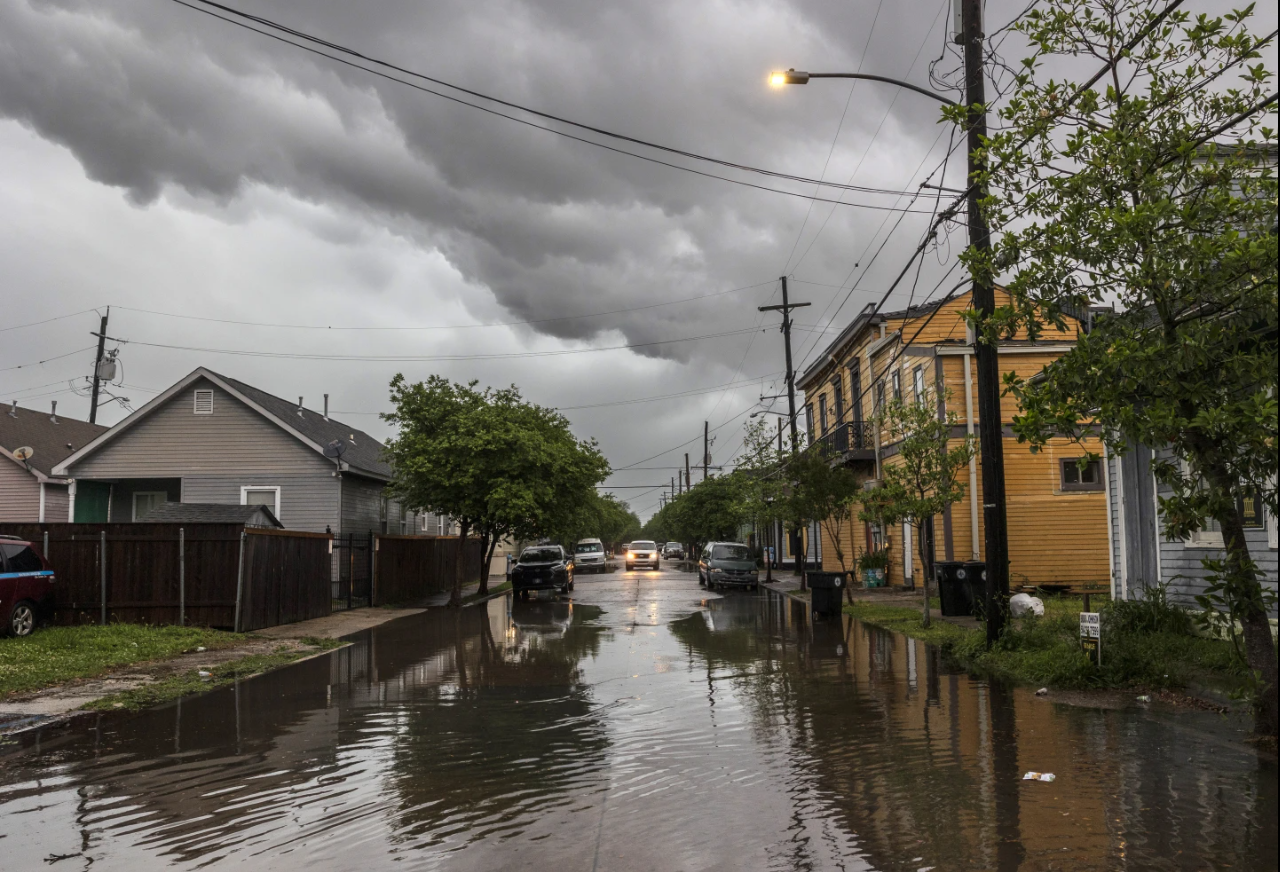
    SLIDELL, La. (AP) — Severe storms blamed for a death in Mississippi spawned a tornado that demolished buildings in one Louisiana city Wednesday while inundating streets in low-lying New Orleans with hours of steady rain that snarled traffic and strained the city’s antiquated drainage system.

    Severe weather stretched across much of the Gulf South with reports of damage from Texas to the Florida panhandle.

    More than 30,000 homes and businesses were without power Wednesday night in Louisiana’s St. Tammany Parish, where a tornado struck the city of Slidell, about 30 miles (48 kilometers) northeast of New Orleans. It ripped roofs off buildings and partially collapsed others in and around the city of about 28,000 people. Authorities said first responders had to rescue people trapped in one heavily damaged apartment building.

    At a Wednesday night news conference, Slidell Mayor Greg Cromer estimated about 75 homes and businesses were damaged in the city. Parish President Mike Cooper said assessments were still underway, but he estimated that hundreds more homes were damaged outside the city.

    Police video showed tree limbs littering the streets and flooded yards that resembled Louisiana swamps. Outside a McDonald’s restaurant, a car was on its side, power poles leaned toward the ground and large pieces of the restaurant’s trademark golden arches were strewn about.

    “I’ve never talked to God so much before in my life,” Robin Marquez said after huddling with coworkers in a two-story building where the roof was ripped away and walls caved in.

    There were no reports of deaths or critical injuries in Slidell.  The National Weather Service said in a social media post Wednesday night that initial surveys of the damage indicate the area was hit by a category EF-1 tornado, with winds anywhere from 86 mph (138 kph) to 110 miles per hour (177 kph). More surveys and analyses were planned to confirm the twister’s strength and path.

    Close to 8 inches (20 centimeters) of rain fell in parts of New Orleans. It came as the system of pipes and pumps that drains the city dealt with problems with its power generating system, forcing workers to divert power from one area to another as needed.

    “During intense rain, the mission sometimes shifts from keeping the streets dry to draining them as quickly as possible,” the New Orleans Sewerage and Water Board, which operates the system, said in a statement Wednesday afternoon.

    Hours after the rain ended, floodwaters lingered in some neighborhoods in New Orleans and in neighboring Jefferson Parish.

    In Mississippi, the death of Shirley Wilson, 64, was attributed to the storm. Wilson had several medical conditions that required her to have access to an electric oxygen machine at all times, Scott County Sheriff Mike Lee said. When her home in the central Mississippi county lost power, her oxygen machine shut down. Emergency responders couldn’t reach her until about 20 minutes after her grandchild called 911 early Wednesday, and she was pronounced dead.

    The Mississippi Emergency Management Agency said 72 homes were damaged.

    In Texas, several people were rescued from homes and vehicles early Wednesday morning when flooding inundated parts of Jasper County, near the Louisiana line, authorities said.

    All major roads into Kirbyville, a Jasper County town of about 2,000 people, were shut down early Wednesday due to the flooding, the sheriff’s office said. Shelters were being set up after about 50 people were displaced from their homes, Billy Ted Smith, the Jasper County emergency management coordinator, said. He estimated the displaced people came from about 20 flooded homes and said there had been around half a dozen people rescued from vehicles. He said no major injuries were reported.

    In the Houston suburb of Katy, strong thunderstorms that passed through the area around 2 a.m. Wednesday collapsed part of the roof of a Firestone repair shop. Storms also damaged businesses and cars in a nearby strip mall, sending a large air conditioning unit that had been on the roof crashing to the parking lot, officials said.

    No one was inside the repair shop, but employees were working at a nearby sports bar when the thunderstorms rolled through, Harris County Fire Marshal Laurie Christensen told reporters later Wednesday morning.

    “We were blessed that no lives were lost,” Christensen said, adding that only minor injuries were reported.

    Some of the damage in Katy had preliminarily been determined to have been caused by an EF-1 tornado with estimated maximum winds of around 90 mph (145 kph), National Weather Service meteorologist Bradley Brokamp said.

    Photos posted on social media showed heavy damage to a church in Port Arthur, Texas, where city officials said they were also dealing with downed trees and powerlines.

    In Mississippi, the sheriff sent out an urgent warning Wednesday to people in parts of Yazoo County, just northwest of Jackson, about a levee failure there. The sheriff’s office called for the evacuation of one subdivision. County officials continued to monitor the levee, WAPT-TV reported.


  • Mississippi Senate blocks House proposal to revise school funding formula

    Mississippi Senate blocks House proposal to revise school funding formula

    JACKSON, Miss. (AP) — Mississippi lawmakers are unlikely to create a new funding formula for public schools this year, after senators blocked a House proposal Tuesday — an action that creates tension during the final weeks of a four-month legislative session.

    Senate Education Committee Chairman Dennis DeBar said leaders of the two chambers should discuss school funding after the current legislative session ends in May and before the next one begins in January.

    “We need to come up with a formula, whatever that may be, that provides predictability, objectiveness and stability for districts as well as the state when it comes to funding our schools,” said DeBar, a Republican from Leakesville.

    House Speaker Jason White said the current funding formula, called the Mississippi Adequate Education Program, is “broken and flawed.”

    “By refusing to have meaningful discussion on this issue … the Senate has moved to preserve the status quo, which will result in less funds to public schools and inadequate distribution in an unfair and inequitable manner,” White said in a statement.

    Lt. Gov. Delbert Hosemann said Senate leaders “are not married to the current formula.”

    “We do, however, believe any appropriation as significant as that which funds our school systems should be vetted and discussed with stakeholders including parents, educators, and the public at-large,” Hosemann said.

    MAEP is designed to give districts enough money to meet midlevel academic standards. It has been fully funded only two years since becoming law in 1997, and that has created political problems as education advocates say legislators are shortchanging public schools.

    MAEP is based on several factors, including costs of instruction, administration, operation and maintenance of schools, and other support services. Senators tried to tried to revise the formula last year, but that effort fell short.

    House leaders this year are pushing to replace MAEP with a new formula called INSPIRE — Investing in the Needs of Students to Prioritize, Impact and Reform Education. It would be based on a per-student cost determined by 13 educators, including the state superintendent of education and local school district administrators, most of whom would be appointed by the state superintendent.

    House Education Committee Chairman Rob Roberson, a Republican from Starkville, said Tuesday that he wants to continue talking to senators about a new formula.

    “If our objective is to get funding out to the most-needed locations, the current formula doesn’t do that,” Roberson said.

    House Education Committee Vice Chairman Kent McCarty, a Republican from Hattiesburg, has said INSPIRE would be more equitable because school districts would receive extra money if they have large concentrations of poverty or if they enroll large numbers of students who have special needs or are learning English as a second language.

    The House voted 95-13 last month in favor of INSPIRE, but the Senate Education Committee killed that bill by refusing to consider it before a deadline.

    The Senate voted 49-0 last month to revise MAEP by requiring local communities to pay a slightly larger percentage of overall school funding. The plan also specified that if a student transfers from a charter school to another public school, the charter school would not keep all of the public money that it received for that student.

    The House removed all of the Senate language and inserted its own INSPIRE formula into the bill. DeBar asked senators Tuesday to reject the House changes. They did so on a voice vote with little opposition.

    As part of the budget-writing process, legislators are supposed to pass a separate bill to put money into schools for the year that begins July 1. A Senate proposal would increase school funding by more than $200 million.

  • As a Mississippi town reels from a devastating tornado, a displaced family finds its way home

    As a Mississippi town reels from a devastating tornado, a displaced family finds its way home

    ROLLING FORK, Miss. (AP) — As a deadly tornado barreled toward their home in the Mississippi Delta, Ida Cartlidge only had time to scoop up her 1-year-old son, Nolan, and hold him close.

    Cartlidge huddled with her husband and three sons on the living room floor of their Rolling Fork mobile home, its thin walls all that separated the family from 200 mph (320 kph) winds.

    “I was holding my baby so tight. I said ‘Baby, I’m probably hurting you right now, but I just can’t let you go,’” she recalled.

    Then the tornado hit, and the home was gone. The twister launched Cartlidge into the air and pulled Nolan from her arms. She remembers seeing him floating above her, as though both were suspended in the air.

    She landed with a thud. Miraculously, Nolan fell on her chest. He was the only family member to escape the storm unscathed.

    The tornado that destroyed Cartlidge’s home last March killed 14 of Rolling Fork’s roughly 1,700 residents and reduced the town to rubble as it charted a merciless path across one of the country’s poorest regions. For the people there, a complicated story of struggle and resilience has emerged in the year since the storm changed everything and exposed vulnerabilities many survivors had been dealing with long before March 2023.

    The Cartlidge family spent the next year in a cramped motel room in search of a more permanent home, like many of their displaced neighbors.

    “There’s still a lot of suffering,” Sen. Joseph Thomas, who represents Rolling Fork in the state Legislature, said in a recent interview. “And you’re looking at an area that was already depressed.”

    Rolling Fork is in Sharkey County, where the poverty rate hovers around 35% — nearly double Mississippi’s roughly 19% rate and triple the nation’s nearly 12% rate, according to the U.S. Census Bureau.
    Before the storm, Cartlidge, 33, and her husband, Charles Jones, 59, had forged a quiet life in a long, narrow three-bedroom, two-bath mobile home with their sons: Jakavien, 13, Amarii, 12, and Nolan. She worked in customer service for an appliance company and Jones was a mechanic for a local auto parts shop.

    Cartlidge suffered a crushed pelvis and broken shoulder in the tornado. Jakavien punctured a lung and shattered bones in his spine and shoulder blade. Amarri had deep lacerations on his back and ankles. Jones injured his ribs and spine.

    The mobile home park where they lived was also home to most of the 14 people who died in the tornado. Large families crowded into one- or two-bedroom units, which helped offset the financial strain endemic to a region where stable jobs are scarce.

    Sharkey County lost nearly 400 jobs after the tornado, according to Rolling Fork Mayor Eldridge Walker. The tornado laid waste to about 300 structures, including numerous homes and businesses, which meant lost tax revenue for the city, he said. In February 2024, Walker wrote to Thomas pleading for additional state funds.

    The city’s infrastructure suffered millions of dollars in damage. Public buildings, streets and the city’s sewer and drainage systems either sustained severe damage or were destroyed. One year after the tornado, buildings throughout town remain boarded up, and the remnants of destroyed properties dot the landscape.

    The local high school remains closed because of lingering damage, leaving students to ride buses to nearby towns. Destroyed vehicles still hinder residents’ ability to navigate their daily lives.

    “People were displaced from their transportation networks,” said William Keith, who worked on disaster response for the American Red Cross. “A lot of people went to the grocery store with their neighbor next door, or they had a buddy a couple blocks away, and then went to work with them.”

    After everyone was discharged from the hospital, the Cartlidge family moved into a two-bed motel room only minutes down the highway from where their mobile home used to be. The Rolling Fork Motel is a one-story brick building with green doors and a bright yellow sign that looms over Route 61, known as the “Blues Highway.”

    Music is integral to Rolling Fork’s history. Blues legend Muddy Waters is a native son. The highway running through town symbolizes the genre’s popular theme of packing up and leaving one’s troubles behind, according to the Mississippi Blues Commission.

    Convincing locals to stay is a harder proposition these days.

    More than 70% of Rolling Fork residents displaced by the tornado were renters. Housing assistance programs run by nonprofits stepped in after the tornado, but most are geared toward homeowners rather than renters or people who lived with family members, Thomas said.

    Queen’terica Jones, 23, lived with her mother, Erica “Nikki” Moore, and three children in a mobile home just down the street from the Cartlidge place. On the evening of the tornado, she found her mother’s lifeless body facedown amid the rubble.

    Jones had no legal rights to her mother’s property and didn’t have the documents required by many programs that financed new mobile homes for displaced residents. Objects that had previously seemed ordinary — housing documents, family heirlooms, tax returns — suddenly took on life-altering significance for her.

    “It’s a hard period. From losing your mom to having to start all over again,” Jones said. “Jesus, that’s a whole lot.”

    Without stable work and housing, Jones has moved between the homes of friends and family members since the storm. It’s a common story in Rolling Fork, where public services and steady work that had always been elusive grew even more scarce in the storm’s aftermath.

    “Towns such as Rolling Fork generally have a smaller tax base with fewer economic resources to respond and recover from such disasters,” said Ryan Thomson, a professor of rural sociology at Auburn University. “Federal and state aid oftentimes lag behind local needs.”

    Nonprofits, the state and the federal government rallied to help. But if the assistance doesn’t address some of the town’s lingering needs, officials fear an exodus is likely.

    “We are striving for a better Rolling Fork,” Walker wrote in his letter to Thomas. “And the chance to keep our people in this town.”

    The Red Cross paid for extended stays at the Rolling Fork Motel for displaced residents, and for months, volunteers clad in red vests doled out groceries and supplies to weary residents. They stacked whatever the storm hadn’t carried off in corners and made room for donated packages of Cup Noodles and Capri Sun.

    For nearly a full year in that cramped motel room, the Cartlidge family lived with only basic necessities. But they had owned their destroyed mobile home, making them eligible for a new one through a nonprofit called Samaritan’s Purse.

    In February, they moved into a renovated trailer near downtown, with a “Home Sweet Home” mat greeting them at the door. They cried in each other’s arms upon seeing the property.

    That night, Ida served the children popcorn and soda on a platter and they all watched horror films — none as scary as the nightmare they’d lived through together a year earlier.

    Then they went to bed, each in their own room.


  • Mississippi state budget is expected to shrink slightly in the coming year

    Mississippi state budget is expected to shrink slightly in the coming year

    JACKSON, Miss. (AP) — Budget writers in the Mississippi Legislature will have slightly less money to spend during the coming year than they did in the current one.

    Top members of the House and Senate met Friday and set a revenue estimate of $7.6 billion for the year that begins July 1. That is a decrease of 1% from the current year.

    The estimate is experts’ best guess of how much money the state will collect, based on economic trends including employment rates and consumer spending patterns.

    Legislators are in a four-month session that is scheduled to end in early May. During the next few weeks, they are supposed to finish writing the budget for the coming year, deciding how much to spend on schools, prisons, health care and other services.

    Republican Lt. Gov. Delbert Hosemann said Friday that legislators will be prudent with money.

    Mississippi is in the process of reducing its personal income tax under a law that Republican Gov. Tate Reeves signed in 2022. In his budget proposal released in February, Reeves said he wants to erase the tax by 2029. Hosemann said Friday that he does not expect movement in that direction this year.

    “I can’t speak for the House. But for the Senate side, I don’t think we’re going to have any income tax cuts,” Hosemann told reporters.

    It has been months since state agencies submitted the budget requests for the coming year. Legislators rarely give agencies all the money they seek, and House Appropriations Committee Chairman John Read said that’s likely to be the case again this session.

    “I’m going to do as much as I can,” said Read, a Republican from Gautier. “We get requests. There’s no way I can do 100% of requests, so I tell people to give me a priority list, and that’s what I go on. We try to help everyone.”

  • 11 injured as bus carrying University of South Carolina fraternity crashes in Mississippi

    11 injured as bus carrying University of South Carolina fraternity crashes in Mississippi

    BAY ST. LOUIS, Miss. (AP) — Eleven people were injured when a bus carrying University of South Carolina students blew a tire and hit a concrete barrier in Mississippi.

    Mississippi state troopers said the driver and a student were critically injured and taken by helicopter to hospitals after the crash Friday, while nine other students were taken by ambulance.

    The 56 passengers were members of the university’s chapter of Sigma Phi Epsilon fraternity and their guests, who were traveling to New Orleans for an event.

    Troopers said the driver, 55-year-old Tina Wilson of Roebuck, South Carolina, was traveling west on Interstate 10 near Bay St. Louis when a tire blew and the bus hit a center concrete barrier. Bay St. Louis Police Chief Toby Schwartz said the bus careened away from the collision on two wheels before Wilson wrestled it back down onto all four wheels. Schwartz told the Sun Herald of Biloxi that Wilson “took every piece of strength in her body to hold that steering wheel long enough to get it back down on the road.”

    The windshield blew out, and Wilson was ejected when the bus hit the ground. A student, Paul Clune, then ran up and grabbed the steering wheel, Schwartz said. Clune tried to keep control until the bus skidded to a stop after nearly half a mile, WLOX-TV reported.

    “If that bus had flipped, we would have had casualties,” Schwartz said. “It’s the bus driver and student that saved those kids. The bus driver is an incredible hero.”

    The uninjured students were taken by school bus to another location and later were taken to New Orleans. The interstate was blocked for hours.

    University of South Carolina spokesperson Collyn Taylor said Saturday that travel arrangements have been made for students who want to return to Columbia and the university will provide mental health and academic support for anyone affected by the accident. Taylor said university officials were trying to determine how many people were still in the hospital.

    Troopers are investigating the crash by the bus owned by Dixon Motor Xpress of Chester, South Carolina. Owner Todd Dixon told The State of Columbia on Saturday that the crash was a “freak thing” and that his company has had no other accidents since it was created in 2019.

    The company has a satisfactory safety rating, according to the U.S. Department of Transportation’s Federal Motor Carrier Safety Administration. In the previous two years, the company had passed an inspection and reported no accidents.

    “We’ve always had safe operations,” Dixon said. “We keep everything in top shape and don’t cut any corners, especially because we know we’re in the business of transporting people.”

    Dixon praised Wilson, saying “she has years of experience and instinctively she is a safe driver.”

  • Mississippi capital to revamp how it notifies next of kin about deaths with Justice Department help

    Mississippi capital to revamp how it notifies next of kin about deaths with Justice Department help

    JACKSON, Miss. (AP) — After men near Mississippi’s capital were buried in a pauper’s cemetery without their relatives’ knowledge, the U.S. Justice Department will help the city’s police revamp policies for performing next-of-kin death notifications.

    The intervention follows the discovery that seven men were buried in unmarked graves without their families’ knowledge. At least three of those men were Black. In Jackson, 80% of the population is Black. Federal officials are stepping in to ensure the notification procedures employed by the Jackson Police Department and Hinds County Coroner’s Office comply with civil rights laws, the Justice Department’s Civil Rights Division announced Thursday.

    “Families want and deserve transparency and the opportunity to make decisions about their loved ones’ burials,” said Assistant Attorney General Kristen Clarke, who leads the division. “Through technical assistance, we aim to ensure that officials are able to deliver death notifications and make decisions regarding burials in a timely and trauma-informed way that complies with federal civil rights law.”

    The Civil Rights Division and the U.S. Attorney’s Office for the Southern District of Mississippi will examine the Jackson Police Department’s policies on death notifications and provide recommendations for training and improvements. The federal agencies will also recommend practices for locating next-of-kin to the Hinds County Coroner’s Office.

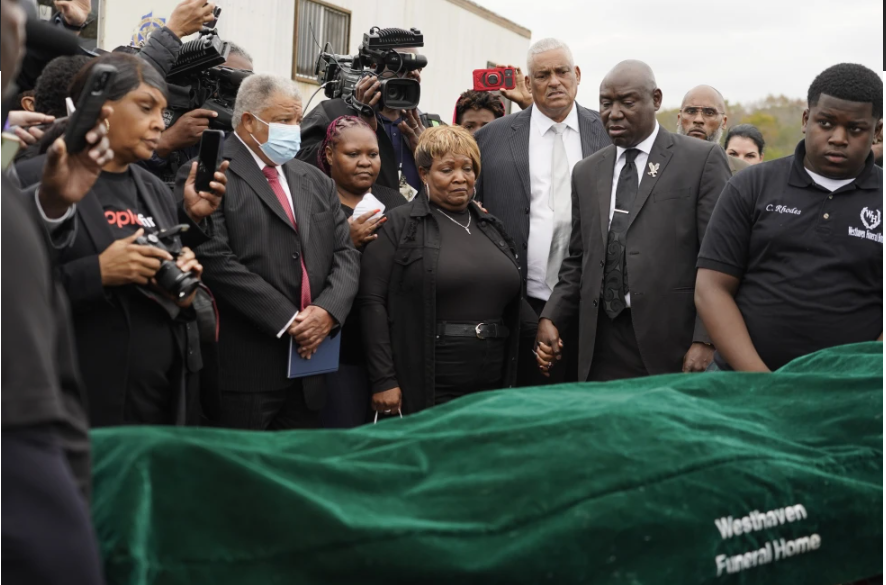
    Seven families learned of a loved one’s death from news reports instead of from officials in Hinds County, Mississippi, according to NBCNews.com. Civil rights attorney Ben Crump, who represents some of the families, has called for a federal investigation into the botched burials.

    Scrutiny of burials near the Hinds County Penal Farm in Raymond, Mississippi, accelerated after the August discovery of Dexter Wade’s body. Wade, 37, died on March 5, 2023, after an off-duty Jackson Police Department officer struck him with a department SUV while Wade was walking across Interstate 55. His mother said it was late August before she learned her son had been killed and buried.

    Wade’s body was exhumed on Nov. 13, and an independent autopsy was conducted. A wallet found in the jeans Wade was buried in contained his state identification card with his home address, credit card and health insurance card, Crump said. On Nov. 20, he was given a proper funeral, attended by more than 200 people, including U.S. Rep. Bennie Thompson and the Rev. Al Sharpton.

    In its Thursday announcement, the Civil Rights Division said the assistance does not indicate a finding of wrongdoing by the Jackson Police Department or the Hinds County Coroner’s Office. In a statement following the federal government’s announcement, Jackson Mayor Chokwe Antar Lumumba said local agencies welcomed federal help.

  • Medicaid expansion plans and school funding changes still alive in Mississippi Legislature

    Medicaid expansion plans and school funding changes still alive in Mississippi Legislature

    JACKSON, Miss. (AP) — Bills to expand Medicaid and rewrite the funding formula for public schools are among measures still alive in the Mississippi Legislature.

    Tuesday was the deadline for House and Senate committees to consider general bills and constitutional amendments originating in the other chamber. Surviving legislation moves to the full House and Senate for more debate. Budget and revenue bills have later deadlines.

    The Legislature’s four-month session is scheduled to end in early May.

    A look at the status of some general bills:

    MEDICAID EXPANSION — ALIVE

    Mississippi lawmakers will try to reach a compromise on expanding Medicaid in one of the poorest states in the U.S. after the Senate voted for a vastly different plan than one proposed by the House. The Senate proposal would insure fewer people and bring less federal money to the state than the version approved by the House. The Senate’s approach also includes a tougher work requirement and measures to prevent a wider expansion of Medicaid benefits in the future.

    EDUCATION FUNDING — ALIVE

    Senate leaders want to alter the Mississippi Adequate Education Program, which is designed to give districts enough money to meet midlevel academic standards but has been fully funded only two years since becoming law in 1997. House leaders are pushing for a new formula called INSPIRE — Investing in the Needs of Students to Prioritize, Impact and Reform Education. It would be based on a per-student cost determined by 13 educators. Senate Bill 2332 was amended to add the House proposal, while the House bill died. Leaders are expected to try to negotiate a final version.

    JUDICIAL REDISTRICTING — ALIVE

    House Bill 722 would update the boundaries of circuit court and chancery court districts. A version of the bill has passed the House. The Senate Judiciary A Committee made changes, and the revised bill awaits consideration in the full Senate. Democratic Sen. Derrick Simmons of Greenville criticized the proposal, saying it would combine two circuit court districts in part of the Delta and reduce the seven current judgeships in the area to three. Judiciary A Committee Chairman Brice Wiggins, a Republican from Pascagoula, said areas losing population are likely to lose judges.

    MOBILE SPORTS BETTING — ALIVE

    House Bill 774 would legalize mobile sports betting. Thirty other states already allow the practice. Republican Rep. Casey Eure of Saucier, the bill’s prime sponsor, said Mississippi could bring in $25 million to $35 million a year in tax revenue. Sports wagering has been legal in the state for years, but online betting has remained illegal amid fears it could financially harm Mississippi casinos.

    SINGLE-SEX SPACES AND BINARY DEFINITION OF SEX — ALIVE

    Senate Bill 2753 and House Bill 1607 would require public buildings to have single-sex restrooms and changing areas, or unisex spaces designated for one person. The bills create a binary definition of sex, and would prohibit people from entering spaces designated for the “opposite sex.” They would block transgender people, including those who have transitioned, from using restrooms that match their gender identity. A person caught entering the wrong area could be sued.

    REGIONAL BOARD TO GOVERN JACKSON WATER — DEAD

    For the second year, a bill to create a state-appointed regional board to govern the water system in the capital city of Jackson has died. Under Senate Bill 2628, the board would have taken over after a federally appointed independent administrator leaves Jackson. Mayor Chokwe Antar Lumumba said the bill was an example of the majority-white and Republican-led Legislature trying to seize control from a majority-Black city. Republican Sen. David Parker of Olive Branch said the bill would help address issues that have disrupted the utility and left residents without consistent access to running water.

    RESTORATION OF SOME FELONS’ VOTING RIGHTS — DEAD

    House Bill 1609 would have created a simpler process for restoration of voting rights for people convicted of some felonies. The House passed the bill, but Senate Constitution Committee Chairwoman Angela Hill, a Republican from Picayune, killed it by not bringing it up for a vote in her committee.

    EARLY VOTING 15 DAYS BEFORE ELECTION — DEAD

    Senate Bill 2580 would have allowed in-person voting beginning 15 days before Election Day. The bill passed the Senate but died when House Apportionment and Elections Committee Chairman Noah Sanford, a Republican from Collins, did not bring it up for a vote in his committee. Mississippi allows absentee voting before elections for people who are at least 65 years old or have a physical impairment or who will be out of town on Election Day. It is one of four states without so-called no-excuse early voting.

    CASINO IN DOWNTOWN JACKSON — DEAD

    House Bill 1989 would have allowed a casino in downtown Jackson. Mississippi only allows state-regulated casinos along the waters of the Mississippi River and the Gulf Coast. House Ways and Means Committee Chairman Trey Lamar, a Republican from Senatobia, sponsored the bill but did not bring it up for a vote in his own committee because House Republicans said there were not enough votes for the bill to pass.


  • What to expect in Mississippi’s US House primary runoff

    What to expect in Mississippi’s US House primary runoff

    WASHINGTON (AP) — Two Republicans will compete on Tuesday for the right to challenge 16-term Democratic incumbent Rep. Bennie Thompson in Mississippi’s 2nd Congressional District. Ron Eller and Andrew Scott Smith were the top vote-getters in the March 12 primary, but neither received the vote majority needed to avoid the runoff election.

    Eller, a military veteran and physician assistant, placed first in the primary with about 47% of the vote compared with about 36% for Smith, who has worked in commercial real estate and has a background in pumpkin farming. Eller also ran for the seat in 2022, placing second in the primary but losing the runoff to Republican Brian Flowers, who went on to lose to Thompson in the general, 60% to 40%.

    In terms of policy issues, Eller touts what he calls “The E-3 Plan,” for education, economics and energy, while Smith calls his platform “The 10 Rs,” which starts with “Restore Economic Dominance” and ends with “Rip Apart the Deep State.” On border security, Eller has calls to “build the wall now” and cut off sanctuary cities from federal funding, while Smith supports a combination of “physical barriers, advanced technology, and increased personnel.” Smith also calls for legalizing marijuana and restoring voting rights for former felons who have completed their sentences.

    Thompson was unopposed in the Democratic primary. He has held a version of this seat since 1993, when he was elected in a special election to replace Democrat Mike Espy, who left to serve as secretary of agriculture under President Bill Clinton.

    The massive district stretches along the Mississippi River bordering Arkansas and Louisiana and comprises about 40% of the state’s geography. It includes most of the state capital of Jackson. The current boundaries were adopted in 2022. Voters in the district supported Democrat Joe Biden over Republican Donald Trump in the 2020 presidential election, 63% to 36%.

    Here’s a look at what to expect on Tuesday:

    PRIMARY RUNOFF DAY

    The Republican primary runoff election in Mississippi’s 2nd Congressional District will be held Tuesday. Polls close at 8 p.m. ET.

    WHAT’S ON THE BALLOT

    The Associated Press will provide coverage for the Republican primary runoff election in Mississippi’s 2nd Congressional District. The two candidates who advanced from the March 12 primary are Ron Eller and Andrew Scott Smith.

    WHO GETS TO VOTE

    Voting in Tuesday’s Republican runoff is available to anyone who voted in the March 12 Republican primary as well as any registered voter in District 2 who did not participate in any party’s primary for this seat. In other words, anyone who voted in the March 12 Democratic primary for this seat may not vote in the Republican runoff.

    DECISION NOTES

    Eller fell about 3.5 percentage points short of clinching the nomination outright on primary night. His best performances were in the district’s more populous counties of Hinds, which includes most of Jackson, and Warren. He received majorities in both counties. He won most of the counties in the Delta, while Smith was ahead in the northern and northeastern regions of the district. For Smith to catch and overtake Eller in the runoff, he would need to eat into Eller’s lead in the vote-rich Jackson area and surrounding counties, while padding his vote majorities in midsize counties like Panola and Grenada.

    About 36,000 votes were cast in the March 12 primary. Turnout for runoff elections tends to be lower than the primaries that preceded them. In a close contest, low turnout could delay the race-calling process, as determining the winner could depend on a handful of untabulated ballots.

    The AP does not make projections and will declare a winner only when it’s determined there is no scenario that would allow the trailing candidates to close the gap. If a race has not been called, the AP will continue to cover any newsworthy developments, such as candidate concessions or declarations of victory. In doing so, the AP will make clear that it has not yet declared a winner and explain why.

    WHAT DO TURNOUT AND ADVANCE VOTE LOOK LIKE

    Turnout in 2023 was about 9% of registered voters in the Democratic primary for governor and about 18% in the Republican primary. There were just shy of 2,067,000 total registered for those primaries.

    As of March 26, only 19 pre-Election Day ballots had been cast in the Republican primary runoff election. In 2023, pre-Election Day voting made up about 8% of the total vote in the gubernatorial primaries.

    HOW LONG DOES VOTE-COUNTING USUALLY TAKE?

    In the March 12 primary, the AP first reported results at 8:07 p.m. ET, or seven minutes after polls closed. The election night tabulation ended at 12:35 a.m. ET with about 97% of total votes counted.

    ARE WE THERE YET?

    As of Tuesday, there will be 217 days until the November general election.


  • Mississippi Senate passes trimmed Medicaid expansion and sends bill back to the House

    Mississippi Senate passes trimmed Medicaid expansion and sends bill back to the House

    JACKSON, Miss. (AP) — Mississippi lawmakers will try to negotiate on expanding Medicaid in one of the poorest states in the U.S. after the Senate voted Thursday for a vastly different plan than one proposed by the House.

    The upper chamber’s proposal would insure fewer people and bring less federal money to the state than the version approved by the House last month. But the Senate’s approach includes a tougher work requirement and measures to prevent a wider expansion of Medicaid benefits in the future.

    Senators debated the bill for nearly two hours before approving it in a 36-16 vote. The move to increase eligibility for the government-funded health insurance program that covers low-income people has set off a struggle between Republican Gov. Tate Reeves and members of his own party. In a social media post Wednesday, Reeves called the bill “Obamacare Medicaid” and said it would amount to “welfare expansion to those able-bodied adults that could work but choose not to.”

    Republican Sen. Kevin Blackwell, who chairs the Senate Medicaid Committee, has dubbed the Senate proposal Medicaid expansion “lite,” and said it is much narrower that what is allowed under the Affordable Care Act, a 2010 federal health overhaul signed by then-President Barack Obama.

    “Many of the comments I’ve seen recently on social media are misleading, inaccurate and designed to be inflammatory,” Blackwell said. “This bill is not Obamacare expansion. This bill is a very responsible, conservative bill geared toward helping the working poor.”

    The Senate’s amended bill would extend eligibility only to those making up to 100% of the federal poverty level, just over $15,000 for one person. That is down from the 138% figure, just under $21,000 for one person, approved by the House.

    House Medicaid Committee Chairwoman Missy McGee said her proposal could extend benefits to as many as 200,000 people. Blackwell said the new version of the bill approved by his committee could make 80,000 people eligible for expanded coverage, but he projects only about 40,000 would enroll.

    Mississippi ranks at the bottom of virtually every health care indicator and at the top of every disparity. Hospitals are struggling to remain open. The state also has one of the nation’s lowest labor force participation rates. Expansion proponents have said the policy could help improve these conditions.

    Senate Democrats introduced amendments that would have expanded Medicaid to more people, but Republicans voted them down on the floor. Even still, Senate Democrats all voted for the bill, with Minority Leader Derrick Simmons arguing that Mississippi is experiencing a “health care crisis” and that the bill is better than the status quo.

    Opponents of Medicaid expansion say the program would foster government dependency, increase wait times for health services and push people off private insurance.

    Republican lawmakers have said expansion without a work requirement is a nonstarter. The Senate version would require people to work at least 30 hours per week to become eligible for expanded benefits, up from the 20-hour work requirement approved by the House.

    The Senate makes expansion depend on President Joe Biden’s administration approving its work requirement. But the administration has consistently revoked work requirement waivers, arguing people should not face roadblocks to getting health care.

    Only Georgia has managed to tie a work requirement to a partial expansion of Medicaid benefits. But the state only requires people to document 80 monthly hours of work, 40 hours less than what Mississippi senators have proposed. Georgia’s program has seen abysmal enrollment.

    The House proposal would have allowed expansion to continue without a work requirement, but the Senate version would disallow Medicaid expansion without one. Blackwell said he is counting on Biden losing in November to a Republican whose administration would welcome a work requirement.

    Under the reduced eligibility level approved by the Senate, Mississippi would also lose an additional financial bonus for expanding Medicaid that would be available under the House’s version.

    The bill now heads back the House, and Reeves is likely to veto the legislation if it reaches his desk. Lawmakers could override his veto with a two-thirds vote from the House and Senate.