Blog

  • George F. Bowles house receives historical marker

    George F. Bowles house receives historical marker

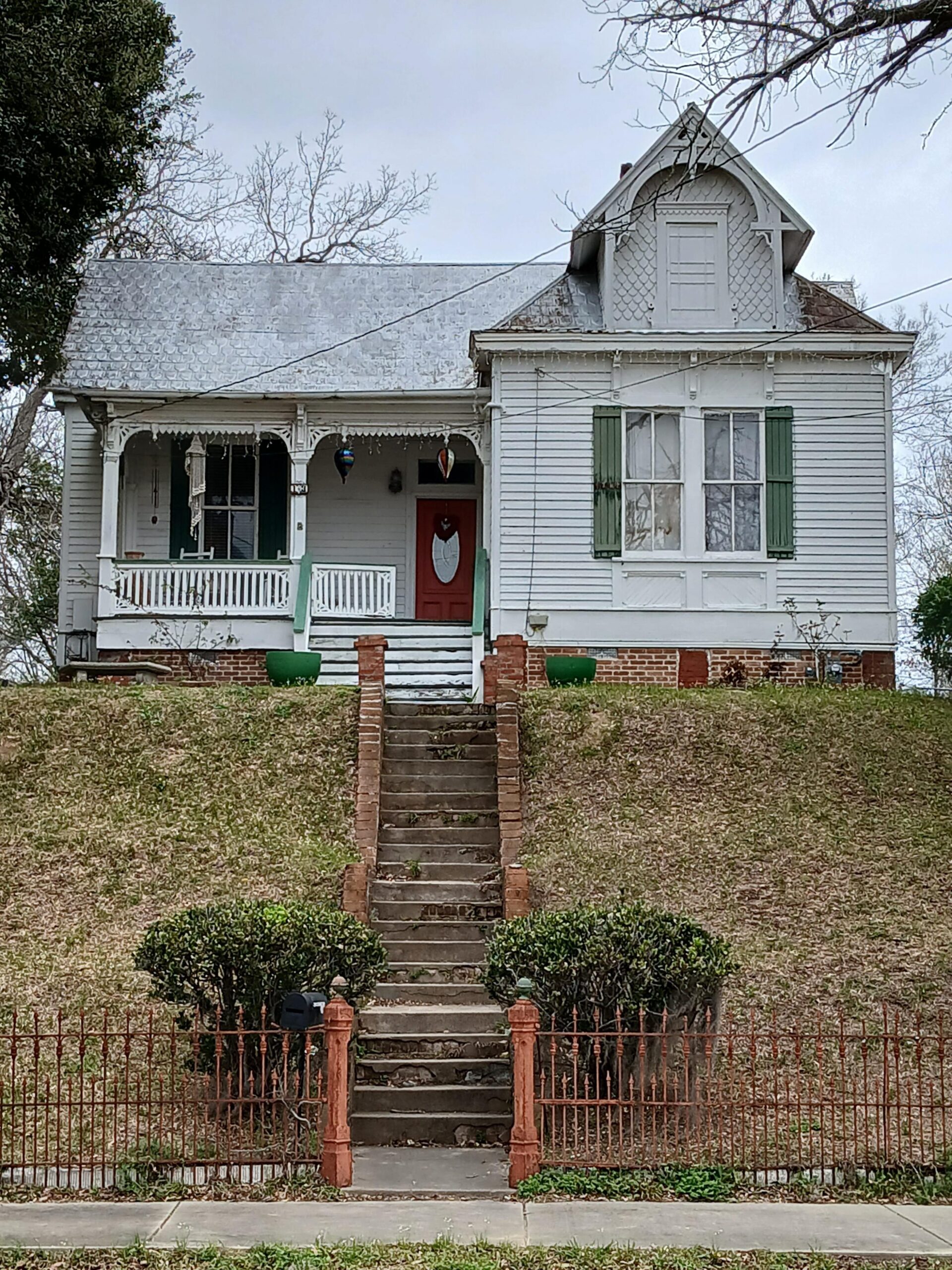
    NATCHEZ, Miss. – The George F. Bowles House, located at 13 St. Catherine St., is the recent recipient of a historical marker presented by the City of Natchez and NAPAC museum.

    Mayor Dan Gibson and a group of local residents unveiled the marker in front of the house during a dedication ceremony Wednesday, Feb. 28. The mayor was joined by Larry and Brenda Holmes, the current owners of the house; Alderwoman Valencia Hall; the Rev. Birdon and Debra Mitchell, next door neighbors; and Dr. Neifa Hardy.

    The George F. Bowles House is the latest recipient of a historical marker, which was dedicated recently in recognition of Black History Month. Those participating in the dedication ceremony included, from left, Rev. Birdon and Debra Mitchell, Alderwoman Valencia Hall, Brenda and Larry Holmes, and Mayor Dan Gibson.

    Friends and family members of the Holmes also attended the event which was held in recognition of Black History Month.

    “It is such a blessing to witness the great things happening in Natchez,” said Gibson. “Being able to celebrate the history of this home, located in the Holy Family Catholic Church Historic District, and in the heart of the historic black business and residential area of North Natchez, is just another step forward in telling our story, all of it, for One Natchez.”

    The marker is inscribed with the words, “The George F. Bowles House: 1886 – 1890.” It displays the NAPAC museum logo and a QR code for additional information on the site.

    Larry Holmes said that he and wife were elated about the marker.

    “We both feel good about it,” he said. “This is something we’ve wanted for a long time. George F. Bowles was an important man in our history and his story, as well as the story of his wife, needs to be told.”

    Larry Holmes grew up behind the house, across the street known as Bowles Alley. In 1977, he moved into the house as a tenant. He said that he and Brenda purchased the house in 1984, and it has been their home ever since.

    Birdon Mitchell, pastor of Zion Chapel A.M.E. Church, has been the Holmes’ neighbor for many years. He said he was happy to see the recognition given for their property.

    “Larry and Brenda are very knowledgeable about the history of this property,” Birdon Mitchell said. “They love telling the stories about this house and they’re eager to share this information with the broader community. Natchez is fortunate to have this property preserved for the present and future generations.”

    George F. Bowles (1844-1899) was a prominent African American who played a significant role in Natchez’s history in the 1800s. Born enslaved in Charleston, S.C., he gained his freedom before the start of the Civil War.

    Bowles came to Natchez in 1871 after practicing law in  Tennessee. In the 1880s and 1890s, he served as a member of the state House of Representatives from Adams County. He was a successful businessman, inventor, newspaper publisher, and philanthropist. His wife, Laura E. Davis Bowles, was a member of a prominent black family.

    George Bowles built his house between 1886 and 1890, according to Mimi Miller of the Historic Natchez Foundation. It is located in the Hospital Hill neighborhood on the very site that was home to Natchez’s first public hospital building, the Mississippi State Hospital, built in 1813.

    Before its main section was demolished in 1866, the hospital existed on the north side of St. Catherine across from the present location of Holy Family Church. The Bowles house is flanked on the west by the Dr. John Bowman Banks house and on the east by the parsonage of Zion Chapel A.M.E. Church.

    The Bowles lived in the house until 1899, the year that both of them died. Laura Bowles died on Aug. 17, 1899, and George died in their home on Dec. 26, 1899, at the age of 55. His pallbearers included Dr. John Banks, G.W. Brumfield and L.D. Kastor. John Roy Lynch was listed as an honorary pallbearer.

    The Bowles house is the latest historical site to be added to the city’s Self-Guided African American History tour, which features 29 sites related to African American history. Barber Jessie Winston’s home was added to the tour in December 2023.

    The city’s self-guided history tour project was unveiled during a Black History program in February 2023. It is a joint initiative of the City of Natchez and NAPAC Museum. Mayor Gibson has said the project is one of many ways through which the city is telling its complete history.

    A detailed article on the history of the George F. Bowles House can be read in the September/October 2023 issue of Natchez Magazine.

  • Caitlin Vinson

    [vc_single_image image=”1514″ img_size=”large” alignment=”center”][vc_single_image image=”1515″ img_size=”large” alignment=”center”][headerText widget_name=”Birthday and Anniversary Cakes Provided By Dairy Queen” level=”h3″ url=”” el_class=””]

    Happy Birthday to Caitlin Vinson!

    Birthday Cake winner 2/29/24

  • What would happen without a Leap Day? More than you might think

    What would happen without a Leap Day? More than you might think

    NEW YORK (AP) — Leap year. It’s a delight for the calendar and math nerds among us. So how did it all begin and why?

    Have a look at some of the numbers, history and lore behind the (not quite) every-four-year phenomenon that adds a 29th day to February.

    BY THE NUMBERS

    The math is mind-boggling in a layperson sort of way and down to fractions of days and minutes. There’s even a leap second occasionally, but there’s no hullabaloo when that happens.

    The thing to know is that leap year exists, in large part, to keep the months in sync with annual events, including equinoxes and solstices, according to the Jet Propulsion Laboratory at the California Institute of Technology.

    It’s a correction to counter the fact that Earth’s orbit isn’t precisely 365 days a year. The trip takes about six hours longer than that, NASA says.

    Contrary to what some might believe, however, not every four years is a leaper. Adding a leap day every four years would make the calendar longer by more than 44 minutes, according to the National Air & Space Museum.

    Later, on a calendar yet to come (we’ll get to it), it was decreed that years divisible by 100 not follow the four-year leap day rule unless they are also divisible by 400, the JPL notes. In the past 500 years, there was no leap day in 1700, 1800 and 1900, but 2000 had one. In the next 500 years, if the practice is followed, there will be no leap day in 2100, 2200, 2300 and 2500.

    Still with us?

    The next leap years are 2028, 2032 and 2036.

    WHAT WOULD HAPPEN WITHOUT A LEAP DAY?

    Eventually, nothing good in terms of when major events fall, when farmers plant and how seasons align with the sun and the moon.

    “Without the leap years, after a few hundred years we will have summer in November,” said Younas Khan, a physics instructor at the University of Alabama at Birmingham. “Christmas will be in summer. There will be no snow. There will be no feeling of Christmas.”

    WHO CAME UP WITH LEAP YEAR?

    The short answer: It evolved.

    Ancient civilizations used the cosmos to plan their lives, and there are calendars dating back to the Bronze Age. They were based on either the phases of the moon or the sun, as various calendars are today. Usually they were “lunisolar,” using both.

    Now hop on over to the Roman Empire and Julius Caesar. He was dealing with major seasonal drift on calendars used in his neck of the woods. They dealt badly with drift by adding months. He was also navigating a vast array of calendars starting in a vast array of ways in the vast Roman Empire.

    He introduced his Julian calendar in 46 BCE. It was purely solar and counted a year at 365.25 days, so once every four years an extra day was added. Before that, the Romans counted a year at 355 days, at least for a time.

    But still, under Julius, there was drift. There were too many leap years! The solar year isn’t precisely 365.25 days! It’s 365.242 days, said Nick Eakes, an astronomy educator at the Morehead Planetarium and Science Center at the University of North Carolina in Chapel Hill.

    Thomas Palaima, a classics professor at the University of Texas at Austin, said adding periods of time to a year to reflect variations in the lunar and solar cycles was done by the ancients. The Athenian calendar, he said, was used in the fourth, fifth and sixth centuries with 12 lunar months.

    That didn’t work for seasonal religious rites. The drift problem led to “intercalating” an extra month periodically to realign with lunar and solar cycles, Palaima said.

    The Julian calendar was 0.0078 days (11 minutes and 14 seconds) longer than the tropical year, so errors in timekeeping still gradually accumulated, according to NASA. But stability increased, Palaima said.

    The Julian calendar was the model used by the Western world for hundreds of years. Enter Pope Gregory XIII, who calibrated further. His Gregorian calendar took effect in the late 16th century. It remains in use today and, clearly, isn’t perfect or there would be no need for leap year. But it was a big improvement, reducing drift to mere seconds.

    Why did he step in? Well, Easter. It was coming later in the year over time, and he fretted that events related to Easter like the Pentecost might bump up against pagan festivals. The pope wanted Easter to remain in the spring.

    He eliminated some extra days accumulated on the Julian calendar and tweaked the rules on leap day. It’s Pope Gregory and his advisers who came up with the really gnarly math on when there should or shouldn’t be a leap year.

    “If the solar year was a perfect 365.25 then we wouldn’t have to worry about the tricky math involved,” Eakes said.

    WHAT’S THE DEAL WITH LEAP YEAR AND MARRIAGE?

    Bizarrely, leap day comes with lore about women popping the marriage question to men. It was mostly benign fun, but it came with a bite that reinforced gender roles.

    There’s distant European folklore. One story places the idea of women proposing in fifth century Ireland, with St. Bridget appealing to St. Patrick to offer women the chance to ask men to marry them, according to historian Katherine Parkin in a 2012 paper in the Journal of Family History.

    Nobody really knows where it all began.

    In 1904, syndicated columnist Elizabeth Meriwether Gilmer, aka Dorothy Dix, summed up the tradition this way: “Of course people will say … that a woman’s leap year prerogative, like most of her liberties, is merely a glittering mockery.”

    The pre-Sadie Hawkins tradition, however serious or tongue-in-cheek, could have empowered women but merely perpetuated stereotypes. The proposals were to happen via postcard, but many such cards turned the tables and poked fun at women instead.

    Advertising perpetuated the leap year marriage game. A 1916 ad by the American Industrial Bank and Trust Co. read thusly: “This being Leap Year day, we suggest to every girl that she propose to her father to open a savings account in her name in our own bank.”

    There was no breath of independence for women due to leap day.

    SHOULD WE PITY THE LEAPLINGS?

    Being born in a leap year on a leap day certainly is a talking point. But it can be kind of a pain from a paperwork perspective. Some governments and others requiring forms to be filled out and birthdays to be stated stepped in to declare what date was used by leaplings for such things as drivers licenses, whether Feb. 28 or March 1.

    Technology has made it far easier for leap babies to jot down their Feb. 29 milestones, though there can be glitches in terms of health systems, insurance policies and with other businesses and organization that don’t have that date built in.

    There are about 5 million people worldwide who share the leap birthday out of about 8 billion people on the planet. Shelley Dean, 23, in Seattle, Washington, chooses a rosy attitude about being a leapling. Growing up, she had normal birthday parties each year, but an extra special one when leap years rolled around. Since, as an adult, she marks that non-leap period between Feb. 28 and March 1 with a low-key “whew.”

    This year is different.

    “It will be the first birthday that I’m going to celebrate with my family in eight years, which is super exciting, because the last leap day I was on the other side of the country in New York for college,” she said. “It’s a very big year.”

  • After The Show PODCAST: Favorite stories from 3 Things To Know this week.

    Did Wendy’s ever really say they were bumping up prices? Also Beyonce’s cowboy fashion influence and comfort food for the win!


  • A wildfire scorching the Texas Panhandle has grown to the largest in state history

    A wildfire scorching the Texas Panhandle has grown to the largest in state history

    CANADIAN, Texas (AP) — A wildfire spreading across the Texas Panhandle became the largest in state history Thursday, growing to nearly 1,700 square miles (4,400 square kilometers) of scorched rural ranchlands and destroyed homes.

    The Smokehouse Creek Fire has merged with another blaze and is 3% contained, according to the Texas A&M Forest Service.

    The fire’s explosive growth slowed as snow fell and winds and temperatures dipped, but it was still untamed and threatening more death and destruction. It is the largest of several major fires burning in the rural Panhandle section of the state. It has also crossed into Oklahoma.

    Firefighters have made little progress corralling it, but Thursday’s forecast of snow, rain and temperatures in the 40s offered a window to make progress before temperatures and winds increase this weekend. Authorities have not said what ignited the fires, but strong winds, dry grass and unseasonably warm temperatures fed the blazes.

    Less than an inch of snow is expected, but moisture is not the only benefit, said National Weather Service meteorologist Samuel Scoleri.

    “It will help keep relative humidity down for the day, and that will definitely help firefighters,” Scoleri said.

    Snow and rainfall were expected to end Thursday afternoon, with dry, windy conditions returning Friday and critical fire conditions possible again Saturday and Sunday.

    An 83-year-old woman is the only confirmed death so far, but with flames still menacing a wide area, authorities have yet to conduct a thorough search for victims or tally the numerous homes and other structures damaged or destroyed.

    Nim Kidd, chief of the Texas Division of Emergency Management, said the weekend forecast and “sheer size and scope” of the blaze are the biggest challenges for firefighters.

    “I don’t want the community there to feel a false sense of security that all these fires will not grow anymore,” Kidd said. “This is still a very dynamic situation.”

    The largest fire recorded in state history was the 2006 East Amarillo Complex fire, which burned about 1,400 square miles (3,630 square kilometers) and resulted in 13 deaths.

    This week, walls of flames were pushed by powerful winds while huge plumes of smoke billowed hundreds of feet in the air across the sparsely populated region. The smoke delayed aerial surveillance of the damage in some areas.

    “There was one point where we couldn’t see anything,” said Greg Downey, 57, describing his escape as flames bore down on his neighborhood. “I didn’t think we’d get out of it.”

    The woman who died was identified by family members as Joyce Blankenship, a former substitute teacher. Her grandson, Lee Quesada, said he had posted in a community forum asking if anyone could try and locate her. Quesada said deputies told his uncle on Wednesday that they had found Blankenship’s remains in her burned home.

    Quesada said she’d surprise him at times with funny little stories “about her more ornery days.”

    “Just talking to her was a joy,” he said, adding that “Joy” was a nickname of hers.

    Republican Gov. Greg Abbott issued a disaster declaration for 60 counties. The encroaching flames caused the main facility that disassembles America’s nuclear arsenal to pause operations Tuesday night, but it was open for normal work Wednesday.

    Hemphill County Emergency Management Coordinator Bill Kendall described the charred terrain as being “like a moonscape. … It’s just all gone.”

    Kendall said about 40 homes were burned around the perimeter of the town of Canadian, but no buildings were lost inside the community. Kendall also said he saw “hundreds of cattle just dead, laying in the fields.”

    Tresea Rankin videotaped her own home in Canadian as it burned.

    “Thirty-eight years of memories, that’s what you were thinking,” Rankin said of watching the flames destroy her house. “Two of my kids were married there … But you know, it’s OK, the memories won’t go away.”

    The small town of Fritch, north of Amarillo, lost hundreds of homes in a 2014 fire and appeared to be hit hard again. Mayor Tom Ray said Wednesday that an estimated 40-50 homes were destroyed on the southern edge. Ray said natural gas remained shut off for the town of 2,200.

    Residents are probably not “prepared for what they’re going to see if they pull into town,” Hutchinson County Emergency Management spokesperson Deidra Thomas said in a social media livestream. She compared the damage to a tornado.

    Near Borger, a community of about 13,000 people, emergency officials at one point late Tuesday answered questions from panicked residents on Facebook and told them to get ready to leave if they had not already.

    “It was like a ring of fire around Borger. There was no way out … all four main roads were closed,” said Adrianna Hill, whose home was within about a mile of the fire. She said wind that blew the fire in the opposite direction “saved our butts.”

    The Pantex nuclear weapon plant, northeast of Amarillo, evacuated nonessential staff Tuesday night out of an “abundance of caution,” said Laef Pendergraft, a spokesperson for the National Nuclear Security Administration’s production office at Pantex. Firefighters remained in case of an emergency.

    Pantex tweeted early Wednesday that the facility was “open for normal day shift operations.”

    The Smokehouse Creek Fire spread from Texas into neighboring Roger Mills County in western Oklahoma, where officials encouraged people in the Durham area to flee. At least 13 homes burned in fires in the state’s Panhandle region, officials said Wednesday.

  • Ryan Gosling, Billie Eilish, Jon Batiste set to perform at the Oscars

    Ryan Gosling, Billie Eilish, Jon Batiste set to perform at the Oscars

    The Oscars just got an infusion of Kenergy.

    Ryan Gosling will sing the pop power ballad “ I’m Just Ken ” at the show on March 10, the show’s producers announced Wednesday. Others set to perform their nominated original songs include Billie Eilish and Finneas O’Connell, Jon Batiste, Scott George and the Osage Singers and Becky G.

    Gosling is also nominated for best supporting actor that evening. While in character as Ken in a promo for the show with Jimmy Kimmel, he shrugged that he’s not going to win. In fairness, even if it was a joke, he might not be wrong: His fellow nominee Robert Downey Jr. has been sweeping the season.

    “I’m Just Ken,” written by Mark Ronson and Andrew Wyatt, still has a chance, however, even if the other “Barbie” song, Eilish and Finneas’s soulful “What Was I Made For” seems to be the clear awards favorite to date, having already won a Grammy. But the Ken ballad is also the one everyone has wanted to see on the Oscars telecast, which will mark Gosling’s first time performing at the show.

    As Ken might shout, hiding behind a corner that he believes is somehow soundproof: “Sublime!”

    The other nominated songs include Diane Warren’s “The Fire Inside,” from “Flamin’ Hot,” Jon Batiste and Dan Wilson’s “It Never Went Away” from “American Symphony,” and Scott George’s “Wahzhazhe” from “Killers of the Flower Moon.”

    The 96th Oscars will be broadcast live on ABC and in more than 200 territories worldwide from the Dolby Theatre in Los Angeles on Sunday, March 10 with the show beginning at 7 p.m. EDT.

  • Bill allowing permitless concealed carry in Louisiana heads to the governor’s desk for signature

    Bill allowing permitless concealed carry in Louisiana heads to the governor’s desk for signature

    BATON ROUGE, La. (AP) — A bill allowing Louisiana residents, 18 and older, to carry a concealed handgun without a permit received final approval from lawmakers Wednesday.

    After years of GOP-led efforts for permitless concealed carry, the bill is poised to become law with Gov. Jeff Landry signaling that he plans to sign the legislation. Upon the Republican’s signature, Louisiana would become the 28th state that allows people to carry a concealed weapon without a permit, according to the U.S. Concealed Carry Association. However, it would be only one of a handful of states where the law would apply to those as young as 18.

    The proposed law will allow eligible people to carry guns hidden in their clothing without having to pay for a government permit, having their fingerprints taken or completing a firearm training course — which are all currently required.

    Legislators also greenlit a bill that would provide a level of immunity from civil liability for someone who holds a concealed carry permit and uses their firearm to shoot a person in self-defense.

    Under the permitless concealed carry bill, those who legally own a gun would still be restricted from carrying it in certain areas, including schools, churches, police stations, courthouses and the Capitol.

    Supporters of the legislation, which was brought forth during a special legislative session that Landry called to address violent crime in the state, routinely describe the measure as a “constitutional carry bill” — arguing that the current permitting requirements are unconstitutional.

    However, this session, proponents of permitless concealed carry also put a particular focus on a need and right for citizens to protect themselves against criminals who ignore laws, saying that “evil is everywhere” and “police alone can not protect us.” This session, lawmakers are considering a slew of “tough-on-crime” policies during their short session — ranging from expanding death row execution methods, charging 17-year-olds as adults and eliminating the opportunity of parole for most jailed in the future.

    “People are getting raped, murdered, carjacked and assaulted,” said Louisiana state Rep. Mike Johnson. “A vote for this bill today gives the citizens of Louisiana the right to defend themselves.”

    Deep South Democrats, some of whom own guns and have gone through the process to obtain concealed carry permits, say that while they support the Second Amendment, they have concerns over a lack of training that would be required for those wishing to carry a gun. In addition, they opposed the age for the bill being 18.

    Opponents of the bill pointed to Louisiana’s high rate of gun violence that they feel could worsen with the bill. The state had the country’s second-highest rate of gun-related deaths in 2021 with 1,314, according to the most recent data from the Centers for Disease Control and Prevention. The figure includes suicides and homicides.

    In addition, some police departments and the Louisiana Fraternal Order of Police have opposed the bill — saying that removing the process could “increase the likelihood of firearms ending up in the possession of those who pose a danger to themselves.”

    Law enforcement officers also worry the legislation could increase the number of dangerous situations they face.

    Louisiana has been close to enacting a permitless concealed carry law before. In 2021, the GOP-dominated Legislature passed a bill that was vetoed by then-Gov. John Bel Edwards, a Democrat. At the start of this month’s special session, Gov. Landry told lawmakers, “Now, you have a governor who will sign it.”

    If the bill is signed by Landry, the law would take effect on July 4.

  • Medicaid expansion proposal advances through Republican-led Mississippi House, will go to Senate

    Medicaid expansion proposal advances through Republican-led Mississippi House, will go to Senate

    JACKSON, Miss. (AP) — Mississippi’s Republican-led House passed a bill Wednesday that would expand Medicaid benefits to hundreds of thousands more residents in one of the poorest states in the U.S. — a landmark shift after state leaders refused to consider the policy for years.

    The bill’s passage was greeted by applause in the House chamber following a bipartisan 98-20 vote. It now heads to the state Senate, where its fate remains uncertain as lawmakers are expected to introduce a competing proposal that could serve as a foundation for further negotiations.

    The move follows years of opposition from Republicans, including Gov. Tate Reeves, to the expansion allowed under the Affordable Care Act, a 2010 federal health overhaul signed by then-President Barack Obama. The bill’s Republican sponsor, Rep. Missy McGee, said lawmakers had a “moral imperative” to put ideology aside to improve Mississippi’s poor health outcomes.

    “It is a topic that should transcend politics and economics. For at its core, it’s about the well-being and dignity of every Mississippian,” McGee said. “Sometimes, it’s OK to do the right thing, because it’s the right thing.”

    Mississippi has the highest rate of preventable deaths in the U.S. Its top health official has said it ranks at the bottom of virtually every health care indicator and at the top of every disparity. Hospitals are struggling to remain open. The state also has one of the nation’s lowest labor force participation rates. Expansion proponents have said the policy could help ameliorate these conditions.

    Opponents of Medicaid expansion say the program would foster government dependency, increase wait times for health services and push people off private insurance. In a social media post on Wednesday before the vote, Reeves repeated those criticisms and tied the bill to the goals of prominent Democrats.

    “Representative McGee keeps saying — over and over — that her bill is for working people,” Reeves said. “The truth is this: her bill passed by the House committee yesterday is straight Obamacare Medicaid Expansion.”

    The proposal would increase eligibility for Medicaid, a health insurance program that covers low-income people. Those making up to 138% of the federal poverty level, or $20,120 annually for a single person, would be eligible under the proposal. Mississippi has about 3 million residents, and its Medicaid program covered 754,585 people in January. McGee said it could extend benefits to about 200,000 people.

    House Speaker Jason White’s ascension to the top leadership position this year helped pave the way for consideration of Medicaid expansion. He said the House is sending the Senate a “conservative plan.” Central to securing Republican votes in the House was a provision that requires people to work at least 20 hours per week to become eligible for the expanded benefits.

    Among the 10 states that haven’t expanded Medicaid, only Georgia has managed to tie a work requirement to a partial expansion of benefits. The Biden administration has revoked work requirement waivers, arguing that people should not face roadblocks to getting health care. If that happens to Mississippi’s Medicaid policy, the state could still move forward with expansion.

    In a statement Wednesday, a CMS spokesperson said the Medicaid work requirements act as barriers to coverage, but it did not rule out granting a waiver.

    “We are concerned about the risks of significant coverage loss and harm to individuals associated with tying Medicaid eligibility to employment,” the spokesperson said in a written statement. “CMS performs a case-by-case review of each demonstration proposal to determine whether its objectives are aligned with those of Medicaid.”

    At a committee hearing Wednesday, McGee touted a financial incentive for expanding Medicaid provided by Congress in the American Rescue Plan. The bonus helped with the passage of Medicaid expansion in North Carolina. In Mississippi, the incentive and other cost offsets like increased tax revenues would pay for the program for about four years, McGee said.

    House Democratic Leader Robert Johnson said he was stunned by the lopsided vote in favor of the bill. The result brought back memories of when Mississippi voted in 2020 to remove the Confederate battle emblem from its state flag.

    “The last time I felt this good, I cried because we changed the flag for the state of Mississippi,” Johnson said. “Today is a great day for working Mississippians.”

    If lawmakers vote to expand Medicaid, Reeves would be likely to veto the bill. Legislators could override his veto with a two-thirds vote from both the House and Senate. White suggested Reeves, a “reasonable, business-minded governor,” might change his mind.

    “In most uncomfortable times, is where we make our best marks,” White said. “And that’s when we move our state forward.”


  • How does your work SHOW UP in other parts of your life? / Leap Day! / The 2 new Oreo flavors

    How does your work SHOW UP in other parts of your life? We know it does.

    Leap Day! Sam explains why we have it, and what free food we can all get on this day.

    Tell you about the 2 new Oreo flavors.


  • Sam has a date next month! Sort of. 😆

    Website: https://murphysamandjodi.com/
    Facebook: https://www.facebook.com/murphysamandjodi
    Instagram: https://www.instagram.com/murphysamandjodi/