Tag: coronavirus

  • Relief Package Billions Can’t Buy Hospitals Out Of Shortages

    Relief Package Billions Can’t Buy Hospitals Out Of Shortages

    Leaders of both parties promise the money will give doctors and nurses the resources they need.

    The billions of tax dollars headed for hospitals and states as part of the $2.2 trillion coronavirus response bill won’t fix the problem facing doctors and nurses: a critical shortage of protective gowns, gloves and masks.

    The problem isn’t a lack of money, experts say. It’s that there’s not enough of those supplies available to buy. What’s more, the crisis has revealed a fragmented procurement system now descending into chaos just as demand soars, The Associated Press has found.

    Hospitals, state governments and the Federal Emergency Management Agency are left bidding against each other and driving up prices.

    For more than a week, governors have pushed back against administration assurances that supplies are available now, bitterly complaining to President Donald Trump that there’s no coordination.

    “It’s pretty much every state for itself,” said Virginia’s secretary of finance, Aubrey Layne, who is deeply involved with his state’s effort to buy medical supplies.

    Masks that were priced at $2.50 a week ago are now being quoted as high as $9, he said, and suppliers make clear that there are “plenty of people out here” looking to buy, even at the high prices.

    “There is a lot of opportunism going on,” Layne said.

    Even if someone took some of this money and built the equipment to make masks, gowns and gloves, it would not solve the problem because none of the materials are made in the United States. That includes latex and rubber, largely from Southeast Asia, as well as textiles used in surgical gowns that can repel fluids but are easily disposable.

    “The suppliers that provide the raw materials needed to make such items have to increase their capacity in order to deliver more materials to manufacturers, which could take time and may not be feasible if the suppliers are located in other parts of the world that are currently crippled by the coronavirus,” said Kaitlin Wowak, an assistant professor at University of Notre Dame business school who specializes in analytics and operations.

    The coronavirus is spreading at an unbelievable rate so you can only expect the demand for personal protective equipment and other medical supplies to follow the same trajectory, which is scary given that there is already a massive shortage of such items at hospitals,” said Wowak.

    Doctors and nurses in hot spots like New York and New Orleans are caring for feverish, wheezing COVID-19 patients without adequate masks, gloves or gowns.

    Can the $100 billion carved out for hospitals in the stimulus package solve that?

    “It is not about throwing money at this problem,” said Lisa Ellram, a professor of supply chain management at Miami University of Ohio.

    Just like consumers who today wander past empty shelves in the toilet paper aisle, state governments and hospitals are finding their suppliers’ warehouses are bare.

    The AP reported last week that imports of critical medical supplies were plummeting due to factory closures in China, where manufacturers had been required to sell all or part of their goods internally rather than export to other countries.

    Now that bottleneck has tightened as the pandemic sweeps through the world, shuttering potential backup factories from one country to the next. Many manufacturers have been ordered to shut down or limit production throughout Southeast Asia and Latin America, including in India and Mexico. In Malaysia, where 75 percent of the world’s medical gloves are made, AP found factories were shut down and only allowed to reopen with half staff, who are now locked in hostels at their workplaces.

    Shipments of medical gloves are down 23% so far this month compared with 2019, and medical gown imports are down 64% for the same period, according to trade data compiled by Panjiva and ImportGenius, services that track imports and exports.

    No medical-grade N95 masks, made almost entirely in China, have arrived at U.S. ports so far this month.

    An Oregon Nurses Association member who spoke on condition of anonymity out of concern for her job said she’s allowed one N95 mask a day to protect against tiny particulates.

    “Wearing the same mask from patient to patient to patient, what are you doing? Are we taking care of them or putting them at greater risk?” she said.

    A colleague has already tested positive for COVID-19, she said. Her own test was lost so she’s being retested. But she continues to work treating patients even though she has minor symptoms.

    Doctors and nurses working in hospitals have also told AP about shortages of saline flushes to clean intravenous catheters, disposable CaviWipe towelettes to clean hospital surfaces, defibrillator electrodes to shock hearts back into beating and oxygen concentrators, which help respiratory patients breathe.

    For most people, the new coronavirus causes mild or moderate symptoms, such as fever and cough that clear up in two to three weeks. For some, especially older adults and people with existing health problems, it can cause more severe illness, including pneumonia, and death.

    Six weeks ago, the Center for Global Development warned that the U.S. should get ready to rapidly scale-up medical supply manufacturing. Minnesota’s 3M Co. was already ramping up, but only in the past week have many others followed.

    A frenzied push to increase domestic production is too little and too late, said Prashant Yadav, a visiting fellow at the center.

    Trump on Friday announced that he was using his power under the Defense Production Act to order General Motors to begin manufacturing ventilators — work that had already been underway, AP reported.

    Yadav said that in addition to more supplies, states and hospitals need a better way to allocate medical supplies to the places they’re needed most.

    “The real challenge is not having a clear dashboard-like function that can help match demand and supply. Just infusing more cash doesn’t create that,” he said Friday.

    Before the crisis, hospitals typically bought masks, gloves and other equipment through independent purchasers that bargain with suppliers to keep costs down. But those groups haven’t been able to fill orders.

    Soumi Saha, director of advocacy at Premier, which purchases equipment for roughly 4,000 hospitals, said 56% of hospitals didn’t receive their orders for N95 masks in February. She said traditional wholesale markets are depleted and hospitals are turning to the gray market, rife with scams and counterfeit products. In a 72-hour period last week, Premier fielded more than 130 requests from hospitals to evaluate unregulated suppliers, none of which were legitimate, Saha said.

    “The short-term solutions are patchwork. We need to start implementing longer term solutions now or I don’t know how much longer the Band Aid can hold on,” she said.

    The new nonprofit Project N95, launched by tech entrepreneurs, former government officials and supply chain experts, is one of many new impromptu clearinghouses for medical equipment trying to solve the crisis.

    Its website says it has requests from more than 2,000 institutions needing more than 100 million items of personal protection equipment in the next 30 days.

    The $100 billion earmarked for hospitals in the stimulus package will help quickly repurpose operating rooms into intensive care units, subsidize hospitals losing revenue due to canceled procedures, and hire additional staff to replace infected workers, said Ashley Thompson, the American Hospital Association’s senior vice president for policy.

    Hospitals will also receive an additional 20 percent Medicare reimbursement for COVID-19 patients, whose providers can use up to two weeks of personal protection equipment in a single day.

    Leaders of both parties promise the money will give doctors and nurses the resources they need.

    Lawmakers are “proud to have secured truly historic investment of hundreds of billions of dollars in hospitals, health systems, state and local governments, ensuring that they have the tools they need to combat the virus,” said House Speaker Nancy Pelosi, D-Calif., on Friday.

    But even some in Congress are dubious.

    “If the administration has a list of critical supplies it is providing, what’s on that list?” said Rep, Norma Torres, D-Calif. “If they’ve conducted a nationwide needs assessment, what did they find? If they’ve met with industry to encourage new manufacturing, who did they meet with?”

    ___

    Associated Press writers Sarah Rankin and Alan Suderman in Richmond, Virginia, and Brian Witte in Annapolis, Maryland., contributed to this report.

  • In Virus Times, Have Americans Found A Shared Experience?

    In Virus Times, Have Americans Found A Shared Experience?

    Tens of millions of Americans are facing the same thing

    As an uneasy March unspooled, as coronavirus dread descended upon the United States, it became commonplace — and, for public figures, quite practical — to point out how, unlike most major events in the 21st century, this was an unusually communal moment.

    There is power and authority in invoking shared experience, whether it comes from the president (“We are all in this together”), the governor of New York (“Nobody’s alone. We are all in the same situation”) or a random Pittsburgh disc jockey (“Everybody’s in the same boat”).

    Even while at odds, Americans crave shared experiences — an understandable yearning for a nation quilted together from an unlikely patchwork of backgrounds, traditions and beliefs. And shared adversity can unite people.

    But as it unfolds before us, is this period actually that increasingly rare of things — a genuinely shared American experience, a touchpoint that touches all? In an age of fragmentation, what might that mean?

    It’s hardly news that many facets of American life have splintered in recent years — not only politically, but in an on-demand culture swimming in social-media echo chambers, endless news sources and confirmation biases around every corner.

    Tens of millions of Americans are facing the same thing, yet in entirely different ways, and deliberately avoiding each other in the process. The unity that comes in the togetherness part of shared experience — as when so many people congregated in their own communities after 9/11 to mourn — is, for many, entirely absent. It’s a paradox: We, if a “we” is even possible in such a diverse republic, are experiencing this together — separately.

    “What we’ve got is a situation where we’re supposed to physically isolate, but we’re socially, electronically connected in dramatically new ways,” says Daniel F. Chambliss, a sociologist at Hamilton College in upstate New York. “The trick is, are they actually thinking of things in the same way?”

    Almost certainly not, at least not yet. There is evidence so far — both philosophical and practical — that these disruptive times are not a mass uniter.

    As of this weekend, cars with New York plates were being stopped in Rhode Island and their occupants directed into quarantine — hardly a we’re-all-just-Americans moment. Some Midwesterners are upset that the coasts aren’t isolating enough. In Pennsylvania, the less-affected west looks at the turnpike that crosses the state and wonders what’s headed its way.

    And that’s only geography. Economic stress, too, dictates whether an experience is shared: Those isolating on a one-acre suburban property are facing different days than their fellow Americans in low-income housing or 40-story apartment buildings. For the homeless, living out a “quarantine” on the street is hardly a unifying moment.

    The shared experience is not on the same timeline, either. The saga is unfolding in very different stages in New York City than in Middlesboro, Kentucky or Coeur d’Alene, Idaho, which interrupts shared experience even if self-isolation connects them.

    At its heart, all this is supposed to be a feature of the United States, not a bug. There has always been a push-pull between regional and national. The notion of local and state identity coexisting with overall Americanness was explicitly baked into the country’s founding documents.

    But big events have injected national experience everywhere. During World War II, stories delivered to Americans in newsreels, movies, network radio updates and news agency dispatches in local papers shaped an “American” view that saturated local ones.

    That endured for decades as TV carried the nation through the Kennedy assassination, the Vietnam War and the Iranian hostage crisis of 1979-81. Dominant voices like Walter Cronkite’s gave Americans a “that’s the way it is” sensibility even as many were having vastly different experiences.

    Today, though, a media illusion of togetherness — while comforting and useful in many instances — tends to group Americans more by specific experiences and political outlooks than by geography or an overall sense of national purpose.

    “You’re seeing local experiences where this is affecting `my community,’ but nationally my impression is that this is not something that is bringing us together as Americans living through this. Maybe in two weeks,” says Jennifer Talarico, a psychology professor at Lafayette College in Easton, Pa., who studies personal experiences of watershed public events.

    “To identify a shared experience, there needs to be a community that shares that experience,” she says. “Is it happening to `us’? Is it happening to `my’ social group, `my’ people? If it’s happening to `my’ people, I will talk about it in a certain way.”

    The “my people” part of that is dicey. Americans have always been drawn to single narratives; in some ways, this nation exists only because it told the story of its existence in its founding documents. In reality, though, there are just about as many storylines as there are Americans.

    Italian novelist Francesca Melandri, in isolation in Rome after her nation’s outbreak, published a letter in The Guardian on Friday aimed at fellow Europeans “from your future.” It might as well have been written to Americans, too.

    “We are now where you will be in a few days,” she wrote. “That boat in which you’ll be sailing in order to defeat the epidemic will not look the same to everyone, nor is it actually the same for everyone: It never was.”

    Perhaps, then, it is a paradox. For Americans, maybe the shared experience is realizing as this washes over us that while it may feel we’re in similar straits, in fact this is a moment that is experienced differently depending on the eyes that see it.

    The question, though, is whether that’s useful in a moment that — just like everything about this 21st-century world — is a strange and surreal collection of fragments that resist real understanding.

    Consider the words of Edna Register Boone of Mobile, Ala., who was 11 when the influenza pandemic hit as World War I was ending. She remembered those days in an oral history given to Alabama Public Health before she died in 2011.

    “It brought families closer together. It brought our little town closer together because we all suffered losses, one way or the other,” she said. “We were like a great big family, you might say.”

    That was 1918, when an American mass culture was just beginning to emerge. Today, substitute “nation” for “our little town” and you’ll see one place where the United States could end up by the time the first frost of autumn arrives.

    “You look at communities that have experienced disasters. And they change. They change the ways that they have of communicating with each other,” says Kate Yurgil, an expert on disaster and trauma at Loyola University New Orleans.

    “It builds the community in ways that future disasters don’t necessarily have the same catastrophic effect on them,” she says. “This is an opportunity for us to connect with each other.”

    ___

    Ted Anthony, director of digital innovation for The Associated Press, has been writing about American culture since 1990. Follow him on Twitter at http://twitter.com/anthonyted

  • Hundreds At Louisiana Church Flout COVID-19 Gatherings Ban

    Hundreds At Louisiana Church Flout COVID-19 Gatherings Ban

    More than 3,300 Louisiana residents have been diagnosed with the disease.

    CENTRAL, La. (AP) — Hundreds of people flouted Louisiana’s COVID-19 ban on gatherings, coming on buses and in personal vehicles to the first of three Sunday services at their church a day after New Orleans police broke up a funeral gathering of about 100 people.

    An estimated 500 people of all ages filed inside the mustard-yellow and beige Life Tabernacle church in Central, a city of nearly 29,000 outside Baton Rouge.

    More than 3,300 Louisiana residents have been diagnosed with the disease caused by a new coronavirus, and nearly 140 of them have died. Deaths include that of the first federal prison inmate — a man with “serious preexisting conditions” who was being held in Oakdale, Lousiana, the U.S. Bureau of Prisons said Saturday.

    Assistant ministers and worshippers outside the front doors and in the parking lot at Life Tabernacle told media to leave, saying cameras would not be allowed on the property and worshippers had been told not to talk to reporters. They went inside without further comment.

    Across the street, neighbors gathered in a driveway, carefully staying at least 6 feet (about two meters) apart.

    Paul Quinn, a resident of Central who lives near the church, says this is a health hazard.

    “Other congregations are using the Internet, Skype, and other safe ways to congregate. Why can’t they? What makes them so special?” said Quinn. “I wish state police would come out and do something. This is above our little local police level. The state needs to get involved. If they get out of church and go to the grocery store, it’s a serious health hazard. They don’t know how many people they’re affecting, and they don’t seem to care. That’s a problem.”

    The virus has killed seven of more than 160 people diagnosed with the disease in East Baton Rouge Parish, according to state figures released Sunday.

    In New Orleans, police broke up a “funeral repast” of about 100 people Saturday afternoon, issuing a warrant for a 28-year-old man who refused to shut it down and giving the band leader a summons, a news release said. Another statement from the department said several complaints about that event were among more than 300 received in the past week about violations of a ban on gatherings of more than 10 people.

    More than 1,300 of the COVID-19 diagnoses and 73 of the deaths have been in New Orleans, and Gov. John Bel Edwards repeated on Sunday’s national news talk shows what he’s been saying for days: the city’s hospitals are likely to run out of ventilators by April 4 and of hospital bed space by April 10.

  • Wash Your Hands, Do-Do Do-Do-Dee-Do

    Wash Your Hands, Do-Do Do-Do-Dee-Do

    Sorry parents, ‘Baby Shark’ is making a comeback — for a good cause.


    Pinkfong’s “Baby Shark” — that jingle earworm that every toddler seems to know — has been reworked to teach good hygiene to combat COVID-19.

    The company has debuted the “Wash Your Hands With Baby Shark” video and started a dance challenge to encourage families to upload videos of their children washing hands to the song.

    “Wash your hands/doo doo doo doo doo/Wash your hands,” go the new lyrics. “Grab some soap/doo doo doo doo doo/Grab some soap.” Videos are tagged with #BabySharkHandWashChallenge.

    Pinkfong uploaded its original version of “Baby Shark” with an accompanying dance and colorful cartoon video to YouTube in June 2016. It has now been viewed over 4.6 billion times, making it one of YouTube’s top five watched videos of all time.

  • Coronavirus Reaches 2 Louisiana Prisons As Cases Increase

    Coronavirus Reaches 2 Louisiana Prisons As Cases Increase

    No inmates have tested positive for the virus, the corrections department said.

    BATON ROUGE, La. (AP) — Two workers at Louisiana state prisons have tested positive for the coronavirus, forcing some inmates into quarantine and heightening concerns that the tightly packed populations are at risk for an outbreak in a state where the virus’s death toll exceeded 100 Friday.

    The Louisiana Department of Corrections announced the confirmed cases of COVID-19 in a statement Thursday evening that didn’t name the two prisons where the employees worked, citing security concerns. The workers had limited contact with other staff and inmates and were isolated at home, the agency said. No inmates have tested positive for the virus, the corrections department said, and inmates who may have been exposed to the workers are quarantined.

    “I can assure you that we’re doing everything that we can in order to protect the people that we have in our custody in our state’s prisons,” Gov. John Bel Edwards said Friday. “It is a challenge, just like it’s a challenge for everybody across the state of Louisiana.”

    Civil rights groups have urged Edwards to take additional public health precautionary measures in Louisiana’s prison facilities, to protect the people housed in state custody and educate the staff about how to avoid disease spread.

    “Imprisoned and detained people are highly vulnerable to outbreaks of contagious illnesses such as COVID-19. They are housed in close quarters and are often in poor health,” the ACLU of Louisiana, the Southern Poverty Law Center and other organizations wrote in a letter to the Democratic governor earlier this month.

    Louisiana has discontinued in-person visits from family and friends of prisoners, in an effort to limit the risk of virus spread. Workers entering the prisons are screened for symptoms and aren’t allowed in if they have a fever, Edwards said.

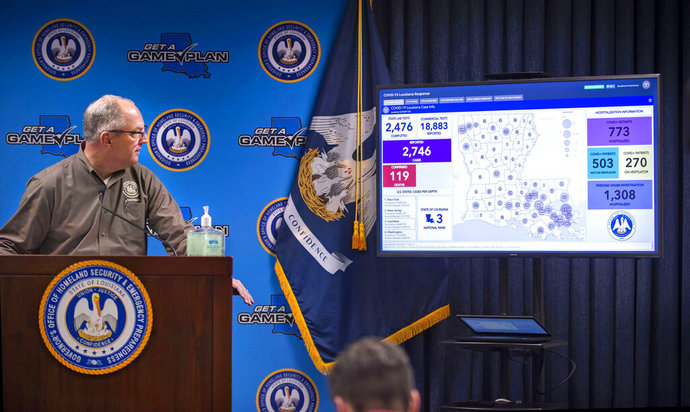
    Louisiana has surpassed 2,700 people known to be infected, with 119 residents dead from COVID-19 — an increase of 36 deaths from a day earlier, according to the health department. Edwards said Louisiana has the third-highest rate of virus cases per capita and the second-highest death rate per capita, with the New Orleans region on track to run out of ventilators to care for the hardest-hit patients by the first week of April.

    “We have put in many days ago orders for 12,000 ventilators,” Edwards said. “To date, we have received exactly 192.”

    The number of virus patients requiring ventilators continued to rise Friday. The health department said 773 infected people were hospitalized, with 270 of them needing ventilation. That’s up from 239 patients needing ventilators a day earlier.

    Although most people recover and many suffer only mild symptoms, COVID-19 can cause serious illness including respiratory problems for some, including the elderly and those with underlying medical conditions. The disease is highly contagious.

    In new data about Louisiana’s COVID-19 deaths, Edwards said early analysis shows 41% of the people who have died were diabetic, 31% had kidney disease and 28% were obese. In a state with high rates of obesity and diabetes, those numbers suggested Louisiana residents could be particularly at risk for some of the virus’s worst impacts.

    While Louisiana’s virus hot spot remained New Orleans, troubling signs emerged of a spike in cases in the Shreveport/Bossier City area. The state health department identified “clusters” of the virus in eight nursing and retirement homes around Louisiana.

    Florida joined Texas in requiring travelers from the New Orleans area to go into mandatory quarantine for two weeks upon arrival, but Florida went further — including travelers from anywhere in Louisiana. Edwards didn’t raise objections, saying he was encouraging people from Louisiana to stay home and wouldn’t second-guess other governors’ decisions.

    In New Orleans, state and city leaders were scrambling to create more hospital space to handle the expected surge in infected patients. The city’s convention center will serve as an overflow site, with the first 120-bed unit ready by the end of the weekend, Edwards said. Two 250-bed federal field hospitals will be set up at the convention center, Edwards said.

    Medical students were getting credentialed early, so hospitals can quickly hire them and fill staffing shortages.

    With widespread business shutdowns because of the “stay-at-home” order, Louisiana’s economic development agency created a state hotline for business questions related to COVID-19.

  • Governor Reeves: Businesses Should “Voluntarily” Change How They Operate

    Governor Reeves: Businesses Should “Voluntarily” Change How They Operate

    Governor Reeves Still Hasn’t Issued Stay-At-Home Order

    Lee Pharr with the office of Institutional Giving at the University of Mississippi Medical Center, inspects a donated case of 400 N-95 face masks from a brickworks company at the medical center in Jackson, Miss., Friday, March 27, 2020. A number of businesses, area residents and schools have donated whatever protective clothing, face masks and eye protection they can spare for those health care professionals working on COVID-19 cases. (AP Photo/Rogelio V. Solis)

    JACKSON, Miss. (AP) — Mississippi Gov. Tate Reeves is allowing many businesses to remain open amid the coronavirus pandemic, but he repeated Friday that some should voluntarily change the way they operate. The Republican added a new twist by implying a threat from trial lawyers who often support Democrats.

    “Large businesses that do not allow employees who could work from home to do so are risking some serious lawsuits down the road if major outbreaks can be traced back to them,” Reeves wrote on Twitter. “Stay home. Stay safe. This is not to be taken lightly, and we are far from the end.”

    Reeves has not issued a statewide stay-at-home order even as the Health Department on Friday updated Mississippi’s confirmed coronavirus caseload to at least 579 people and eight deaths. Neighboring Louisiana has one of the fastest-growing caseloads in the U.S., and people commute between the two states.

    Reeves spent part of Friday touring military facilities he said could be used to treat patients if Mississippi health care facilities become too busy.

    The governor said Thursday that it’s OK if cities and counties impose tighter restrictions than what he’s ordered in response to the coronavirus pandemic. Reeves issued an executive order Tuesday telling people to avoid gatherings of 10 or more and broadly defining which businesses are so “essential” that they can remain open. That order said restaurants can offer carry-out or delivery meals but must close their dining rooms unless they’re able to keep 10 or fewer people, including staff, at least 6 feet (2 meters) apart.

    Some cities went further, ordering all restaurant dining rooms closed. After hearing from the Mississippi Municipal League, Reeves issued a clarification to his executive order acknowledging they have the power to do that.

    “Many of them are working very, very hard, and we want to allow them to do what’s best for their communities,” Reeves said Thursday during a news conference at the Governor’s Mansion.

    Because testing remains limited as the outbreak grows, many people moving around their communities may not know they’ve inhaled the virus until well after they’ve infected others. Places where people who aren’t isolating share the air with others pose a particular risk, since the highly contagious virus has been shown to live in the air for several hours.

    Most infected people experience mild or moderate symptoms, such as fever and cough that clear up in two to three weeks, but a fraction of people suffering more severe illnesses can require respirators to survive, and as as the caseload rapidly grows, hospitals are bracing for a coming wave of patients.

    A Democratic state official, northern district Public Service Commissioner Brandon Presley, said people should not be complacent just because Health Department numbers don’t yet show confirmed cases of the virus in some parts of Mississippi.

    “You can rest assured that this virus is in every county,” Presley said Friday on social media. “It doesn’t know where the county line is. … It’s simply a matter of time until your county shows up on the map.”

    The University of Mississippi Medical Center announced Friday that its pathology lab has begun running results for commercially available coronavirus test kits and eventually will be able to deliver results for up to 180 people a day. That should ease the burden on the state health lab, which has been handling most of the testing in Mississippi.

  • Concordia Parish Reports First Case Of COVID-19 Coronavirus

    Concordia Parish Reports First Case Of COVID-19 Coronavirus

    Patient Receiving Treatment In Mississippi Hospital

    Official Statement from the Concordia Parish Office Of Homeland Security:

    This is the first case that has been reported for Concordia Parish.  We do understand that there are a lot of eyes on Concordia Parish at this time in relation to how Concordia Parish handles this situation. The Concordia Parish Office of Homeland Security & Emergency Preparedness has verified with the Director of the Louisiana Department of Health & Hospitals that all policies/procedures and guidelines set forth by the Louisiana Department of Health & Hospitals and the CDC are being followed and have been in place in preparation for a positive COVID-19 case in Concordia Parish.  The Louisiana Department of Health & Hospitals and GOHSEP has done a tremendous job in keeping all OEP Offices in the Parish up to date with any and all changes in policies and procedures in preparation for this event.

    Concordia Parish Mayors have worked well in conjunction with the OEP Office in combating the spread of the COVID-19 Virus in Concordia Parish.  Communication has been flowing from LDH and GOHSEP through the OEP Office and has been getting disbursed to all the Mayors, Police Chiefs, Fire Chiefs, Hospitals, Home Health Agencies, and EMS in through out the Parish.  I can say that all of that leadership in Concordia Parish has bene preparing for this.  It has been several times the comment has been made “It is not a matter of if, but when”.  We are asking the public to take the spread of this virus serious.  It is the position of the Concordia Parish Office of Homeland Security not to cause fear, hysteria, or panic due to the threat of the COVID-19 virus, but encourages the public to be well informed and take the “stay at home order” seriously, this is not the time to become complacent.  I am very proud of our Parish and I am extremely thankful that the leadership of Concordia Parish is working so well together in keeping the public informed, and in being vigilant in their efforts to stop the spread of this disease.  Stopping the wide spread of this disease is not a “one man show”, it is going to take the efforts of not just all of the leadership in the Parish, but also the residents of the Parish.

    No further information is available at this time

    Thank You,

    Timothy Vanier

    OEP Director Concordia Parish

  • Mississippi gov: Cities can to set tighter limits amid virus

    Mississippi gov: Cities can to set tighter limits amid virus

    JACKSON, Miss. (AP) — Mississippi Gov. Tate Reeves hasn’t ordered a statewide stay-at-home order even as the Health Department updated the state’s confirmed coronavirus caseload on Friday to at least 579 people and eight deaths.

    The Republican leader did say it’s OK if cities and counties impose tighter restrictions than what he’s ordered in response to the coronavirus pandemic.

    Reeves issued an executive order Tuesday telling people to avoid gatherings of 10 or more and broadly defining which businesses are so “essential” that they can remain open. That order said restaurants can offer carry-out or delivery meals but must close their dining rooms unless they’re able to keep 10 or fewer people, including staff, at least 6 feet (2 meters) apart.

    Some cities went further, ordering all restaurant dining rooms closed. After hearing from the Mississippi Municipal League, Reeves issued a clarification to his executive order acknowledging they have the power to do that.

    “Many of them are working very, very hard, and we want to allow them to do what’s best for their communities,” Reeves said Thursday during a news conference at the Governor’s Mansion.

    Because testing remains limited as the outbreak grows exponentially, many people moving around their communities may not know they’ve inhaled the virus until well after they’ve infected others. Places where people who aren’t isolating share the air with others pose a particular risk, since the highly contagious virus has been shown to live in the air for several hours.

    Most infected people experience mild or moderate symptoms, such as fever and cough that clear up in two to three weeks, but a fraction of people suffering more severe illnesses can require respirators to survive, and as as the caseload rapidly grows, hospitals are bracing for a coming wave of patients.

    Reeves has been criticized by some lawmakers and mayors who say he hasn’t been aggressive enough.

    Mississippi will begin investigations to find people who have been near those testing positive for the coronavirus and will tell those contacts to quarantine themselves, Reeves and the state health officer, Dr. Thomas Dobbs, announced Thursday.

    Dobbs said the contact-tracing plan is based on programs that helped slow the spread of the virus in Singapore and South Korea. Those countries have had widespread testing, though, and that scale of testing is not yet available in the United States. It’s not clear whether the contact-tracing efforts in Mississippi are beginning too late to have much effect or whether the state Health Department and other agencies will have enough people to work on the program.

    Dobbs said if health officials find a rapid growth of cases in a particular community, they could seek broad limitations on people’s movements.

    Mississippi legislators left the state Capitol last week to curb the spread of the virus in a building that typically attracts hundreds of people a day. House and Senate leaders said Thursday that they are dropping the plan for legislators to return April 1, and the session remains on hold indefinitely.

  • Scary Meme Isn’t Truthful

    Scary Meme Isn’t Truthful

    Viral Meme Designed To Scare People

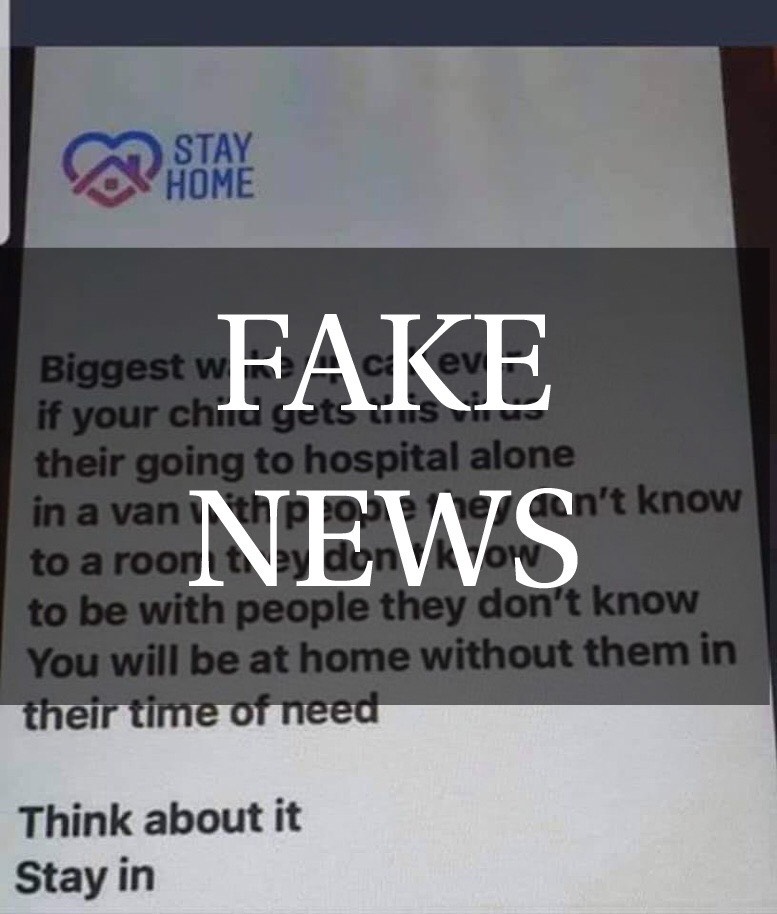
    This meme has been making the rounds on social media in the past few days.  IT IS A HOAX.

    The Center For Disease Control and the American Medical Association have never recommended that children be separated from their parents for COVID19 coronavirus treatment.

    Click here to see the American Medical Association treatment protocols.

    Click here to see the Centers For Disease Control treatment protocols.

    It’s bad enough that supposed miracle cures are floating around social media.  This meme was specifically designed to scare people.

    So please stop sharing it!

  • Drew Brees, Wife Brittany Donating $5M to State of Louisiana for COVID-19 Relief

    Drew Brees, Wife Brittany Donating $5M to State of Louisiana for COVID-19 Relief

    New Orleans Saints quarterback Drew Brees and his wife, Brittany, pledged $5,000,000 to the state of Louisiana to help with the coronavirus pandemic.

    “After considerable research and conversations with local organizations, we will be mobilizing our partnerships with Second Harvest Food Bank, Ochsner Health Systems, Walk-Ons, Jimmy Johns, Smalls Sliders and Waitr to prepare and deliver over 10,000 meals per day throughout Louisiana for as long as it takes to children on meal programs, seniors, and families in need,” Brees wrote on Instagram.