Tag: covid-19

  • PODCAST: Interview with Dr. Blane Mire of the Natchez COVID-19 Task Force

    PODCAST: Interview with Dr. Blane Mire of the Natchez COVID-19 Task Force

    Dr. Mire answers your questions:

    Dr. Blane Mire works at Internal Medicine Associates at Merit Health hospital in Natchez.  He is a graduate of LSU’s School of Medicine, and is on Natchez Mayor Darryl Grennell’s COVID-19 Task Force, and the Economic Recovery Task Force as well.

    The doctor talked with us this morning about where the Miss-Lou is currently with this pandemic, and what it takes to move forward.  He also answers questions like:

    How do I go back to work and keep myself and my family safe?

    How do I stay calm and center myself when the uncertainty about what is next is driving me crazy?

    How do I stay safe after I go shopping and bring food home?

    Should I wipe down packages delivered to my house?

    Do mosquitoes spread COVID-19?

    Which will come first, a treatment or a vaccine?

    If I’m making a homemade mask, how thick and how many layers should my mask be?

    You’ll hear answers to these questions and more facts in this outstanding interview!

  • Mississippi Inmates, Prison Staff Get Masks During Pandemic

    Mississippi Inmates, Prison Staff Get Masks During Pandemic

    The highly contagious virus is difficult to control in prisons

    ###

    JACKSON, Miss. (AP) — All inmates and employees in Mississippi prisons have been given masks to try to slow the spread of the new coronavirus, the state Department of Corrections said Monday.

    Advocates have repeatedly raised concerns that the highly contagious virus is difficult to control in prisons, where inmates have little chance to keep distance from one another even when they’re told to do so. They have also pushed for wider testing for COVID-19 in prisons.

    The corrections department said four Mississippi inmates had tested positive for the highly contagious virus by Monday — two at the State Penitentiary at Parchman and two in the Winston-Choctaw County Regional Correctional Facility. The department has previously said one of the Parchman cases was an inmate who died.

    The department said 21 inmates had tested negative for COVID-19 as of Monday. Two were waiting for test results; one was at the Marshall County Correctional Facility and one was at Delta Correctional Facility.

    For most people, the coronavirus causes mild or moderate symptoms, such as fever and cough. But for others, especially older adults and people with existing health problems, the highly contagious virus can cause severe symptoms and be fatal.

    In court papers filed earlier this month, the Department of Corrections said and inmates in crowded spaces are being encouraged to sleep face-to-feet with each other rather than face-to-face. Prisoners’ rights attorneys said in a separate court filing that in some areas of Parchman, more than 100 inmates were sleeping about 18 inches (46 centimeters) apart from each other.

    More than 18,500 people are in custody in Mississippi prisons. Long before the pandemic, multiple health inspections showed sanitation problems including broken sinks and toilets in cells and widespread mold in showers.

    The Department of Corrections said gloves and additional soap are being provided in prisons. A news release said hand sanitizer is available in “strategic locations,” including dining areas. In court papers filed in mid-April, the Department of Corrections said hand sanitizer with 60% or more alcohol is a security concern, and distributing it to all inmates is not feasible.

    “Running a prison in the midst of the COVID-19 pandemic is all the more difficult, as corrections systems are neither infallible nor immune from the virus’s spread,” the department said in the court papers. Those came in response to demands made by attorneys who sued the state early this year over conditions at the Mississippi State Penitentiary at Parchman.

    The Mississippi Emergency Management Agency and Mississippi Prison Industries Corporation have provided many of the masks being used by inmates and prison employees. The news release said Parchman inmates are using 5,000 masks donated by REFORM Alliance, affiliated with entertainment mogul Jay-Z.

    Mississippi prisons were hit by outburst of violence in late December and early January that left several inmates dead or injured. The Justice Department announced Feb. 5 that its civil rights division would investigate Mississippi prisons that have also struggled with tight budgets, short staffing and poor living conditions.

    Mississippi prison officials have told state budget writers for years that the department has trouble hiring guards because the jobs are dangerous and the pay is low. Despite the requests, budgets were cut.

    Two federal lawsuits have been filed on behalf of prisoners since January, saying Parchman is dangerous, vermin-infested and unfit for human habitation. Attorneys in both lawsuits are being paid by Jay-Z, rapper Yo Gotti and Team Roc, the philanthropic arm of Jay-Z’s Roc Nation.

  • Louisiana Stay at Home Order Extended Until May 15

    Louisiana Stay at Home Order Extended Until May 15

    Everyone in Louisiana should wear masks when in public; Next announcement will be May 11

    Today, Gov. John Bel Edwards announced he will extend Louisiana’s Stay at Home order until May 15 to continue to slow the spread of COVID-19. Louisiana does not currently meet the White House criteria for entering Phase One of reopening.

    While Louisiana has seen positive, improving trends statewide in terms of new case growth and new hospitalizations, in several regions across the state, new cases and hospitalizations continue to increase or to plateau, according to data from the Louisiana Department of Health. The White House criteria calls for declining numbers of new cases and hospitalizations, among other things.

    “Thanks to the commitment of the people of Louisiana, our state has made progress in flattening the curve and reducing the spread of the novel coronavirus. Unfortunately, we still have a little work to do before we meet the criteria to safely move to the next phase of reopening, so I will extend the state’s Stay at Home order until May 15, with a few minor changes,” Gov. Edwards said. “While this is not the announcement I want to make, I am hopeful, and all of Louisiana should be hopeful, that we will enter into the next phase of reopening soon, in mid-May. I am anxious to get all areas of our economy reopened, but if we accelerate too quickly, we may have to slam on the brakes. That will be bad for public health and for businesses, bad for our people and bad for our state.”

    Gov. Edwards’ decision is based on regional data that shows that while overall new cases and hospitalizations have decreased, this is not the case in several regions. In the Baton Rouge and Monroe regions, both new cases and new hospitalizations have increased. Some increases are also being seen in terms of new cases in Acadiana and a plateau for hospitalizations in Southwest Louisiana and a plateau of new cases on the Northshore.

    • Click here to view the Governor’s presentation on regional data trends.

    Under the extended order, which will be issued on Friday, May 1, businesses that previously were directed to be closed will remain closed, including salons, barber shops, bars and casinos, among other things. Businesses that are deemed essential under the third phase of federal CISA guidance may still be open. Non-essential retail businesses in Louisiana continue to be able to open with fewer than 10 people total inside.

    Three major changes in the new Stay at Home order include:

    • Malls will remain closed to the public, but stores may open for curbside delivery.
    • Restaurants will be allowed to open their outside areas for patrons to eat meals only, without tableside service.
    • All employees of a business who have contact with the public must wear a mask.

    Additionally, both the CDC and the Louisiana Department of Health strongly urge everyone to wear masks when in public.

    “Wearing cloth masks or protective face coverings is part of the new normal,” Gov. Edwards said. “Wearing a mask is being a good neighbor and in Louisiana, we pride ourselves on being good neighbors. Your mask protects me and other people and my mask protects you.”

    Hopefully, Louisiana will meet the White House criteria and move to Phase 1 on May 15, provided symptoms, new case counts and hospitalizations decrease and the state continues to surge testing and contact tracing capacity. Phase 1 lifts the Stay at Home order and eases restrictions on some public spaces like houses of worship and restaurants and opens other businesses that have been closed such as barber shops and salons, but with restrictions on occupancy and strict requirements for personal distancing and masks to keep everyone safe. Phase One occupancy for these businesses will be limited to 25 percent.

    As Louisiana prepares for its next phase of reopening, business owners and faith leaders are encouraged to plan as well, including understanding their building’s maximum occupancy limits, which may require contacting local government or the State Fire Marshal’s office. They should also plan on ensuring their employees have masks.

    Gov. Edwards intends to make his next announcement on moving to Phase 1 in Louisiana on or by May 11. Members of the public can continue to get information from the Governor’s office on coronavirus.la.gov and by texting LACOVID to 67283.

  • Eric Church wants people to feel safe when concerts return

    Eric Church wants people to feel safe when concerts return

    “When people roared, they roared. I believe that will happen again.”

    April 24, 2020

    NASHVILLE, Tenn. (AP) — Country star Eric Church doesn’t know when concerts might resume in the United States after the spread of the coronavirus, but he wants people to feel safe when they return to hear live music.

    The singer known for his often-worn sunglasses sent a message to fans over the weekend in a new video and tease of a new song that offers his belief in the American resolve to overcome the pandemic.

    With echoes of the 2017 mass shooting in Las Vegas in his mind, Church recorded the song “Through My Ray Bans,” co-written with Luke Laird and Barry Dean, in February about seeing people standing shoulder to shoulder, “like an army of Friday night soldiers.”

    “It could be sports. It could be music. It could be church. It’s that fellowship that we have that makes life worth living,” Church said in an interview with The Associated Press.

    The virus reminded him of the fear that many people, even himself, felt after the Route 91 Harvest music festival, where Church had played the night before the shooting.

    “The thing that shook me about Vegas was that was my safe place,” Church said. “As messed up as the world is, I never in a million years thought that could be a danger area.”

    Now as tours and festivals are canceled or rescheduled or postponed indefinitely, Church wants to remind fans that concerts and gatherings will resume eventually, but urged people in his new video not to give into fear and panic.

    “When people come back, they have to feel that it’s OK to be there, that they can experience it the way they want to experience it,” Church said. “They should be able to go up and throw their arms around the person next to them. They should not be scared about being three feet away and not six.”

    But Church said he thinks major festivals and touring could be delayed as far out as next year.

    “For me, I think it’s summer or fall of ’21. I am going on the promise of a vaccine. I’m going on the possibility of a therapeutic that could change the game,” Church said.

    The virus has also upended a lot of plans for album releases this year, including his own. Prior to the virus spread, Church voluntarily secluded himself in a makeshift studio in the North Carolina mountains to record for a full month with several writers and his band. He wrote and recorded a song each day, ending up with about 28 songs. “It’s always intrigued me, a kind of old rock ‘n’ roll model,” Church said. “You write the song in the studio. You record the song the same day.”

    Even though he hasn’t released any songs for download or streaming or to radio yet, he’s been living with them a lot longer than he normally does before the public or even the people at his label or management has heard them.

    “I don’t know if this is an album, if it’s two albums, if it’s three,” he said. “I feel confident enough with the material that people will get to hear all of these songs at some point.”

    Meanwhile, Church said he is looking to history as a guide for what’s to come after the pandemic.

    “I think about the 1918 pandemic and there’s a reason the Roaring Twenties happened,” said Church. “When people roared, they roared. I believe that will happen again.”

  • Governor Tate Reeves Signs Safer At Home Order

    Governor Tate Reeves Signs Safer At Home Order

    JACKSON — Today, Governor Tate Reeves signed a new executive order establishing a statewide Safer at Home order for Mississippi to continue protecting public health while beginning the process to safely reopen the state’s economy.

    In his new executive order, Governor Reeves lays out a measured and strategic plan to reopen Mississippi while continuing to flatten the curve and conserve healthcare resources. Consulting with our state health experts, the Executive Order sets out guidelines for certain business operations and healthcare activities to safely resume.

    Governor Reeves announced his new executive order at his daily press briefing today, which you can view live on our Facebook page here.

    “This disease has not hit every American fairly. And the economic damage has not hit every American fairly. Wall Street and Hollywood will be fine. Mississippi small businesses and workers are not. That’s who has been asked to shoulder the country’s burden. It’s not fair, and it’s not right. We are starting to re-open our economy. It’s not a light switch that only goes on and off. It’s a dimmer. We can take measured steps to make life better,” said Governor Tate Reeves.

    In this latest executive order, the Governor lays out the guidelines of the Safer at Home order to continue flattening the curve, including:

    • Mississippians are encouraged to stay at home unless they need to leave for essential activities or essential travel, such as caring for someone in the vulnerable population, getting food or necessary supplies, and going to work.
    • All those in the vulnerable population are instructed to continue sheltering in place to protect their health.
      • This includes all elderly individuals (age 65 or older per CDC guidelines) and individuals with serious underlying health conditions, including high blood pressure, chronic lung disease, diabetes, obesity, asthma, and those whose immune systems are compromised as such by chemotherapy for cancer or any other condition requiring such therapy.
    • When outside of their homes, people must follow social distancing guidelines by maintaining a 6-foot distance from others and avoid groups of 10 or more.
    • Social and other non-essential gatherings in groups of more than 10 people must be cancelled or rescheduled.
    • Evictions are suspended, though people are still required to pay any rent or make any mortgage payments.
    • Certain businesses previously closed under the shelter-in-place are allowed to reopen, while following health and safety mandates recommended by the Mississippi State Department of Health (MSDH).
    • Places of amusement or entertainment, like movie theaters and museums, and businesses that cannot avoid sustained person-to-person contact, like salons or gyms, will remain closed, other than curbside pick-up, drive-thru, or delivery for retails sale of their products but not services.
    • All businesses and non-profit organizations are encouraged to continue allowing their employees to work from home or telework to all extent possible.
    • Restaurants and bars may only remain open for drive-thru, curbside pick-up, and/or delivery service.
    • Retail businesses are to implement reasonable measures to prevent the spread of COVID-19, including limiting the number of customers in their stores at one time to no greater than 50% of their store capacity and making hand sanitizer available to customers upon entry.
    • Healthcare professionals and facilities may resume performing elective medical and dental procedures and surgeries as allowed and approved by MSDH. Such non-emergent procedures and surgeries should limit their use of disposable PPE and not request PPE from any public source.

    You can view the Safer at Home Executive Order here.

    Safer at Home FAQs can be found on the Governor’s website at governorreeves.ms.gov/covid-19.

  • 26 Million Have Sought US Jobless Aid Since Virus Hit

    26 Million Have Sought US Jobless Aid Since Virus Hit

    WASHINGTON (AP) — More than 4.4 million laid-off workers applied for U.S. unemployment benefits last week as job cuts escalated across an economy that remains all but shut down, the government said Thursday.

    Roughly 26 million people have now filed for jobless aid in the five weeks since the coronavirus outbreak began forcing millions of employers to close their doors. About one in six American workers have lost their jobs in the past five weeks, by far the worst string of layoffs on record. Economists have forecast that the unemployment rate for April could go as high as 20%.

    The enormous magnitude of job cuts has plunged the U.S. economy into the worst economic crisis since the Great Depression of the 1930s. Some economists say the nation’s output could shrink by twice the amount that it did during the Great Recession, which ended in 2009.

    The painful economic consequences of the virus-related shutdowns have sparked angry protests in several state capitals from crowds insisting that businesses be allowed to reopen. Thursday’s report, showing that the pace of layoffs remains immense, could heighten demands for re-openings.

    Some governors have begun easing restrictions despite warnings from health authorities that it may be too soon to do so without causing new infections. In Georgia, gyms, hair salons and bowling alleys can reopen Friday. Texas has reopened its state parks.

    Yet those scattered re-openings won’t lead to much rehiring, especially if Americans are too wary to leave their homes. Most people say they favor stay-at-home orders, according to a survey by The Associated Press-NORC Center for Public Affairs and believe it won’t be safe to lift social distancing guidelines anytime soon. And there are likely more layoffs to come from many small businesses that have tried but failed to receive loans from a federal aid program.

    The number of people who are receiving unemployment benefits has reached a record 16 million, surpassing a previous high of 12 million set in 2010, just after the 2008-2009 recession ended. This figure reflects people who have managed to navigate the online or telephone application systems in their states, have been approved for benefits and are actually receiving checks.

    In some states, many laid-off workers have run into obstacles in trying to file applications for benefits. Among them are millions of freelancers, contractors, gig workers and self-employed people — a category of workers who are now eligible for unemployment benefits for the first time.

    “This has been a really devastating shock for a lot of families and small businesses,” said Aaron Sojourner, a labor economist at the University of Minnesota. “It is beyond their control and no fault of their own.”

    In Florida, applications for unemployment benefits nearly tripled last week to 505,000, the second-highest total behind much-larger California’s 534,000. Florida has had trouble processing many of its applications. Its figure suggests that the state is finally clearing a backlog of filings from jobless workers.

    In Michigan, 17% of the state’s workforce is now receiving unemployment aid, the largest proportion in the country. It is followed by Rhode Island at 15%, Nevada at 13.7% and Georgia at 13.6%.

    Just about every major industry has absorbed sudden and severe layoffs. Economists at the Federal Reserve estimate that hotels and restaurants have shed the most jobs — 4 million since Feb. 15. That is nearly one-third of all the employees in that industry.

    Construction has shed more than 9% of its jobs. So has a category that includes retail, shipping and utilities, the Fed estimated. A category that is made up of data processing and online publishing has cut 4.7.

    When the government issues the April jobs report on May 8, economists expect it to show breathtaking losses. Economists at JPMorgan are predicting a loss of 25 million jobs. That would be nearly triple the total lost during the entire Great Recession period.

    A $2 trillion-plus federal relief package that was signed into law last month made millions of gig workers, contractors and self-employed people newly eligible for unemployment aid. But most states have yet to approve unemployment applications from those workers because they’re still trying to reprogram their systems to do so. As a result, many people who have lost jobs or income aren’t being counted as laid-off because their applications for unemployment aid haven’t been processed.

    Among them is Sasha McVeigh, a musician in Nashville. Having grown up in England with a love of country music, she spent years flying to Nashville to play gigs until she managed to secure a green card and move permanently two years ago. McVeigh had been working steadily until the city shut down music clubs in mid-March.

    Since then, she’s applied for unemployment benefits but so far has received nothing. To make ends meet, she’s applied for some grants available to out-of-work musicians, held some live streaming concerts and pushed her merchandise sales.

    By cutting expenses to a bare minimum, McVeigh said, “I’ve managed to just about keep myself afloat.” But she worries about what will happen over the next few months.

  • Louisiana Governor: Masks To Be Part Of ‘New Normal’

    Louisiana Governor: Masks To Be Part Of ‘New Normal’

    NEW ORLEANS (AP) — Masks will be recommended attire for Louisiana residents even when stay-at-home orders and restrictions on business activity are eased during the coronavirus pandemic, Gov. John Bel Edwards said Wednesday.

    He noted medical experts’ guidance saying proper masks keep patients infected with coronavirus from spreading it to others.

    “Think of wearing a mask in public as just being polite to others,” Edwards said at his daily news conference, calling mask-wearing part of “new normal” of life when restrictions are lifted.

    It remained unclear exactly how and when restrictions will be lifted, but Edwards said he expects to deliver more information as early as Monday.

    Louisiana’s current stay-at-home emergency order, banning gatherings of more than 10 people and forcing closure of many nonessential businesses, expires April 30. As debate continues around the nation over when and how to reopen, some Republican officials around Louisiana have expressed eagerness to start reopening at least some businesses May 1.

    The Democratic governor has been reluctant to speculate on what will be done next, preferring to wait for more data on the spread of COVID-19, the disease caused by the virus. On Wednesday he told the inaugural telephone meeting of the Resilient Louisiana Commission, a group he assembled for guidance on reopening, that it will be early next week before he can start talking about what will happen May 1. He has said, however, that he won’t simply extend what’s in place.

    Edwards reiterated at the meeting that the state’s actions will largely be based on guidance from a White House task force, including thresholds for reduction in symptoms and cases and assurance of hospital capacity as measured over a 14-day period.

    “We’re about halfway through the 14 days and the current trajectory looks promising,” Edwards said later at his daily news conference.

    Edwards also announced a plan to help the state’s oil industry, a major employer staggered by plummeting demand and prices during the pandemic. He said the state revenue department will delay collection of severance taxes on oil and gas produced in the state, which bring in about $40 million a month. Revenue Secretary Kimberly Robinson said severance taxes that are due April 25 are being extended until June 25.

    Earlier Wednesday, business interests from around the state released a 16-page “Preliminary Framework for Louisiana’s Economic Recovery.” The report was released by the Baton Rouge Area Chamber on behalf of nearly 50 local chambers of commerce and business and industry lobbying groups.

    The report suggests a “Stay at Home and Safe at Work Order” with safety rules for businesses that could reopen as early as May 1, “or the best date advised by healthcare leaders.” The early emphasis would be on opening workplaces as safely as possible while maintaining guidance calling for people to “avoid congregating and social interaction in large groups.”

    The report has extensive recommendations on workplace safety, the need to prepared for a “second wave” of infections, the necessity of opening all non-emergency medical, dental and mental health facilities, day care needs and help for minority- and women-owned businesses and rural businesses trying to navigate complicated federal aid programs.

    The efforts take place against a backdrop of daily COVID-19 statistics numbers both sobering and hopeful. Louisiana’s death toll from the virus continues to rise, reaching 1,473 on Wednesday, an increase of 68 from the day before, according to figures released by the state health department. The number of known coronavirus infections, based on testing by the state health department and commercial labs, topped 25,000.

    However, the number hospitalized in the state dropped to 1,747 Wednesday. It has consistently been under, 1,800 in recent days after having peaked at 2,134 earlier this month. And the number needing ventilators, 287on Wednesday, had peaked at 571 in early April.

    For most people, the new coronavirus causes mild or moderate symptoms that usually clear up within weeks. For some, it can cause severe illness and be life-threatening.

    In other virus-related developments Wednesday, Louisiana State Police postponed plans to hold a cadet class in the summer because of the “financial challenges” caused by COVID-19. And the state Supreme Court extended an existing delay for criminal and civil trials in state courts to June 30.

    ___

    Associated Press reporter Melinda Deslatte contributed to this story from Baton Rouge, Louisiana.

    ___

    Follow AP coverage of the virus outbreak at https://apnews.com/VirusOutbreak and https://apnews.com/UnderstandingtheOutbreak.

  • Defiant Louisiana Pastor Arrested Over Coronavirus Protest

    Defiant Louisiana Pastor Arrested Over Coronavirus Protest

    BATON ROUGE, La. (AP) — Louisiana authorities arrested a pastor on an assault charge on Tuesday after he admitted that he drove his church bus toward a man who has been protesting his decision to hold mass gatherings in defiance of public health orders during the coronavirus pandemic.

    The police department in Central, a suburb of the capital of Baton Rouge, said on a posting on their Facebook page that Tony Spell, the pastor of Life Tabernacle Church, turned himself into the department and was arrested on charges of aggravated assault and improper backing. Officials said Spell also had outstanding traffic tickets.

    Spell was taken to the East Baton Rouge Parish prison, where about 70 of his parishioners, dressed in their Sunday best, arrived in church buses to show support. Men in jackets and ties, women in dresses and children, some in matching outfits, gathered in a parking lot across the street. They stood close to each other, praying and singing hymns while guards, some wearing protective masks watched.

    Spell eventually walked out of the jail to applause from his supporters, after his wife entered the jail with a handful of cash that had been delivered by someone in a car. Online booking records indicate bail was set at $175.

    “My rights to have church and to preach the gospel of Jesus Christ are endowed to me by my creator, not my district attorney, not my chief of police and not my governor, John Bel Edwards,” Spell said. “Not my president and not my Department of Justice.”

    The arrest happened on the same day the East Baton Rouge Parish coroner reported that deaths in the parish, which encompasses the state capital of Baton Rouge and Central, had surpassed 100.

    Before Spell was released, one Spell supporter shouted defiantly at Trey Bennett, the protester Spell is accused of assaulting. Bennett also showed up at the jail, carrying his protest sign. It says “Close this church” on one side and “Danger: coronavirus incubator” on the other.

    “Our church will never close, you get that?” the man yelled.

    Bennett has kept up a one-man demonstration in front of the church since Easter Sunday, when he noticed hundreds of parishioners still attending services in defiance of the state’s stay-at-home mandate, which bans gatherings of more than ten people. Houses of worship across Louisiana have turned to online services instead.

    This Sunday, Spell drove a church bus in reverse in the direction of the sign-holding protester. Spell acknowledged as much in a telephone interview with WAFB-TV on Monday. He said he just wanted to get out and confront the protester, but his wife talked him out of it.

    Spell already faces misdemeanor charges for holding in-person church services despite the ban on gatherings. Authorities have said they did not book him into jail previously because they did not want to add to the jail population at a time when the highly infectious disease is running rampant. They have not taken any action to close his church.

    Parishioner Nathan Boyce Thomas also faces charges of aggravated assault and reckless operation of a vehicle after being seen on video driving his white pickup truck to within about a foot of where Bennett was standing at the road side. Police said Thomas drove at a high rate of speed, then braked just before turning into the church parking lot. Dougherty said Thomas also planned to turn himself in later Tuesday.

    Bennett said he was used to getting scowls and verbal jabs from parishioners, but was “shocked” to see vehicles being driven at him.

    Videos of the two incidents on April 19 were obtained and reviewed by The Associated Press. One shows the church bus making a sharp turn and then backing in the opposite direction of traffic on the shoulder to within a few feet of Bennett before coming to a stop. Another shows a white pickup truck swerving out of its lane and onto the shoulder within about a foot of Bennett’s body.

    ___

    Plaisance reported from New Orleans. Associated Press reporter Kevin McGill in New Orleans contributed to this story.

  • Many Small Businesses Say Loans Won’t Get Them To Rehire

    Many Small Businesses Say Loans Won’t Get Them To Rehire

    WASHINGTON (AP) — Some small businesses that obtained a highly-coveted government loan say they won’t be able to use it to bring all their laid-off workers back, even though that is exactly what the program was designed to do.

    The Paycheck Protection Program promises a business owner loan forgiveness if they retain or rehire all the workers they had in late February. But owners say the equation isn’t so simple, in part because of current economic conditions and partly due to the terms of the loans.

    As a result, the lending may not reduce unemployment as much as the Trump administration and Congress hope.

    The government’s $2 trillion relief package included $349 billion for the small business loan program, which was besieged with applications and ran out of money Thursday. Congress and the White House reached a deal Tuesday that would provide another $310 billion.

    To get the loans forgiven, companies need to spend 75% on payroll within eight weeks of receiving the money. The other 25% can be spent on rent, utilities, and mortgage payments. Otherwise, the loan has generous terms: Only a 1% interest rate and six months before any principal is due.

    Many of the small companies that were able to obtain a loan are having second thoughts and a few plan to return the money. Others will use what they can on rent and utilities, and will use some to rehire a portion of their laid-off staff. But most are unsure they will be able to reopen eight weeks from now. They see little point in rehiring all their workers, paying them to do little or nothing, and then potentially laying them off again if business remains weak two months from now.

    “You’re turning the business into a pass through for the federal government,” said Joe Walsh, who owns Clean Green Maine, a cleaning service in Portland, Maine with 35 employees. “You’re doing very little to actually help the business.”

    It’s unclear how much the small business lending program can hold back the surge in joblessness — a record 22 million people sought unemployment aid in the past month. Most economists forecast the unemployment rate will reach between 15% and 20% when the monthly jobs report is released in early May.

    More money is clearly needed: Roughly 1.6 million small companies were able to obtain loans, the Small Business Administration said, out of at least 6 million that were likely eligible, according to Census data. Bank of America economists estimate that another $650 billion would be necessary to meet demand.

    Also, the generous unemployment aid that was also included in the government’s relief package has made it more difficult to rehire. Many workers are making more with unemployment checks, which now include a $600 weekly benefit from the federal government.

    Walsh, who received a $280,000 loan from the SBA, said that he is reluctant to push his employees to return to work because, under unemployment benefit rules, they could lose their weekly checks if they turn down potential jobs.

    “That’s just putting me as the employer in a really difficult position,” Walsh said. He pays at least $17 an hour, with benefits, but his former employees are getting the equivalent of roughly $25 an hour from unemployment.

    Right now, Walsh’s business is closed due to lack of demand for cleaning services. He hopes to reopen soon and bring back some workers, retrain them on new sanitizing processes, and earn a bit of revenue. Still, he doubts his business will be anywhere close to what it was anytime soon, which means his workforce won’t be either.

    “There’s no way that I’m getting to 100% employment by the end of 8 weeks,” he said.

    The National Federation for Independent Business, a small business advocacy group, is pushing the government to make it easier for loans to be forgiven.

    The group wants the SBA to eliminate the requirement that 75% be spent on payroll, or at least reduce it to 50%. It also wants the rehiring window extended beyond eight weeks and is pushing for a “good faith” provision that would credit companies for trying to rehire workers who prefer unemployment aid instead.

    The NFIB also asked that half the next round of funding be reserved for businesses with fewer than 20 employees, to counter complaints that many large, publicly-traded companies obtained loans in the first round. The agreement reached late Tuesday did not make that change but directed some funds to smaller banks.

    According to a survey of its members, the NFIB said that just half of those who have applied for loans expect that they will rehire all their workers and get the entire amount forgiven. A quarter expect that at least three-quarters of the loan will be forgiven, while 15% didn’t know.

    Adam Rammel received a $160,000 loan for his restaurant and bar in Bellefontaine, Ohio, near Columbus, though he’s uncertain about how many of his 17 laid-off staffers he will be able to rehire and when. Even when Ohio ends its restaurant shutdown, Rammel expects to face restrictions on how many people his place, Brewfontaine, can have on the premises.

    “We have a small restaurant — we usually pack 90 to 100 in and they’re on top of each other. If everyone has to be six feet apart, with 40 or 45 (customers) we can’t pay the bills,” Rammel said. He expects to bring his employees back slowly.

    Accounting firm Isdaner & Co., based near Philadelphia, said in a client note that “some employers will decide not to sign their loan agreement because their business is essentially closed and choose not to pay their employees for not working.”

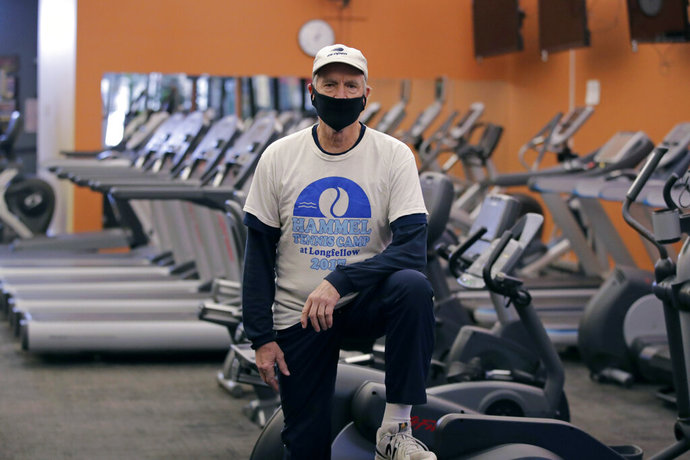
    Laury Hammel owns six gyms in Massachusetts, New Hampshire and Salt Lake City and employs about 480 workers. He doubts he will be able to reopen his Massachusetts locations within eight weeks, so rehiring workers now would simply force him to lay them all off again. And he’d be left with no money to pay them when he eventually does re-open.

    Hammel is using some of the loan he received to pay for his former workers’ health care coverage, which can be forgiven. If he doesn’t use 75% on rehiring his employees, he may accept the rest as a loan. His bank doesn’t want to carry the loan, however, so he may try and return the money.

    “The process leaves (small businesses) cash-poor at the time when they have to re-open,” Hammel said. “Me having the money and paying people to not come to work doesn’t help my business one iota.”

    ___

    AP Business Writer Joyce M. Rosenberg in New York City contributed to this report.

  • Louisiana Hospital Cheers Release Of 1,500th Virus Patient

    Louisiana Hospital Cheers Release Of 1,500th Virus Patient

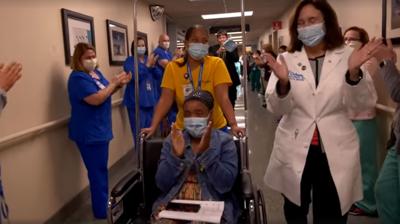
    NEW ORLEANS (AP) — A hospital in New Orleans celebrated the discharge of their 1,500th coronavirus patient amid cheers from doctors and nurses more than a month after getting their first virus patient.

    A video on the Ochsner Medical Center Facebook page showed Kathleen Bennett, 57, as she was reunited with her granddaughter on Monday while a musician who followed behind her played “When the Saints go Marching In.”

    Bennett was admitted to the medical center on March 27. After her arrival, she was placed in the intensive care unit and put on a ventilator for 12 days, the hospital said in a news release. Doctors will continue caring for Bennett after she heads to Kansas to continue quarantining with the rest of her family.

    The hospital got their first coronavirus patient on March 9. Since then, they said they have admitted approximately one-third of the state’s 1,789 coronavirus hospital patients.

    As of Tuesday, Louisiana’s Health department reported there are nearly 25,000 coronavirus cases in the state, and 1,405 people have died from the virus.