Tag: covid19

  • Coronavirus Ravages Storied New Orleans Mardi Gras Group

    Coronavirus Ravages Storied New Orleans Mardi Gras Group

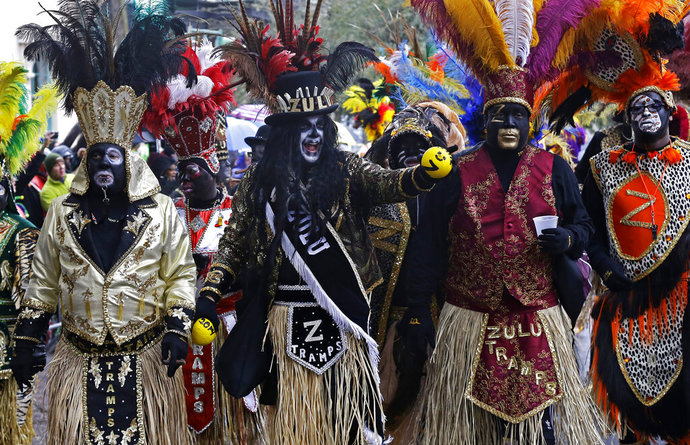
    In a city ravaged by the coronavirus outbreak, members of the Zulu krewe have paid a heavy price.

    NEW ORLEANS (AP) — On Fat Tuesday, 51-year-old Cornell Charles was taking part in a storied New Orleans Mardi Gras tradition central to the city’s African American community — driving a car in the Zulu Social Aid and Pleasure Club’s parade.

    A month later his wife of three decades was watching him take his last breath, a victim of the coronavirus epidemic raging through the city.

    “I talked to him. I told him how much I was going to miss him,” said his wife, Nicole, describing those last minutes on March 24. “He literally took his last breath in front of my face and that was it.”

    In a city ravaged by the coronavirus outbreak, members of the Zulu krewe, one of the groups that sponsor Mardi Gras parades and balls, have paid a heavy price. Four of the fraternal organization’s members have died from coronavirus-related complications, said Zulu President Elroy A. James. Two others have also died since the pandemic began, though it’s not known if their deaths were caused by the virus, he said.

    An additional 20 have tested positive. Some are self-quarantining at home, some were hospitalized and released, while others are still hospitalized, James said.

    James spends his days on the phone, texting with and calling board members and officers of the roughly 800-member Zulu organization.

    “Members are calling every day checking on each other: ‘How’s this member doing? How’s this family member doing?’” he said.

    It’s also taken a financial toll. Many Zulu members work in the hospitality sector and are out of work, James said, a widespread problem in a city with an economy closely tied to the restaurants, bars and nightclubs now largely shuttered due to the statewide stay-at-home order.

    “Zulu is really a microcosm of the city of New Orleans,” said state Sen. Troy Carter, a longtime Zulu member. “We’re made up of every social and economic background that you can imagine. Our members come from all different walks of life.”

    The predominantly African American club is in some ways a reflection of how the disease has affected the black community in Louisiana. More than 70 percent of the state’s coronavirus patients who have died are black, according to state data released this week.

    For most people, the coronavirus causes mild symptoms like fever and a cough that resolve in two to three weeks. But for some, especially older adults and people with existing health problems, more severe symptoms can occur, including pneumonia, that can lead to death.

    For over a century Zulu members have paraded for Mardi Gras in their distinctive grass skirts and black face inspired by a 1909 vaudeville skit, according to a history compiled for the group’s 100-year anniversary in 2009. It was not just a Mardi Gras parade group but one of the benevolent societies that played an important role in African American history by providing life insurance or funeral costs to its dues-paying members.

    Over the decades Zulu Mardi Gras parades have featured ever-larger floats, with costumed float riders tossing out beads and trinkets, including the group’s hand-decorated coconuts, among the event’s most-coveted throws. The most famous man to reign as Zulu king was Louis Armstrong in 1949. Members are also elected to be one of the group’s coveted characters, such as Mr. Big Stuff or The Big Shot.

    “Nobody has more fun than Zulu,” said Mardi Gras historian, Arthur Hardy. But, he emphasized, there’s a lot more to the group than the parade. Zulu is known for it’s philanthropic works all year round, including the Junior Zulu program that reaches out to disadvantaged children and an annual Christmas bike giveaway.

    That spirit of service is what drew Charles, said his wife, Nicole.

    “The brotherhood, what they have given to the community. He loved that. My husband loved parades, so that was definitely an attraction, but he liked what he saw outside of the fun part of it,” she said.

    Charles started work every day by 3 a.m. as a courier delivering medication to hospitals and medical facilities. But his real passion, his wife said, was coaching young people. The football, baseball and basketball practices and games kept “Dickey” as he was often called, busy, but the father of two daughters always made time for family, his wife said.

    She has been amazed at the outpouring of support from people telling her how much her husband meant to them. His likely would have been a big funeral with one of the jazz parades often seen in New Orleans funerals, but social distancing guidelines meant only a handful of people could be there.

    Nicole hopes the coronavirus risk will have receded by June 23 — his birthday — so that family and friends can come together for the memorial service he deserves.

    Lost opportunities to come together one last time to honor members is being felt keenly. Carter, the state senator, said a Zulu member’s service in normal times might include a performance by the organization’s gospel choir, a proclamation read by the group’s president and a musical procession that begins on a somber note and ends with a “full fledged energetic celebration of life.”

    “I’m not sure if anyone else in the world does it the way New Orleans does,” he said.

    The organization plans a large memorial service in the safer future, complete with a “grand second-line,” said James, the group’s president, referring to a parade during which onlookers fall in behind the band and mourners, forming a “second line.”

    The group has weathered hard times before. In the aftermath of Hurricane Katrina in 2005, at least 10 members died, many members’ homes were flooded and the group’s headquarters on Broad Street was swamped with water. But come Mardi Gras 2006 they paraded, believing it was an important part of the city’s rebuilding.

    James said he’s confident that Zulu will play a role in the city’s post-coronavirus resurgence.

    “We also need to show the world that the city of New Orleans will return after this pandemic,” he said.

  • 20,000: US Death Toll Overtakes Italy’s As Midwest Braces

    20,000: US Death Toll Overtakes Italy’s As Midwest Braces

    Worldwide, the true numbers of dead and infected are believed to be much higher

    CHICAGO (AP) — The U.S. death toll from the coronavirus eclipsed Italy’s for the highest in the world Saturday, surpassing 20,000, as Chicago and other cities across the Midwest braced for a potential surge in victims and moved to snuff out smoldering hot spots of contagion before they erupt.

    With the New York area still deep in crisis, fear mounted over the spread of the scourge into the nation’s heartland.

    Twenty-four residents of an Indiana nursing home hit by COVID-19 have died, while a nursing home in Iowa saw 14 deaths. Chicago’s Cook County has set up a temporary morgue that can take more than 2,000 bodies. And Chicago Mayor Lori Lightfoot has been going around telling groups of people to “break it up.”

    In Europe, countries used roadblocks, drones, helicopters, mounted patrols and the threat of fines to keep people from traveling over Easter weekend. With infections and deaths slowing in Italy, Spain and other places on the Continent, governments took tentative steps toward loosening the weeks-long shutdowns.

    Glorious weather across Europe posed an extra test of people’s discipline.

    “Don’t do silly things,” said Domenico Arcuri, Italy’s special commissioner for the virus emergency. “Don’t go out, continue to behave responsibly as you have done until today, use your head and your sense of responsibility.”

    The outbreak’s center of gravity has long since shifted from China to Europe and the United State s, which now has by far the largest number of confirmed cases — over a half-million — and a death toll higher than Italy’s count of nearly 19,500, according to the tally kept by Johns Hopkins University.

    The death rate — the number of dead relative to the population — is still far higher in Italy than in the United States, which has more than five times as many people. And worldwide, the true numbers of dead and infected are believed to be much higher because of testing shortages, different counting practices and concealment by some governments.

    About half the deaths in the U.S. are in the New York metropolitan area, where hospitalizations are nevertheless slowing and other indicators suggest lockdowns and social distancing are “flattening the curve” of infections and staving off the doomsday scenarios of just a week or two ago.

    New York state on Saturday reported 783 more deaths, for a total of over 8,600. Gov. Andrew Cuomo said the daily number of deaths is stabilizing, “but stabilizing at a horrific rate.”

    “What do we do now? We stay the course,” said Cuomo, who like other leaders has warned that relaxing restrictions too soon could enable the virus to come back with a vengeance.

    With authorities warning that the crisis in New York is far from over, Mayor Bill de Blasio announced that the city’s 1.1 million-student school system will remain closed for the rest of the academic year. But Cuomo said the decision is up to him, and no such determination has been made.

    In the Midwest, pockets of contagion have alarmed state and city leaders and led to stricter enforcement.

    Nearly 300 inmates at the Cook County Jail have tested positive for the virus, and two have died. In Wisconsin, health officials expect to see an increase in cases after thousands of people went to the polls Tuesday for the state’s presidential primary.

    Michigan’s governor extended a stay-at-home order with new provisions: People with multiple homes may no longer travel between them.

    In Kansas, the state Supreme Court heard arguments in a dispute Saturday between Democratic Gov. Laura Kelly and Republican lawmakers who overturned her executive order banning religious services and funerals with more than 10 people. New Mexico’s governor expaned a ban on mass gatherings to include churches and other houses of worship.

    An AP tally from media reports and state health departments indicates at least 2,500 deaths have been linked to coronavirus in nursing homes and long-term care facilities across the United States, though the federal government has not been releasing a count of its own.

    The Internal Revenue Service said the first economic support payments from a $2.2 trillion rescue package have been deposited in taxpayers’ bank accounts, but it didn’t say how many people received them or how much money has been disbursed so far.

    Elsewhere around the world, Italian authorities set up roadblocks around Milan to discourage people from going on Easter weekend trips. British police kept a close watch on gatherings in parks and at the seaside on one of the hottest days of the year. And France deployed some 160,000 police, including officers on horseback who patrolled beaches and parks.

    With religious leaders around the globe urging people to observe Easter safely at home, the archbishop of Turin, Italy, allowed a video streaming display of the Shroud of Turin, believed by the faithful to be the burial cloth of Jesus, so that they can pray in front of it during the epidemic.

    Pope Francis celebrated an Easter vigil Mass in an empty St. Peter’s Basilica, where the footsteps of the pontiff and his small entourage on the marble floor could be heard clearly as they walked in slow procession toward the altar. Francis likened coronavirus fears to anxiety felt by Jesus’ followers after his crucifixion.

    “For them, as for us, it was the darkest hour,” he said, encouraging people to “sow seeds of hope, with small gestures of care.”

    Austria aims to reopen small shops on Tuesday. Spain, with more than 16,600 dead, plans to allow workers in some nonessential industries to return to factories and construction sites Monday. Spanish authorities said they will distribute 10 million face masks at major train and subway stations.

    Italy continued to include all nonessential manufacturing in an extension of its national lockdown until May 3. But Premier Giuseppe Conte held out hope that some industry could re-open earlier if conditions permit.

    Arcuri said that the exit from the lockdown will include increased virus testing, the deployment of a voluntary contact-tracing app and mandatory blood tests as Italy seeks to set up a system of ‘’immunity passports.’’

    India extended its lockdown of the nation of 1.3 billion people by two more weeks. But Iran, the site of the worst outbreak in the Middle East, reopened government offices and businesses outside Tehran.

    In Indonesia, inmates set fire to a prison on Sulawesi island during a riot, apparently angry over restrictions imposed to contain the coronavirus. There were no reports of riot-related deaths.

    Britain on Saturday reported 917 more deaths from the coronavirus, down from the peak of 980 recorded a day earlier. The country’s overall death toll neared 10,000. At the same time, data suggest that the number of hospital admissions in Britain is leveling off.

    Prime Minister Boris Johnson, the first major world leader confirmed to have COVID-19, continued to recover at a London hospital, where he was able to take short walks, according to his office.

    Worldwide, confirmed infections rose to about 1.8 million, with over 108,000 deaths, according to Johns Hopkins. More than 400,000 people have recovered.

    For most people, the coronavirus causes mild or moderate symptoms, such as fever and cough. But for others, especially older people and those with health problems, it can cause severe symptoms like pneumonia.

    ___

    Forliti reported from St. Paul, Minnesota. Moulson reported from Berlin. Associated Press journalists around the world contributed to this report.

  • Ex-MLB player finishes medical school, primes to fight COVID19 coronavirus

    Ex-MLB player finishes medical school, primes to fight COVID19 coronavirus

    Next stop for the Mark Hamilton is the first-hand fight against the coronavirus pandemic in New York City.


    NEW YORK (AP) — If he wanted, Mark Hamilton could show off his World Series ring at work.

    But the fill-in first baseman for the 2011 champion St. Louis Cardinals prefers to keep that prize safe at home.

    “The surgical scrub tub, not the most conducive place to wear it,” Hamilton said.

    On Friday, under an accelerated schedule prompted by dire circumstances, the former big leaguer is set to graduate a month early from medical school on Long Island.

    Next stop for the rookie doc, the first-hand fight against the coronavirus pandemic in one of the world’s hardest-hit areas.

    “I could get the call tomorrow, that it’s time to go in,” Hamilton said this week. “I have had an incredible journey to becoming a doctor over the last four years, and not once did I think that I would find myself entering the field in a time like this.”

    “Over both my careers, it’s the same thing. You’ve got a job to do, you’re needed, do them to the best of your ability,” he said.

    The 35-year-old Hamilton spent the first half of the 2011 season with the Cardinals. He subbed for slugger Albert Pujols a few times and even got a winning hit that ultimately helped St. Louis squeeze into the playoffs by one game.

    The left-handed hitter who played 47 games in the majors will join another lineup once he leaves the Donald and Barbara Zucker School of Medicine at Hofstra/Northwell.

    “That’s a great story, what Mark’s done. That’ll be a high point at this period,” said Hall of Famer Tony La Russa, Hamilton’s manager with the Cards.

    “What he’ll be doing, out there on the front lines helping people, that’s really something,” he said.

    Throughout baseball history, plenty of guys have drawn the nickname Doc — Dwight Gooden and Roy Halladay among them.

    Far fewer have earned the title in the classroom — including Moonlight Graham, the real-life ballplayer-turned-doctor portrayed in the film “Field of Dreams.”

    Perhaps the most prominent was Bobby Brown, an October star for the New York Yankees in the 1940s and ’50s who also was a military veteran, president of the American League and longtime cardiologist.

    It’s a path Hamilton — who played at Tulane, as did Brown — planned on long ago.

    “Academia was always important to me,” Hamilton said. “I always felt like I was going to do this.”

    Hamilton comes from a family that has achieved success on and off the field.

    His brother played soccer in college, his sister is a top equestrian. His grandfather was a basketball star in the forerunner of the NBA.

    Hamilton’s father, Stanley, was the longtime head of pathology and laboratory medicine at MD Anderson Cancer Center in Houston. He currently holds the same position at the City of Hope center in Southern California.

    “My dad jokes that the athletic ability skipped a generation,” Hamilton said.

    A 6-foot-4 power hitter, Hamilton helped Tulane reach the 2005 College World Series. The next year, he was a second-round draft pick by the Cardinals.

    “Good size, live bat, good pop,” La Russa remembered. “Good intelligence. He knew what was going on.”

    In September 2010, Hamilton got the call to the majors and posted his first two hits. In 2011, he stayed with St. Louis almost all the way to the All-Star break, mostly as a pinch hitter.

    Hamilton’s highlight came on July 4 before a big crowd at Busch Stadium. Batting for ace Chris Carpenter with two outs and a runner on third in the eighth inning of a scoreless game, his infield single off Johnny Cueto gave the Cardinals a 1-0 win over Cincinnati.

    His reward? An on-field pie in the face during the postgame celebration.

    “Felt pretty good,” he said.

    Within a week, Hamilton was sent back to Triple-A for good. He spent parts of the next three years in the St. Louis, Boston (getting a big welcoming hug from David Ortiz) and Atlanta organizations.

    After nine productive pro seasons that included over 100 home runs in the minors, he was released in July 2014, three days before his 30th birthday.

    Hamilton’s final major league stats, including time as a left fielder and designated hitter: 12 for 61 (.197) with three doubles, four RBIs and five runs scored.

    Plus, a World Series ring that he says he rarely wears.

    “I wasn’t on the field when we won,” he said. “In a way, I was part of it. In a way, I wasn’t.”

    Hamilton plans to enter the field of interventional radiology. But before that, his first year as an internal medicine resident is certain to be dominated by the virus outbreak, managing patients admitted at Long Island Jewish Medical Center and North Shore University Hospital in the Northwell Health system. He’ll also spend elective weeks in the ICU.

    “My role in the COVID crisis will be considerably more involved once that starts,” he said. “Entering the front lines straight out of school is daunting. But I’m ready, I’m prepared.”

    Hamilton lives in Queens, about a 15-minute drive from the New York Mets’ home at Citi Field, with wife Lauren and their 9- and 6-year-old daughters. He said he can’t pinpoint the last time he swung a baseball bat.

    He’s not playing the what-if game, either.

    “Would I trade it now? No, I wouldn’t. I couldn’t be happier with the way things have worked out,” he said. “No regrets.”

  • Masks Returned To New Orleans Hospital After Official’s Arrest

    Masks Returned To New Orleans Hospital After Official’s Arrest

    State Troopers recovered the masks at Vernon Giscombe’s home

    NEWS ORLEANS (AP) — Eighty respirator masks taken by a high-ranking official were returned to a makeshift hospital for recovering coronavirus patients in New Orleans, authorities said.

    Ernest N. Morial Convention Center’s director of public safety, Vernon Giscombe, was arrested over the weekend and charged with one count of malfeasance in office, The Times-Picayune/ The New Orleans Advocate reported. The convention center is being used as a facility for coronavirus patients so hospitals aren’t overrun.

    Louisiana Department of Public Safety Officer Donald Furca told investigators he saw a woman leave the convention center and place two boxes in Giscombe’s car about 11:20 p.m. Friday.

    When Furca questioned Giscombe and the woman, Giscombe said he told the woman to bring the boxes, which contained 40 N95 masks for medical workers staffing the 1,000-bed hospital inside the convention center.

    Giscombe later admitted he had a different employee bring him two additional boxes containing 40 masks, Louisiana State Police said.

    Troopers recovered the masks at Giscombe’s home and Orleans Parish Magistrate Court Commissioner Brigid Collins ordered them to be returned to the hospital.

    Neither of the employees will face charges, police said.

    It’s unclear what Giscombe wanted to do with the masks. People elsewhere have been caught trying to sell the masks at inflated prices.

    It’s also unclear whether he had an attorney who could comment on his behalf.

    N95 masks filter out about 95% of liquid and airborne particles and are recommended for frontline health care workers who expect to encounter particularly infectious diseases.

    Hospitals have reported a shortage of the masks as COVID-19 has spread.

    ___

  • African Americans More Than Half Of Mississippi Virus Deaths

    African Americans More Than Half Of Mississippi Virus Deaths

    State Epidemiologist Dr. Paul Byers, provides media an update to the state’s response to COVID-19 and an update as to the number of individuals who have tested positive with the virus, at a press conference in Jackson, Miss., Friday, March 13, 2020. (AP Photo/Rogelio V. Solis)


    JACKSON, Miss. (AP) — African Americans in Mississippi are being disproportionately affected by the new coronavirus, and many have underlying health problems that make them more vulnerable to it, the state epidemiologist said Tuesday.

    Dr. Paul Byers said about 50% and “maybe a little bit more” of those testing positive for the highly contagious virus and more than 50% of those dying from it in the state are black.

    “This is troubling, obviously,” Byers said during a news conference.

    African Americans make up about 38% of Mississippi’s population of nearly 3 million people.

    Mississippi has high rates of heart disease, diabetes and asthma. The state also has a high poverty rate and a large percentage of uninsured residents who might be less likely to seek preventative medical care for chronic conditions.

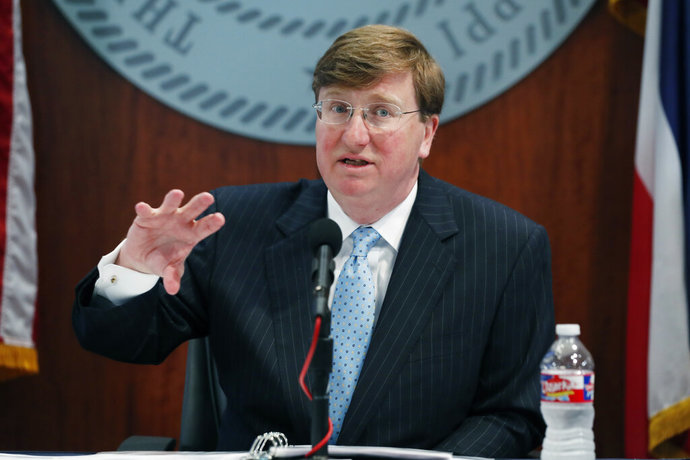
    Republican Gov. Tate Reeves said Tuesday that he wants African American community leaders, including pastors and politicians, to talk to people about trying to protect themselves and seek medical help if they think they might have the virus.

    “Let’s communicate and talk about the dangers that exist out there, and there are dangers to anyone that has chronic medical conditions,” Reeves said.

    The governor posted a short Health Department video to his Facebook page Tuesday showing actor Morgan Freeman, who lives in Mississippi, telling people to wash their hands, disinfect surfaces and keep distance from others to slow the spread of the virus.

    “We will emerge from this pandemic stronger as a state and as a people, I’m sure,” Freeman says. “Stay home and stay healthy, Mississippi.”

    Mississippi’s overall coronavirus caseload grew to at least 1,915 infections as of Monday evening, with 59 deaths, the Health Department said Tuesday. That is an increase of 177 cases and eight deaths from the previous day.

    For most people, the coronavirus causes mild or moderate symptoms, such as fever and cough. But for others, especially older adults and people with existing health problems, the highly contagious virus can cause severe symptoms and be fatal.

    The Mississippi Health Department website, as of Tuesday, still did not show information about the race of people affected by the coronavirus.

    Racial disparities are showing up in other places. Alabama officials said Tuesday that more than 40% of COVID-19 deaths in that state have been in African Americans; about 27% of Alabama’s population is black.

    Most of the people who have died of COVID-19 in Mississippi are 60 or older, and the outbreak has spread to at least 38 long-term care facilities, the state said Tuesday.

    The most-populated areas are seeing the largest caseloads. These include three counties in the metro Jackson area — Hinds, Rankin and Madison; DeSoto County in the northwestern corner of the state bordering Tennessee; coastal Harrison and Jackson counties; and south Mississippi’s Pearl River County, which borders hard-hit Louisiana and is a place where people commute to work and shop between the two states.

    But some areas with smaller populations are seeing growing caseloads.

    Bolivar County is in the Delta, with about 30,600 people, 64% African American, according to the Census. It had 54 confirmed coronavirus cases and two deaths by Monday evening.

    Wilkinson County is in the southwestern corner of the state, bordering Louisiana. Its population of about 8,600 is 71% African American. It has 32 confirmed cases and three deaths.

    The Health Department said Tuesday that 20,370 coronavirus tests had been done in the state, by public and private labs, as of Sunday. Cases were reported in 80 of 82 counties.

    Reeves issued a statewide stay-at-home order that took effect Friday evening and remains in place until the morning of April 20. It bans gatherings of 10 or more people.

    Reeves has said people should limit their outings to essential errands like grocery shopping. He said law enforcement officers will break up big groups of people who are out socializing. Grocery stores, pharmacies and other businesses deemed essential will remain open.

  • Coronavirus Claims Singer-Songwriter John Prine At Age 73

    Coronavirus Claims Singer-Songwriter John Prine At Age 73

    Prine’s family admitted him to a hospital on March 29th

    The news was confirmed by both Rolling Stone and Billboard Magazine.  The singer-songwriter started his music career in Chicago in the early 1970s, and was convinced to move to Nashville by producer “Cowboy” Jack Clement.

    Well-known for his story songs with vivid imagery, countless artists covered Prine’s songs, including Johnny Cash (“Sam Stone”), Bette Midler (“Hello in There”) and Bonnie Raitt (“Angel From Montgomery”), as well as Zac Brown Band (“All the Best”), Miranda Lambert (“That’s the Way the World Goes Round”) and George Strait (“I Just Want to Dance with You”). He is also an uncredited co-writer on “You Never Even Call Me by My Name,” made famous by David Allan Coe and recorded by countless others.

    Read more about John Prine’s career in Billboard.


  • Mississippi working to expand hospital capacity for virus

    Mississippi working to expand hospital capacity for virus

    “It is serious, it is contagious and it can be fatal.”

    JACKSON, Miss. (AP) — Mississippi Gov. Tate Reeves said Monday that hospitals in the state have about 3,000 beds, and projections show that almost 400 more beds will be needed when the state reaches is peak of the coronavirus outbreak in the next few weeks.

    He said officials are working on a system to send the sickest patients to larger, better equipped hospitals. He said smaller, rural hospitals could care for patients who have either not yet reached the most severe part of the illness or are past the most severe part and are recovering.

    Reeves also said a military base in south Mississippi, Camp Shelby, has 200 beds that can be used for less severe patients, and officials are close to finding a site in north Mississippi that could also be set up with a 200-bed capacity.

    “There will be more Mississippians who die from this virus,” Reeves said Monday. “It is serious, it is contagious and it can be fatal.”

    The Mississippi Health Department said Monday that as of Sunday evening, the state had 1,738 positive tests for the virus and 51 deaths. The state has about 3 million residents.

    For most people, the coronavirus causes mild or moderate symptoms, such as fever and cough. But for others, especially older adults and people with existing health problems, the highly contagious virus can cause severe symptoms and be fatal.

    Mississippi has high rates of heart disease, diabetes and asthma. Reeves said Monday that many people in the state have “unique risks.”

    The Health Department has not released statistics showing the race of people who have tested positive or died from COVID-19. Jim Craig, the department’s senior deputy and director of the Office of Health Protection, said in response to a question Monday that he thinks African Americans have been disproportionately affected.

    Mississippi on Sunday became the latest U.S. state declared a major disaster area by President Donald Trump, giving it access to more federal assistance to confront the pandemic. Reeves announced Friday that he had asked Trump to issue the declaration.

    Reeves issued a stay-at-home order that took effect Friday evening and remains in place until the morning of April 20. It bans gatherings of 10 or more people.

    Reeves has said people should limit their outings to essential errands like grocery shopping. He said law enforcement officers will break up big groups of people who are out socializing. Grocery stores, pharmacies and other businesses deemed essential will remain open.

    Republican Reeves has said he does not think government has the power to shut down churches, and he urged people to worship through online services rather than in person.

    A church in southwest Mississippi held a Palm Sunday service with about 250 people attending, the Natchez Democrat reported. The service at New Hope the Vision Center Missionary Baptist Church in Adams County was carried live on Facebook. Its pastor, the Rev. Stanley Searcy, told the newspaper that people who attended were seated far from each other in a sanctuary that can hold 1,800.

    One member of the church is Adams County Sheriff Travis Patten, who tested positive for the coronavirus several days ago. Patten told the newspaper that he has not been to church since March 17. The sheriff said he received several calls from people wanting to know why the church was holding an in-person service.

    Searcy said he believes having 250 people inside the church does not violate the governor’s order. The sheriff disagreed, but said he is not going to shut down services as they are happening.

    “I’m not coming to anybody’s pulpit and snatching them off of holy ground,” Patten told the newspaper. ”Whatever happens will happen outside of the church, and we will deal with it.”

    Asked about that church service on Monday, Reeves said: “People do not need to be going to large gatherings of churches of more than 10 people. It is not smart to do that, and I do believe that it is in violation of the order of keeping folks from being in groups of larger than 10 people.”

  • Debunking The Alkaline Foods Coronavirus Hoax

    Debunking The Alkaline Foods Coronavirus Hoax

    Eating alkaline foods WILL NOT kill the coronavirus COVID-19

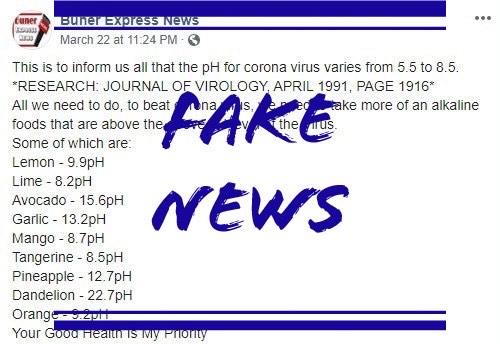
    CLAIM: Eating alkaline foods will stave off the novel coronavirus, which has a pH level of 5.5 to 8.5.


    A false post circulating on social media claims that COVID-19 has a pH level between 5.5 to 8.5, and in order to fend off the virus people must consume alkaline foods.

    “This is to inform us all that the pH for corona virus varies from 5.5 to 8.5. All we need to do, to beat coronavirus, we need to take more of an alkaline foods that are above the pH level of the virus,” the post falsely states, citing the “Journal of Virology & Antiviral Research.”

    THE FACTS:

    “A virus itself does not have a pH,” said Sarah Stanley, associate professor of infectious diseases and vaccinology at the University of California, Berkeley School of Public Health. Stanley explained in an email that “pH is something that applies to a water based solution, which a virus is not.” In addition, she said, it’s not possible for diet to change the pH of blood, cells or tissues. The body regulates pH levels, it’s not something a person would want to change.  “Eating a healthy and balanced diet supports immunity and can be helpful for fighting off infections. However, there is no evidence that consuming alkaline foods specifically is beneficial,” she said.

    The false post lists a number of foods to fight off the novel coronavirus, including lemons, limes and pineapples, but the pH levels provided for them are incorrect. For example, it gives a pH level of 9 for lemons and a level of 9.2 for limes, when both have a pH of about 2, a food science specialist noted.

    “These pH values for these foods are completely wrong,” Donald Schaffner, extension specialist in food science at Rutgers University, told the AP. “The human body is designed to be really good at maintaining its pH.” “Eat these foods if you want,” Schaffner said in a phone interview. “The best way to keep from getting a virus is to stay away from people.”

    The Journal of Virology published an article in April 1991 about another type of coronavirus, which is mouse hepatitis type 4 (MHV4). The report analyzed what happens to the pH of cells in rats or mice when they are infected with MHV4. The coronavirus mentioned in the report is entirely different from COVID-19 which is a respiratory illness.

  • Sidewalk Notes Bring Smiles To Hospital Staff During Virus

    Sidewalk Notes Bring Smiles To Hospital Staff During Virus

    Unknown artist leaves messages outside Ochsner Medical Center in New Orleans

    NEW ORLEANS (AP) — The messenger is anonymous — but the messages are heartfelt, and appreciated.

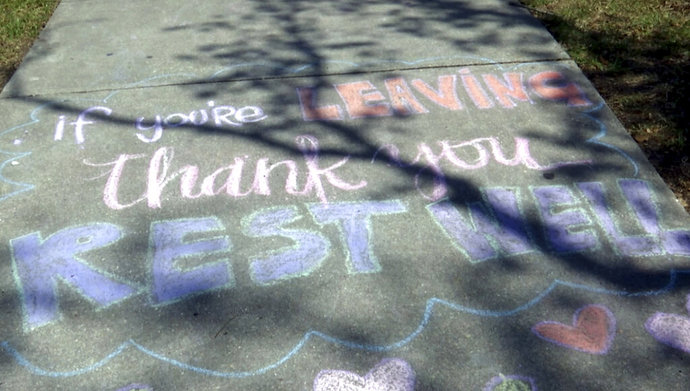
    In recent days, workers at New Orleans’ Ochsner Medical Center who take the familiar stroll from the parking lot to the main entrance have been greeted with expressions of gratitude from an unnamed artist, sketched out on the sidewalk.

    “If you’re just arriving, thank you for what you’re about to do,” says one.

    And a little further along: “You are extraordinary.”

    And for those finishing their shifts: ”If you are leaving, thank you … Rest well.”

    The hospital workers have been under strain. The region has been hard hit by the coronavirus, so much so that the state’s governor said earlier this week it might run out of breathing machines by the weekend and hospital beds next week.

    Ochsner, one of the largest hospitals in the area, has been so overwhelmed that regular patient rooms have been converted into ICU-like wards to accommodate the surge in patients.

    Someone has taken note, and has reached out in chalk to tell Ochsner staffers that they are appreciated, The message has been received, loud and clear.

    “It definitely meant a lot to me and was a surprise, a colorful surprise, walking out and going home to go to bed after a long shift,” said first-year resident Leslie Miller, who works in the hospital’s pediatric care unit.

    Miller said hospital employees are used to dealing with heightened stress but for many, the coronavirus has taken stress and anxiety to another level. The messages are a balm.

    They “give us hope,” said lab technician Minerva Martin.

    ___

    While nonstop global news about the effects of the coronavirus has become commonplace, so, too, are the stories about the kindness of strangers and individuals who have sacrificed for others. “One Good Thing” is an AP continuing series reflecting these acts of kindness.

    ___

  • Louisiana Officials Report 68 More Coronavirus-Linked Deaths

    Louisiana Officials Report 68 More Coronavirus-Linked Deaths

    The Louisiana Department of Health reported the figures on its website Sunday

    NEW ORLEANS (AP) — Louisiana health officials reported 68 coronavirus-related deaths on Sunday, marking the state’s biggest jump in reported deaths since the outbreak began.  The number of infections reported to the state also increased by more than 500 cases from 12,496 to 13,010.

    Before Sunday, the largest number of deaths reported in a single day was 60. The numbers represent when the tests were reported to the state, not necessarily when the infections or deaths occurred.

    Louisiana and the New Orleans area have been an epicenter for the virus, and Gov. John Bel Edwards has repeatedly warned of looming shortages for ventilators and intensive care units.

    For most people, the new coronavirus strain causes mild or moderate symptoms, such as fever and cough that clear up in two to three weeks. For some, especially older adults and those with existing health problems, it can cause more severe illness, including pneumonia, and be life-threatening.